Erika 

22.1K posts

Erika  banner
Erika 

Erika 

@ExploreCosmos_

Canadian astrophysicist focused on extragalactic astronomy & early-universe galaxies. Seeking mountain peaks. Writing through the chaos; riding away from it.

Cosmos Katılım Ekim 2020
907 Takip Edilen53.8K Takipçiler
Erika 
Erika @ExploreCosmos_·
Kepler’s first law is valid, but it’s an approximation of a two-body system where one mass dominates. In that limit, the orbit is an ellipse with the Sun at one focus. That works extremely well for planets like Earth. But the more general solution doesn’t place one body at rest. Both bodies orbit their common center of mass. In that exact two-body case, each object follows an ellipse around the barycenter, not around a fixed Sun. Kepler’s laws fall out of Newtonian gravity under simplifying assumptions. They’re not being ignored, they’re being generalized. For Earth, the difference is negligible, so saying “ellipse with the Sun at one focus” is fine. For Jupiter, it starts to break down because the Sun itself moves noticeably. So the accurate hierarchy is: Kepler is a very good approximation, barycentric motion is the full description.
English
0
0
2
33
Erika 
Erika @ExploreCosmos_·
What we usually picture when we think about the Solar System is simple: the Sun sitting still at the center, and the planets tracing clean ellipses around it. It’s a useful image, and for most purposes it works remarkably well. But it is not strictly true. Gravity is never one-sided. Every object pulls on every other object, which means nothing in the Solar System is perfectly fixed, not even the Sun. In reality, planets and stars do not orbit one another in the way we often imagine. They orbit a shared point in space called the barycenter, the center of mass of the system. If one object is overwhelmingly more massive, that point lies deep inside it, and the motion looks almost indistinguishable from a simple orbit around the larger body. That is why we comfortably say that Earth orbits the Sun. The approximation is extremely good. But it is still an approximation. Jupiter changes the picture. It is so massive that the center of mass of the Sun–Jupiter system does not lie inside the Sun at all, but just outside its surface. This means that Jupiter is not circling a fixed Sun. Both Jupiter and the Sun are moving around a point in space between them. The Sun itself performs a small but measurable wobble in response to Jupiter’s gravitational pull. From far away, you would not see a stationary star with planets orbiting it. You would see a star tracing a subtle, looping path, constantly responding to its largest companion. Once you include all the planets, the situation becomes more complex. The Solar System is not a tidy two-body problem but a many-body system, where every planet slightly shifts the position of the barycenter over time. The Sun’s motion is not a simple circle or ellipse, but a constantly evolving trajectory shaped mainly by the giant planets. Jupiter dominates this effect, but Saturn, Uranus and Neptune all leave their imprint. So when you hear that “Jupiter does not orbit the Sun,” it is not wrong, but it is incomplete. It reflects a more precise description of gravitational motion, one that abandons the idea of a fixed center. At the same time, saying that planets orbit the Sun remains a valid and practical description, because the Sun still contains almost all the mass in the system and dictates its overall structure. The real lesson is not that the familiar picture is incorrect, but that it is simplified. The deeper reality is more dynamic. Nothing is truly at rest. Even the Sun is in motion, continuously shifting under the influence of the planets that orbit it. What looks stable at first glance is, in fact, a subtle gravitational dance where every object, no matter how large or small, plays a role.
Erika  tweet media
English
14
29
139
3.1K
Erika 
Erika @ExploreCosmos_·
That mixes a few things that aren’t really connected. The fact that a planet has an initial velocity doesn’t mean it’s not orbiting the barycenter. That velocity is exactly what allows an orbit to exist in the first place. In Newtonian mechanics, the clean solution is that two bodies move around their common center of mass. The barycenter is not an optional concept, it’s the natural reference point of the system. Eccentricity is also a separate issue. The 6% variation in Earth’s distance just tells you the orbit isn’t a perfect circle, not what point it’s orbiting. You can have an eccentric orbit around the barycenter just as well. And yes, for Earth the barycenter stays well inside the Sun most of the time, so describing Earth as orbiting the Sun is a very good approximation. But that doesn’t change the underlying physics. The correct statement is that all bodies orbit the system’s center of mass, even if that point happens to lie inside the Sun in most cases.
English
1
0
6
102
Really_Bad_At_Names, Good at Science🦎
@ExploreCosmos_ Planets do not strictly orbit around the barycenter because they have an initial velocity. At maximum eccentricity the Earth has a 6% difference between average distance and minimum/maximum distances from the sun, the barycenter is rarely more than a few 100K Kms outside the sun.
English
1
0
0
121
Hunter🔫Leosia Ret
Hunter🔫Leosia Ret@HunterHarleyHD·
@ExploreCosmos_ It’s completely random to display power deliberately for illustration and entertainment purposes. Beings in the hierarchy of rank and power display their influence or lack of influence openly for information purposes. A constant reminder to keep everyone honest to some degree.
English
1
0
0
108
Erika 
Erika @ExploreCosmos_·
Some very massive stars do something that looks, at first glance, like a supernova: they suddenly brighten enormously and throw large amounts of material into space. But unlike a real supernova, the star is not destroyed. It survives. That is why we call these events “supernova impostors.” They are not fake in the sense of being unimportant; they are fake only because they imitate the brightness and violence of a stellar death without actually being one. The central problem is that we still do not fully understand what triggers these eruptions or how much mass the star loses during them. This matters because mass loss is one of the key ingredients that determines how massive stars evolve, what kind of supernova they may eventually produce, and what kind of remnant they leave behind, such as a neutron star or a black hole. In the most massive stars, losing material is not a small detail. It can completely redirect the star’s evolutionary path. A new study focuses on eruptive mass loss, especially in red supergiants and other very massive evolved stars. These stars can become unstable because their outer layers are loosely bound and their radiation pressure is enormous. One possible mechanism involves super-Eddington conditions: moments when radiation trying to escape from the star becomes strong enough to help drive material away. Stellar evolution models can include this effect, but until now they have needed a poorly constrained efficiency parameter, essentially a dial that tells the model how strong these eruptions should be. The study tried to calibrate that dial using real stellar populations in the Local Group. Instead of relying only on individual outbursts, they compared models of red supergiant populations with observations from the Small Magellanic Cloud, the Large Magellanic Cloud and Andromeda. These galaxies are useful because they have different metallicities, meaning different amounts of elements heavier than hydrogen and helium. The interesting result is that eruptive mass loss appears to become stronger with increasing metallicity. In other words, stars richer in heavy elements may be more prone to violent mass loss. The models suggest that, when this effect is included, stars born with more than about 20 solar masses may lose so much material that they never become classical red supergiants at all. Instead, they may evolve along a different route, which could help explain why we do not see as many very luminous red supergiant supernova progenitors as simple models might predict. This does not mean the mystery is solved. The trend with metallicity is promising, but it still needs to be tested in more galaxies and with more detailed physical modelling. The open question is whether metallicity helps trigger the eruptions themselves, or whether it mainly changes how much material escapes once an eruption begins. Either way, these “impostors” are not just stellar curiosities. They are clues to one of the most uncertain phases in the life of massive stars: the messy transition between being a swollen, unstable giant and finally collapsing or exploding for real. 👉 share.google/KvpMiwxO1qygnx…
Erika  tweet media
English
10
30
165
3.1K
Erika 
Erika @ExploreCosmos_·
Finding “dead worlds” is not pointless. Most of science advances by measuring what exists before assuming what we want to find. Even a lifeless planet can teach us how atmospheres evolve, how planets lose water, how stellar radiation affects habitability, and why Earth ended up different. Also, the measurement problem in quantum mechanics is a foundational issue, not an engineering bottleneck preventing interstellar travel. Solving it would not suddenly give us ships capable of crossing light-years. Exoplanet surveys are how we build the map first. Exploration in person, if it ever becomes possible, would still need targets.
English
1
0
4
60
Sean Gratton I, Esquire
Sean Gratton I, Esquire@themonkeymusic·
@ExploreCosmos_ What's the point of finding a bunch of dead worlds? Man, just focus on overcoming the measurement problem so we can explore in person instead.
English
1
0
0
76
Erika 
Erika @ExploreCosmos_·
Canada has proposed a new micro-satellite mission called POET, short for Photometric Observations of Exoplanet Transits, designed to search for Earth-sized and super-Earth planets around small, cool stars. The mission would focus on ultracool dwarfs, including K-type stars, M-type stars and brown dwarfs, because planets crossing in front of these smaller stars produce a deeper and easier-to-detect dip in brightness than they would around a Sun-like star. In other words, the smaller the star, the more noticeable the transit of an Earth-sized world becomes. POET would use the transit method, the same basic technique behind many exoplanet discoveries: it would watch for tiny, repeated decreases in starlight caused by a planet passing in front of its host star. The proposed telescope would have a 20-centimeter aperture and would observe across several wavelength ranges, from near-ultraviolet through visible light and into near-infrared and short-wavelength infrared. That would make it more capable than earlier Canadian micro-satellite missions such as MOST and NEOSSat, which had smaller 15-centimeter telescopes and observed mainly in visible light. The mission is currently proposed for launch in 2029. Researchers have already built a target catalog of ultracool dwarfs that POET could observe. Starting from more than 7,200 candidates, they narrowed the list to just over 3,000 stars within 100 parsecs, or about 326 light-years, after removing systems that would be less suitable, such as binaries or overly bright targets. Simulations suggest POET could detect planets between about 1 and 2.5 Earth radii, with orbital periods from 7 to 50 days. For a one-year mission, the team would prioritize roughly 100 to 300 of the most promising targets. The scientific value is not just in finding more exoplanets, but in finding the right kind of exoplanets. Earth-sized worlds around nearby ultracool dwarfs would be especially useful for follow-up atmospheric studies, because their small host stars make planetary signals easier to isolate. Some of these planets could become prime targets for JWST or, later, the Habitable Worlds Observatory, especially if they orbit in regions where temperatures might allow liquid water. POET would not directly prove that any of these worlds are habitable, but it could identify some of the best nearby candidates for future searches for atmospheric biosignatures. 👉 share.google/UqP3BEkY6Bcerl…
Erika  tweet media
English
9
32
175
3.5K
Erika 
Erika @ExploreCosmos_·
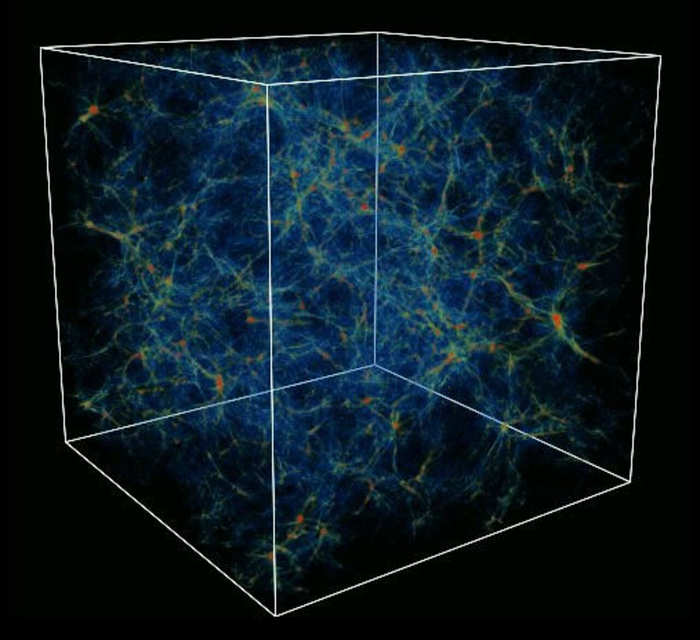
Why do galaxies seem to align their spins? For a long time, we imagined galaxies as mostly independent islands of stars, each rotating according to its own history. A galaxy forms, collapses, gathers gas, spins up, and evolves. From that perspective, the direction of its rotation should be more or less random. One galaxy spins one way, another spins another way, with no deeper pattern across the universe. But the universe is rarely that simple. Galaxies do not form in isolation. They grow inside the cosmic web, a vast network of filaments, sheets, clusters, and voids made of dark matter, gas, and galaxies. On the largest scales, matter is not distributed randomly. It flows along filaments, gathers at intersections, and collapses under gravity into increasingly complex structures. So the question becomes more interesting: if galaxies form inside this web, could the web itself influence the way they spin? The answer appears to be yes, at least to some extent. The basic idea comes from tidal torque theory. In the early universe, matter was not perfectly smooth. Tiny density differences created uneven gravitational pulls. As proto-galaxies formed, these surrounding tidal fields could twist them slightly, giving them angular momentum before they fully collapsed. In simple terms, a young galaxy gains spin when its early shape is slightly misaligned with the gravitational pull of its surroundings. That mismatch creates a torque. This does not mean all galaxies spin the same way. They do not. The universe is not a giant synchronized machine. But statistical patterns can still exist. For example, low mass galaxies are often found with spins more aligned along cosmic filaments, while more massive galaxies can show different behavior, sometimes orienting more perpendicular to those structures. This is thought to reflect different formation histories: smaller galaxies grow along filaments, while larger galaxies experience more mergers and interactions, which can reorient their spin. That is where the topic becomes really interesting. A galaxy’s rotation is not just a local property. It can carry memory of how that galaxy assembled, where gas flowed in, whether it merged with others, and how it was embedded in the cosmic web. In recent years, astronomers have also reported possible large scale asymmetries in the apparent spin directions of spiral galaxies. Some studies using deep surveys, including JWST fields, have claimed an imbalance between clockwise and counterclockwise spiral galaxies. These results are intriguing, but also controversial, because measuring spin direction from images is difficult. Selection effects, image orientation, classification bias, telescope geometry, and sample size can all create apparent patterns if not handled very carefully. One JWST based study reported asymmetry in galaxy spin directions in deep fields, but this remains an active and debated area rather than a settled result. So there are really two related questions here. The first is conservative and well grounded: do galaxy spins correlate with their local cosmic environment? The answer is increasingly yes. Galaxies appear to remember the structure they formed in. The second is much more provocative: is there a preferred direction in the universe as a whole? That would be a much bigger claim, because it would challenge the cosmological principle, the assumption that the universe is statistically homogeneous and isotropic on large scales. At the moment, the evidence for that stronger claim is not conclusive. The standard cosmological picture still holds very well overall, but these possible anomalies are worth investigating carefully. There is also a newer and very visual piece of this story: rotating cosmic filaments. In 2025, astronomers reported a huge rotating filament of galaxies and gas, roughly 50 million light years long, using observations including MeerKAT radio data. Structures like this suggest that angular momentum may not belong only to individual galaxies. It may also exist coherently on much larger scales inside the cosmic web. That does not mean the whole universe is spinning. If the universe had a global rotation, we would expect to see strong directional signatures in the cosmic microwave background and large scale galaxy distributions. Current observations place very tight limits on that possibility. But it does mean that local and regional alignments can emerge naturally from gravitational structure formation. The subtlety is important. Random does not mean patternless. A shuffled deck of cards has no designed order, but you can still find local sequences. In the same way, galaxy spins may be random globally while still showing correlations with nearby filaments, clusters, and tidal fields. That is why this topic matters. It sits right at the boundary between galaxy formation and cosmology. If spin alignments are local, they help us understand how galaxies acquire angular momentum. If they persist on unexpectedly large scales, they could tell us something deeper about the early universe, structure formation, or hidden observational biases in our surveys. For now, the safest answer is this: galaxies do not seem to spin in complete isolation. Their rotation is shaped by the cosmic web around them. But whether there is a truly cosmic preferred direction remains unproven. And that is exactly why the question is fascinating. Because every galaxy spins. But the deeper mystery is whether some of them still remember the direction from which the universe built them.
Erika  tweet media
English
38
70
379
10.5K
Gus
Gus@Gustronico·
@ExploreCosmos_ Is the image yours Erika? It's perfectly clear and complete, as the whole post is. Congratulations for this great article.
English
1
0
2
239
Erika 
Erika @ExploreCosmos_·
Thanks for taking the time to write this out, I appreciate the effort and the openness to feedback. The idea of trying to provide a deeper, more unified substrate beneath GR and QFT is clearly something many people are interested in, so the motivation itself is reasonable. That said, my concern is still at the same level as before, and it’s mainly about rigor rather than intent. The framework is described as reproducing all the established results of GR, QFT, and the Standard Model, but that’s a very strong claim that requires explicit mathematical demonstration. In practice, that means deriving the field equations, recovering Lorentz invariance without introducing a preferred frame, reproducing quantum field theory in a form that matches scattering amplitudes and precision observables, and showing how the Standard Model gauge structure and couplings emerge quantitatively. Right now, most of what’s presented reads as a physical interpretation or analogy rather than a derivation at that level. The “medium” picture is intuitive, but historically these approaches run into tight constraints from Lorentz invariance tests, so that’s something that would need to be addressed very explicitly and quantitatively. Similarly, statements about reproducing quantum behaviour would need to be framed in terms of Hilbert space structure, operators, and measurable predictions, not just conceptual descriptions. On the prediction side, it would help a lot to have one or two very clear, quantitative predictions that differ from standard physics, with defined magnitudes and experimental conditions. That’s usually what allows a new framework to be meaningfully tested. So overall, I’d say it’s an interesting conceptual direction, but at the moment it reads more like a reinterpretation of existing physics than a fully developed, testable theory. The next step would really be tightening the mathematical formulation and making the equivalence to known physics explicit, or identifying clear observational signatures where it departs from it. I hope that helps, and I’m happy to look at more detailed parts if you develop the formal side further.
English
1
0
1
32
James M Powell
James M Powell@James_M_Powell·
Hi Erika, Thank you for your thoughtful and detailed feedback - I genuinely appreciate the honest critique and the time you took to respond. You raised a very fair and important point: any viable theory must reproduce existing experimental results and offer clear, testable predictions. To address this directly, I’ve written a short article that explains exactly how EpiCosmology aligns with (and builds upon) the successes of GR, QFT, and the Standard Model: EpiCosmology: A Deeper Foundation That Fully Reproduces Every Successful Modern Physics Prediction x.com/James_M_Powell… In the article I show that the framework recovers all the precision predictions you mentioned - gravitational lensing, time dilation (including GPS corrections), the measured constancy of c, entanglement correlations, and every high-precision test of QFT - as effective low-energy descriptions emerging from a single responsive light medium. It doesn’t compete with established physics; it aims to provide the deeper mechanistic substrate beneath it, similar to how GR deepened Newtonian gravity. I’d be very grateful for any further thoughts you might have after reading it, especially if you spot any remaining conflicts with data. Thanks again for the constructive pushback! Best regards, James M. Powell Independent Researcher S.T.A.R.S. – Sincerity and Truth for the Advancement of Revolutionary Science
English
1
0
1
25
Erika 
Erika @ExploreCosmos_·
Quantum gravity is an attempt to unify two frameworks that currently describe the universe in incompatible ways: quantum mechanics, which governs particles and fields at microscopic scales, and general relativity, which describes gravity and the structure of spacetime on cosmic scales. Each works extremely well in its own domain, but when pushed into extreme conditions, such as those that existed at the very beginning of the universe, they break down or contradict each other. The problem becomes most evident when we try to describe the Big Bang. General relativity predicts that if you rewind the universe far enough, everything collapses into a singularity, a point of infinite density and temperature where the equations stop making physical sense. This is usually interpreted as a sign that the theory is being used outside its valid range rather than a literal description of reality. At those earliest moments, quantum effects should dominate, but we do not yet have a theory that consistently includes both quantum physics and gravity. Quantum gravity aims to provide that missing description. Instead of treating spacetime as a smooth, continuous fabric as in Einstein’s theory, many approaches suggest that spacetime itself may have a discrete or quantum structure at extremely small scales. In that regime, gravity would not simply be the curvature of a smooth geometry but something that also follows quantum rules, possibly involving fundamental units or excitations, like gravitons or more abstract structures depending on the model. Recent work explored in the article focuses on a specific framework called quadratic quantum gravity, which modifies Einstein’s equations so they remain well-behaved at very high energies. In this picture, the early universe does not necessarily begin with a problematic singularity. Instead, the physics of gravity itself, when properly extended into the quantum regime, could naturally describe the universe’s initial state and even generate features like the rapid early expansion without needing additional hypothetical fields. If such ideas are correct, quantum gravity would not just fix a mathematical inconsistency; it would fundamentally change how we think about the origin of the universe. The Big Bang would no longer be a boundary where physics stops, but a phase that can be described within a deeper, unified theory. It could also provide testable predictions, for example through subtle signatures like primordial gravitational waves, offering a possible path from speculation to empirical science. 👉 share.google/TOpQkQl5W4Dwzm…
Erika  tweet media
English
32
39
252
6.2K
Erika 
Erika @ExploreCosmos_·
No. A scientific law is not an “absolute truth” that requires no justification. It is a mathematical description of a regular pattern in nature, supported by observation and experiment. Newton’s law of gravitation worked extremely well in many regimes, but it was later shown to be incomplete and was superseded by general relativity in stronger gravitational fields or higher-precision cases. So Newtonian gravity is not an axiom. It is an empirical law: tested, useful, predictive, but not absolute. General relativity is also not an axiom. It is a theory built on principles, mathematics and empirical tests. It explains more than Newtonian gravity, but it is still a scientific model, not an unquestionable truth.
English
4
0
1
84
Lennard Rage
Lennard Rage@LRage57308·
@ExploreCosmos_ "A principle recognized as absolutely true, which cannot be proven and requires no justification". Does this description apply to the law of gravitation?
English
1
0
0
72
Erika 
Erika @ExploreCosmos_·
For a long time, the speed of light in vacuum has been treated as the ultimate cosmic speed limit: matter, energy and information cannot travel faster than it. But a recent experiment adds an interesting nuance. Researchers have directly measured tiny “dark points” inside light waves, known as optical vortices or phase singularities, and found that under certain conditions these points can move faster than the light wave itself. These dark points are places where the wave cancels itself out, so the amplitude drops to zero. In other words, they are not objects or particles moving through space, but points of darkness embedded in the structure of a wave. The key point is that this does not break Einstein’s relativity. These vortices do not carry mass, energy or information, so their superluminal motion cannot be used to send a signal faster than light or violate causality. It is similar in spirit to the way a shadow or a laser spot can appear to sweep across a distant surface faster than light without anything physical actually travelling that fast. What the team has confirmed is a subtle prediction from the 1970s: certain features inside waves can move faster than the wave medium that produces them. To observe this, the researchers used a special microscopy system and a material called hexagonal boron nitride. Inside this material, light can form polaritons, hybrid light-matter waves that move much more slowly than light in vacuum. That slowing made it possible to track the motion of these optical vortices with enough precision. The team observed pairs of opposite singularities accelerating toward each other, reaching superluminal speeds before annihilating. So the headline “darkness is faster than light” is catchy, but it needs context. Darkness itself is not a substance racing through the universe. What moves faster than light here is a mathematical and physical feature of a wave: a zero point created by interference. The result is important not because it overturns relativity, but because it shows that these wave singularities obey measurable, universal rules. The same kind of physics may appear in sound waves, fluids, superconductors and other complex systems. The new microscopy techniques could also help us study extremely fast nanoscale processes in materials, chemistry, biology and quantum information. 👉 nature.com/articles/s4158…
Erika  tweet media
English
39
60
349
11.9K
Erika 
Erika @ExploreCosmos_·
That idea doesn’t really fit what we observe. These “little red dots” are seen at very high redshift, which means their light has been traveling for over 13 billion years. So we’re not looking at something “outside” our observable universe or from a different, older universe, we’re seeing objects as they were when the universe itself was very young. Also, red giants don’t match the data. They’re individual stars with specific spectra and luminosities, while these sources are far more compact and luminous, and in at least some cases show signatures consistent with accreting black holes. You would need an implausibly large number of red giants packed into a tiny region to reproduce what we see. And the “evaporating” part doesn’t line up with stellar physics either. Red giants lose mass, but not in a way that would produce these infrared-bright, compact, high-redshift sources. So it’s not just unlikely, it’s incompatible with multiple independent observations.
English
1
1
1
88
embii
embii@EMBII4U·
@ExploreCosmos_ They are evaporating red giants from a much older universe that is outside of our observable universe
English
1
0
0
37
Erika 
Erika @ExploreCosmos_·
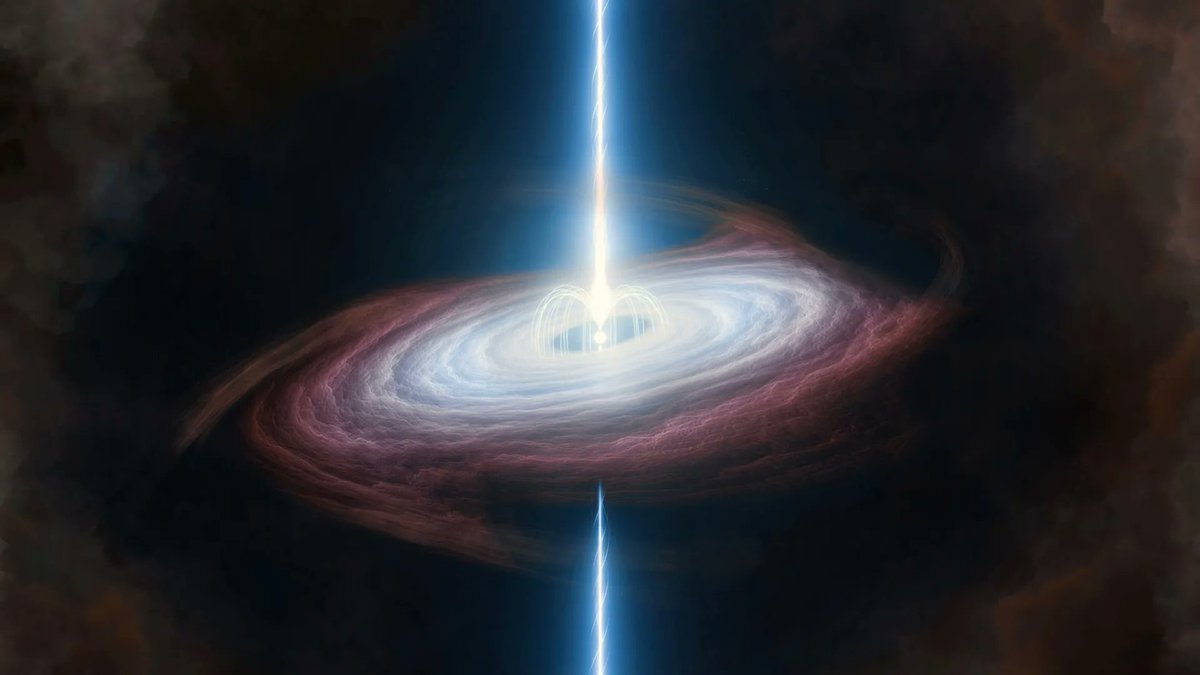
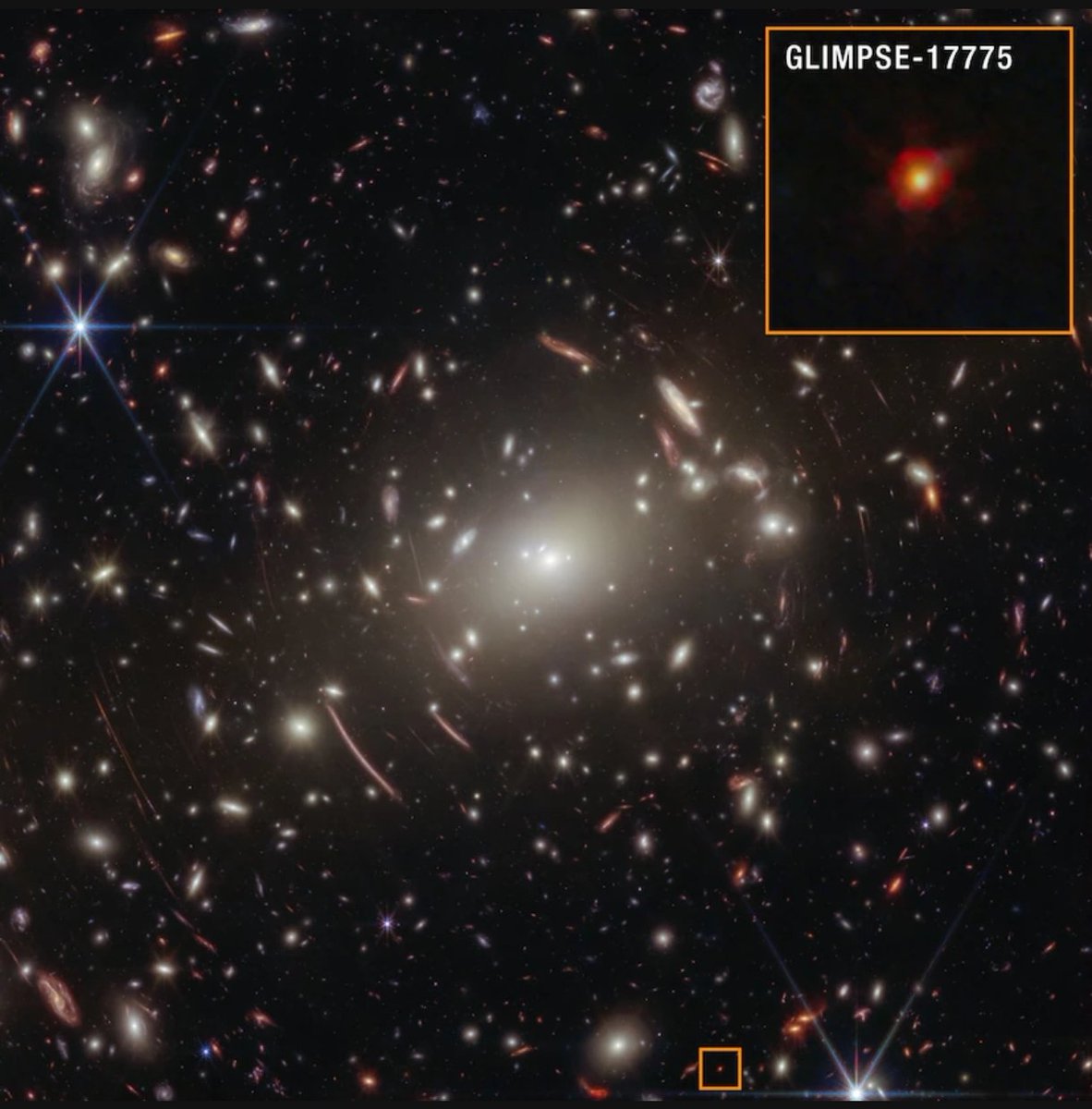
The new observations connect two previously separate views of the same mysterious population in the early universe known as “little red dots,” first identified by the JWST. These objects appear as very compact, red sources seen less than a billion years after the Big Bang, and they have been difficult to interpret because they don’t fully behave like typical galaxies or standard active black holes. What NASA has now done is combine Webb’s infrared data with X-ray observations from the @chandraxray revealing for the first time one of these objects emitting X-rays. This is important because most little red dots previously showed little or no X-ray emission, which made it unclear whether they actually hosted actively feeding black holes. The detection of an “X-ray dot” strongly suggests that at least some of them do contain growing black holes, but ones that are still heavily buried in dense gas. The proposed picture is that these systems represent a transitional phase in the early growth of supermassive black holes. At first, the black hole is embedded in thick gas that absorbs or hides high-energy radiation, so the object looks red and compact in infrared light. As the black hole accretes matter and consumes its surroundings, that gas becomes patchy, allowing X-rays to start escaping. Eventually, once most of the gas is cleared, the object would resemble a more familiar active galactic nucleus. This connection helps address one of the key problems raised by Webb: how supermassive black holes managed to grow so quickly in the early universe. If little red dots are indeed an early, obscured phase of black hole growth, they could represent the missing stage between primordial collapse and fully visible quasars, providing a more continuous evolutionary pathway. However, the interpretation is not fully settled, and alternative explanations such as extremely dense stellar systems or exotic early objects are still being considered.
Erika  tweet media
English
11
24
154
3.2K
Erika 
Erika @ExploreCosmos_·
Yes, I think you misunderstood me. I didn’t say the laws of motion have nothing to do with gravity. In Newtonian physics, the laws of motion describe how objects respond to forces, and gravity is one of those forces. But gravity is not derived from the laws of motion alone; you also need Newton’s law of universal gravitation. So gravity is connected to motion, but it is not just “motion renamed.” In GR, the picture is deeper: objects move according to spacetime geometry, not because gravity is merely a label.
English
1
0
0
63
Lennard Rage
Lennard Rage@LRage57308·
@ExploreCosmos_ I'll experiment with entropy for you, and you experiment with gravity for me. That mysterious gradient, without a container. Deal? And now, seriously: The laws of motion have nothing to do with gravity? I misunderstood you there, didn't I?
English
1
0
0
62
Erika 
Erika @ExploreCosmos_·
Gravity is not less “evident” than entropy. Entropy is also not something we see directly; we infer and calculate it from measurable thermodynamic and statistical properties. Gravity is measured through falling bodies, tides, planetary orbits, gravitational lensing, time dilation, binary pulsars and gravitational waves. These are not vague observations, but precise quantitative tests. Also, gravity is not “derived from Newtonian axioms.” Newton modeled it as a force; general relativity describes it as spacetime curvature sourced by mass-energy. The fact that we do not yet have a complete quantum theory of gravity does not make gravity “just a label.” By that standard, temperature, charge and entropy would also be “just labels.”
English
1
0
0
74
Lennard Rage
Lennard Rage@LRage57308·
@ExploreCosmos_ Entropy is evident. In any experiment. Gravitation, on the other hand, is simply not evident outside of observation and measurement. And of course, it is an axiom, just like the Newtonian axioms from which gravity is derived. A kind of axiomaxiom.
English
1
0
0
67
Erika 
Erika @ExploreCosmos_·
That sounds impressive until you look at what’s actually being claimed. String theory not predicting Standard Model parameters is a fair criticism. It’s one of the central open problems. But pointing to a model that allegedly derives “58 constants with zero free parameters” is exactly where you should become more skeptical, not less. If that were robust, internally consistent, and compatible with known data, it would already be a major result in high-energy physics. The E₈-based claims you’re referring to have been around for years in various forms. The issue isn’t that people ignored them. It’s that they don’t reproduce the full structure of the Standard Model in a consistent way, they run into mathematical and phenomenological problems, and they haven’t survived detailed peer review. So the comparison isn’t “string theory failed, this solved everything.” It’s “string theory is incomplete, and so far, alternative claims like that haven’t held up either.” And the landscape point still stands. It’s not a feature people invented for fun, it emerges from trying to build consistent compactifications. Whether that’s telling us something deep or signaling a problem with the framework is still an open question. Criticism of string theory is valid. But replacing it with claims that bypass the same level of scrutiny doesn’t really improve the situation.
English
1
0
0
20
Timothy McGirl
Timothy McGirl@Tim_McGirl·
@ExploreCosmos_ 40+ years. Billions in grant money. 10^500 vacua. Still can't predict a single Standard Model constant. Meanwhile GSM derives 58 of them from E₈ → H₄ icosahedral geometry. Zero free parameters. Lean 4 proofs.. But please, tell me more about the landscape.
English
2
0
0
11
Erika 
Erika @ExploreCosmos_·
String theory is one of the most ambitious attempts to describe nature at its most fundamental level. Instead of treating particles as structureless points, it proposes that what we perceive as electrons, quarks, or even gravitons are different vibrational modes of extremely small one-dimensional objects. In this picture, particles are not fundamentally distinct entities but different excitations of the same underlying object, which naturally points toward a unified description of matter and forces. For the theory to be mathematically consistent, spacetime cannot be limited to the four dimensions we experience. Modern versions require ten dimensions in superstring theory or eleven in M-theory, with the extra dimensions compactified at extremely small scales. These hidden dimensions are not just a technical detail. Their geometry directly determines the physical properties we observe, such as particle masses and interaction strengths. In that sense, the large-scale physics of our universe may be encoded in the microscopic structure of spacetime itself. One of the most compelling aspects of string theory is that it naturally incorporates quantum gravity. The graviton emerges as an unavoidable vibrational mode of the string, something that does not happen in standard quantum field theories. The framework has also led to deep theoretical insights, such as holographic dualities, where a gravitational theory in one spacetime can be equivalent to a quantum theory without gravity in fewer dimensions. These ideas have had real impact beyond cosmology, from particle physics to strongly interacting systems. But then comes the difficult part: our universe. String theory does not predict a single unique vacuum. Instead, it appears to allow an enormous number of possible solutions, often referred to as the “landscape,” potentially on the order of 10^500 distinct vacua. Each corresponds to a different way of compactifying the extra dimensions, and therefore to a different set of physical laws. This richness is both a strength and a problem. It provides flexibility, but it also makes it hard to extract a clear, testable prediction for our universe. This is where the “swampland” idea enters. The proposal is that many low-energy theories that look consistent from a classical or quantum field theory perspective cannot actually arise from a complete theory of quantum gravity. They belong to the swampland, not the landscape. In this view, additional constraints must exist, sharply limiting which effective theories are physically viable. The tension becomes especially clear when we consider dark energy. Observations indicate that the universe is undergoing accelerated expansion driven by a positive vacuum energy, well described by a de Sitter-like geometry. However, constructing stable de Sitter solutions within string theory has proven extremely difficult and remains an open problem. Some approaches even suggest that exact de Sitter vacua may be incompatible with fundamental consistency conditions. If that is the case, dark energy might not be a true constant but something dynamical that evolves over time. That possibility is now being explored both theoretically and observationally. There are hints, but nothing conclusive. So string theory sits in an unusual position. It is mathematically rich and internally consistent, and it offers a framework where gravity and quantum mechanics coexist naturally. But it has not yet made decisive contact with experiment. The theory is elegant. It is powerful. But it is also incomplete. Current research is shifting toward a more phenomenological approach, asking what observable signatures could constrain or even falsify specific realizations of the theory. Its future will depend less on its mathematical beauty and more on whether it can eventually connect, even indirectly, with the universe we actually observe.
Erika  tweet media
English
61
63
311
9.2K
Erika 
Erika @ExploreCosmos_·
That’s not how physics uses the word “cause.” We do not need a final metaphysical explanation of gravity to know that it is not merely a label. A label just names a pattern. A physical theory does more: it gives equations, makes quantitative predictions and survives attempts to falsify it. GR predicted light bending, gravitational time dilation, black holes, orbital precession and gravitational waves before several of them were directly observed. That is far more than naming motion after the fact. Also, gravity is not an axiom in that sense. In Newtonian gravity, it is modeled as a force. In general relativity, it is modeled as spacetime geometry sourced by energy and momentum. We may not yet have the final quantum theory of gravity, but that does not reduce all of gravitational physics to “a label.” By that standard, almost everything in science would be “just a label” until we reach ultimate causes. Electromagnetism, quantum fields, mass, charge, entropy: all are theoretical structures inferred from observations and tested by predictions. That is not weakness. That is exactly how physics works.
English
1
0
1
98
Lennard Rage
Lennard Rage@LRage57308·
@ExploreCosmos_ Yes, that's exactly what it means. As long as you don't know the cause of your observations, it's a label for the movements you're describing. Nothing more, nothing less. An axiom.
English
2
0
1
84
Erika 
Erika @ExploreCosmos_·
You’re mixing historical origins with scientific validity. Yes, early astronomy and astrology were entangled. Ancient cultures developed mathematical tools to track planetary motions, and those calculations could be quite accurate. But that’s exactly the point: the part that worked became astronomy. The interpretive layer that links planetary positions to personality or human events never held up under controlled testing. Modern astrology does not derive its claims from physics, does not produce precise, testable predictions, and consistently fails statistical tests when evaluated rigorously. That’s why it’s not considered a scientific theory. String theory, whether correct or not, operates in a completely different domain. It is built on quantum field theory, general relativity, and advanced mathematics. It is constrained, internally consistent, and in principle testable, even if current technology limits direct verification. And just to be clear, I’m an astrophysicist. Dismissing astrology isn’t casual or arbitrary. It’s based on how it performs when you actually test it.
English
1
0
0
25
Davor Virkes
Davor Virkes@DavorVirkes·
@ExploreCosmos_ So... you don't have a clue about astrology. The very math came mostly from astrology, and the planetary mechanics calculations were described with great accuracy more than thousand years ago. Google ganita for more information. You just can't dismiss astrology wholesale.
English
1
0
0
15