
Sabitlenmiş Tweet
F.Mackenzie 约克.小汽车. 嘟嘟
37.5K posts


F.Mackenzie 约克.小汽车. 嘟嘟
@FMackenzie7
🇬🇧 AI, LLM interpretation, Maths, Information geometry, Manifold hypothesis, SAE and EV battery safety
London Katılım Kasım 2019
3K Takip Edilen1.9K Takipçiler
AXPLORER
Democratizing the search for interesting mathematical constructions
Open sourced
🙇♂️🙇♂️🙇♂️🙇♂️🙇♂️
🥰🥰🥰🥰🥰
🙌🙌🙌🙌🙌
Axiom@axiommathai
We open-sourced Axplorer. Axplorer builds on PatternBoost; it discovers outlier math constructions to attack open problems. On Turán 4-Cycles, No 5 Points on Sphere, and Isosceles-Free Sets, Axplorer matched SOTA w/ a fraction of compute cost and time. It's now in your hands.
English
F.Mackenzie 约克.小汽车. 嘟嘟 retweetledi

CC + autoreseach 来发现新的越狱算法。
越来越多的类似的研究工作完全可以自动化。
autoresearch 重塑学术,正在发生。
Alexander Panfilov@kotekjedi_ml
New paper: We deploy Claude Code in an autoresearch loop to discover novel jailbreaking algorithms – and it works. It beats 30+ existing GCG-like attacks (with AutoML hyperparameter tuning) This is a strong sign that incremental safety and security research can now be automated.
中文
Claudini: Autoresearch Discovers State-of-the-Art Adversarial Attack Algorithms for LLMs
🙇♂️🙇♂️🙇♂️🙇♂️🙇♂️
Alexander Panfilov@kotekjedi_ml
New paper: We deploy Claude Code in an autoresearch loop to discover novel jailbreaking algorithms – and it works. It beats 30+ existing GCG-like attacks (with AutoML hyperparameter tuning) This is a strong sign that incremental safety and security research can now be automated.
English
Towards end-to-end automation of AI
research
🙇♂️🙇♂️🙇♂️🙇♂️🙇♂️
Sakana AI@SakanaAILabs
The AI Scientist: Towards Fully Automated AI Research, Now Published in Nature Nature: nature.com/articles/s4158… Blog: sakana.ai/ai-scientist-n… When we first introduced The AI Scientist, we shared an ambitious vision of an agent powered by foundation models capable of executing the entire machine learning research lifecycle. From inventing ideas and writing code to executing experiments and drafting the manuscript, the system demonstrated that end-to-end automation of the scientific process is possible. Soon after, we shared a historic update: the improved AI Scientist-v2 produced the first fully AI-generated paper to pass a rigorous human peer-review process. Today, we are happy to announce that “The AI Scientist: Towards Fully Automated AI Research,” our paper describing all of this work, along with fresh new insights, has been published in @Nature! This Nature publication consolidates these milestones and details the underlying foundation model orchestration. It also introduces our Automated Reviewer, which matches human review judgments and actually exceeds standard inter-human agreement. Crucially, by using this reviewer to grade papers generated by different foundation models, we discovered a clear scaling law of science. As the underlying foundation models improve, the quality of the generated scientific papers increases correspondingly. This implies that as compute costs decrease and model capabilities continue to exponentially increase, future versions of The AI Scientist will be substantially more capable. Building upon our previous open-source releases (github.com/SakanaAI/AI-Sc…), this open-access Nature publication comprehensively details our system's architecture, outlines several new scaling results, and discusses the promise and challenges of AI-generated science. This substantial milestone is the result of a close and fruitful collaboration between researchers at Sakana AI, the University of British Columbia (UBC) and the Vector Institute, and the University of Oxford. Congrats to the team! @_chris_lu_ @cong_ml @RobertTLange @_yutaroyamada @shengranhu @j_foerst @hardmaru @jeffclune
English
Manifold geometry underlies a unified code for category and category-independent features
🙇♂️🙇♂️🙇♂️🙇♂️🙇♂️
🥰🥰🥰🥰🥰
🙌🙌🙌🙌🙌
David Klindt@klindt_david
I like @HSompolinsky and @s_y_chung manifold capacity theory, but I always wondered how it avoids neural collapse (tinyurl.com/neuralcollapse), where each category manifold collapses to a point. That would clearly be at odds with identifiability theory and all the empirical work finding linearly decodable features in neural representations. Excited to see this new paper combining the two! biorxiv.org/content/10.648… *also, shameless plug, here is our theory why/when doing classification necessitates learning a linear representation of *all* (task-relevant) latent variables: arxiv.org/abs/2410.21869
English


Manifold Generalization Provably Proceeds Memorization in Diffusion Models
🙇♂️🙇♂️🙇♂️🙇♂️🙇♂️
🥰🥰🥰🥰🥰
Chaumian@chaumian
Manifold Generalization Provably Proceeds Memorization in Diffusion Models arxiv.org/abs/2603.23792
English
TurboQuant: Redefining AI efficiency with extreme compression
🙇♂️🙇♂️🙇♂️🙇♂️🙇♂️
Google Research@GoogleResearch
Introducing TurboQuant: Our new compression algorithm that reduces LLM key-value cache memory by at least 6x and delivers up to 8x speedup, all with zero accuracy loss, redefining AI efficiency. Read the blog to learn how it achieves these results: goo.gle/4bsq2qI
English

Speed by Simplicity: A Single-Stream Architecture for Fast Audio-Video Generative Foundation Model
🙇♂️🙇♂️🙇♂️🙇♂️🙇♂️
Pengfei Liu@stefan_fee
Seedance 2.0 is impressive. But it's closed-source! Introducing our daVinci-MagiHuman — a single-stream 15B Transformer trained from scratch that jointly generates video + audio. No cross-attention. No multi-stream branches. Just self-attention. ⚡ 5s 1080p video in 38s on a single H100 🏆 80% win rate vs Ovi 1.1 | 60.9% vs LTX 2.3 (2,000 human comparisons) 🌍 6 languages 📦 Fully open-source Speed by simplicity. By @SII_GAIR × @SandAI_HQ 📄 arxiv.org/abs/2603.21986 💻 github.com/GAIR-NLP/daVin… 🤗 huggingface.co/spaces/SII-GAI…
English

Harness design for long-running application development
🙇♂️🙇♂️🙇♂️🙇♂️🙇♂️
Anthropic@AnthropicAI
New on the Anthropic Engineering Blog: How we use a multi-agent harness to push Claude further in frontend design and long-running autonomous software engineering. Read more: anthropic.com/engineering/ha…
English
Fast-WAM: Do World Action Models Need Test-time Future Imagination?
🙇♂️🙇♂️🙇♂️🙇♂️🙇♂️
Hang Zhao@zhaohang0124
Our recent findings on World Action Models (WAMs): the core advantage of WAMs is not test-time “imagination” of futures, but the training-time supervision from future video prediction. We propose Fast-WAM, which makes inference simple, fast, and policy-centric.
English
Attention Residuals
🙇♂️🙇♂️🙇♂️🙇♂️🙇♂️
Kimi.ai@Kimi_Moonshot
Introducing 𝑨𝒕𝒕𝒆𝒏𝒕𝒊𝒐𝒏 𝑹𝒆𝒔𝒊𝒅𝒖𝒂𝒍𝒔: Rethinking depth-wise aggregation. Residual connections have long relied on fixed, uniform accumulation. Inspired by the duality of time and depth, we introduce Attention Residuals, replacing standard depth-wise recurrence with learned, input-dependent attention over preceding layers. 🔹 Enables networks to selectively retrieve past representations, naturally mitigating dilution and hidden-state growth. 🔹 Introduces Block AttnRes, partitioning layers into compressed blocks to make cross-layer attention practical at scale. 🔹 Serves as an efficient drop-in replacement, demonstrating a 1.25x compute advantage with negligible (<2%) inference latency overhead. 🔹 Validated on the Kimi Linear architecture (48B total, 3B activated parameters), delivering consistent downstream performance gains. 🔗Full report: github.com/MoonshotAI/Att…
English
F.Mackenzie 约克.小汽车. 嘟嘟 retweetledi

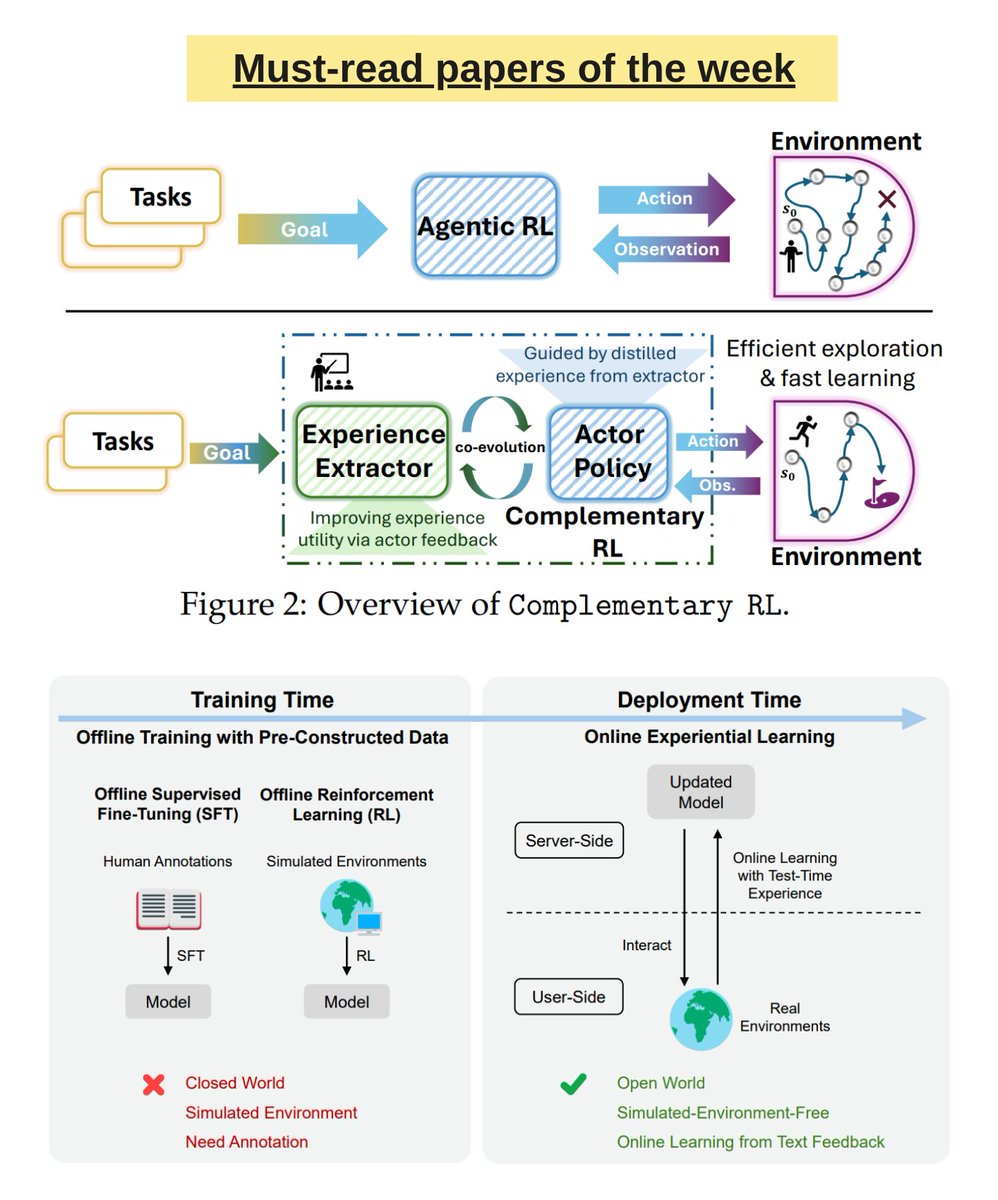
Must-read AI research of the week:
▪️ Complementary Reinforcement
▪️ Efficient Exploration at Scale
▪️ MetaClaw
▪️ Online Experiential Learning for LMs
▪️ A Subgoal-driven Framework for Improving Long-Horizon LLM Agents
▪️ When AI Navigates the Fog of War
▪️ Attention Residuals
▪️ Mixture-of-Depths Attention
▪️ Efficient Reasoning on the Edge
▪️ Beyond Single Tokens: Distilling Discrete Diffusion Models via Discrete MMD
▪️ Unified Spatio-Temporal Token Scoring for Efficient Video VLMs
▪️ HopChain: Multi-Hop Data Synthesis for Generalizable Vision-Language Reasoning
▪️ Cognitive Mismatch in MLLMs for Discrete Symbol Understanding
▪️ LoopRPT: Reinforcement Pre-Training for Looped LMs
▪️ AI Can Learn Scientific Taste
Find the full list and the main AI news here: turingpost.com/p/fod145
English
Anthropic Science Blog
🙇♂️🙇♂️🙇♂️🙇♂️🙇♂️
Anthropic@AnthropicAI
Introducing the Anthropic Science Blog. Increasing the pace of scientific progress is a core part of Anthropic’s mission. The Science Blog will feature new research and stories of how scientists are using AI to accelerate their work. Read the intro: anthropic.com/research/intro…
English
F.Mackenzie 约克.小汽车. 嘟嘟 retweetledi
