Ehren Stanhope

2.9K posts

Ehren Stanhope banner
Ehren Stanhope

Ehren Stanhope

@FactorInvestor

Chief Investment Strategist and Co-Head of Investments. Researcher of Financial Markets https://t.co/V6c32YhRIG. Avid Reader. Proud New Orleanian. Father. Husband.

Connecticut, USA Katılım Ekim 2009
1.5K Takip Edilen7K Takipçiler
Ehren Stanhope
Ehren Stanhope@FactorInvestor·
With both sides now coming to the negotiating table, we could see volatility calm down as we move into Spring... HOWEVER... the WH will likely continue to apply kinetic pressure to facilitate negotiations with China (and Iran via proxy) on a path forward. It will take some time for the world to parse through the economic impact of intensified global competition, which will almost certainly impact supply chains, trade, and the global security apparatus. In 2026, we have seen two dramatic security shifts - a reincarnation of the Monroe doctrine with VZ in the Western Hemisphere, and a rewriting of the status quo in the Middle East with Iran. A third will manifest at some point. With Japan set to re-militarize and US-Sino negotiations set to begin, expect a reset in Asia as well, though hopefully much more subtle! While volatility may decline, one can argue it will settle in at either a higher absolute level or with greater dispersion within equity indexes until a clearer path is well-established.
Ehren Stanhope@FactorInvestor

The most challenging thing about this market environment is that global macro factor correlations are trending towards 1, which means portfolio diversification is disappearing beneath the risk models. Look at a chart of stocks, gold, silver, bonds. It’s all correlated since the conflict in Iran broke out. Oil is the only diversifier, and as we saw yesterday, that has its own risks. Really tough time to allocate with conviction.

English
0
0
1
1.3K
Ehren Stanhope retweetledi
Javier Blas
Javier Blas@JavierBlas·
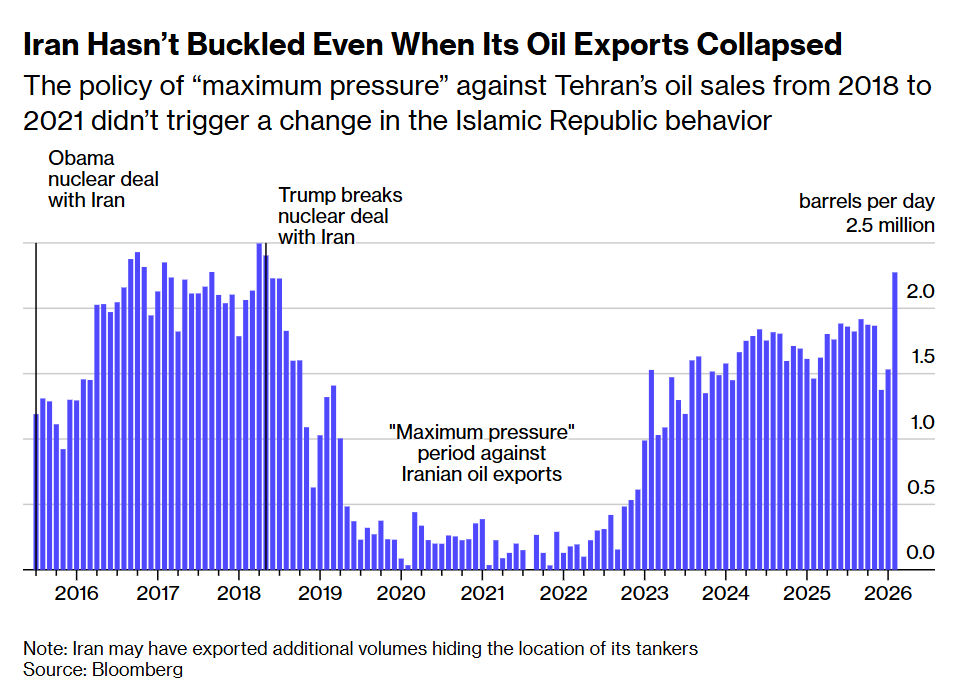
But Iran has weathered long periods of ultra-low oil exports. Back in 2020-22, Iran endured American "maximum pressure" on its petroleum industry, with exports at times down 90% from today's levels. And Iran didn't buckle then. Thus, it's unlikely to do so now. 🧵9/10
Javier Blas tweet media
English
10
127
548
69.4K
Ehren Stanhope
Ehren Stanhope@FactorInvestor·
Volatility set to continue this week as: 1. Despite the President's Friday tweet, kinetic actions are likely accelerating. 2. Degrossing and repositioning is rampant across asset classes. 3. Markets struggle to price in both an economic growth shock (recession) and an energy supply shock - obviously inter-related. 4. Equities are waking up to the possibility of a prolonged impaired growth trajectory. 5. Rates actually matter now to bellwethers given AI-related debt issuance. There is currently an asymmetric downside to being early back into risk assets. Important to note in this regime that bonds are no longer risk-free given inflation risks. We've been discussing this structural shift for a few years with clients. There will be an entry point, but it probably won't be a flash point as has existed in previous crises with the Fed swooping in to the rescue. They are hamstrung here in what I call Policymaker Purgatory.
Ehren Stanhope@FactorInvestor

This is going to be a challenging week in financial markets ahead. Investors will be forced to reconcile with either prolonged conflict or prolonged disruption in the flow of critical commodities. Either gets you to the same place, some version of extreme risk: existential (the Gulf States raison d’etre), economic (everyone loses during kinetic conflict), and inflation (lock in of critical energy, AI, and agricultural commodities). This conflict too shall pass, but on what timeline and what long-term impact to financial markets, nobody knows.
English
0
1
5
2.6K
Ehren Stanhope
Ehren Stanhope@FactorInvestor·
The WH thought Epic Fury would be as easy as Absolute Resolve (VZ). Trump wants out, like yesterday. As long as the surviving Iranian regime agrees to keep oil flowing and leave Israel alone, a deal can be done. If so, there are two huge new massive suppliers of oil to the global market at a couple mb/d in the next few years, Oil vol crushed, global oil supply glut.
English
1
0
4
547
Ehren Stanhope
Ehren Stanhope@FactorInvestor·
One of the key challenges for the near-term was pointed out in @BobEUnlimited morning note, that wars are political, which is to say that the actions of the key players over the next few weeks may or may not be rational. You have a series of actors in a conflict for which some face economic hardship, some economic demise, and others existential risk. The decision matrices don't align right now. The reaction of market participants to whatever results will more likely be driven by their portfolio positioning, leverage, and realized volatility than their true view. Take a low conviction approach and position for the range of possibilities. Whatever level of conviction you think you have, cut it in half, then in half again, and position accordingly.
English
0
1
1
759
Ehren Stanhope
Ehren Stanhope@FactorInvestor·
This is going to be a challenging week in financial markets ahead. Investors will be forced to reconcile with either prolonged conflict or prolonged disruption in the flow of critical commodities. Either gets you to the same place, some version of extreme risk: existential (the Gulf States raison d’etre), economic (everyone loses during kinetic conflict), and inflation (lock in of critical energy, AI, and agricultural commodities). This conflict too shall pass, but on what timeline and what long-term impact to financial markets, nobody knows.

English
0
0
2
2.1K
Ehren Stanhope
Ehren Stanhope@FactorInvestor·
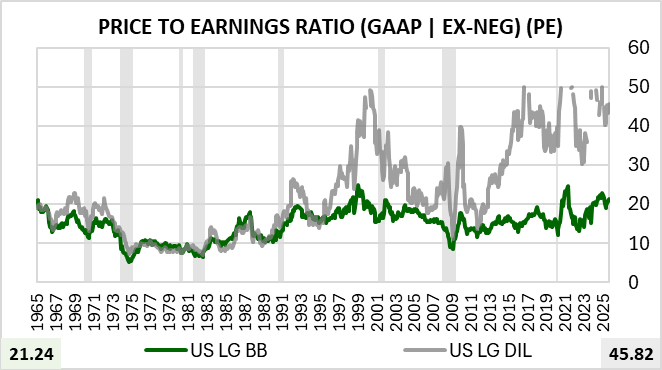
@dampedspring it is empirically true that stocks with high buybacks are on average priced cheaper and have better fundamental growth than high dilution stocks chart below US LG BB = US Large Cap High Buybacks, US LG DIL = US Large Cap High Dilution
Ehren Stanhope tweet mediaEhren Stanhope tweet media
English
2
0
2
96
Andy Constan
Andy Constan@dampedspring·
Did share repurchases over the last decade increase company specific and broad multiples? Would the end of share repurchases do the opposite?
English
10
0
18
13K
Ehren Stanhope
Ehren Stanhope@FactorInvestor·
@BradHuston Bob has been a gold bull for years. Why is it unreasonable to change one’s opinion after a 100% run in an asset class and a 12% depreciation in USD?
English
0
0
0
150
Ehren Stanhope
Ehren Stanhope@FactorInvestor·
There is a rhythmic life cycle of personalities on this app. It’s a shame because many get ridiculed unfairly. It’s usually the ones that grow their followers the fastest that succumb because they get lured into the sense that it’s a “community”. Somewhere along the way, the algo turns. People pile on. It’s sad.
English
0
0
1
826
Kris Sidial🇺🇸
Kris Sidial🇺🇸@Ksidiii·
I’ve noticed that when people on this app (especially on fintwit) display reactive, unhinged, emotionally driven behavior, it usually signals one of two things: they either never managed real money, or they were not very good at it when they did. Back on the trading floor, I came across all kinds of characters. Some cursed, screamed, even smashed screens. Almost without exception, those were the people who were not particularly good at their jobs. Beyond trading, a complete lack of self awareness, discipline, and emotional control especially to the point where you let strangers online get under your skin tends to reveal deeper issues with communication and composure. You never want to be that guy.
English
34
26
463
65K
Bob Elliott
Bob Elliott@BobEUnlimited·
@MarkKahn2 Effectively worked out to be a bet on falling discount rates lifting all assets, which has done well in the last 8 weeks or so.
English
1
0
3
505
Bob Elliott
Bob Elliott@BobEUnlimited·
We have seen hedge funds, particularly macro folks, pick up equity exposure in recent months (and long bonds too), which has been an important driver of the strong returns we've seen of late.
Bob Elliott tweet media
English
28
9
102
68.6K
Ehren Stanhope
Ehren Stanhope@FactorInvestor·
This issue was preordained a few years ago as PE dramatically outperformed in 2022 (few write downs) which boosted its allocation vs publics. Then private cash flows started slowing down, which would have ordinarily been the method to reallocate away from privates. Will be interesting to see who has the institutional will to wait for the cycle to turn.
English
0
0
3
1.2K
Dan Rasmussen
Dan Rasmussen@verdadcap·
What strikes me is the group think. Why are there no outliers among the large endowments? No one who resisted the herding into privates? A huge correlated mistake by the smartest minds in the investing business
Dan Rasmussen tweet media
English
77
48
517
126K
Ehren Stanhope
Ehren Stanhope@FactorInvestor·
Agreed that there is a macro driver of declining interest costs and effective tax rates, but I don't think it is ZIRP. Its more likely China/globalization starting in late 1970's and ramping in the early 1990's. There is an interplay between secularly declining interest rates and globalization, but I would argue globalization is the cause of secular profit margin expansion.
English
0
0
1
11
Pitfall Harry
Pitfall Harry@JKD_ff·
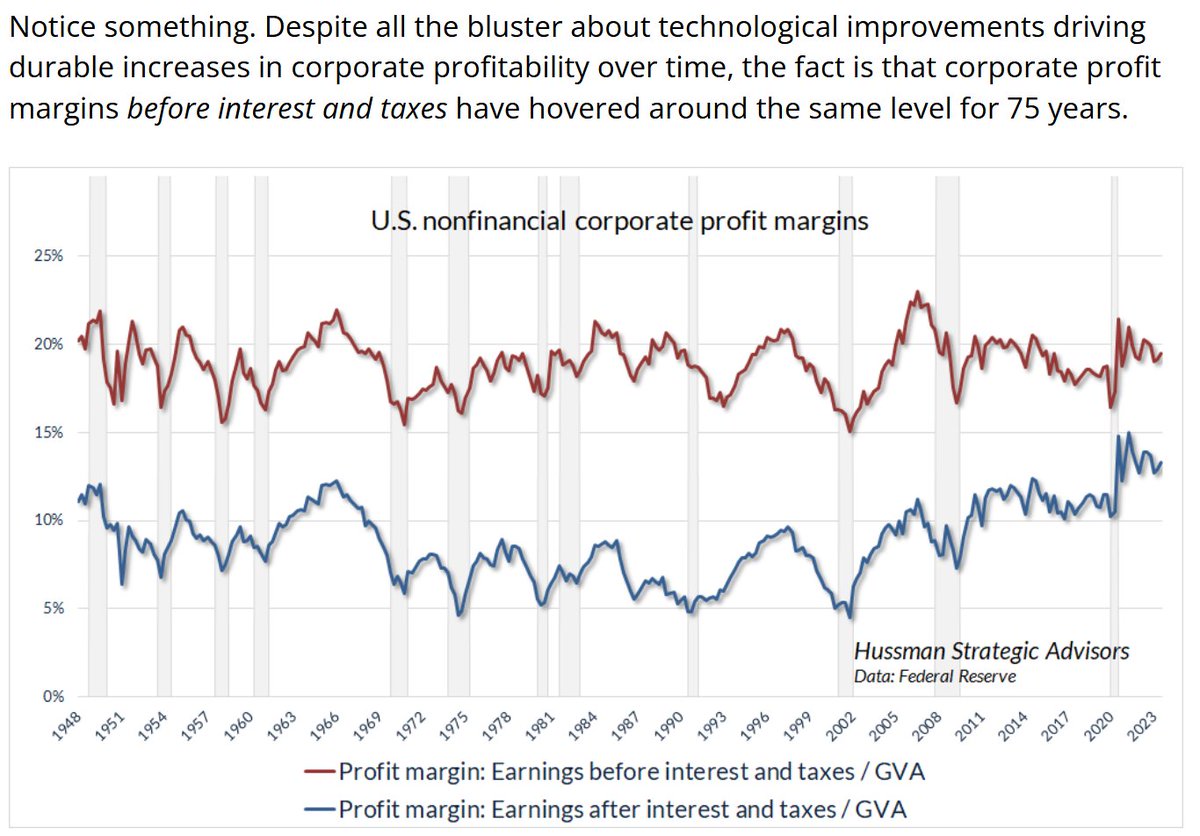
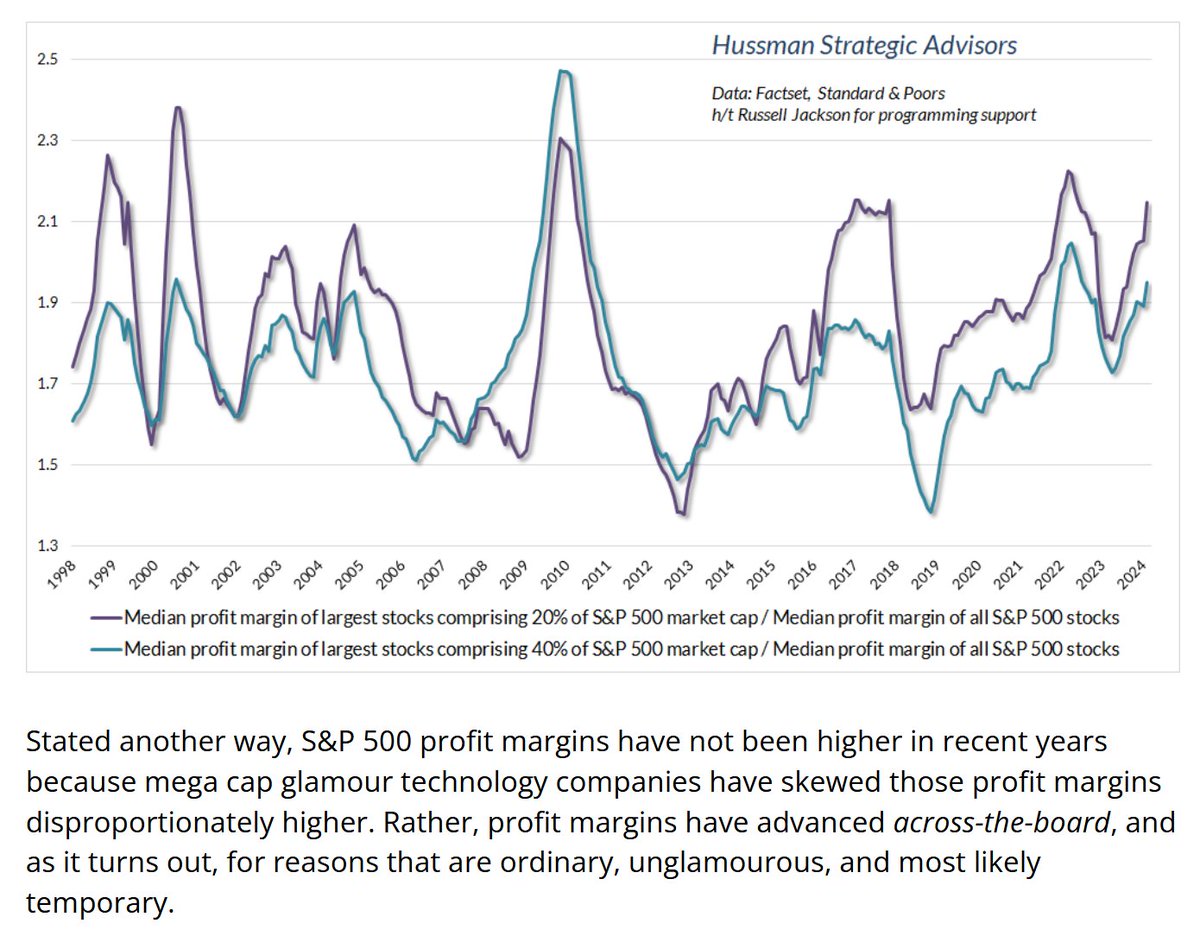
tl;dr I am just fleshing this out for myself, not intended to badger or solicit a response. I misspoke re taxes, allow me to restate... *taxes paid as a percentage of revenues* is unchanged in 40 years (see 1st chart). Interest expense as a percentage of revenues has dropped meaningfully. And since profit margins *before taxes and interest* (not gross margins), are unchanged going back 70+ years (see red line in next chart), the explanatory factor (in the past 40 years) must be the drop in interest expense (with much volatility due to many cyclical forces). This is top down, all inclusive by definition. Any bottoms up analysis that seems explanatory must be leaving out offsetting factors. Also, if the 'capital-light' story were explanatory, we would see a steady trend higher in megcap tech margins relative to the entire S&P. We don't. Their growth in relative margins has been strong since pandemic-era deficits took off, but today's levels are still well with range of the past 25 years (see last chart). The fact is, capital intensive non-tech companies have *also* seen their margins soar. What explains the sustained increase in large-cap margins across the board (not just capital light tech giants with great moats)? Sustained very low interest rates, and cyclically, huge government sector deficits. The permanence of today's very high margins is dependent on the permanence of these factors, not the accounting treatment of R&D or some other bottom up factor, despite what Wall St would like us to believe. So far, so good. Pandemic fiscal & monetary hysteria allowed for the entire large-cap universe to refinance at very low rates, and government austerity does not appear anywhere on the horizon. No one knows when/if this will change; we could be back at ZIRP in no time. My only recommendation for investors is to be looking in the right direction for oncoming risks. Accounting treatment of R&D is not going to save profit margins in the event of sustained higher rates and/or a drop in fiscal deficits, if and when they ever do occur.
Pitfall Harry tweet mediaPitfall Harry tweet mediaPitfall Harry tweet media
English
1
0
0
48
Pitfall Harry
Pitfall Harry@JKD_ff·
tl;dr 1st chart is just the inverse of interest expense as a %age of revenues (ZIRP effect) US large caps aren't any more profitable today than they have been for 70+ years, operationally. If you look long term, profit margins *before* interest and taxes are unchanged since the 1950s. And effective tax rates haven't changed much since the 1980s. So on a secular basis, today's high margins are largely explained by low interest expense (as %age of revs). Cyclically, government surplus/deficits have a large impact. So we need to factor this in as well (the 2000 peak did coincide with a sustained drop in margins through the late 90s as we moved to government surplus, and lockdown spending was heavily impactful). But what happens as deficits level out (as they are currently doing), and interest rates do not return to zero? People are going to learn that the profit margin growth post GFC is an artifact of ZIRP, not some suspension of capitalism, or mag7 miracle productivity. Of course we may be back at ZIRP and massive government spending before reversion completes. Wouldn't surprise me.
Ehren Stanhope@FactorInvestor

While accurate and agreed that US equities are expensive, the structure of the market is very different and much healthier. US Large cap profit margins then ~9% vs nearly 15% now. (1st chart) In terms of capital allocation, there was massive share issuance (dilutive) and massive "investment" in the internet (read burning cash) -> Profligate Without Profit. 2nd chart. One could argue that now we are Profligate With Profit (3rd chart) h/t @Jesse_Livermore for the charts


English
1
0
0
213
Ehren Stanhope
Ehren Stanhope@FactorInvestor·
@SweetStocks22 @MebFaber @LeutholdGroup That’s definitely one view. Mean reversion is real, but reversion to what? If the market’s assets are 90% intangibles property protected by a moat, do comparisons to an historically different economic structure matter, probably, but not by some hard and fast rule.
English
0
0
0
28