
Matthias Fahn

343 posts

Matthias Fahn banner
Matthias Fahn

Matthias Fahn

@FahnMatthias

Associate Professor @HKUFBE, Associate Director of @CAMO_HKU (https://t.co/TDIy9HJFWM), co-organizer of @RelConWorkshop.

Katılım Ağustos 2019
679 Takip Edilen592 Takipçiler
Sabitlenmiş Tweet
Matthias Fahn
Matthias Fahn@FahnMatthias·
Happy to see that our article "The Evaluation Tax: Why AI Demands a Shift from Production to Verification" (joint with Jin Li) has been published by the Financial Times China (@FTChinese ). An English version is available here: camo.hku.hk/the-evaluation…
HKU Centre for AI, Management and Organization@camo_hku

In the #GenAI era, firms face a growing challenge on assessing quality, accuracy, and relevance. The new @ftchinese article by CAMO’s professors Jin Li & @FahnMatthias explores “The Evaluation Tax” — why AI demands a shift from production to verification: ftchinese.com/story/001108619

English

1
2
6
632
Matthias Fahn retweetledi
Hyunjin Kim
Hyunjin Kim@hyunjinvkim·
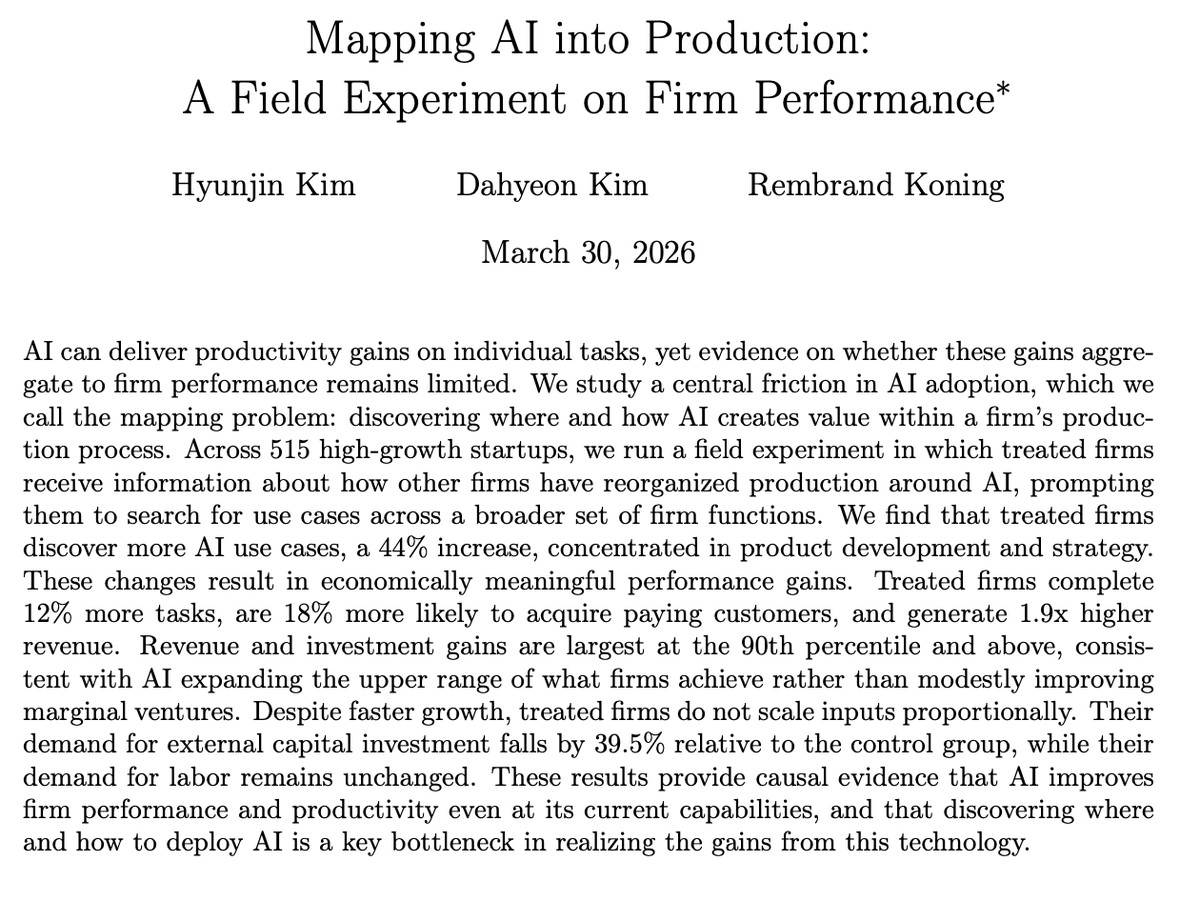
🚨 Excited to share a new working paper! 🚨 AI can improve individual tasks. But when does it improve firm performance? Our paper proposes one key friction firms face: the "mapping problem" -- discovering where and how AI creates value in a firm's production process. 🧵1/
Hyunjin Kim tweet media
English
15
72
343
157.9K
Matthias Fahn retweetledi
Seyed Mahdi Hosseini
Seyed Mahdi Hosseini@SeyedMH98·
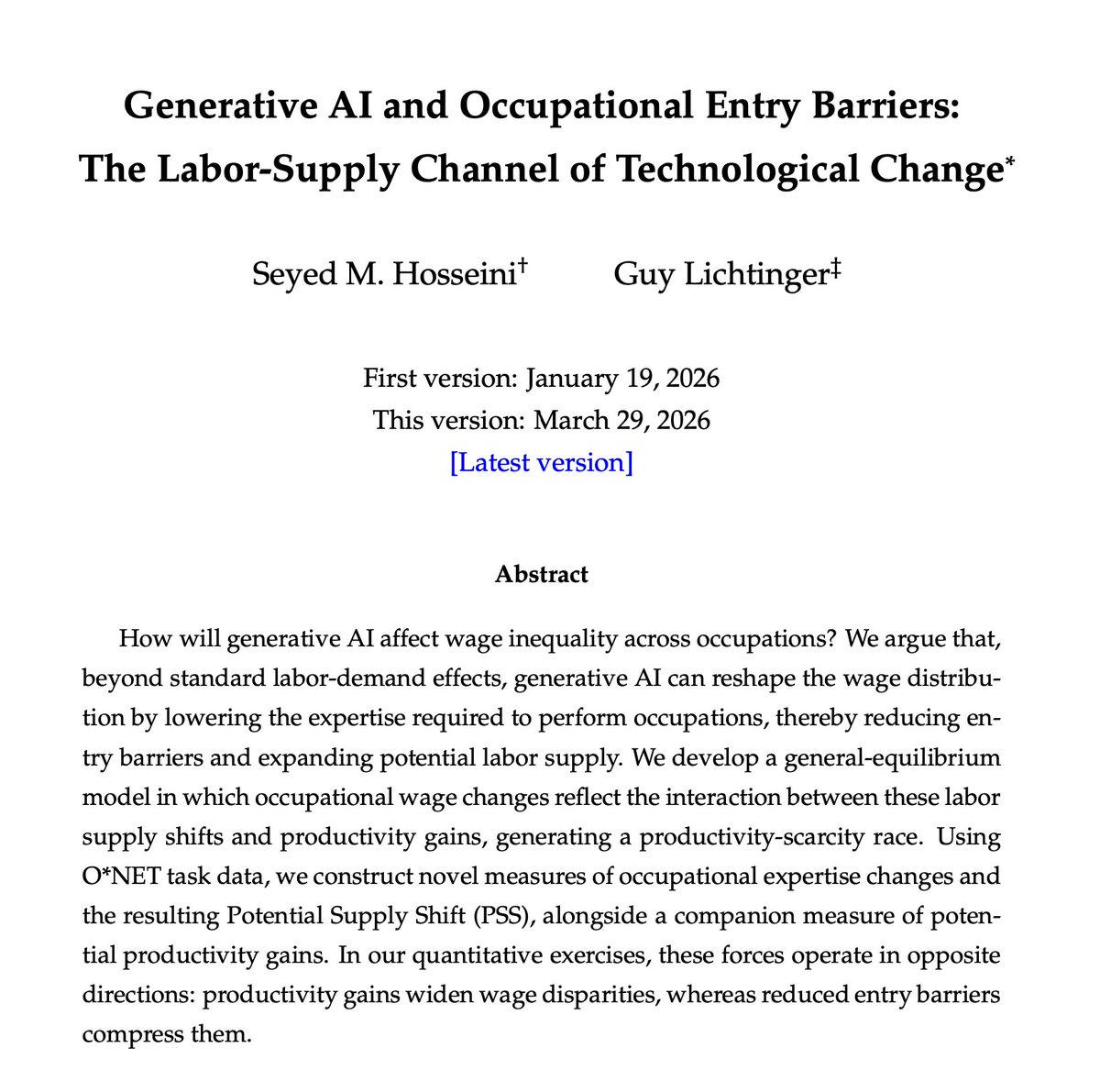
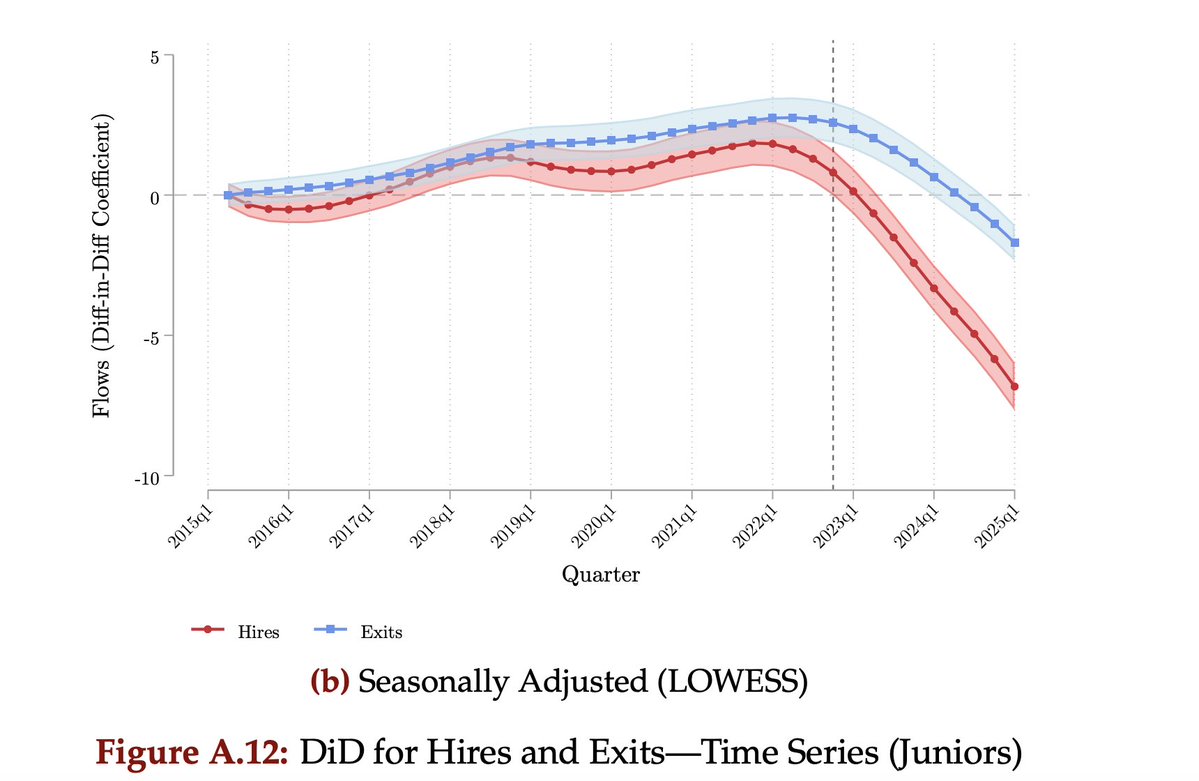
1/ 🚨We’ve posted a substantial new version of our paper (with @LichtingerGuy ) on GenAI and occupational entry barriers. The broad question is how AI will affect wage inequality. A thread 🧵
Seyed Mahdi Hosseini tweet media
English
1
22
71
14K
Matthias Fahn retweetledi
Seyed Mahdi Hosseini
Seyed Mahdi Hosseini@SeyedMH98·
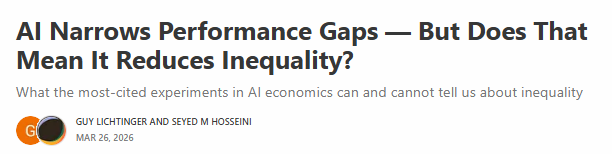
Guy and I are starting a Substack on AI and economics. Check out our first post on what we currently know, and don’t know, about AI and inequality. We look forward to hearing your thoughts!
Guy Lichtinger@LichtingerGuy

A few thoughts @SeyedMH98 & I had on AI and inequality (our first Substack post!): Several influential experiments show that AI helps lower-performing workers more. Many take this as evidence that AI will reduce inequality. But there's more to the story. A thread 🧵 1/3

English
2
10
54
6K
Matthias Fahn retweetledi
Guy Lichtinger
Guy Lichtinger@LichtingerGuy·
A few thoughts @SeyedMH98 & I had on AI and inequality (our first Substack post!): Several influential experiments show that AI helps lower-performing workers more. Many take this as evidence that AI will reduce inequality. But there's more to the story. A thread 🧵 1/3
Guy Lichtinger tweet media
English
3
6
27
7.8K
Arvind Narayanan
Arvind Narayanan@random_walker·
AI agents seem to be killing the ability to do cold outreach. Look at it from my perspective — someone who gets dozens of unsolicited invitations/requests in my email from strangers every day. In the past there used to be a sharp distinction between unpersonalized mass emails and those that were meant specifically for me. My spam filter could mostly automate this classification, and it even when it didn't, it would take me only a few seconds to tell if an email was worth reading/responding to. Now the distinction is gone because it is trivial to use AI to send out mass emails that appear deeply knowledgeable about each recipient's work and expertise. I guess we have to go back to the bad old days of needing to be "introduced" to someone before communicating with them.
English
25
37
353
124.1K
Alex Imas
Alex Imas@alexolegimas·
Working with collaborators from other fields (psych, CS, etc) I’ve seen huge differences in the role of grad students. This explains the very different reactions in how AI will affect the student pipeline. In lab-based models (psych, CS) it is much more apprenticeship based. PhD students are expected to come in and work on the supervisor’s projects. They are funded by the prof and don't really work with other faculty. You can see how there would be a lot of worry in these fields that AI agents would disrupt the pipeline as supervisors can substitute (expensive) students with AI tools. Econ is much more of a pure advising model. Students are accepted into the PhD program and paid by the department. The faculty's main role is to guide students on their own projects, and co-authoring (students working on faculty projects) is often actively discouraged. I have seen less worry about PhD student displacement because they're not working on faculty projects in the first place. Most of the discussion has been about AI substituting for pre-docs and RAs. My personal view: in the near term, these worries are a bit overblown. At least at this (potentially brief) stage, a good PhD student/RA with AI is much more productive than either w/o AI or AI on its own. Labs/faculty should be training their team with the tools and just produce higher quality work.
Rudi Bachmann@BachmannRudi

Professors who view students (PhD or otherwise) as coding agents, display a grave lapse in professional ethos.

English
10
20
226
52.5K
Matthias Fahn retweetledi
Matthias Fahn
Matthias Fahn@FahnMatthias·
But will it reduce the dominance of top US schools? Well, hope dies last...
English
0
0
0
56
Matthias Fahn
Matthias Fahn@FahnMatthias·
It will also be interesting to see what this does to teaching. Understanding mechanisms will still be essential, but it may push us more toward generalization, i.e., understanding broad classes of models rather than deep expertise in one narrow setup.
English
1
0
0
64
Matthias Fahn
Matthias Fahn@FahnMatthias·
Great insights on the future of empirical econ. I expect a similar shift in theory: less premium on solving ever complex models, more on identifying and designing the right model for a specific situation. So we should see fewer extensions, more model design.
Gauti Eggertsson 🇺🇦@GautiEggertsson

AI is a game changer for economic research. We will look back and think: before and after. The junior job market used to place enormous value on technical skills — and rightly so. We wanted to pass on the latest research methods to new PhD students. But the cost of mastering frontier solution techniques has dropped dramatically. I now find myself replicating papers and experimenting with frontier methods in an evening or a few days using Claude Code. That would have taken weeks before — which in practice meant I wouldn’t have done it at all. So what does the new equilibrium look like? Some are pessimistic: ChatGPT can write PhD dissertations, they say. Maybe. But those dissertations won’t push the frontier or generate excitement. I take the other side of that bet. We are in the business of figuring out how the world works and generating new knowledge. There is plenty we don’t understand, and no shortage of questions to answer. AI just accelerates the process. The returns on conceptual thinking and original ideas are now relatively higher compared to the technical grunt work of debugging code and cleaning datasets. I think this is a great development. My guess is it will also erode the monopoly that top US schools — and a handful of others — have long enjoyed. Part of that monopoly rested on access to knowledge that didn’t travel easily. Person-to-person transmission has always been far more efficient than learning from books or published papers — which are outdated by the time they appear, given publication lags. Now knowledge transmission is nearly instantaneous. I find myself using techniques I understood in principle but could never justify the time to implement, because other methods were simply faster. That’s no longer true. The same goes for big data work. One question keeps nagging me though: how should this change how we teach?

English
1
1
3
635
Matthias Fahn
Matthias Fahn@FahnMatthias·
@krishnanrohit @alexolegimas @arpitrage Very interesting, thanks for sharing! I probably should have been more precise and written “Western classical music.” In that field, the vast majority of listeners show little interest in new compositions (we still refer to works from the early 20th century as “modern music.”)
English
1
0
2
9
Alex Imas
Alex Imas@alexolegimas·
Some personal news: I’m starting a Substack, largely focused on AI, tech, and economics more broadly. I know what you're thinking, "oh god, why"? I’ve found myself writing longer posts lately, and I've always loved the essay format. It helps me explore ideas more formally without running the 5-year academic publishing gauntlet. This will give me a space to publish original research (models, new experiments) and to collaborate with smart folks across fields. I'll be providing links to all the posts with quick summaries in this mega-thread. Link to subscriber in reply:
Alex Imas tweet media
English
31
56
465
156.6K