Farnoosh Hashemi
29 posts

@Farn8sh_h
Ph.D. Student @CornellInfoSci, MSc Student @UBC_CS Interested in Computational Social Science


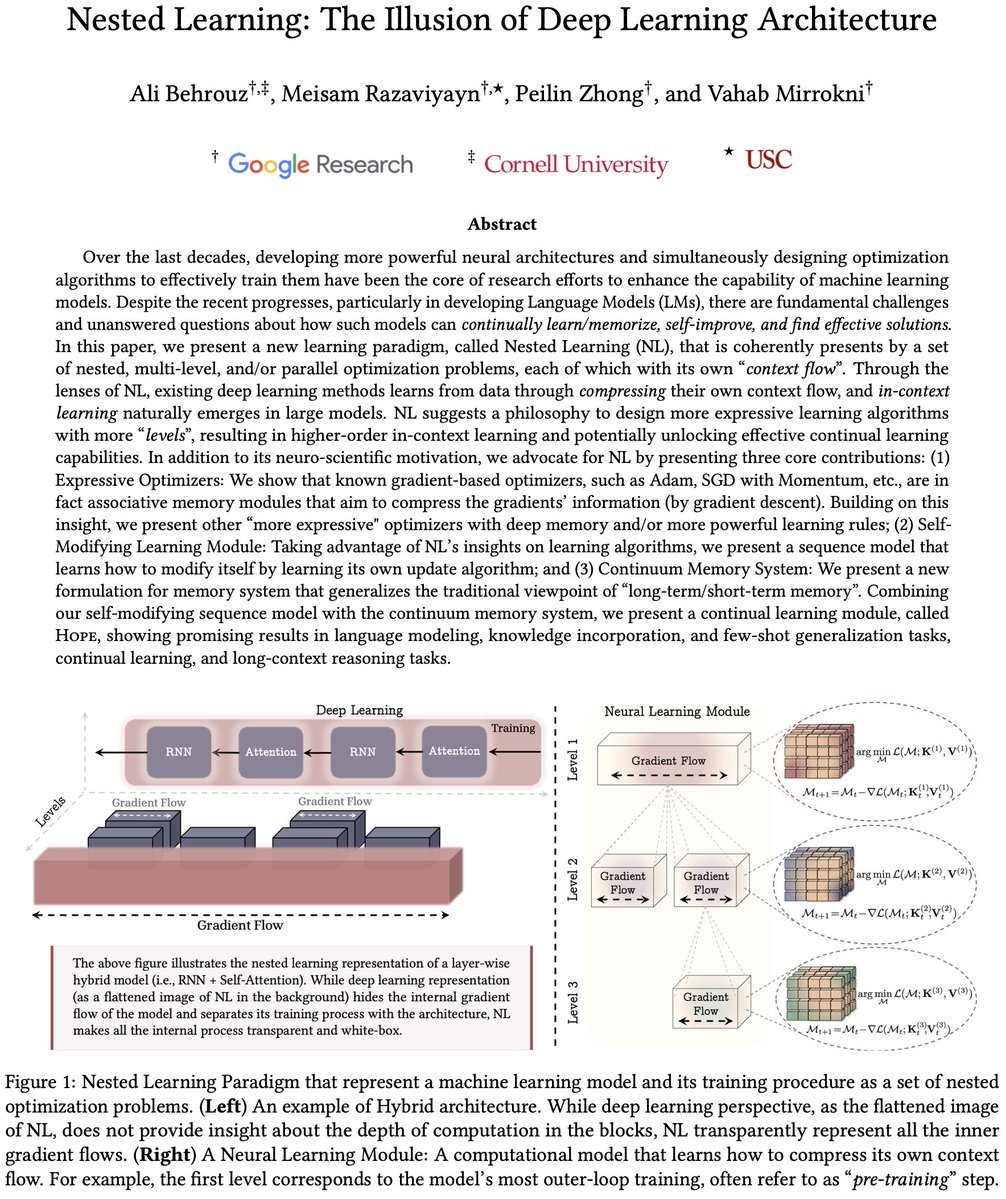
Moving from conventional ML to continual learning requires revisiting even the fundamental concepts such as “test”/“train” time. LLMs Need Sleep and Dreaming! We introduce a phase, where the model consolidates its fragile short-term memories into stable long-term memories, and then dreams to recursively self-improve over time. For memory consolidation, we introduce a new form of distillation, called Knowledge Seeding (KS), where a small model(s) distills its knowledge to a larger model. Our experiments on continual learning and reasoning tasks show that this new phase can help the model to perform better and relatively better mitigates catastrophic forgetting.


Introducing 𝑨𝒕𝒕𝒆𝒏𝒕𝒊𝒐𝒏 𝑹𝒆𝒔𝒊𝒅𝒖𝒂𝒍𝒔: Rethinking depth-wise aggregation. Residual connections have long relied on fixed, uniform accumulation. Inspired by the duality of time and depth, we introduce Attention Residuals, replacing standard depth-wise recurrence with learned, input-dependent attention over preceding layers. 🔹 Enables networks to selectively retrieve past representations, naturally mitigating dilution and hidden-state growth. 🔹 Introduces Block AttnRes, partitioning layers into compressed blocks to make cross-layer attention practical at scale. 🔹 Serves as an efficient drop-in replacement, demonstrating a 1.25x compute advantage with negligible (<2%) inference latency overhead. 🔹 Validated on the Kimi Linear architecture (48B total, 3B activated parameters), delivering consistent downstream performance gains. 🔗Full report: github.com/MoonshotAI/Att…

Today at #NeurIPS2025, we present Titans, a new architecture that combines the speed of RNNs with the performance of Transformers. It uses deep neural memory to learn in real-time, effectively scaling to contexts larger than 2 million tokens. More at: goo.gle/3Kd5ojF