Billy really said “less talking, more staking”👀
The funny part is the dad was just giving normal life advice… Save smart, think long term, be wise with money.
Next thing you know, Billy’s already staking on @Rezor_Official like he understood the assignment before the conversation even finished 😂
Lowkey the kind of financial decisions we like to see.
Start staking at rezor.org today!
#Rezor#RZR#Crypto#Staking
Decentralized storage is becoming a core layer of Web3.
But discovering files across a decentralized network isn’t always simple.
That’s where 𝐁𝐓𝐅𝐒 𝐅𝐢𝐧𝐝𝐞𝐫 comes in.
A powerful tool from BitTorrent that helps users search, upload, and share files across the BitTorrent File System (BTFS).
Here’s how it works 🧵👇
#TRONEcoStar@justinsuntron@BitTorrent
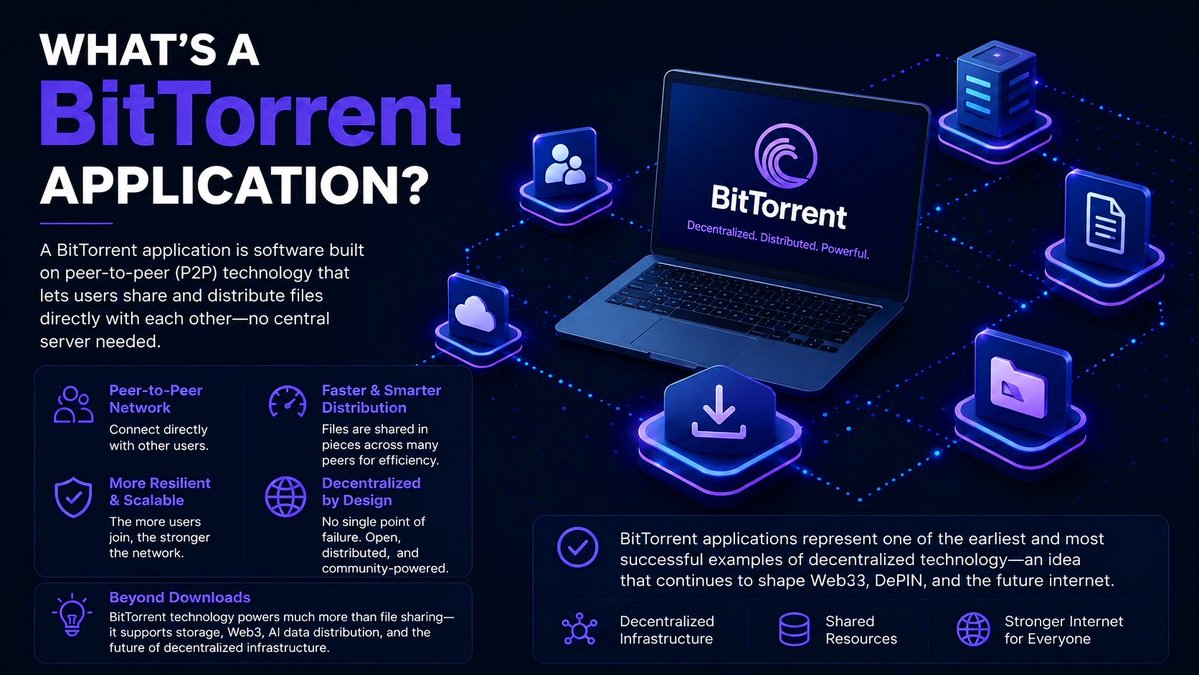
What’s a BitTorrent Application?
The internet was built around centralized platforms, where files are stored, controlled, and distributed from single servers. But long before Web3 became mainstream, BitTorrent introduced a different idea: a decentralized way to move and share data across the internet.
A BitTorrent application is more than just a file-sharing tool. It is software built on peer-to-peer (P2P) technology, where users connect directly with each other instead of relying entirely on one central server. Every participant in the network can help distribute files, making the system faster, more scalable, and more resilient.
This model changed how digital distribution works.
Instead of downloading a file from one source, BitTorrent applications break files into smaller pieces and distribute them across multiple users, known as peers. As more users join the network, distribution can become more efficient rather than more congested.
Why This Technology Still Matters
Many people associate BitTorrent only with media downloads, but the underlying technology represents something much bigger: decentralized infrastructure.
In today’s digital economy, applications require:
• Faster data distribution
• Lower infrastructure costs
• Better scalability
• Reduced dependency on centralized systems
• Greater resilience against downtime and censorship
This is exactly where peer-to-peer systems remain relevant.
BitTorrent applications demonstrate how distributed networks can coordinate storage, bandwidth, and data transfer without relying completely on a single authority. That concept has become increasingly important in the era of Web3, DePIN, and decentralized computing.
Beyond File Sharing
Modern BitTorrent-based systems are no longer limited to downloading files. The technology now connects with broader decentralized ecosystems involving:
• Decentralized storage
• Distributed data infrastructure
• Blockchain integrations
• Content delivery systems
• Web3 applications
• AI data distribution
As digital ecosystems continue expanding, decentralized transfer protocols become more valuable because data itself is becoming one of the internet’s most important assets.
Why Peer-to-Peer Infrastructure Is Powerful
Traditional infrastructure scales by adding larger centralized servers. Peer-to-peer infrastructure scales differently — through participation.
The more users contribute bandwidth and storage, the stronger the network can become. This creates a collaborative infrastructure model where participants are not only consumers, but also contributors.
This idea aligns strongly with the direction of decentralized internet infrastructure:
• Distributed ownership
• Shared resources
• Open participation
• Reduced central points of failure
• More resilient systems
BitTorrent was one of the earliest large-scale demonstrations that decentralized coordination on the internet could actually work.
BitTorrent and the Future of Web3
As Web3 evolves, decentralized applications increasingly require systems capable of handling large amounts of data efficiently. Blockchains are excellent for verification and transactions, but they are not optimized for heavy file storage or large-scale content delivery.
This is where BitTorrent-style infrastructure becomes important.
Peer-to-peer applications can support:
• Decentralized storage networks
• Distributed content delivery
• AI data access
• Media distribution
• Archival systems
• Cross-platform data sharing
The combination of blockchain verification and decentralized data transfer creates a stronger foundation for scalable Web3 ecosystems.
The Bigger Picture
A BitTorrent application is not simply software for downloading files.
It represents a broader shift toward decentralized internet architecture — where networks become more open, distributed, and community-powered rather than controlled entirely by centralized platforms.
@justinsuntron@BitTorrent#TRONEcoStar
𝗚𝗮𝘀𝗙𝗿𝗲𝗲 𝗜𝘀 𝗤𝘂𝗶𝗲𝘁𝗹𝘆 𝗧𝘂𝗿𝗻𝗶𝗻𝗴 𝗨𝗦𝗗𝗧 𝗧𝗿𝗮𝗻𝘀𝗳𝗲𝗿𝘀 𝗢𝗻 𝗧𝗥𝗢𝗡 𝗜𝗻𝘁𝗼 𝗔 𝗪𝗮𝗹𝗹𝗲𝘁-𝗡𝗮𝘁𝗶𝘃𝗲 𝗘𝘅𝗽𝗲𝗿𝗶𝗲𝗻𝗰𝗲
⚡️ #GasFree is now supported across multiple wallets including @TronLinkWallet, @GuardaWallet, @klever_io, and @NOW_Wallet.
That expansion matters more than people realize.
Because infrastructure adoption accelerates when users don’t need to change behavior to access it.
The real innovation behind GasFree is not just lower fees.
It’s the removal of native-token friction from stablecoin transfers on TRON.
Users can now send $USDT without needing to hold $TRX for gas:
➠ no manual Energy management
➠ no extra swap step
➠ no failed transactions from insufficient TRX
➠ no complicated onboarding flow
And now that functionality is increasingly being integrated directly into wallets people already use daily.
That’s strategically important.
Because mass adoption usually happens when infrastructure becomes invisible inside familiar interfaces.
The hidden layer here is UX abstraction.
TRON’s resource system still exists underneath…
but GasFree abstracts that complexity away from the user experience.
The result is a smoother payment-style flow built around stablecoin movement instead of gas-token management.
As more wallets integrate GasFree, the transfer experience across the TRON ecosystem starts looking less like traditional crypto infrastructure…
…and more like seamless internet-native payments.
That shift is much bigger than a feature update.
It’s infrastructure evolution happening in real time.
@DeFi_JUST@justinsuntron#TRON#USDT#TRONEcoStar
you know you’ve got to loosen up a bit during the week 😮💨
and today was just one of those days for me on @Immutable
from gaming to completing quests, i genuinely had fun today
what did you all get into today? 👀
A few days ago, I was trying to explain to someone why most DeFi projects eventually lose people’s trust.
We both understood clearly that it is not because the idea is bad. Also, not because the technology doesn’t work.
But because somewhere in the background, there’s usually still a small group holding too much control.
A wallet that can pause things.
An admin key that can change rules.
A team that can “adjust” liquidity when things get difficult.
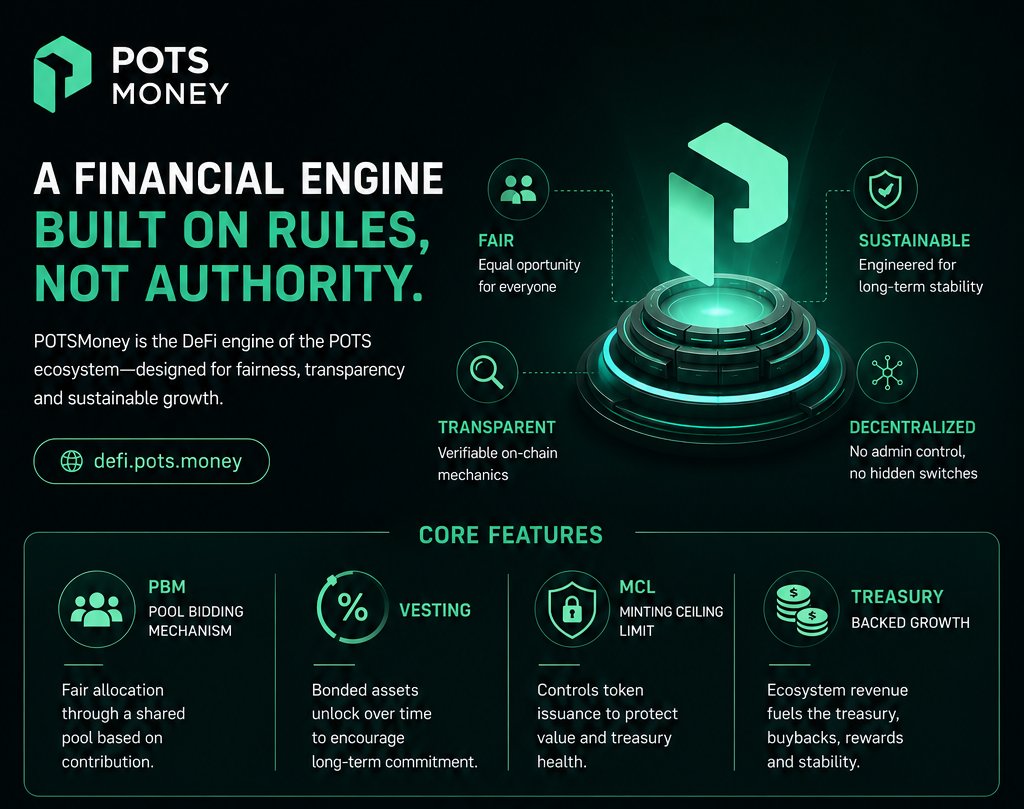
While we were deep into that conversation, I quickly remembered 𝐏𝐎𝐓𝐒𝐌𝐨𝐧𝐞𝐲. We started surfing their website: pots.money
And the more I looked into it, the more I realized this project is not just trying to market itself as another “next big DeFi token.”
It is recognizes Trust as a major concern and making valid steps to solve it.
One thing I noticed immediately is that POTSMoney's entire structure seems engineered around a single idea:
"What happens when finance operates through fixed rules instead of human intervention?"
That sounds simple until you compare it to how most DeFi systems actually work.
I've seen a lot of protocols preaching decentralization, but behind the scenes: emissions can change, liquidity can move, permissions still exist, and communities are expected to “trust the team.”
From what I'm seeing, @pots_money seems to be moving in the opposite direction.
The mechanics are designed to reduce reliance on authority and increase reliance on transparent systems.
That’s a very different mindset.
The part I found most interesting was the 𝐏𝐁𝐌 model, the Pool Bidding Mechanism.
Most DeFi launches rewards whoever gets there first: bots, insiders, fast wallets, or people with better positioning.
But with 𝐏𝐁𝐌, that dynamic is changed already.
Instead of a speed race, users enter through a shared pool structure where allocation depends on contribution weight.
Maybe that sounds technical, but the implication is important:
It shifts participation away from “who clicks fastest” toward a more balanced entry model.
Honestly, that’s something DeFi has needed for a long time.
Another thing I appreciated is that the ecosystem actually is maintained to slow down reckless extraction.
For example, bonded assets don’t unlock instantly. Rewards vest over time.
At first, some people may dislike that.
But if you have been in DeFi long enough, you know instant liquidity is usually where the problems begin: aggressive dumping, short-term farming, and constant sell pressure.
The vesting system feels intentionally designed to prioritize sustainability over quick excitement.
I also think the 𝐌𝐂𝐋 mechanism deserves more attention.
Most people ignore supply mechanics until things collapse.
𝐏𝐎𝐓𝐒𝐌𝐨𝐧𝐞𝐲 introduces a Minting Ceiling Limit to control how many new IBS tokens can enter circulation.
That may not sound exciting on the surface, but it addresses one of the biggest flaws that destroyed a lot of algorithmic systems in previous cycles:
unchecked expansion.
In simple terms, the protocol appears to understand that growth without limits usually ends badly.
What makes 𝐏𝐎𝐓𝐒𝐌𝐨𝐧𝐞𝐲 interesting to me is not that it claims to be perfect.
It’s that the design philosophy feels different from the average DeFi playbook.
It has less focus on noise, but more focus on structure.
𝐋𝐞𝐬𝐬 “𝐭𝐫𝐮𝐬𝐭 𝐮𝐬.”
𝐌𝐨𝐫𝐞 “𝐯𝐞𝐫𝐢𝐟𝐲 𝐭𝐡𝐞 𝐬𝐲𝐬𝐭𝐞𝐦.”
And in a space where trust gets broken constantly, that approach feels refreshing.
I’m still exploring the ecosystem myself, but I genuinely think projects trying to solve the architecture of trust are worth paying attention to.
I'm not giving you a financial advice though.
It's just an observation from someone who spends a lot of time studying how systems are built.
Explore here: pots.money
Follow: @pots_money and @pots_market
XOOB Network – Complete Breakdown: The ImpactFi Layer for Web3 Growth
XOOB Network is a Web3 growth and gaming infrastructure project trying to fix one of crypto’s oldest problems: fake growth. If you’ve seen @XOOBNetwork on X talking about “ImpactShare” and “ImpactFi”, here’s what it actually is, how it works, and why it matters.
The Core Problem XOOB Is Solving
Web3 marketing is broken.
Right now, 90% of campaigns pay influencers and KOLs for likes, retweets, views, and “reach”. But nobody knows if that actually drives deposits, TVL, users, or liquidity. Projects burn millions on hype and get bots, fake volume, and zero retention in return.
XOOB calls this the split between MindShare and On-chain Actions. MindShare is what people say about you. On-chain Actions are what people actually do with your product.
XOOB’s goal: connect those two worlds and make projects pay only for confirmed, verifiable results.
What XOOB Actually Does
XOOB is infrastructure for any blockchain and ecosystem. It’s built as a growth layer that tracks, measures, and rewards real impact.
Core components:
A. ImpactShare
This is XOOB’s scoring and reward system. It tracks the full journey: Content → Engagement → On-chain Actions → Measurable Results.
Instead of paying for a tweet, ImpactShare scores creators based on:
Originality and quality of content
Consistency over time
Genuine engagement, not bot activity
Actual on-chain actions driven: deposits, sign-ups, TVL, liquidity, trades
The system uses on-chain attribution, so every metric is public and provable. No fake dashboards.
B. CPA Model – Cost Per Action
Projects don’t pay for attention. They pay only when a real user completes a confirmed action that comes from a specific creator.
Example: If Creator A brings 50 users who each deposit $100 into Project B, Project B pays only for those 50 deposits. Not for 100k views.
C. On-chain Attribution & AI Scoring
All contributions are recorded on Chromia’s modular L2. AI filters out spam, sybil attacks, and low-quality content. This makes the system resistant to manipulation.
D. Referral System
Fully trustless referral mechanics. If you refer a project that launches a campaign, you get 50% of the platform fee from that campaign. If you refer users, you get 10% commission from their earnings.
Current Campaigns and Mechanics
90-Day ImpactShare Campaign
Running until June 3, 2026.
Key details:
Rewards Pool: 2% of total XOOB token supply allocated to quality creators
XP Pool: 200,000 XP points total
Posting Limit: 1 quality post per 24 hours per creator to prevent spam
Referral Boost: Earn 10% commission from your network
NFT Boost: Genesis NFTs give up to 50% earnings multiplier
Rewards are distributed based on overall impact, not follower count. A small creator who drives 20 real deposits can out-earn a large influencer who drives 100k views and 0 deposits.
XOOB XPedition
Seasonal quest system with 5 weeks of daily challenges, XP earning, NFT minting, and exclusive Discord roles. This is how users onboard and start earning before getting into the main ImpactShare campaign.
Tech Stack and Infrastructure
XOOB runs on Chromia’s modular L2. Chromia gives it:
Low gas costs for frequent on-chain attribution
Fast finality for real-time scoring
Scalability for handling thousands of creators and campaigns
XOOB positions itself as chain-agnostic infrastructure. Any project on any chain can launch a campaign and track results.
Tokenomics: $XOOB
Utility:
Rewards for creators in ImpactShare
Mining rewards in the XOOB MiniApp
Mystery boxes and in-app mechanics
Platform fees and governance eventually
Distribution:
2% of supply allocated to the current 90-day ImpactShare campaign
100M tokens allocated for the first mining season in the Telegram MiniApp
Mining seasons run 90 days. Season 1 started Jan 29, 2025 with 10 planets, blocks every 10 seconds, all recorded on-chain
The latest network data highlights a consistent and structured expansion in the BitTorrent ecosystem.
@BitTorrent continues to demonstrate steady global adoption, with cumulative client installations now reaching 579,273,239 as of 20 May.
What stands out is not only the scale, but the quality of growth trajectory.
This reflects a measured and continuous upward trend, rather than volatile spikes, indicating sustained network participation and long-term protocol usage.
Unlike speculative metrics often seen in the industry, installation base growth represents a real-world adoption signal, tied directly to user presence and active infrastructure deployment.
From a network perspective, this type of progression is important because it suggests:
• Stable user acquisition over time
• Low churn within the installed base
• Continued relevance of decentralized distribution infrastructure
• Expanding global footprint of the protocol
In a broader context, BitTorrent remains one of the largest decentralized distribution networks globally, and these figures reinforce its position as a foundational layer for peer-to-peer data transfer.
The key takeaway is simple:
Growth is not accelerating in spikes — it is compounding steadily.
And in large-scale networks, compounding adoption is what defines long-term dominance.
#TRONEcoStar@justinsuntron#TRON#BitTorrent
Everybody keeps talking about AI tools…
But I think people are sleeping on something much bigger:
👉 the people building the workflows behind the AI.
That’s the part that caught my attention digging into Action Model’s marketplace.
You don’t need to code.
You don’t need a technical background.
If you know how to complete a useful process online, you can turn that workflow into a reusable asset and publish it to the marketplace. docs.actionmodel.com
Think about that for a second.
A workflow could be:
• setting up a campaign
• creating a wallet
• onboarding a user
• configuring software
• automating repetitive tasks
Basically… anything humans do repeatedly online.
And once it’s published?
People can use it over and over while you earn from it passively. docs.actionmodel
That’s honestly a very different way to think about digital work.
For years, people only valued:
• code
• content
• capital
Now we’re entering a phase where:
👉 useful processes themselves become assets.
And the crazy part?
Some people are already naturally good at workflows without realizing it.
The friend who always knows how to set things up faster.
The person who automates repetitive work.
The one who understands tools quickly.
That knowledge suddenly becomes monetizable.
Personally, I think this is one of the most underrated shifts happening right now.
Not everyone will build AI models…
But a lot of people can build workflows that AI systems and users rely on every day. @ActionModelAI
If you actually look at the BitTorrent ecosystem, it is not just one tool. It is a full stack of downloaders built for different types of users:
→ BitTorrent Web (Windows)
→ BitTorrent Web (Mac)
→ BitTorrent Classic
→ BitTorrent Android
Now let’s properly break down BitTorrent Web Torrent client (Windows), because this is the entry layer most users interact with first.
BitTorrent Web is designed to remove complexity from torrenting and turn it into a simple browser-based experience that anyone can use without technical setup.
𝗛𝗲𝗿𝗲 𝗶𝘀 𝗲𝘃𝗲𝗿𝘆𝘁𝗵𝗶𝗻𝗴 𝗶𝘁 𝗼𝗳𝗳𝗲𝗿𝘀:
→ Built-in torrent search tool for finding and downloading content easily
→ Safe torrent scanner to help users discover files more efficiently
→ Stream torrents instantly while they are still downloading
→ Support for magnet links with direct in-browser playback
→ Simple browser-based interface with no complex configuration required
→ Ability to download and manage any file type, not just videos
→ Save downloaded files directly into local folders
→ Control upload and download speeds to manage bandwidth usage
→ Tools to optimize network usage and reduce system load
→ Available in 15+ languages including Spanish, French, Russian, Korean, Portuguese, Italian, and more
Now looking at the pricing structure, BitTorrent Web follows a clear freemium model:
→ BASIC version is free and provides the core torrenting experience
→ Ad-Free plan at $6.95 per year removes ads and reduces bandwidth usage
→ PRO plan at $19.95 per year includes antivirus scanning and premium support
→ PRO + VPN plan at $69.95 per year includes CyberGhost VPN, privacy protection, and support for multiple devices
What is interesting here is how the product is positioned.
@BitTorrent Web is not built for advanced users. It is clearly designed as the onboarding layer of the ecosystem, making torrenting accessible to everyday users through a clean and familiar browser interface.
Instead of forcing users to learn torrenting, it adapts torrenting to the user.
That is what makes it strategically important in the broader ecosystem.
𝗛𝗼𝘄 𝘁𝗼 𝘂𝘀𝗲 𝗕𝗶𝘁𝗧𝗼𝗿𝗿𝗲𝗻𝘁 𝗪𝗲𝗯
BitTorrent Web is designed to be simple and intuitive.
If you already have a torrent file, you can:
→ Click it directly
→ Or drag it into the BitTorrent Web browser window
Alternatively:
→ Use the search bar inside BitTorrent Web to find torrents
→ If the safe torrent scanner is installed (offered after setup), it helps find torrents directly from search results without visiting unsafe websites
You can also:
→ Choose the exact folder or hard drive where downloads should go
→ Change default download location in settings anytime
👉 Anticipate BitTorrent Web for Mac in the next breakdown.
#TRONEcoStar@justinsuntron#TRON