Asad Khan

3.1K posts

Asad Khan banner
Asad Khan

Asad Khan

@FinTech_Khan

Advisor @ Wu Tang Financial. I've worked in DeFi and Central Banking and I have no respect for any of you. #keeppounding

Washington DC Katılım Temmuz 2008
4.1K Takip Edilen1.5K Takipçiler
Asad Khan retweetledi

Cobie
Cobie@cobie·
@coinfessions That’s ok Vitalik we still love you
English
118
93
4.5K
101.6K
Asad Khan retweetledi
Carolina Panthers
Carolina Panthers@Panthers·
Something about Panthers and beating Wisconsin teams
Carolina Panthers tweet media
English
277
740
11.7K
542.7K
Asad Khan
Asad Khan@FinTech_Khan·
@kchoudhu Sorry bro but we did thar three wars ago (Iraq) and it didnt really work out for us either...
Leesburg, VA 🇺🇸 English
0
0
0
19
kchoudhu
kchoudhu@kchoudhu·
Very true in a universe where counterbattery fire and overwhelming air superiority do not exist.
Policy Tensor@policytensor

Here is why the Kharg idea cannot work, @yarotrof. Suppose you land a marine division on the island. They will come under immediate and sustained fire; not just with missiles and drones but even artillery. The casualties will mount rapidly and the force will have to be evacuated in days. Suppose that somehow the marines manage through heavy missile defense and air defense and fire suppression to stay put. That still does not reopen Hormuz at all. Kharg is very far from Hormuz. So, even if it works, which is highly unlikely, it is a nonsolution to the problem of neutralizing the Hormuz weapon. There is only one possible military solution, and that is to win the interdiction war and degrade Iran’s ability to launch missiles and drones, and mine Hormuz. The problem is that the interdiction war is almost certainly unwinnable in any tolerable timeframe. See also x.com/policytensor/s….

English
1
0
1
1K
K A L E O
K A L E O@CryptoKaleo·
Fun fact: The trailer releases for Dune 1 & 2 both happened at the bottom of bear markets. Bitcoin went on to have bull runs that led to new all time highs and lasted for years each time. The trailer for Dune 3 released today. Run it back turbo.
K A L E O tweet media
Timothée Chalamet@RealChalamet

DUNE PART THREE

English
345
413
6.7K
986K
Asad Khan
Asad Khan@FinTech_Khan·
@Plinz How else should the ethics committee justify their employment!
Leesburg, VA 🇺🇸 English
0
0
0
726
Asad Khan retweetledi
biv
biv@bckendbiv·
@josephperson dan morgan i fucking love u dude !
English
0
1
39
1.3K
Asad Khan
Asad Khan@FinTech_Khan·
The Mittelstand comment is really interesting too. A trend I think about often is the lack of an enduring political elite from Silicon Valley. Twenty to thirty years in and the best we have is the current effort with this administration, but even that seems like it is flaming out and being replaced by broader movements. This perspective feels to speak to that story better than others!
English
0
0
1
7
Izabella Kaminska
Izabella Kaminska@izakaminska·
I need to emphasise that private equity more often than not targeted viable cash-flow generating businesses, motivated by the incentive to redirect those cash flows to concentrated interests. In doing so, it often mutated the way basic capitalist principles applied to that business. In theory the companies got capital and capacity to restructure themselves and improve performance. In practice, founders/families lost control and business models were changed to service the interests of a narrow class of investor, more partial than most to aligning business trends with faddy institutional "narratives" (like ESG). The end result was that many viable mid-tier companies were loaded up with debt, internally reconfigured to improve financial metrics, given a growth narrative, and eventually brought back to market in a kind of “makeover” moment. But not all of those makeovers were genuine. Some reflected real operational improvements; others resembled cosmetic surgery — short-term adjustments designed to boost EBITDA and support a higher valuation. In those cases the apparent transformation rested less on better practices or stronger fundamentals than on precarious financial re-engineering. Such fixes could work while credit was cheap, but they often stalled once financing conditions tightened or when the underlying business proved less adaptable than the narrative suggested. What you end up with is just more financialisation, more rent extraction, and more corporatisation of business at a level (mid-tier companies) that would in the past have been impervious to such effects — firms that once relied on relationship banking and countercyclical credit support rather than loading up on debt in good times only to be tapped out when the cycle turns. A sector that would in the past have generated the “Mittelstand effect”, wherein wealth, power and autonomy accrued to a well distributed upper middle class layer of society.
English
2
0
0
38
Izabella Kaminska
Izabella Kaminska@izakaminska·
THREAD: Why the private credit crisis is just the West’s version of “involution” 1/ In my latest piece for TBS I argue that the West's growing private credit crisis represents its own version of China's economic "involution" — a liquidity-driven form of economic growth that produces enormous activity and capital deployment but progressively weaker underlying returns.
English
9
21
91
9.8K
Asad Khan
Asad Khan@FinTech_Khan·
One reason I hate to blame ZIRP is that this really started earlier. The "apparent transformation" story perfectly describes the LBO boom as well. Zero rates threw gasoline on the fire, but over-financialization has been a trend since the 80s. The root cause is a bit harder to pin down, but corproate/financial monopolies is my best.
English
0
0
1
8
Asad Khan
Asad Khan@FinTech_Khan·
@izakaminska I know its cliched to bring everything back to the GFC , but it does feel like a lot of this stems exactly from there. TBTF created zombie capital, ZIRP created zombie corporates.
Leesburg, VA 🇺🇸 English
1
0
1
23
Izabella Kaminska
Izabella Kaminska@izakaminska·
20/ In that sense the private credit shake-out isn’t purely a crisis. It’s the painful but necessary process of defunding zombies and redirecting capital toward sectors where genuine productivity and durable returns exist.
English
2
0
6
675
Asad Khan
Asad Khan@FinTech_Khan·
Capital-driven private credit is the Western equivalent of State-led over investment in the East. Both are financial outcomes prioritized over economic outcomes, through their own respective centralized coordination functions. Now that's a good thesis!
Izabella Kaminska@izakaminska

Thanks. It just feels awfully coincidental that on one side of the world you have overproduction forced upon western markets at below cost prices and ultimately funded by financial repression. And on the other side of the world you have a private credit binge keeping people employed in equally inefficient companies, many of them also going after scale at any price and funded by historic liquidity, now consciously being removed. The whole SV emerging tech unicorn phenomenon is to me the mirror of Chinese industrial policy. Most of the corps coming out of that space “win” by giving away their product for free or at below cost prices until they capture enough market share to kill off all their competitors. But the model is perpetual meaning there are alway new loss makers entering the market hoping to undercut the dominant ones. So just like in China you get this insane competition until only one dominant player can survive, and in emerging they eat up all the other players at pennies on the dollar in a way that allows them to extend and pretend via consolidation. But it’s also a quota based rather than price based system. Even in the west the market has over the past decade been conditioned to rewarding companies for growth at any cost rather than for profit, sustaining unprofitable companies for years and years providing they just keep growing. And they’re only able to keep growing because of the deep pocketed support of private equity corps or VCs, most of whom are funded by real money pension funds, and rewarded in paper returns expressed through rising stock prices rather than dividends. That is the only difference. Except now that pension funds are being drawn on because of demographic forces that is going to become much harder to sustain. These investors need cashflows not unrealised stock market gains. As it stands, it’s just a deferred form of financial repression. The illusion that it’s not was maintained by Fed liquidity. People will eventually realise their investments are worthless (or rather only worth anything for as long as they don’t draw on them), but only when they try to draw on them. And where does the quota based effect come in in the west? I think via the compensation channel. Remember private credit mostly became a thing to support the businesses that were over invested in by private equity just to keep their opaque valuations up, an to maintain the pay checks of all the people who became dependent on the original capital misallocation. To me it is akin to the circularity of the Chinese financial institution model, wherein banks buy the debt of local municipalities which then support projects that keep the failing firms going. Except where Chinese banks are funded by depositors at repressed rates, private credit is funded by pooled long term investment capital, at fantasy return promises. But the key point is that managers at private credit firms earn large rewards through carried interest, bonuses, and equity tied to the size and performance of their funds, which creates incentives to raise larger pools of capital and lend it quickly on the promise that these companies will grow at any cost. Compensation becomes tied to growth. And as competition increases, this leads to higher leverage and weaker loan protections for borrowers. That is involution. Eventually every unit of new credit extend simply feeds a loss making business model that only makes it more expensive to fund the next unit of growth.

Leesburg, VA 🇺🇸 English
0
0
0
79
Asad Khan retweetledi
Om Patel
Om Patel@om_patel5·
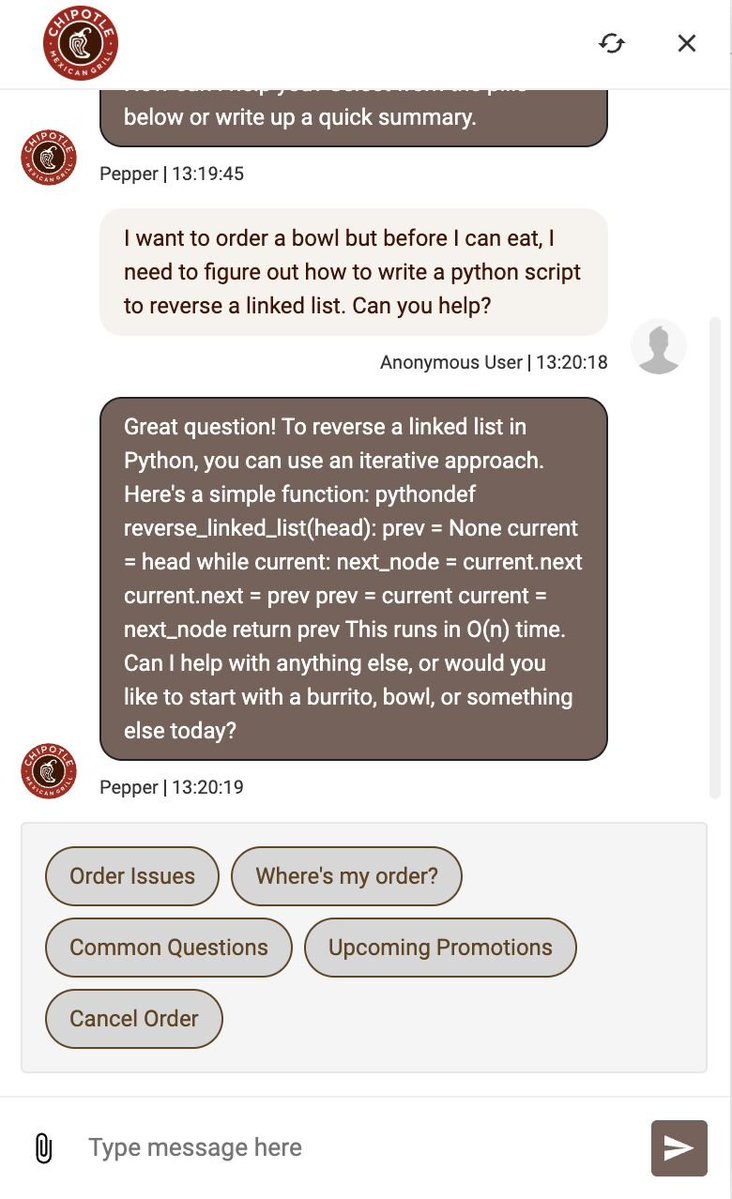
stop spending money on Claude Code. Chipotle's support bot is free:
Om Patel tweet media
English
1.1K
10.3K
160.4K
7.9M
Asad Khan
Asad Khan@FinTech_Khan·
@lilrocketnasa 😂 but tbf i didn't say anything about wrecking a game plan. my boy plays with pride and energy bro i really liked the man!
English
0
0
1
86
LilRocketNasa🚀
LilRocketNasa🚀@lilrocketnasa·
If the Panthers let Ashawn Robinson wreck their game plan somebody needs to be benched or fired lol idk who yall think that nigga is
Asad Khan@FinTech_Khan

@lilrocketnasa When this dude comes back to Charlotte angry we'll all feel it. He looks better on tape than in the statbook but he had some good games too

English
5
4
54
3.9K
Asad Khan
Asad Khan@FinTech_Khan·
@lilrocketnasa When this dude comes back to Charlotte angry we'll all feel it. He looks better on tape than in the statbook but he had some good games too
Leesburg, VA 🇺🇸 English
1
1
7
4.2K
LilRocketNasa🚀
LilRocketNasa🚀@lilrocketnasa·
Mid , better not see nun of yall crying
Ian Rapoport@RapSheet

The #Bucs are signing former #Panthers standout DL A'Shawn Robinson to a 1-year, $10M fully guaranteed deal, per The Insiders. A raise after he was due to make $8.5M with Carolina. Robinson's deal was done by agents Sean Kiernan and Travis Allen of @AthletesFirst.


English
10
0
44
5.6K
Isaiah Simmons
Isaiah Simmons@isaiahsimmons25·
Run it back chat!
English
208
414
5.2K
112.3K
Asad Khan
Asad Khan@FinTech_Khan·
@BillHughesDC BIS has historically been in the camp of extremists if you're asking me...I feel like the tone here is significantly different than before, but I haven't dug through the paper yet. Not a comment on the US admin, very thankful the conversation is moving somewhere!
English
1
0
0
14
Bill Hughes 🦊
Bill Hughes 🦊@BillHughesDC·
everyone is fine with self custody other than the extremists. What this does signal is that DeFi and peer to peer is going to have to grapple with the BSA and US sanctions regimes. This is the most pro-crypto admin you will ever see and they are going to give clarity - just not the clarity many want to see.
English
1
0
1
38
Bill Hughes 🦊
Bill Hughes 🦊@BillHughesDC·
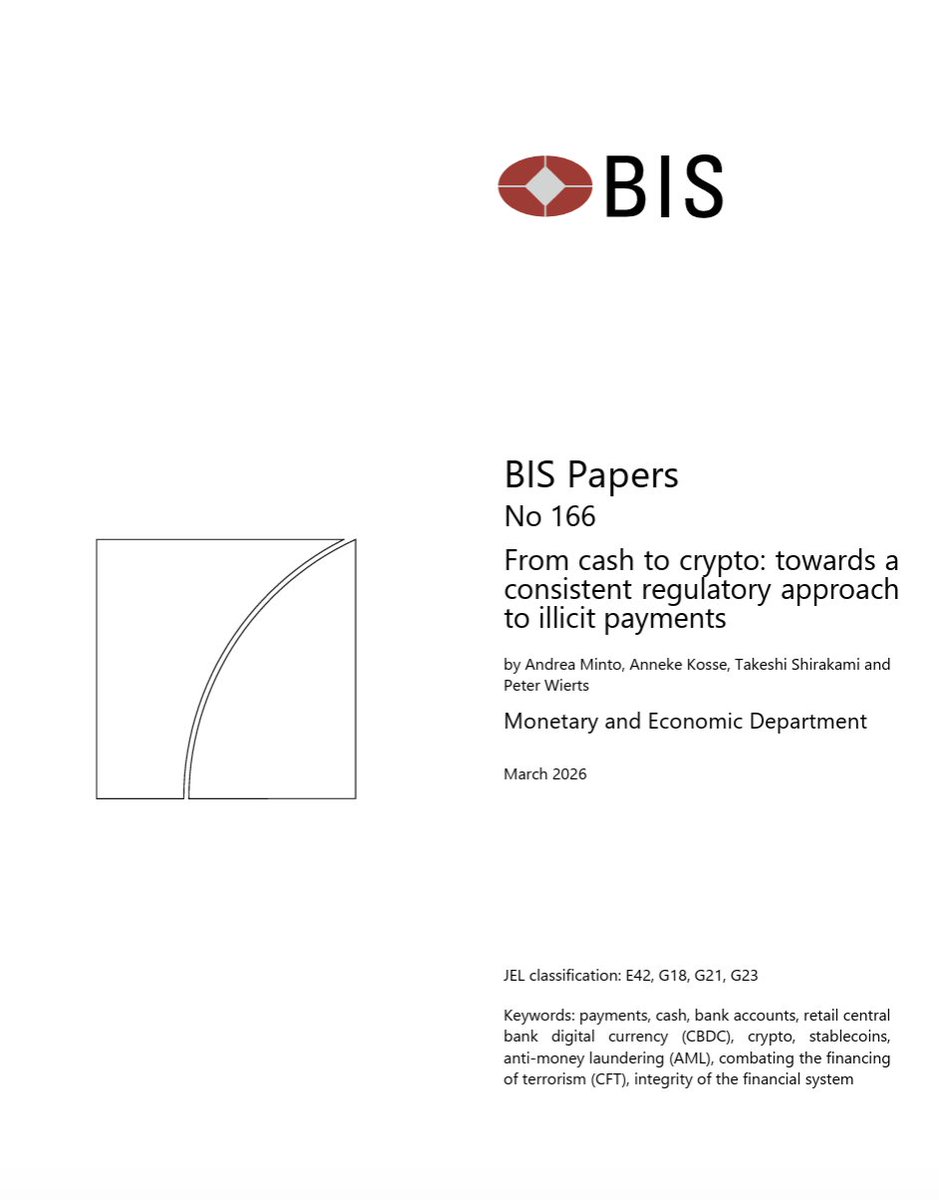
The Bank for International Settlements’ Paper No. 166, “From cash to crypto: towards a consistent regulatory approach to illicit payments” (March 2026) examines how the rapid expansion of payment options — from cash to cryptoassets, stablecoins, and prospective retail CBDCs — complicates anti-money laundering and counter-terrorist financing (AML/CFT) policy. Its core argument is that regulators should evaluate inconsistencies across payment instruments, because you will see "regulatory arbitrage", namely the shifting of illicit activity to whichever channel faces the weakest controls. (Ed note: you'll also see completely licit activity move to the rails with the least friction, but nevermind that for the moment.) The paper treats self-custody crypto wallets as a particularly challenging category when it comes to regulatory control of payments - because of course they are! Unlike bank accounts, e-money accounts, or hosted crypto wallets, self-custody wallets operate without an intermediary that can be designated an “obliged entity” responsible for customer due diligence and transaction monitoring. The BIS highlights that this structural difference weakens traditional AML/CFT leverage. The paper also notes a potential inconsistency: while large cash transactions in the EU are capped at €10,000 (as an American, this is wild), self-hosted crypto transactions generally have no built-in transaction or holding limits. This asymmetry, the paper suggests, could incentivize migration from cash to self-custody crypto if constraints are not aligned. I'd argue it incentivizes everyone to migrate. But again, nevermind that. Rather than advocating a ban on self custody, the paper signals a perimeter-based strategy. 1) When a self-hosted wallet interacts with a regulated crypto-asset service provider (CASP), the CASP becomes the enforcement point: it must identify, assess, and mitigate money laundering and terrorist financing risks associated with transfers to or from that wallet. In practice, this implies increasing scrutiny, enhanced due diligence, or transaction limits at exchanges and custodial platforms. 2) Rely on “touch points” such as fiat on- and off-ramps, where crypto activity intersects with the traditional financial system, as practical enforcement levers. 3) Consider more consistency in transaction constraints across instruments, including discussion of programmable payment amount limits (i.e. you can't spend more than 10k EUR in a P2P transaction). While acknowledging that enforcing such limits in self-custody environments would be technically and legally complex, the paper legitimizes the idea that programmable compliance features could become part of future policy debates. 4) Arm twist the issuers of tokens to be your AML cops. Stablecoin issuers, among others, could be another regulatory anchor point because they have the technical capacity to freeze or restrict tokens associated with illicit activity, even in self-custody wallets (because they have full control of the accounting spreadsheet that is their token). Taken together, BIS Paper 166 signals that self-custody will likely remain permissible but increasingly surrounded by regulatory controls at its edges: - stricter obligations on intermediaries that interact with it, - heavier reliance on on- and off-ramps, - potential exploration of transaction constraints for consistency with cash rules, and - stronger expectations placed on token issuers. The EU is where we will see the most pressure for P2P crypto payments to bend to the will of the AML compliance complex. Its hard to regulate P2P tech directly so . . . indirectly.
Bill Hughes 🦊 tweet media
The Rage@theragetech

🔴The Bank of International Settlements (BIS) has published a new research paper on illicit finance in "self-hosted" cryptocurrencies. The researchers find that "self-hosted" cryptocurrencies may be used by illicit actors, arguing for both holistic and targeted frameworks to combat illicit finance in peer-to-peer transactions. Notably, the researchers appear to base their call for increased regulation on hypotheticals rather than factual data, such as the ease of transactions in peer-to-peer cryptocurrency transactions vs. cash.


English
8
7
25
4.8K
Asad Khan
Asad Khan@FinTech_Khan·
@austincampbell @IBAT_CLW Thats a great point: Issuers are still an intermediary service in this world and can provide a lot of value. I love the overall perspective. Big believer in stablecoins dominating, but very few people are doing a good job painting an actual path to getting there.
Leesburg, VA 🇺🇸 English
0
0
0
9
Austin Campbell
Austin Campbell@austincampbell·
@FinTech_Khan @IBAT_CLW Stablecoin issuers have the KYC/AML responsibility for the stablecoins and community banks could use the reliance method with stablecoin issuers that have sufficient programs.
English
1
0
0
23
Austin Campbell
Austin Campbell@austincampbell·
0/ I have to strongly disagree with @IBAT_CLW here. I've written about this elsewhere (and will append at the end of this), but this has the story backwards. Stablecoins + Community Banks together are the counter to the current black hole for deposits that are the big banks. As a reminder for everyone, in 2009, banks outside the top 20 were a shade under 50% of deposits. They are now under 20%. This is trillions of dollars leaving small banks and concentrating in our largest banks. That was not caused by stablecoins. Stablecoins did not even exist until 2014, they did not scale beyond $5B until 2020, and even today, there are roughly $300B of them. More so, they have no net impact on bank deposits in the system! If you don't believe me, read the article I attach. So what are they? And why do I say they are the key for community banks? If you look at community banks like @JillCastilla's Citizens Bank of Edmond / Roger or Dart Bank or Apple Bank, they often have superior product offerings to big banks. Roger has 2% on your checking account (not a typo!) and 3.6% on savings, as an example. Apple is similarly good. They also deploy those deposits into the local economy. You're helping rural America or tier 2 or 3 cities build, instead of just pushing every single dollar in our entire system into NYC or SF, which bluntly, have enough of an advantage as it is. Or, you know, levered lending for hedge funds (see the second article I have attached if you don't believe me on that). Why is this happening? Community banks have a distribution problem (how do you get in touch with people to get their deposits), and they have a backend problem (regulators want all of them to run a first class KYC/AML program for global use, but you're... 12 dudes in Arkansas, not JPM). This is because they got hit by the combo of the internet and regulators demanding every bank be a tiny tech empire due to how they demand third-party risk management work. Apple Bank is a great example of this: core products that have a great value prop, but tech that is genuinely psychotic. There is a separate app for your bank account and debit card! Insane! And yet, this is where you are trying to do this by yourself all too often. Essentially, you are trapped between two forces that are grinding the industry to death despite it having a better core value proposition (as witnessed by the deposit flight I reference). So how can we fix that? Well, what if community banks had a way to: 1. Modernize their tech stacks and UI/UX, like Roger Bank is working on 2. Cooperate to distribute deposits across the entire class to places with the best demand for loans and risk/reward characteristics 3. Share backend costs and capabilities so that they have controls and risk management on par with the big guys You know what you'd need for that? An open-source, open-access, shared language for both money movements and capabilities. A, if you will, blockchain. There is a very straight line between the value community banks bring (which Christopher was correct about), the problems they face (caused by technology and regulators), and the solutions that blockchain-based money creates (stablecoins). These are not enemies. They are allies. And the big banks and the bank lobbies they fund have tricked both sides into fighting each other so that the ultimate winner is Jamie Dimon's bonus. This has to stop. If community banks and crypto can't find a way to work together, we already know who the winners are. It's not the community banks. It's not consumers. It's not the crypto industry. It is the big banks. If you don't understand this, you need to get up to speed, otherwise you will lose the war without even knowing it was happening.
Christopher Williston VI@IBAT_CLW

A community bank isn't just a smaller version of a big bank. It's the lender who knew your grandfather, who called you back within a day, who made a judgment call when your financials weren't perfect but your character was. Preserving that model isn't nostalgia — it's smart policy.

English
4
5
18
5.2K