Fiona Conlon

920 posts

Fiona Conlon

Fiona Conlon

@FionaConlon4

Science & solidarity • Here to learn • Problem-solving/bio/innovation/systems/policy/wellbeing/optimism

London, UK Katılım Mart 2020
1.6K Takip Edilen524 Takipçiler
Fiona Conlon retweetledi
Anish Moonka
Anish Moonka@anishmoonka·
A parasite that has been eating people for 3,500 years is about to be wiped off the planet. It infected 3.5 million people in 1986. Last year, it infected 10. And I have not seen it make a single front page. It is called Guinea worm. You drink contaminated water from a pond in a poor village. A year later, a worm up to three feet long starts coming out of your leg through a burning blister. There is no pill that stops it and no surgery that works. You wrap the worm around a stick and pull it out slowly, over days or weeks, inch by inch. If you rush, the worm breaks inside you and causes a fresh infection. Guinea worm is ancient. Preserved worms have been pulled out of Egyptian mummies from around 1000 BCE. The Ebers Papyrus, an Egyptian medical scroll from 1550 BCE, describes pulling the worm out with a stick. For three and a half thousand years, that was the best humans could do. Then in 1986, public health workers decided to kill the parasite off. They had no vaccine and no drug. What they had was cheap cloth water filters and a small army of volunteers willing to walk from village to village for decades. The plan was simple. Give everyone who drinks from a pond a cloth filter to strain out the tiny water fleas that spread the parasite. Then send volunteers walking house to house, year after year, teaching people how to use the filters and keeping anyone with an emerging worm out of the water. It worked. From 3.5 million cases a year to 10. Four were in Chad, four in Ethiopia, two in South Sudan. The other four countries where the worm used to be common, Angola, Cameroon, the Central African Republic, and Mali, had zero human cases for the second year in a row. The World Health Organization has already certified 200 countries as Guinea worm free. Six are left. The last hurdle is dogs. Cameroon had 445 infected animals last year and Chad had 147, so a lot of the remaining work is on animals, not humans. Strays get leashed, and crews treat ponds to kill any remaining worms. The campaign keeps watching until the number hits zero. When Guinea worm hits zero, it becomes the second human disease ever erased from the planet. The first was smallpox. It will also be the first parasite humans have ever wiped out, and the first disease ever ended without a single dose of medicine. Volunteers walked village to village with cloth filters for 40 years. Now a plague from the age of the pharaohs is about to be gone.
ً@prinkasusa

Give me the kind of good news from around the world that nobody ever talks about... but should.

English
732
20.8K
129.6K
7.9M
Fiona Conlon retweetledi
kamilė
kamilė@kamilelukosiute·
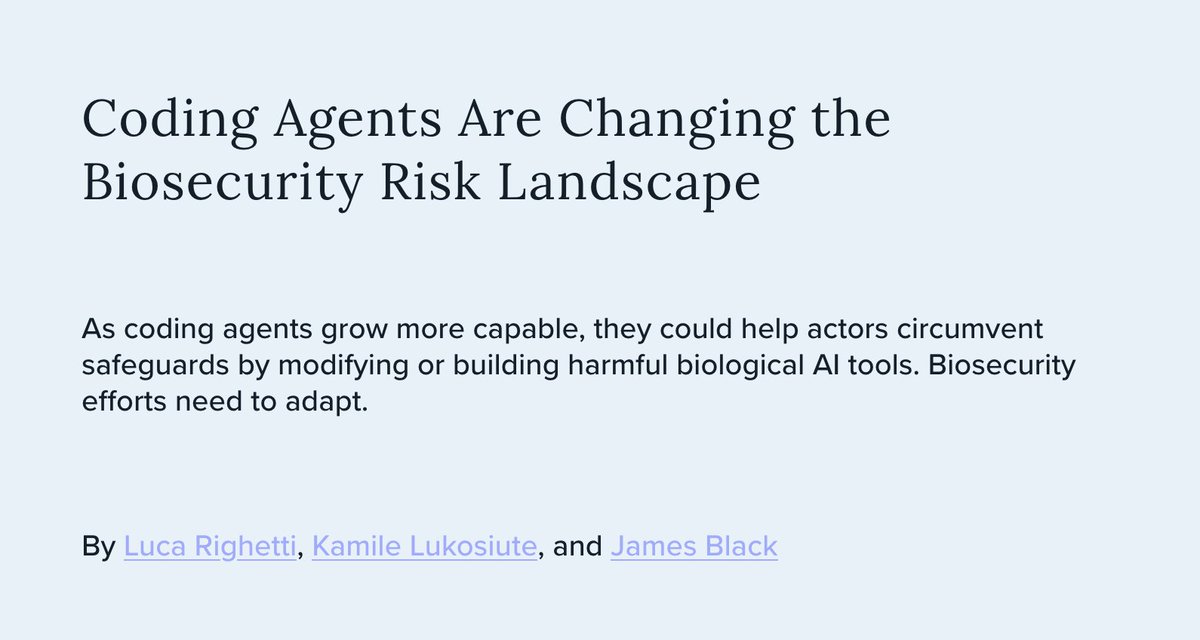
Over a weekend and with ~$760, I (not a biologist) used Claude Code to fine-tune a biological AI model on human-infecting viral sequences. Although my experiment wasn't dangerous, it demonstrates how coding agents are changing the biosecurity risk landscape. In a new @GovAIOrg blog post with @lucafrighetti and James Black, we describe this experiment and its policy implications. Biosecurity has traditionally divided AI risks into two buckets: general LLMs that "raise the floor" by democratizing knowledge and specialized biological AI models (BAIMs) that "raise the ceiling" by enabling experts. Increasingly capable coding agents blur that line via three mechanisms: 1) Coding agents let both novices and experts operate BAIMs more effectively, expanding the pool of potential misusers and letting experts test more designs faster. 2) Data filters on BAIMs are brittle when coding agents can autonomously fine-tune the models, as my experiment shows. 3) Coding agents speed up ML engineering, making it more feasible for threat actors to train new specialized models optimized for harmful capabilities from scratch. Policy recommendations: BAIM developers should move beyond data filtering toward trusted-access programs; LLM developers should test agent interactions with BAIMs; policymakers should prioritize physical chokepoints like DNA synthesis screening. Read the piece: governance.ai/analysis/codin…
kamilė tweet media
English
8
19
84
8.1K
Fiona Conlon retweetledi
Alexander Berger
Alexander Berger@albrgr·
Coefficient Giving recently passed $5 billion in total grants directed since we started in 2014. A few things about what that number actually represents 🧵
English
3
8
167
9.6K
Fiona Conlon retweetledi
Coefficient Giving
Coefficient Giving@coeff_giving·
Today, we're opening a new Request for Proposals in Biosecurity. Broadly speaking, we want to support work aimed at preventing engineered biological threats from emerging and improving our response should prevention fail. 🧵
English
4
21
74
8.1K
Fiona Conlon retweetledi
Dean Yang
Dean Yang@deanyang·
New in @AEA_Journals' American Economic Review: migration doesn't hollow out the home economy — it builds it up. More than 75% of the long-run income gains from migration are domestic. The home economy itself grows. Here's what we found: 🧵
English
3
48
177
23.5K
Fiona Conlon retweetledi
Ryan Hill
Ryan Hill@RyanReedHill·
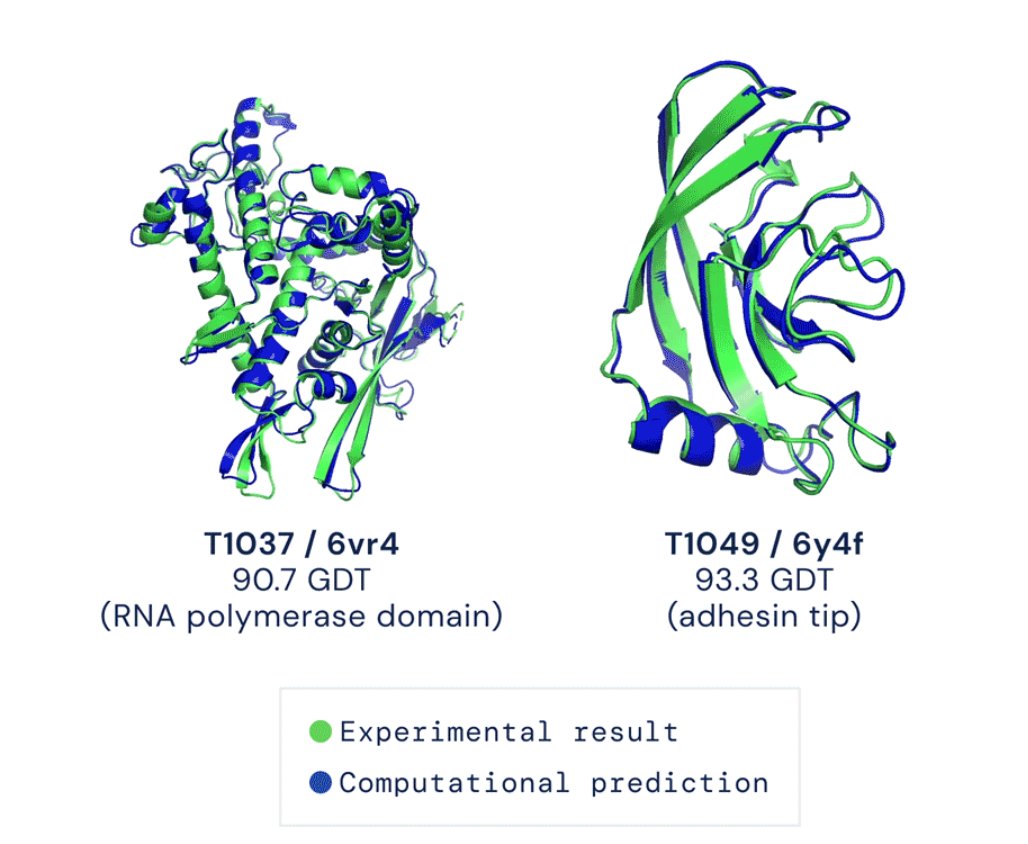
There is great excitement about the potential for AI to reshape science, but so far very little empirical evidence about how that is (or is not??) happening in real time. I'm excited to share a new working paper with @carolyn_sms about the impact of AlphaFold on science ->
Ryan Hill tweet media
English
2
43
139
25K
Fiona Conlon
Fiona Conlon@FionaConlon4·
Interesting new method for quantifying poverty which avoids key downsides of traditional poverty lines - it better reflects the full income distribution (not just counting "who is above or below a line") and doesn't require setting an arbitrary line at all voxdev.org/topic/methods-…
English
0
0
0
40
Fiona Conlon retweetledi
Atul Gawande
Atul Gawande@Atul_Gawande·
Bill Foege, rest in peace. He was a hero of public health, key to the eradication of smallpox (which killed more than half a billion people), a former head of CDC, and unfailingly wise, kind, and persistent. @celinegounder recalls his life beautifully: wapo.st/3M51JVO
English
7
156
545
26.2K
Fiona Conlon retweetledi
Nan Ransohoff
Nan Ransohoff@nanransohoff·
New blog post: There should be ‘general managers’ for more of the world’s important problems There’s a surprisingly big category of problems that are ‘orphaned.’ By ‘orphaned’ I mean: you can’t point to a specific person or organization who thinks it’s their responsibility to deliver the outcome in its entirety. Lots of people talk about the problem, and often many work on slices of it. But if you asked: ‘is there a hyper-competent person waking up every day feeling accountable for making sure this gets solved?’—the answer is very often, ‘no.’ These problems exist across domains and at a variety of ‘altitudes.’ Indeed, some are perhaps better described as ‘things we want to be true’ rather than ‘problems.’ In any event, a few examples that have been on my mind recently: (1) Can we prevent infection from all respiratory pathogens (including the common cold)? (2) Can we make every new building in SF both serve its function and be beautiful? (3) Can we permanently fix the American west’s water problem? (4) Can we halve X risk? (5) Can we eliminate single-use plastic globally without making convenience trade-offs? (6) Can we make childcare costs so low that they’re a non-factor in deciding whether to have kids? In my opinion, there should be ‘general managers’—GMs—for problems like these. These are founder-types who feel personally responsible for delivering a specific outcome (vs field-building generally); hyper-competent leaders who will pull whatever levers necessary to achieve the defined outcome. Most companies wouldn’t let an important initiative go unmanned or without a ‘directly responsible individual’ — why are we OK not having GMs for even more wide-reaching problems? (Link to full post in reply)
English
45
67
601
138.6K
Fiona Conlon retweetledi
Lee Crawfurd
Lee Crawfurd@leecrawfurd·
You may remember talk of "fractional dosing" during COVID. Its still relevant - we could save thousands of lives and millions of dollars by stretching vaccines for various diseases, giving lower doses to more people at less cost. New by @vientsek
Lee Crawfurd tweet media
English
1
11
26
4.2K
Fiona Conlon retweetledi
Michael Eddy
Michael Eddy@MichaelEddy·
Impact-focused funders often ask: if it worked here, will it work there? This paper is a small, but impt step toward a generalized approach (grounded in theory + human data) to generalize research across settings—core to putting social science to use at scale.💪
Benjamin Manning@BenSManning

Brand new paper with @johnjhorton that I'm very excited to share: "General Social Agents" Suppose we wanted to create AI agents for simulations to make predictions in never-before-seen settings. How might we do this? We explore an approach to answering that question!

English
1
3
11
1.2K
Fiona Conlon retweetledi
Rachel Glennerster
Rachel Glennerster@rglenner·
In March 2020 as covid-19 struck I was in UK govt. I had expertise in vaccine innovation financing so was quickly brought into policy decisions on UK domestic & international covid-19 vaccine policy. Domestically, the UK made a lot of good calls and we got vaccines early... 🧵
English
3
41
114
34.3K
Fiona Conlon retweetledi
Alexander Berger
Alexander Berger@albrgr·
Something I've been thinking about a lot recently is the lack of speed/urgency in global health. COVID and the earlier eradication of smallpox showed that the world can act fast when it cares. But we are not doing so right now for the biggest killers of kids in the world. 🧵
English
4
57
275
78K
Fiona Conlon retweetledi
Jacob Trefethen
Jacob Trefethen@JacobTref·
Next post: there is much to learn from the last 28 years of Product Development Partnerships, on how to organise research and develop public goods. For example - that PDPs exist! A dozen institutions few people have heard of, quietly marching to results: blog.jacobtrefethen.com/reinventing-re…
English
0
15
50
15.9K
John Burn-Murdoch
John Burn-Murdoch@jburnmurdoch·
NEW: an ideological divide is emerging between young men and women in many countries around the world. I think this one of the most important social trends unfolding today, and provides the answer to several puzzles.
John Burn-Murdoch tweet media
English
1.5K
12.6K
49.5K
27.5M