Juan First KPC

2.3K posts

Juan First KPC banner
Juan First KPC

Juan First KPC

@FirstKPC

Bitcoin will always be a benchmark, while Kaspa continues to grow.

Katılım Mayıs 2024
498 Takip Edilen157 Takipçiler
Sabitlenmiş Tweet
Juan First KPC
Juan First KPC@FirstKPC·
Aplicativos para Android de código aberto, estou apenas ajudando a rede hoje kaspa custa 3 centavos de dólar, será que a rede tem futuro? Eu acredito que sim 🎉🥳 comunidade incrível
Juan First KPC tweet media
Português
0
11
38
748
Juan First KPC retweetledi
CryptoManiac 🇸🇦
CryptoManiac 🇸🇦@CrypttoManiac_·
Kaspa tiene más seguridad de hashrate que Litecoin aún con menos capitalización de mercado. La gente aún no sabe el significado de $kas. Kaspa es la red más segura después de Bitcoin.
Español
2
13
79
2K
Juan First KPC retweetledi
Kaspa Commons
Kaspa Commons@Kaspa_Commons·
With the Toccata fork upcoming, @p4bpj asked - "What would a "normal transaction versus stark-proof." look like? @michaelsuttonil broke it down in his typical brilliant fashion! We like to try visualize and contextualize. We recognize these illustration often are not perfect, but we wanted to offer a more commoner kick at this. So, here goes...Picture a #Kaspa block like a delivery truck. Every block has two limits: 1. How much weight it can carry (compute mass) 2. How much space is inside (byte size) Today, normal transactions are like small boxes with heavy locks on them. Each lock is a signature, and those signatures are expensive in weight. So the truck fills up by weight before it runs out of space. That’s why we land around a few hundred typical transactions per block. The #Toccata update makes the truck bigger in terms of space. More room inside. But the weight limit stays the same. So normal transactions still hit the same ceiling. Now introduce a STARK proof. Instead of hundreds of small boxes, you load one large crate. It takes up a lot of space It uses a meaningful portion of the weight But it still fits within both limits And inside that crate is something different. It’s a proof that many actions already happened correctly. The network doesn’t have to re-do all that work. It just checks the proof. What this means For simple payments, nothing changes. You still send and receive the same way. What changes is what a transaction can represent. Instead of one action per inclusion, a single transaction can carry a fully verified outcome of many actions. The network verifies the result instead of replaying every step. That shows up as: - Fewer steps to reach finality - More happening behind a single confirmation - Greater confidence that what you’re seeing is already resolved And this extends beyond simple transfers. Where systems generate large volumes of activity, this model allows that activity to be batched, proven, and anchored ONCE. Enterprise infrastructure Large event streams, logistics, energy, telecom, identity systems could aggregate activity and settle a single verified state. Banks and financial systems Payments, clearing, and position updates could be grouped into provable batches, where correctness is established before settlement and then verified on-chain. Large corporations Internal systems, supply chains, and audits could produce verifiable state commitments, reducing the need to reconcile thousands of individual records. AI systems Computation-heavy processes could commit results as proofs, allowing outcomes to be verified without exposing or replaying all intermediate steps. Different domains. Same pattern. Same system. Same limits. More settled per block.
Kaspa Commons tweet media
Michael Sutton@michaelsuttonil

Normal transactions are dominated by sig cost (1000 compute gram per sig, where 500k is the compute mass block limit -> max 500 sigs per block). Compute mass also counts byte size (1 gram per byte), so 500 sigs are unrealistic, hence the known ~300 txs per block number. It assumes 300 1:2 txs (1 in, 2 outs) with minimal size. Increasing the block *byte-size* limit (aka transient mass) from 125kb to 250kb means that you are still constrained with 300 typical txs but they can carry more data (eg in their payload) a stark proof on the other hand, costs 250 sigops + ~225kb in size. so compute mass is at least 250*1000 + 225kb = 475kg ~< 500kg compute mass limit and raw size is, as said, 225kb so it’s still bellow the transient mass limit


English
1
49
150
3.7K
Juan First KPC retweetledi
ꓘasparium
ꓘasparium@Kaspacryptoking·
🚀 Help us get OKX’s attention! We want to see Kaspa (KAS) listed on #OKX one of the fastest and most innovative PoW cryptocurrencies out there. 👉 Like, repost, and share this flyer so it reaches @okx @star_okx The stronger the community, the louder the message. Let’s make it happen. #ListKaspa #Kaspa #Crypto #OKX kaspa:native #KAS #okxweb3
ꓘasparium tweet media
English
19
144
430
4.5K
Juan First KPC retweetledi
Vijay 𐤊ailash, CFA, CFP®
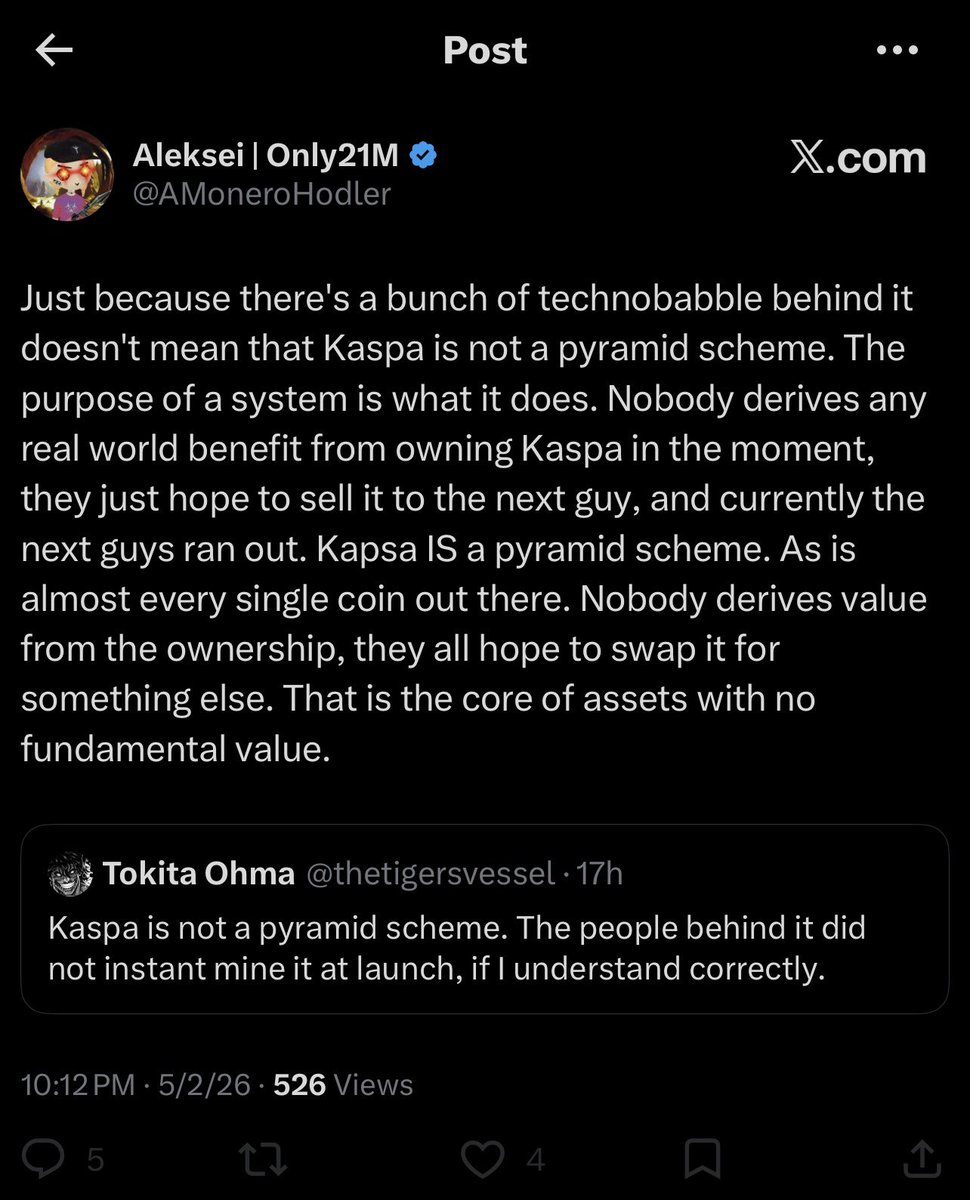
I use $KAS daily In fact, I believe Kaspians use $KAS more than most other crypto hodlers use their coins #Kaspa actually has utility We use it to message others We use it to upload videos We use it to post on social media We use it to pay for goods and service New use cases emerge nearly weekly $KAS adoption is accelerating.
Vijay 𐤊ailash, CFA, CFP® tweet media
₿ЯT 𐤊 🐈📈@brt2412

@AMoneroHodler I use Kaspa every single day of my life. You are wrong

English
8
36
189
5.1K
Juan First KPC retweetledi
Cade O'Neill
Cade O'Neill@CadeONeill·
$KAS Toccata Hard Fork is coming in June 2026 🔥 🟢 Mainnet activation window: June 5–20, 2026. What will this achieve? 👇 ‣ Native tokens & issuance ‣ Covenants & ZK infrastructure ‣ Full L1 smart contracts & programmability Why you should be bullish on $KAS? 👇 ‣ From ultra-fast payments to a complete decentralized programmable Layer-1. ‣ 95%+ supply already circulating. ‣ Emissions nearing zero. ‣ The tech upgrade the market has been waiting for is arriving no later than this summer. 👉 " $KAS is $BTC, but better", do you agree? 👀 #Kaspa #KAS #Toccata #Layer1 #SmartContracts
English
7
45
287
4.7K
Juan First KPC
Juan First KPC@FirstKPC·
@realvijayk Then you buy a few more things, it would be around 500 reais, but even so taxes are very high and inflation is high in Brazil. If you earn in dollars here you can live well. Unfortunately that’s not my standard of living yet, earning in dollars, I hope it will be someday.
English
0
0
0
9
Vijay 𐤊ailash, CFA, CFP®
This is what $100 gets you at Costco This would've costed <$50 10-15 years ago What happened?
Vijay 𐤊ailash, CFA, CFP® tweet media
English
21
0
47
5.1K
Juan First KPC retweetledi
BaN𐤊ℚuOτE
BaN𐤊ℚuOτE@BankQuote·
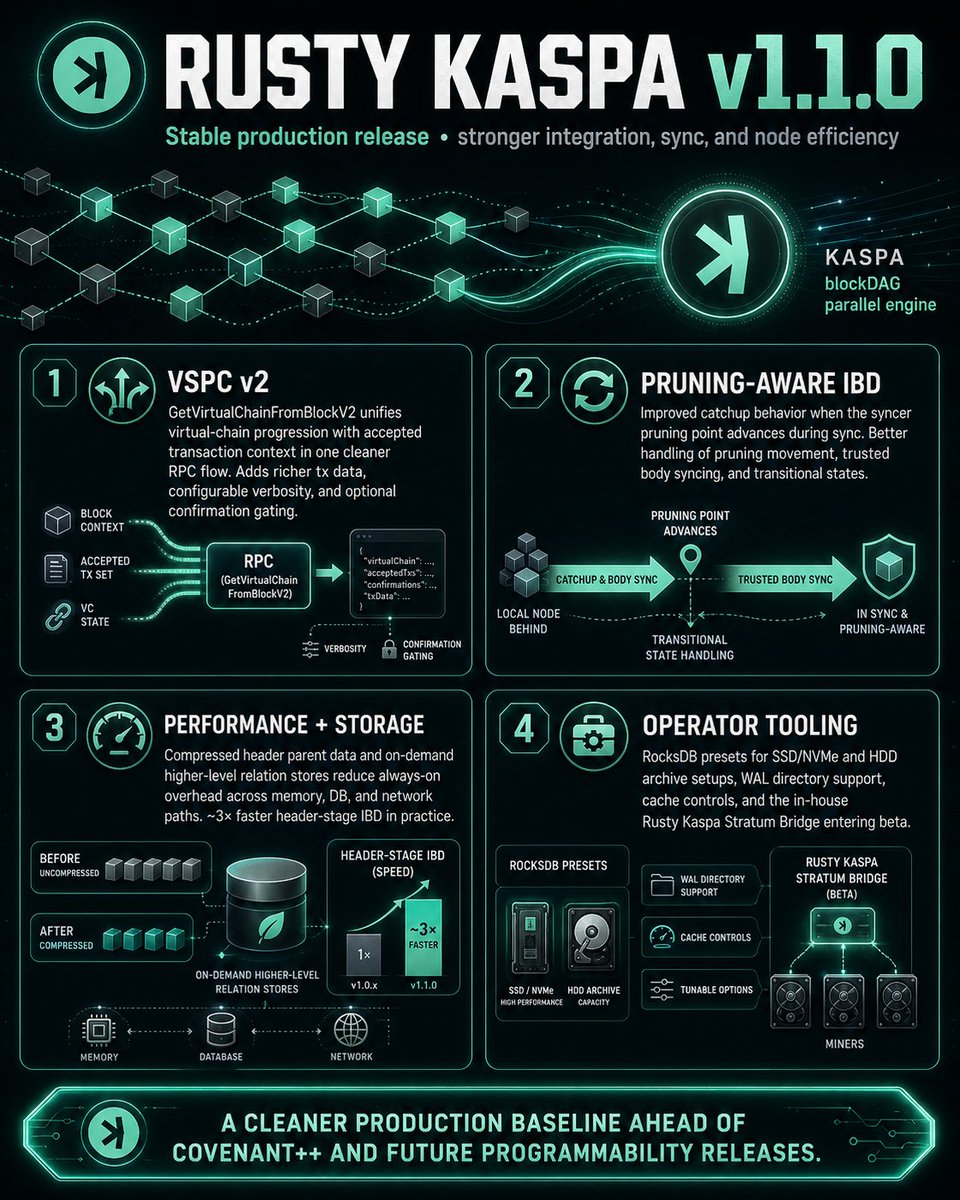
Rusty Kaspa v1.1.0 is not a cosmetic release. It is a structural hardening pass across the node’s integration surface, IBD behavior, pruning logic, header-processing pipeline, and storage profile. The headline is not one isolated feature, but the fact that Kaspa’s production implementation just became easier to integrate, faster to sync, lighter to operate, and more resilient under pruning-heavy conditions. The most important integrator-facing change is GetVirtualChainFromBlockV2, opcode 151, the new VSPC v2 flow. Instead of forcing wallets, explorers, exchanges, and indexers to stitch together virtual-chain progression, accepted transaction context, added-block listeners, sender recovery, and fee data from multiple async paths, VSPC v2 gives them a cleaner canonical ingestion surface. It returns removed chain blocks, added chain blocks, and per-added-chain-block accepted transaction data through one coherent RPC path, with configurable dataVerbosityLevel controls: None, Low, High, and Full. That matters because Kaspa is not internally shaped like a linear chain. It is a blockDAG, which means the consensus engine has to preserve parallel block production, mergeset acceptance, and DAG-native ordering internally, while external infrastructure still needs deterministic progression it can consume without rebuilding the node’s logic from the outside. VSPC v2 is abstraction engineering done correctly: the node keeps the complexity where it belongs, while integrators get a cleaner flow for accepted transaction context, sender data, fee-related use cases, and optional confirmation gating through minConfirmationCount. The second major upgrade is pruning-aware IBD catchup. This release covers the case where the syncer advances its pruning point while a fresh syncee is still catching up. That sounds obscure, but it is exactly the kind of edge case fast networks must solve. High-throughput systems do not just need fast blocks; they need recovery paths that remain coherent while the live network keeps moving. v1.1.0 introduces pruning catchup logic that detects pruning-point mismatch, validates header relationships before irreversible movement, handles UTXO-set download, and manages transitional states around pruning-point movement and body syncing. The performance work is just as important. Header parents_by_level data is now compressed instead of carrying redundant repeated parent vectors everywhere, and higher-level relation stores are no longer maintained continuously for all headers. They are built on demand when needed for pruning-proof paths. That cuts always-on overhead across memory, database, and network paths. In practice, the release reports roughly 3x faster header-stage IBD, which is not marketing throughput, but node-level entropy reduction: less redundant state, less write pressure, less storage drag, and less wasted computation. The RocksDB upgrades also matter. v1.1.0 adds storage presets for SSD/NVMe and HDD/archive nodes, WAL-directory support for hybrid NVMe+HDD setups, larger archive write buffers, stronger compression, BlobDB usage for large values, larger SST files, and better cache/rate-limit controls. In plain terms, archive operation becomes more realistic, cheaper storage becomes more usable, and node operators get sharper control over their performance envelope. The in-house Rusty Kaspa Stratum Bridge also enters beta, pushing more mining infrastructure into the native Rust stack. Overall, Rusty Kaspa v1.1.0 is a stronger production baseline. Not louder, not more bloated, and not a theatrical feature release, but cleaner, faster, and more durable. It gives Kaspa better integration ergonomics, better sync resilience, better storage behavior, and a more stable foundation before the next Covenant++ and programmability-related releases arrive.
BaN𐤊ℚuOτE tweet media
English
3
64
198
2.5K
Juan First KPC retweetledi
KasMap
KasMap@KasMaporg·
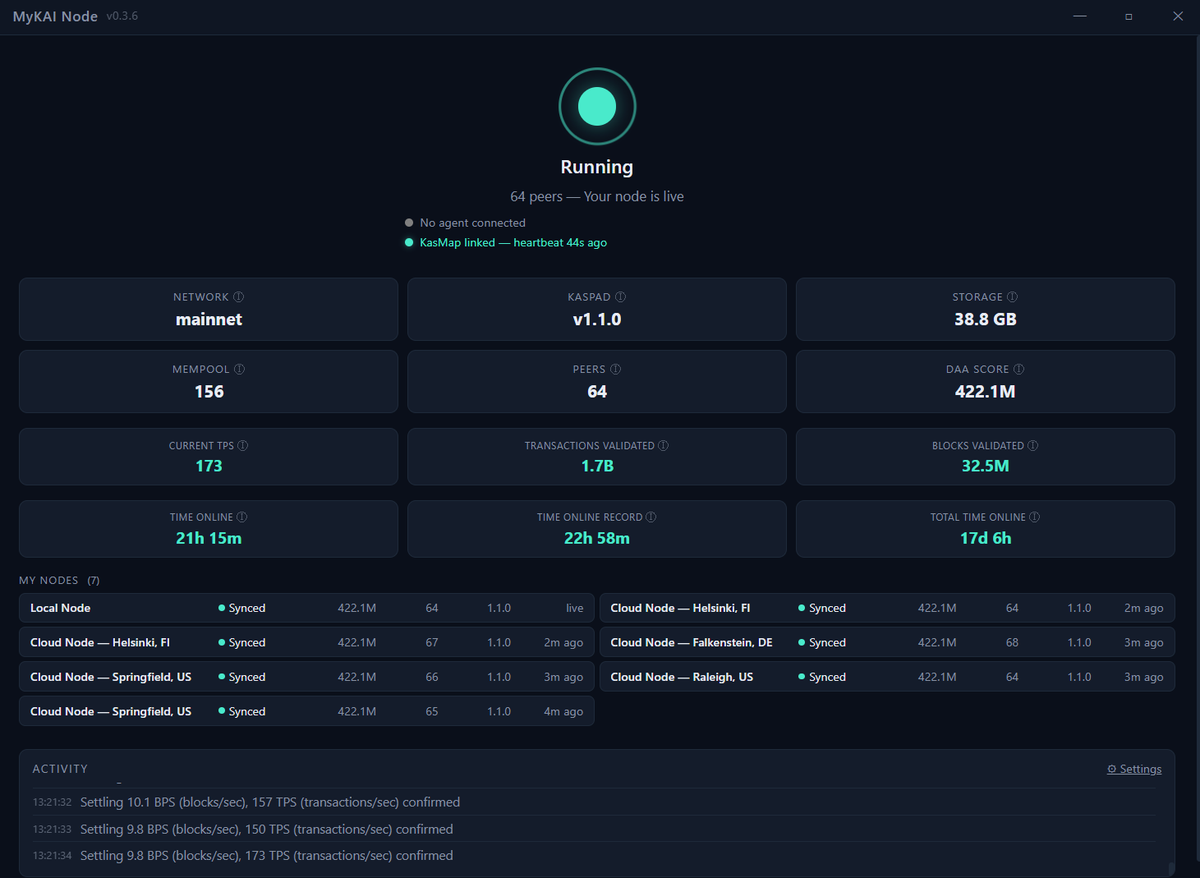
#KasMap & #MyKAI are making it simple to run a node. 1-click-download & 1-click-install. You can even run it on your PC or Laptop in the background. mykai.dev more info in the thread below.
KasMap tweet media
English
10
55
176
8.3K
KBeam.app
KBeam.app@KBeam_app·
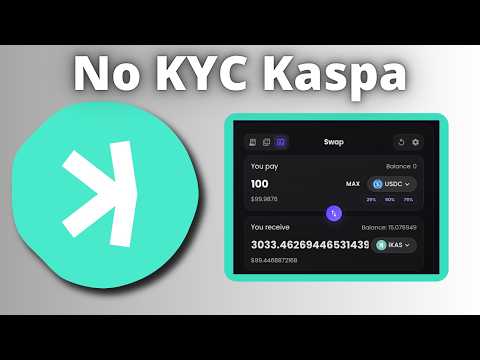
Everything related to NFC, POS, and payments will be public. But even if that weren’t the case, I wouldn’t see it as a problem, because the Kaspium Wallet is a completely separate piece of software. In KBeam itself, only data is transferred — no actual payment is processed unless you specifically choose to pay directly through the integrated wallet.
Juan First KPC@FirstKPC

@KBeam_app Will it all be open source? Trust is only possible if everyone can audit the project.

English
1
3
21
759
Juan First KPC
Juan First KPC@FirstKPC·
@KBeam_app Will it all be open source? Trust is only possible if everyone can audit the project.

English
0
0
2
1K
KBeam.app
KBeam.app@KBeam_app·
🚀 Just tried it myself — and I’m honestly speechless! I simply threw a normal PDF invoice into my test POS system… The AI pulled all the data, recognized everything perfectly, and turned it into a Kaspa payment via NFC in seconds! Contactless, straight on the phone — and it works with every invoice. No more filling out bank transfer forms. Never again. 🤯 With KBeam it’s even instant. With the normal Kaspium Wallet it’s a bit slower, but that will get better. This really feels like the future. Who else wants this? 🔥 #KBeam #Kaspa #CryptoPayments
English
13
69
184
15.3K