Paulibär

6K posts

Paulibär

Paulibär

@FlashBozZ

crypto class of '17

Hamburg, Deutschland Katılım Şubat 2015
196 Takip Edilen108 Takipçiler
Paulibär
Paulibär@FlashBozZ·
@fundmyfund This is the Most obvious buy ever imo. Slight chance that NGSRI info leaked but I thinks its more likely that I was put in the same basket as POET and just sold of for no reason. I bought shares and calls.
English
1
0
0
81
Fund.Drone.DefenseTech.Photonics $LPTH $UMAC 🐋
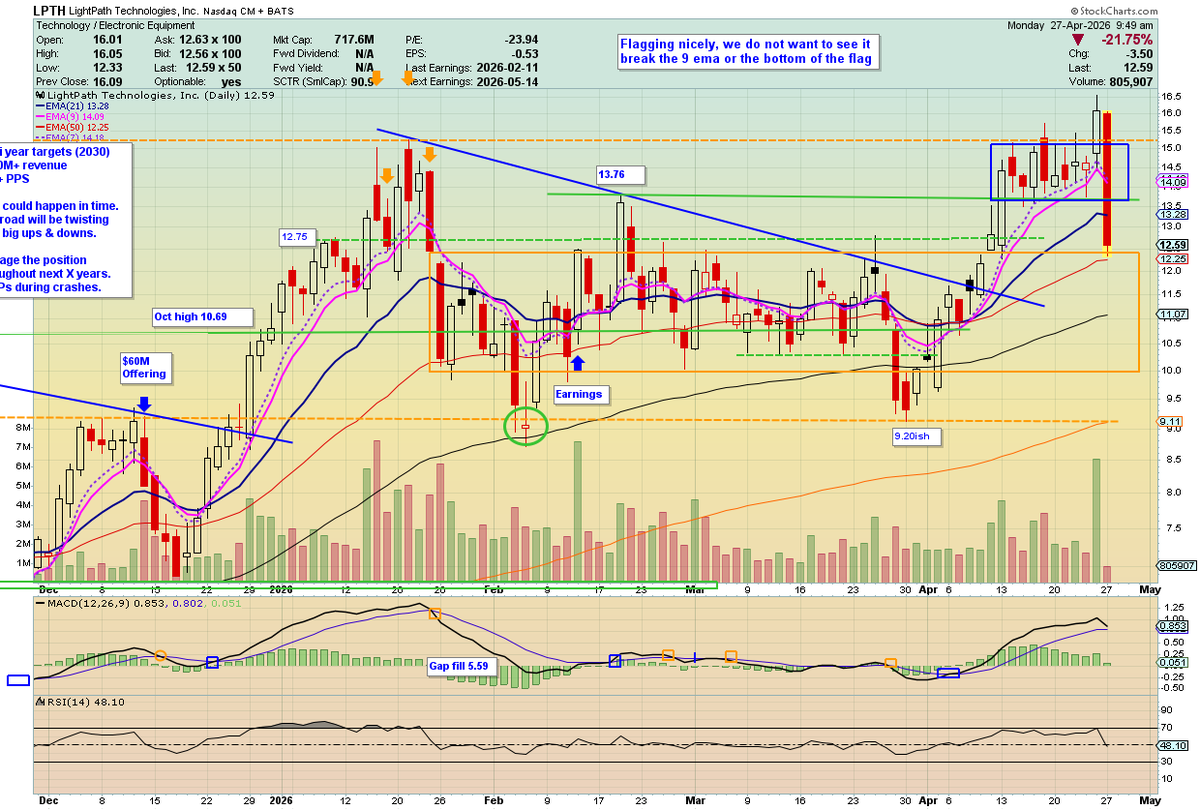
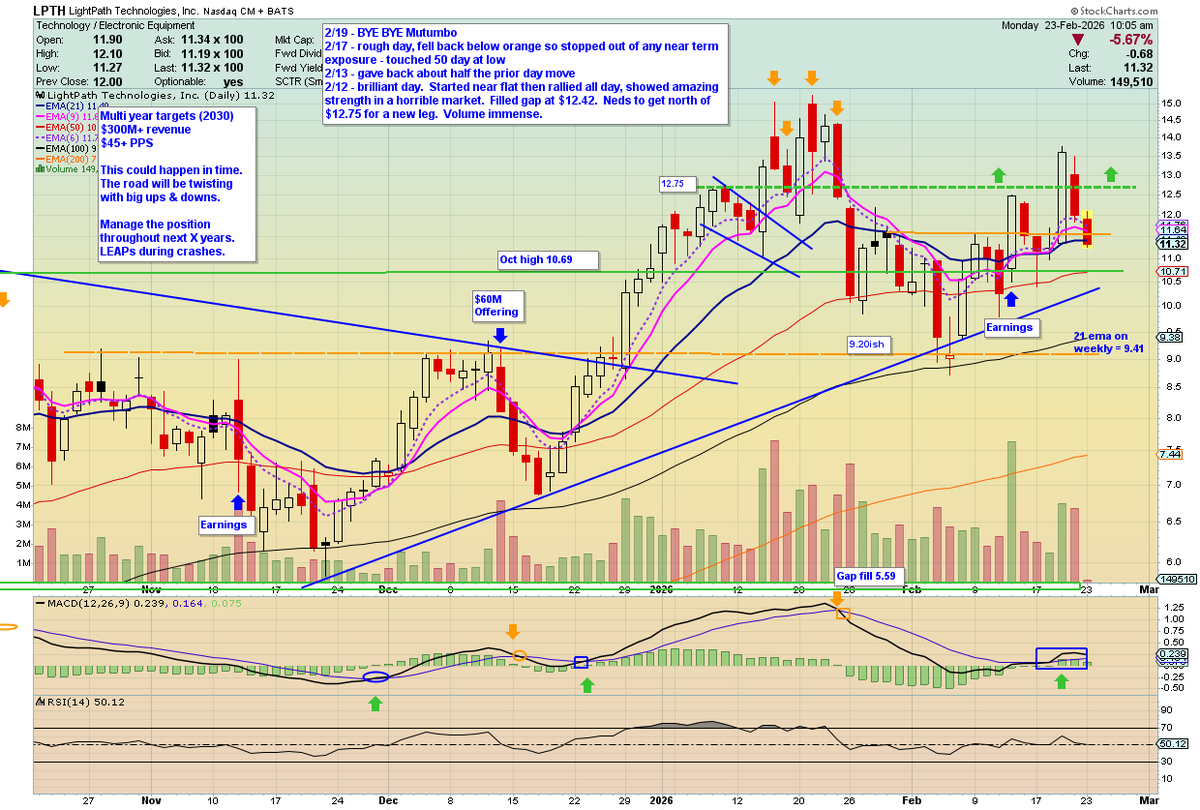
Pretty insane but as I said with $POET sh** happens Reality of being in the stock market. From breakout continuation near $17 in pre market to.... 50 day moving average. Whew. $LPTH I am "DCAing" off my fundamental conviction into Jan 27 and Jan 28s. Didn't expect to see these prices again but here we are so I have more cash than I did 2 weeks ago to build up the long term garden My trading position of common and Sep 26s will be another issue and treated different. I am watching to see if it breaks the 50 day. If so I will reduce risk. (reduce or punt entirely) Wild action. Lightpath has zero to do with the 'photonics' trade as most people on here have thrown them into. Nothing to do with a data center etc - but we cannot argue with algos. Will leave a mark.
Fund.Drone.DefenseTech.Photonics $LPTH $UMAC 🐋 tweet media
Fund.Drone.DefenseTech.Photonics $LPTH $UMAC 🐋@fundmyfund

$LPTH nearing $17 in pre - my first target of $16.88 might be hit in pre. I will have some out for sale there. I "loaded the boat" in this 8 day flag, buying at or below $14s and selling tranches near $15s. But each cycle of that revolving door, I built the position larger on the dips in the flag due to conviction into the name fundamentally. If it broke the flag I would have been disciplined and followed my rules, and sized down. But it didn't. So not only do I have my own loaded boat, I have a few other boats I brought along. Dot... dot... dot Normally I have 3-5 'tranches' in a position to sell off in pieces (and buy back on dips); $LPTH size is more like 12 so I'll be very actively trading it but still have a lot of things in the background - the Sep 26 calls are my 'trading vehicle' along with common - have had 28 LEAPs for a good while now in $9-$10 range and added 27 LEAPs in that range last week when it dipped into upper $13s to $14. The latter 2 won't be sold anytime soon. Maybe if NGSRI hits next 60 days we can get a move like $ATOM - wouldn't that be nice. $UMAC will eventually do the same thing 'in time'. Not remotely close to doing that now based on chart.

English
6
0
12
5K
Crazy Investing
Crazy Investing@Craaazy1231·
$POET just confirmed an order from $MRVL and has 30,000 optical engines lined up to ship in 2026 for AI data centers. $430M cash. Manufacturing ramp underway. Q1 earnings May 13. The commercialization has started 🚀
English
11
23
282
64.5K
Paulibär
Paulibär@FlashBozZ·
@BULLOFBRITAIN It’s just that IV is so high that it’s foolish to play the short side via options and im not a fan of outright shorting.
English
0
0
0
266
BULL OF BRITAIN
BULL OF BRITAIN@BULLOFBRITAIN·
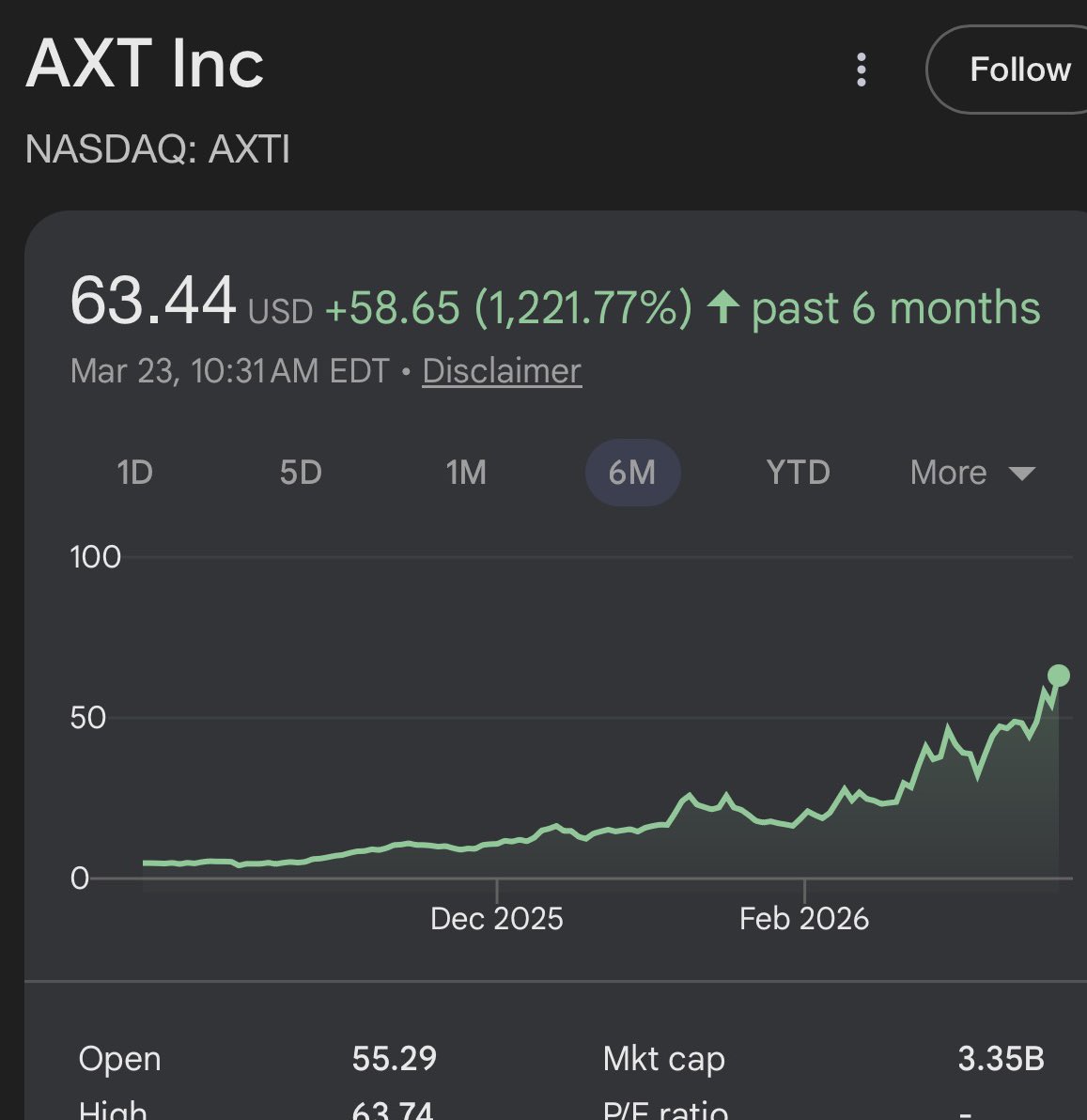
$AXTI - Is no one else scared shitless of the ER call soon? The two-tier pricing system of Gallium and Geranium means that Chinese buyers are paying $245/kg for the exact same gallium that Western buyers are paying $2,269/kg. That's an 824% spread on the same molecule. Every single trend of news I've read coming out of China recently has gone one direction. Hoarding domestic supply due to demand issues. Without the Western premium buyers (permit denial). The company is being priced on almost 10x multiples via a narrative that is most definetly real. But with massive fucking downsides. Downsides that could be absolutely insane based on the next ER call. If permits are flowing through and dilution is used properly. $AXTI 100% deserves its price. But until the fantasy is reality. I will not believe any different.
BULL OF BRITAIN@BULLOFBRITAIN

$AXTI Short report: Permits denied. Bottleneck debunked. Insiders gone. Shareholders next. LESSON: JUST BECAUSE SOMETHING GOES UP. DOES NOT MAKE YOU RIGHT On the 24th of March $AXTI reached ATH and I predicted on that same day that it would eventually crash 50% at some point. It's now 7th of April and its down 42% since then. 1. LAST QUARTERLY REPORT I felt like I was in a fever dream. On the Q4 2025 earnings call, VP Timothy Bettles confirmed that export permits are being DENIED for the first time in the company's history. I felt like I was in a fever dream watching the stock continue to go up after this. "This is the first time we've actually received denials on permits and we're not utterly sure why. No transparency to this. We don't see any particular reason why any of these permits should not be approved." Management tried to spin it "they come with instructions to resubmit." But if resubmission was a formality, why did Q4 revenue miss consensus by 10.14%? Why did revenue DECLINE 8.2% YoY to $23.04M? Why did FY2025 revenue drop 11.1% to $88.3M with losses widening 81.7% to -$21.4M? If you follow critical metals, you know exactly where this is heading. Chinese tungsten exports are down 34% YoY with APT exports at literally ZERO in Jan-Feb 2026. Gallium restricted. Germanium restricted. Antimony restricted. Indium phosphide is on the same dual-use export control list. China is hoarding domestic supply of every strategic material. Why would anyone think InP permits are going to get BETTER when every other critical material is getting MORE restricted? The permits aren't coming back. The CEO knows it. 2. ANALYST B.RILEY AT THE OFC CONFERENCE Riley, March 18, after the Optical Fiber Communication Conference: "One major company denied the existence of an InP bottleneck. Another secured a 7-year supply agreement with Sumitomo, which is expected to scale capacity. These findings directly contradict AXTI's management narrative that Sumitomo would be unwilling to expand capacity to avoid aiding laser competitors like LITE." AXTI management told investors Sumitomo wouldn't expand. A hyperscaler just signed a 7-YEAR deal proving that was false. The entire $3B valuation was built on a scarcity story. The industry itself says it doesn't exist. 3. THE DILUTION — 50 MILLION NEW SHARES December 2025: AXTI raised $87M by issuing 7.1M shares at $12.25. April 2026: Board proposes increasing authorised shares from 70M to 120M. That's 50M additional shares up to $2B worth of potential dilution at recent prices. The proposal triggered a -14% selloff on the day it was announced. Shareholder vote is May 14. -> Dilute at $12.25 in December -> Stock runs to $70.88 -> Insiders dump $26M+ in March -> Request permission for 50M MORE shares This isn't a growth story. This is management extracting maximum value before the export permits dry up completely. If the vote passes May 14, that's confirmation the dilution machine is running and shareholders are funding management's exit. 4. THE INSIDER SELLING CEO Morris Young: - 125,893 shares sold March 9 ($4.6M) - 37,905 shares sold March 13 ($1.9M) - 30,832 shares sold March 10 ($1.4M) - Total: 159,536 shares, $6.9M dumped - 5-year track record: 11 transactions. 1 buy. 10 sells. CFO Gary Fischer: - 405,233 shares sold across March - Including 80,776 shares in a SINGLE DAY on March 13 - Total: $16.8M dumped Director Jesse Chen: Cut his direct stake sharply. $700K. Director David Chang: 40,000 shares, ~$1.5M. Total insider selling in March: over $26 MILLION. Total insider buying in March: ZERO. Total insider buying in 12 months: ZERO. These are the people who see the permit data before you do. They see the customer pipeline before you do. They know whether the bottleneck is real before you do. EVERY SINGLE ONE OF THEM IS SELLING into their companies version of the World Cup (a bottleneck in the entire AI buildout). This is the reason I told people close to me to sell after the QR. Despite its price going up. Despite what Twitter thought. Despite what algos were doing. This is why you don't mindlessly follow the rules of the game. DYOR is here for a reason. The companies entire being is held by geo-politics.

English
8
1
33
14.1K
Paulibär
Paulibär@FlashBozZ·
@aleabitoreddit I saw that number in the filings and was confused as to why the markets didnt really react initially. Seems like drastic inefficiancies still exist.
English
11
0
0
1.4K
Serenity
Serenity@aleabitoreddit·
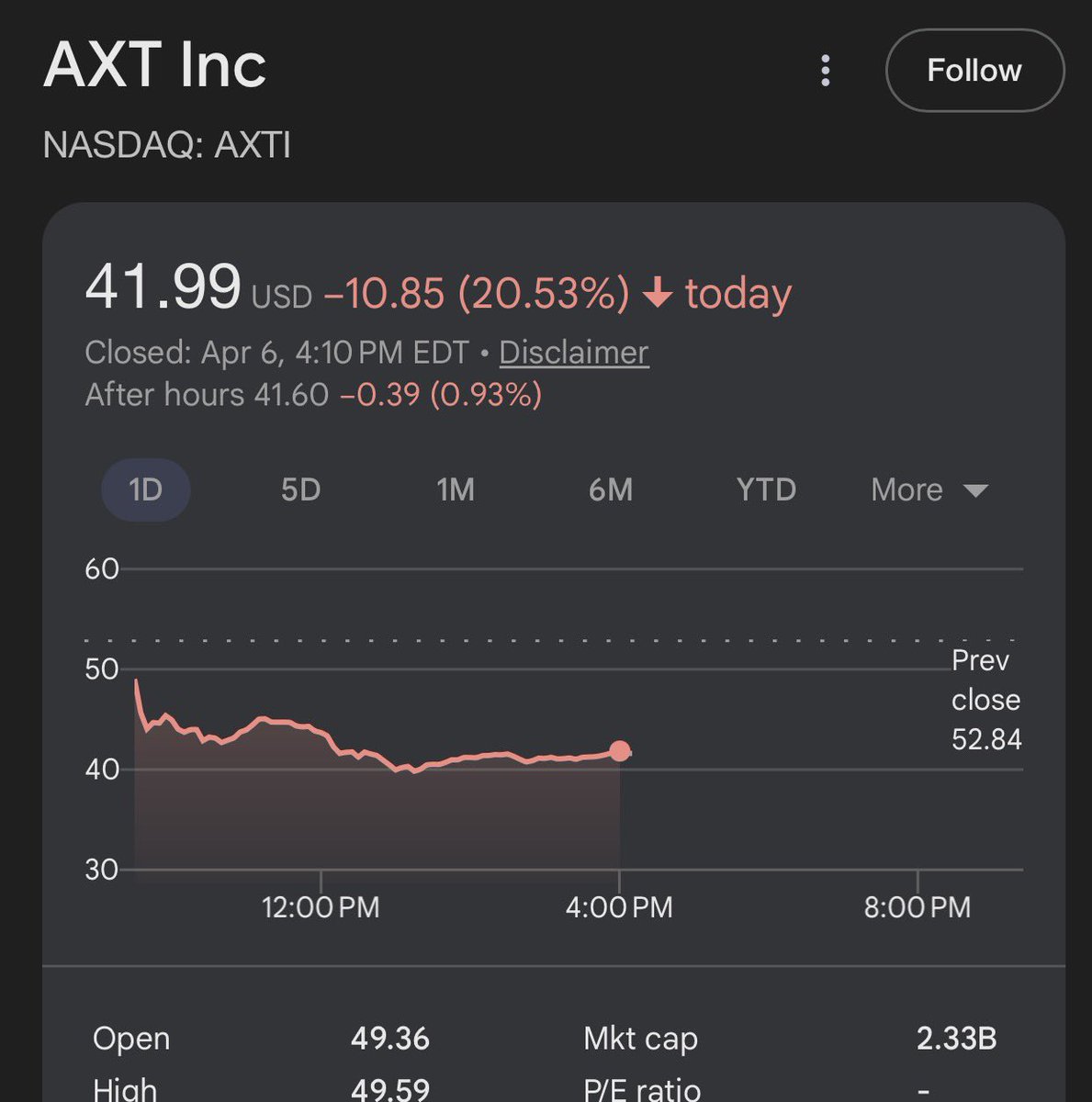
If you’re curious about $AXTI: It’s down 21% on the new potential dilution news. Board wanted to add 50M more shares (up to $2B worth to dilute) for shareholders vote in the 14th. 70m -> 120m shares. I say this about $IREN excessive $6B dilution and it’s the same with AXT price proposal that I hold. I would not “trust in management” to use it wisely and the fact it’s filed is a red flag. That being said: we’ll see what happens on the 14th. If it passes for 50m more share authorized dilution, I personally would not hold. But it fails, I expect a recovery.
Serenity tweet media
English
107
67
978
241.1K
Paulibär
Paulibär@FlashBozZ·
@crux_capital_ It still says following product qualification. Do you think thats still an issue? I thought it’s solved by now.
English
1
0
0
274
Gaetano
Gaetano@crux_capital_·
$AAOI With another 800G order! $71m! I guess any concerns from Lightcounting about 800G becoming generally oversupplied in 2026 isn't impacting AOI at this time And in this update they also said they shipped 10,000 units of 800G to another hyperscaler Execution.
Gaetano@crux_capital_

$AAOI just officially announced (03/23) a new initial volume order totaling more than $53 million for its 800G single-mode data center transceivers. This $53 million order comes from the exact same major hyperscale customer that recently placed a massive $200 million volume order for AOI’s next-generation 1.6T transceivers. This dynamic perfectly validates AOI’s technological roadmap, proving that the transition to 1.6T does not kill 800G demand. Instead, hyperscalers are actively buying both generations concurrently to support massive GPU cluster buildups and manage their long-term operating costs, power efficiency, and cost per bit. Also, the delivery timeline for this $53 million order is extremely compressed. Shipments are expected to begin in the second quarter of 2026 and be entirely completed by the middle of the third quarter of 2026. CFO Stefan Murry explicitly categorized this as an “initial” order and the “first of more to come” as the customer scales its AI infrastructure across multiple regions. Considering AOI’s 800G revenue was under $4 million in Q4 2025, fulfilling a $53 million order in roughly a one-and-a-half-quarter window represents an explosive step-function increase in their near-term run rate. We like to see this! The more orders, the better. And the tight time frame really shows the belief in management that they can execute.

English
15
7
194
43.8K
Hardik Shah
Hardik Shah@AIStockSavvy·
📢 𝐉𝐔𝐒𝐓 𝐈𝐍: $LITE Lumentum to Build U.S. Laser Fab for AI Data Centers 👉 𝐊𝐞𝐲 𝐇𝐢𝐠𝐡𝐥𝐢𝐠𝐡𝐭𝐬: ➤ Lumentum to open 𝟐𝟒𝟎,𝟎𝟎𝟎 sq. ft. 𝐔.𝐒. manufacturing facility in North Carolina. ➤ Facility will produce 𝐈𝐧𝐏-𝐛𝐚𝐬𝐞𝐝 optical devices for AI data centers. ➤ 𝐍𝐕𝐈𝐃𝐈𝐀 named as a key customer for advanced laser components. ➤ Site acquisition from 𝐐𝐨𝐫𝐯𝐨 includes skilled workforce transfer. ➤ Company to invest 𝐡𝐮𝐧𝐝𝐫𝐞𝐝𝐬 𝐨𝐟 𝐦𝐢𝐥𝐥𝐢𝐨𝐧𝐬 in expansion. ➤ Production ramp expected by 𝐦𝐢𝐝-𝟐𝟎𝟐𝟖. ➤ Project to create 𝟒𝟎𝟎+ U.S. jobs and boost 𝐀𝐈 𝐢𝐧𝐟𝐫𝐚𝐬𝐭𝐫𝐮𝐜𝐭𝐮𝐫𝐞 supply chain.
Hardik Shah tweet media
English
3
5
56
7.4K
Paulibär
Paulibär@FlashBozZ·
@aleabitoreddit Any concern about the customs statistics showing flat levels of indium product exports over Jan/Feb 2026 with respect to Dec25 which was dissapointing from AXTI pov? I know InP wafer exports are not recorded in this statistic but could it be a proxy?
English
9
0
1
849
Serenity
Serenity@aleabitoreddit·
Everyone thought I was crazy when I gave $AXTI a $150 PT from $12-15. All the doubters suddenly disappeared? Reason my YTD is over 600%+ is because I identify the biggest chokepoints in hyperscaler supply chains before anyone else. Then go long.
Serenity tweet mediaSerenity tweet media
Serenity@aleabitoreddit

Warning: The entire AI industry will likely be bottlenecked by two companies: 1. $AXTI ($700M) 2. $SMTOY ($31.7B) Which both control 60–70%+ of the world's InP substrates. Future $NVDA, $GOOGL TPU v7 pods, $META, $MSFT, $AMZN hyperscaler clusters require InP-based lasers and receivers. $AVGO, $LITE, $COHR use for EMLs for 800G/1.6T transceivers, DFB lasers, and other optical infra. Without InP substrates, the supply chain falters. After looking at TPU BOM to Maia BOM, it looks like future ASICs + GPUs + hyperscaler deployments are heavily reliant on photonics. And two vendors could freeze the global InP substrate market covering nearly all of: - Hyperscaler optics (TPU pods, etc) - Optical transceivers (5g, data) - LiDAR (robotaxis, drones, military) -Optical Modules (interconnect clusters) - Silicon photonics laser dies (Nvidia’s future co-packaged optics and Intel/Broadcom SiPh engines use InP CW laser arrays.) Since these companies make up majority of the market supply: -AXTI (est. ~30–35%) -Sumitomo (est.~30%) - JX Nippon (est. 10-15%) That’s it. (eg. 2021 industry note from Yole states that "Sumitomo Electric + AXT together had “more than 75%” of the InP substrate market") Hyperscalers/AI are moving toward photonics but the entire AI industry is fragile. If either $AXTI or $SMTOY stop supplying materials, the entire future AI buidlout gets crippled. It's even crazier that a $700m company could become the the center of it all. InP substrate will likely one of the biggest bottlenecks alongside HMB as the AI industry shifts to photonics.

English
64
55
1.1K
187.1K
Serenity
Serenity@aleabitoreddit·
I feel like markets should value: $AAOI $93 -> $162 (~$13B MC) after their new capacity projections today. and $SIVE should be valued at 7.7 -> 38.5 ($1.1B MC) at least? If one is ramping to ~$1.97B capacity EOY 2027 (which is basically revenue, since hyperscalers are buying anything they can make) Then the other is the likely laser supplier to hyperscaler supply chains from $AMZN Trainium to $MSFT Maia Clusters? At the very least, should price in forward revenue growth. This is including execution uncertainty, and without premiums assigned to others like $LWLG at $1.1b+. If Win semi qualifies $SIVE and $POET/Ayar/and others scale up. I feel like $SIVE valuation could easily 20x-30x from here? If $AAOI hits $378M/month projections, could easily 5x from here to a ~$30B MC. These possible price targets is how insane the optical supercycle is (like memory), but largely depends on how each company can execute.
Serenity tweet mediaSerenity tweet media
English
45
56
679
120.4K
Paulibär
Paulibär@FlashBozZ·
@crux_capital_ Based on these projections the stock should just straight up double in the coming weeks
English
1
0
0
36
Gaetano
Gaetano@crux_capital_·
@FlashBozZ Yeah man. If they even get anywhere close to these projections…
English
1
0
1
51
Paulibär
Paulibär@FlashBozZ·
@crux_capital_ bruh they guided 4.5billion rev in 2027 on datacenters alone wtff
English
2
0
0
760
Paulibär
Paulibär@FlashBozZ·
Monster earnings by $AAOI. Today was the dip to buy.
English
0
0
1
252
Paulibär
Paulibär@FlashBozZ·
@fundmyfund Don’t focus so much on intraday stuff. Volatile stocks like that cant be charted. Just hold on to shares or leaps and don’t overthink it. The Company is on a great path and has lots of upside surprise potential.
English
0
0
0
25
Paulibär
Paulibär@FlashBozZ·
@TheValueist Regarding share count. As i understood it, the 53.2 Million Shares at the end of Q1 include the raise from Q4, so no new dilution planned
English
0
0
0
59
TheValueist
TheValueist@TheValueist·
$AXTI EXECUTIVE CALL SUMMARY: (AXT Inc 02/19/26) AXT reported Q4 2025 revenue of $23.0 million, down 17.9% sequentially versus $28.0 million in Q3 2025 and down 8.4% year-over-year versus $25.1 million in Q4 2024. Non-GAAP gross margin was 21.5% (GAAP 20.9%), down 0.9 pp sequentially but up 3.6 pp year-over-year, indicating continued recovery from prior-period under-absorption but still well below historical peak profitability. Non-GAAP net loss was $2.3 million (non-GAAP EPS of $0.05), versus a non-GAAP net loss of $1.2 million ($0.03) in Q3 2025 and a non-GAAP net loss of $4.3 million ($0.10) in Q4 2024; GAAP net loss attributable to AXT was $3.5 million ($0.08). The quarter’s primary narrative was the divergence between demand and reported revenue driven by export-permit timing, with management explicitly characterizing Q4 as permit-constrained rather than demand-constrained (“We were disappointed that we didn’t receive as many export permits in Q4 as we had hoped”).  The call’s incremental content versus prior quarters was the sharpening of 2 opposing vectors: (1) accelerating indium phosphide (InP) demand signals, including record backlog (“over $60 million”) and qualitative evidence of tighter supply and longer-dated customer commitments, and (2) deteriorating visibility on export-permit cadence, including variability and the first explicit acknowledgement of permit denials with opaque rationale. Management’s near-term guidance framework shifted to an explicit “floor plus upside” construct rather than a traditional range, anchored by approximately $26 million of Q1 revenue that can be recognized with permits already received or where permits are not required, plus unquantified upside contingent on incremental permits. This framing implicitly increases quarter-to-quarter earnings volatility and reduces the usefulness of point estimates in near-term modeling; valuation sensitivity becomes more dependent on assumptions around permit throughput and conversion of backlog into shipments than on demand end-markets. FINANCIAL PERFORMANCE AND MIX Reported revenue contraction in Q4 was driven by substrate shipment timing, especially InP, rather than a broad-based end-demand slowdown. Management’s product-category disclosure indicated Q4 revenue composition of approximately $8.0 million InP (primarily data center applications), $7.0 million gallium arsenide (GaAs), $0.231 million germanium (Ge), and $7.6 million from consolidated raw-material joint ventures. Sequentially, this mix implies that the revenue decline was disproportionately borne by InP, consistent with the narrative that export permits constrained the company’s ability to ship into the highest-growth, AI-optical related demand pocket. Regional mix was highly Asia-Pacific weighted at 81.5% of revenue (Europe 17.5%, North America 1%), and customer concentration was low in the quarter (top 5 customers at 22.6% of revenue, no customer above 10%), which can be read in 2 ways: a genuine broadening of the customer base, and/or an artifact of permit timing that prevented outsized shipments to any single large customer. Gross margin performance showed modest sequential degradation and meaningful year-over-year improvement. The sequential decline is directionally consistent with fixed-cost under-absorption from lower revenue and potential adverse mix, particularly if higher-margin InP shipments were disproportionately delayed. The year-over-year margin improvement is consistent with cost actions, better factory utilization versus prior-year lows, and improved product mix relative to weak 2024 conditions. At the operating line, non-GAAP operating expenses were $7.5 million (GAAP $8.7 million), down materially year-over-year but insufficient to offset the gross profit decline from lower shipments, resulting in a non-GAAP operating loss of $2.6 million.  Balance sheet strength was materially improved by the late-December equity raise. Cash and cash equivalents were $120.3 million at year-end, with an additional $8.1 million of restricted cash, consistent with management’s call commentary that “cash, cash equivalents, and investments” were $128.4 million. Inventories were $81.7 million at December 31, 2025, which remains elevated relative to quarterly revenue and indicates ongoing working-capital intensity, particularly in a model where production continues ahead of permits (“semi-finished goods or finished goods staging in our cleanroom ready to be shipped”). Short-term loans were $62.8 million, implying that gross liquidity is high but working-capital financing remains meaningful.  PERMIT-CONSTRAINED REVENUE RECOGNITION AND THE “DEMAND-VS-SHIPMENTS” GAP The call reinforced that export permits remain the dominant driver of near-term reported financials and a structural source of volatility. Management explicitly stated that guidance is “somewhat tricky” because permit issuance timing is “not predictable nor in our control,” and further characterized the permitting process as “not transparent at all” with “quite a lot of variability.” The explicit disclosure of permit denials is a material incremental negative: “We have actually received a couple of denials,” with resubmission required but without clarity on the underlying reasons. This introduces 3 investment-relevant implications: 1.QUARTERLY TIMING RISK INCREASES, NOT JUST LEVEL RISK Permits appear to shift from a relatively consistent processing-time model (previously described as approximately 60 business days) to a variable and episodically adverse model. That increases the probability that quarterly outcomes deviate significantly from internal demand indicators (backlog, customer forecasts) without those indicators being invalidated. 2.WORKING CAPITAL AND INVENTORY MANAGEMENT BECOME CORE UNDERWRITING VARIABLES Management’s operating posture is to “build to forecast and to the backlog” rather than “build to permits,” which supports fast shipment upon permit receipt but also increases exposure to inventory build if permits stall. With inventories already at $81.7 million, the risk is less solvency and more margin dilution via storage time, potential yield drift, and the possibility of customer reprioritization if the permitting regime structurally changes. 3.CUSTOMER RELATIONSHIP AND QUALIFICATION RISK IS BINARY In markets such as Tier-1 optical components, qualification cycles and supply assurance matter. Prolonged export friction increases the incentive for customers to dual-source or redesign, even if near-term supply is tight. Management attempted to offset this by highlighting active collaboration, long-term agreements, and ecosystem interdependence, but the structural risk remains tied to policy rather than execution. DEMAND SIGNALS: INP BACKLOG, CUSTOMER BROADENING, AND AI OPTICAL CYCLE LEVERAGE The call’s most constructive content was the strength and breadth of InP demand signals. Management stated that “backlog for Indium Phosphide wafers” reached “over $60 million,” described as a new high, and emphasized that customers are placing longer-term orders and providing “more visibility.” The Q&A expanded this into unusually long planning horizons: forecasts “out beyond 2030” and discussions involving “minimum demand requirements” over the next “2-3 years.” The intensity of customer engagement was underscored by management’s comment that meetings are occurring with “CEOs and General Managers” rather than procurement, with demand forecasts “increasing every week.” While these statements are qualitative and inherently promotional, they matter because they reflect the supply-constrained nature of the market and the strategic role of InP in AI-related optical connectivity (EML and silicon photonics). A key call detail was the geographic bifurcation of demand growth. Management stated that China’s data center build-out is “early in its ramp” but accelerating, with revenue related to the China data center market expected to grow by “more than 60% in Q1 over Q4.” This matters because China-domestic demand could partially decouple growth from export-permit constraints if shipments remain in-country; however, the call also emphasized that globalized supply chains and non-China demand remain highly relevant, and export permits are still described as the “single most significant gating factor.” In effect, the incremental underwriting question becomes: what share of incremental capacity can be monetized domestically versus requiring export approvals? GUIDANCE AND COMPARISON TO PRIOR GUIDANCE Q1 2026 GUIDANCE APPROACH (FLOOR + OPTIONALITY) Management provided Q1 guidance anchored by approximately $26 million of revenue that “can be realized in Q1” for which export permits are already secured or not required, with a “high degree of confidence” in recognition. OpEx is expected to be approximately $9.0 million. Non-GAAP net loss is guided to $0.02-$0.04 per share, and GAAP net loss to $0.04-$0.06 per share, with estimated share count of approximately 53.2 million shares. The guidance embeds an explicit upside call option if additional permits arrive intra-quarter, but without a quantified range. This structure is consistent with management’s acknowledgment that quarterly reported numbers may not “align with our quarterly reporting” given permit timing. The implied message is that Q1 guidance should be treated as a minimum shipment base rather than a central estimate.  Q4 2025 OUTCOME VERSUS ORIGINAL Q3 2025 GUIDANCE In the prior quarter (Q3 2025 call), management guided Q4 revenue to $27-$30 million, explicitly decomposed into approximately $20 million of highly confident revenue plus an incremental $7-$10 million contingent on permits: “we have approximately $20 million in revenue that can be realized in Q4,” plus “an incremental $7 to $10 million… if we are awarded permits,” leading to “revenue in the range of $27 to $30 million.” They also guided Q4 OpEx to approximately $9 million and non-GAAP net loss to $0.01-$0.03 per share, with GAAP net loss $0.03-$0.05 and share count approximately 43.8 million shares. Actual Q4 revenue of $23.0 million fell 14.8%-23.3% below the original $27-$30 million range, and non-GAAP EPS of $0.05 was worse than the original $0.01-$0.03 guidance, consistent with under-absorption and shipment deferral. The miss appears explainable by permits but still represents a meaningful reliability issue for near-term guidance, increasing the discount rate investors typically apply to management-provided ranges under policy-constrained regimes.  Q4 2025 OUTCOME VERSUS THE JANUARY 8, 2026 GUIDANCE RESET On 01/08/26, AXT updated Q4 revenue expectations to $22.5-$23.5 million, “primarily due to fewer export control permits for indium phosphide being issued… than previously expected,” and expressed hope for additional permits in Q1 2026. Q4 reported revenue of $23.0 million landed within this revised range, suggesting that once the company reset expectations closer to realized permit cadence, it executed in-line. The key inference is that near-term forecasting error is dominated by permit timing rather than operational mis-execution, but that does not reduce investor uncertainty because the permit process itself remains opaque.  CAPACITY EXPANSION, CAPEX REQUIREMENTS, AND EXECUTION RISK Management outlined an aggressive capacity roadmap intended to match perceived multi-year demand. Key elements were: approximately 25% capacity added since October, a plan to double capacity from Q4 2025 levels by year-end 2026, and an implied quarterly revenue capacity run-rate of approximately $35 million by the end of 2026. Capex for the 2026 doubling was indicated at approximately $30 million, characterized as “on the low end” due to brownfield expansion (existing cleanroom and infrastructure at Tongmei). Beyond 2026, management suggested the possibility of doubling again in 2027, with capex of $100-$150 million due to greenfield requirements (building, clean power, utilities). This roadmap has 2 principal investment implications: 1.CAPACITY IS BEING BUILT AHEAD OF REPORTED REVENUE, NOT AHEAD OF DEMAND Management explicitly described demand as the non-issue and manufacturing capacity plus permits as the constraint set. If permits normalize, capacity becomes a material earnings lever and supports rapid revenue scaling. If permits remain constrained, the company risks suboptimal utilization and margin pressure from fixed-cost absorption, albeit partially mitigated by China-domestic demand growth. 2.6-INCH INP IS A STRATEGIC PIVOT WITH NEAR-TERM MARGIN RISK Management emphasized increased investment in 6-inch InP as the market evolves toward higher-speed optical devices and next-gen EML/silicon photonics. Larger diameters were described as structurally margin-accretive over time (“the larger the size we go, the better the margin we will get”), but 6-inch was also described as still “in development stage,” implying initial yield and cost headwinds. A near-term mix shift toward 6-inch could therefore depress gross margin before scale benefits materialize, creating a transition-period margin trough even under rising revenue. PROFITABILITY PATH AND HISTORICAL COMPARISONS Management provided a quantitative profitability aspiration: at approximately $40 million of quarterly revenue “in aggregate,” gross margin could be “somewhere close to 35%.” This is directionally consistent with the company’s historical ability to generate mid-30% to low-40% gross margins during stronger utilization regimes. For context, in Q3 2022 AXT delivered revenue of $35.2 million with non-GAAP gross margin of 42.2% (GAAP 42.0%), and fiscal 2022 GAAP gross margin was 36.9%. Relative to that benchmark, current Q4 2025 non-GAAP gross margin of 21.5% indicates that the company is still far from peak profitability, and that management’s margin outlook relies on a combination of (a) significant revenue scale, (b) improved absorption, (c) yield/efficiency improvements, and (d) potential incremental contribution from integrated supply chain businesses (“locomotive engine” pulling “cars in the back”).  A simple arithmetic translation of management’s framework illustrates the operating leverage and the sensitivity to permits. At $40 million quarterly revenue and 35% gross margin, gross profit would be $14 million; if quarterly OpEx is approximately $9 million, operating income would be approximately $5 million before other items. Conversely, at the guided Q1 floor of $26 million and a gross margin in the low-20%s, gross profit is in the mid-$5 million range, implying an operating loss of roughly $3-$4 million before non-operating items, consistent with the guided net loss per share. The investment relevance is that incremental shipments enabled by permits have an outsized effect on profitability because fixed costs are relatively stable and margin expands with absorption. STRATEGIC AND CORPORATE STRUCTURE ITEMS: TONGMEI IPO The Tongmei STAR Market IPO remains positioned as an optional catalyst but with low visibility. Management reiterated interest and described Tongmei as “in process” within a “more selective and smaller group of prospective listings,” and the earnings release documents that the Shanghai Stock Exchange approved the listing in 07/2022 and that the CSRC accepted the application in 08/2022, with the IPO still subject to review and approval by the CSRC and other authorities. The strategic rationale emphasized on the call is that China’s AI infrastructure build-out is accelerating local demand for InP and that Tongmei, as a China-based entity, is viewed domestically as a plausible IPO candidate. The principal implication is optionality for local capital formation and valuation discovery for the China manufacturing asset, but the timeline remains uncertain and subject to regulatory discretion and geopolitical conditions.  INVESTMENT IMPLICATIONS The call increases conviction on long-cycle demand for InP substrates tied to AI optical connectivity, but simultaneously increases uncertainty on the timing and monetization of that demand due to permits. Investment outcomes appear increasingly dominated by policy throughput (permits) and execution on scaling capacity and yields, rather than by end-market demand per se. Key positives reinforced or introduced in this call: • Record InP demand indicators and visibility: “over $60 million” InP backlog, expanding customer base, and long-dated forecasting discussions (“out beyond 2030”). • Structural supply tightness and strategic positioning: explicit characterization of an unusual market environment with customers seeking capacity commitments and elevated urgency; potential pricing support implied by tight supply and rising input costs. • Liquidity to fund growth: post-offering cash and restricted cash of approximately $128.4 million supports the stated $30 million 2026 expansion plan and reduces near-term financing risk.  Key negatives reinforced or introduced in this call: • Visibility deterioration: the permitting process is “not transparent” with “variability,” and “a couple of denials” were disclosed, introducing a new tail risk to shipment timing and customer assurance. • Guidance quality remains structurally impaired: Q4 revenue came in materially below the original $27-$30 million guidance range from the prior quarter; while the later Q4 reset proved accurate, it underscores that guidance accuracy is contingent on permit clarity rather than operational control.  • Working-capital intensity and inventory risk: inventories remain at $81.7 million and production is being staged ahead of permits, increasing exposure to delayed conversion and potential margin drag if permit cadence remains slow.  • Dilution: share count is expected to rise to approximately 53.2 million in Q1 2026 versus diluted shares of 44.7 million in Q4 2025, diluting per-share upside even as it strengthens the balance sheet.  Primary underwriting debate after this call: • Is the permit regime a temporary administrative bottleneck that normalizes with process learning and resubmissions, or a structurally tightening policy lever that caps exports and forces a re-architecture of customer supply chains? The call provided evidence for both interpretations: denials and opacity are negative, but explicit resubmission pathways and ongoing permit receipts in early 2026 were presented as supportive. Catalysts and monitoring items implied by the call: • Weekly/monthly cadence of permit approvals and the proportion of approvals tied to Tier-1 optical customers; any disclosure of approval rate trends or average processing time. • Backlog conversion velocity: evidence that >$60 million backlog converts into shipped revenue as permits are received, versus backlog growth outpacing conversion (indicative of persistent gating). • Q1 revenue outcome versus the $26 million “high-confidence” floor and evidence of upside realization; the gap between floor and actual functions as a proxy for permit throughput. • Capacity expansion execution milestones: evidence of 25% added capacity translating into incremental output, and progress toward the targeted doubling by year-end 2026; associated capex pacing and yield outcomes, especially for 6-inch InP. • Gross margin trajectory at higher volumes: validation of the ~35% gross margin potential at ~$40 million quarterly revenue, and whether integrated supply chain benefits show up in gross margin as volumes rise. • Tongmei IPO updates: regulatory developments and any changes in stated timing or structure. Scenario framing implied by management commentary (directional, not probabilistic): • Upside case: permits accelerate and capacity ramps toward the stated ~$35 million quarterly run-rate by year-end 2026, enabling sharp margin expansion via absorption and product mix; profitability returns as quarterly revenue approaches ~$40 million and gross margin approaches mid-30%s. • Base case: permits remain variable but gradually improve; Q1 at least meets the $26 million floor with episodic upside; capacity expansion continues but utilization remains partly constrained, producing gradual margin recovery and intermittent profitability. • Downside case: permit denials become more frequent or processing times extend materially; backlog grows but conversion lags; inventory rises and margins remain pressured by under-absorption, forcing either slower capex deployment or acceptance of suboptimal returns on expanded capacity. COMPANY PARTICIPANTS • Morris S. Young, Co-Founder, Chief Executive Officer and Chairman • Gary Fischer, Chief Financial Officer, Vice President & Corporate Secretary • Tim Bettles, Vice President, Business Development • Leslie Green, Investor Relations • Unidentified Speaker, Unidentified Title RESEARCH ANALYSTS • Richard Shannon, Craig-Hallum Capital Group • Tim Savageaux, Northland Capital Markets • Matt Bryson, Wedbush Securities
English
2
4
19
10.8K
Paulibär
Paulibär@FlashBozZ·
No further dilution planned in Q1 $AXTI
English
0
0
0
180
Paulibär
Paulibär@FlashBozZ·
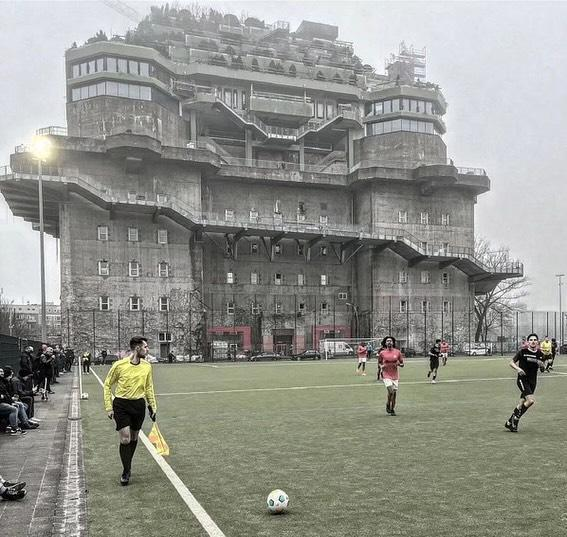
@BigDaveWHUFC @FTBLsection @PaulCoo08541835 Nope, I have played there against the amateurs of FC St. Pauli who also have their matches there. The Millerntor Stadium is right behind the field in the picture.
English
0
0
8
1.6K
The Footy Section
The Footy Section@FTBLsection·
This is the 'Sportanlage Heiligengeistfeld' stadium of SC Hansa Hamburg, a German lower-league team. In the background, there's a bunker from World War II.
The Footy Section tweet media
English
105
499
5.4K
996.2K
Paulibär
Paulibär@FlashBozZ·
@SebastianFrazer idk you just posted when you had millions and all was well, then it got quiet. I guess thats just the way it goes...
English
2
0
1
35
Seb
Seb@SebastianFrazer·
@FlashBozZ you never asked me how i was its been 5 years nigu
English
1
0
0
32
Seb
Seb@SebastianFrazer·
Being with non virgin women both times was the dumbest mistake i made in my life, i was 16 the first time though naive enough to get groomed by a 19 year old and the second was just the looks and me going through a 8 figure loss and physical issues/neuropathy and using her as a cope to escape reality which then ended up me being with her for multiple years which didn't end up well. Then i got indoctrinated by dumb culture that hooking up with countless women is somehow gonna help me heal or make me feel better which just ended up leaking my energy. That was the dumbest shit i did my VRILL has never been the same I never mastrubated before or talked to whores but i was just too permiable/irrational at the time, falling for the suicidal degradation leaves you empty with a VOID. Call me mysoginistic but the sexual liberation movement feels like the work of the devil, probably the jews and mind control artists were proliferating this debauchery. It does feel good at the time getting all the attention for the moment, its human nature but the devil comes masquerading as the angel of light. All these succubus are out there for the VRILL of the SENSITIVE YOUNG MAN. They'll be bamboozled by your looks/charisma because you dont care about fitting in or social validation but its gonna become annoying a few weeks/months in because you wont be catering to their needs fitting in with normie culture.I dont wanna bend their reality or tell them the truth about anything because they'll end up calling me mentally Ill schizo. I have been retaining for a very long time now feel much better comparatively. Me and @DionysianAgent are gonna retain our VRILL for life until we reach ENLIGHTENMENT.
English
1
0
8
506
Seb
Seb@SebastianFrazer·
New gold market alert would recommend slowly getting into the no contracts, pretty easy 20 percent honestly. poly.market/frazer-sebasti…
Seb tweet media
English
2
0
2
368
Mr.Presentable
Mr.Presentable@MrPresentable2·
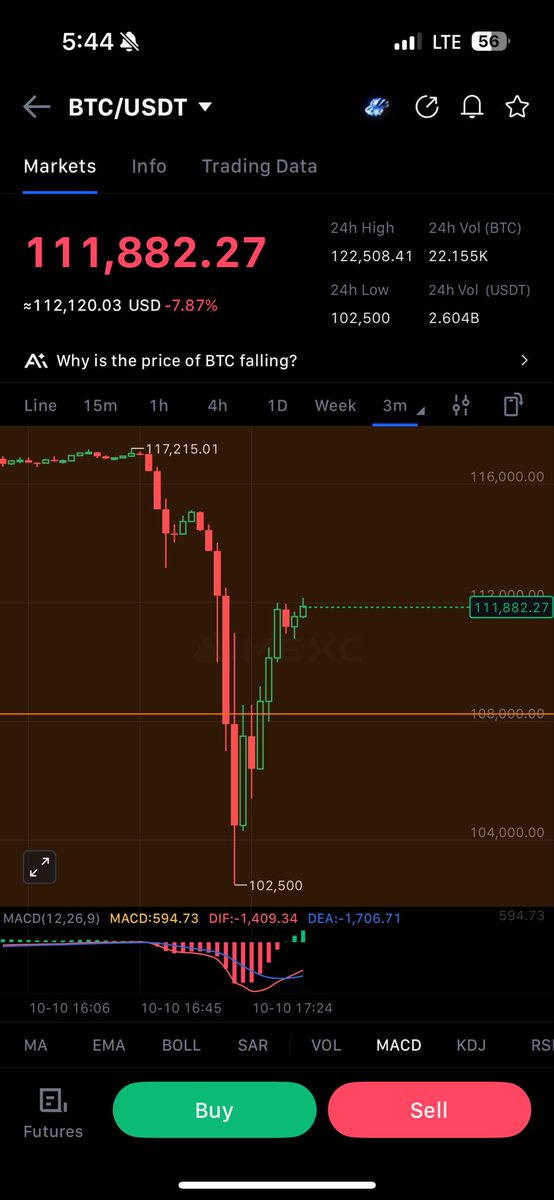
@coinmamba Nahhhhhhhh. Covid we did 69k to 29k in a week and a half. We broke beneath a critical fib level and got stuck under it. All the fundamentals are holding up right now. We retested the 108.25k level, panic pulled a wick way below it and snapped right back over.
Mr.Presentable tweet mediaMr.Presentable tweet mediaMr.Presentable tweet media
English
4
0
8
2.2K
CoinMamba
CoinMamba@coinmamba·
This is worse than Covid dump..
English
122
122
3.1K
170.1K