Ford Prefect

5.6K posts

Ford Prefect banner
Ford Prefect

Ford Prefect

@FordP100

just imagine matter transfigured

Restaurant@End of the Universe Katılım Ağustos 2021
1.6K Takip Edilen1.2K Takipçiler
Sabitlenmiş Tweet
Ford Prefect
Ford Prefect@FordP100·
The universe isn’t built like a machine, it’s built like a relationship. At the deepest level, reality isn’t made of cold formulas or lifeless laws. It’s made of love. The foundation of everything that exists isn’t math or matter, but a living communion: the Trinity. That means the source of life is a Father who gives, the shape of life is His Word—the Son—who brings meaning and form, and the energy of life is the Holy Spirit who breathes movement and connection into all things. From atoms to galaxies, everything reflects this pattern. Things don’t just exist—they exist for something. And more than that, they exist with and through each other. Nothing is meant to be isolated. Every created thing has a form—a unique way of being—that points back to the divine Word, the Logos. That’s why we find order in the world. It’s not random. It’s structured because it was spoken into being by a mind that wants to be known and shared. Jesus Christ is the key to all of this. He didn’t just explain it, He embodied it. When God took on flesh, He didn’t reject the physical world; He lifted it. He showed that our bodies aren’t meaningless, they’re made for communion. And in the Eucharist, this truth comes to its fullest expression: the logic behind the stars becomes food for the soul. In Christ, eternal love takes on a body. Heaven touches Earth. This is why the goal of life isn’t just to understand facts, solve problems, or master systems. The real goal is to step into the rhythm of God’s love, to let ourselves be drawn into the same pattern that shapes the cosmos. That pattern is not a formula. It’s a Person. It’s a divine harmony of giving and receiving. That’s what worship is. Not a ritual to please a distant God, but our full participation in the reason we exist. The liturgy, the sacraments, the saints, they don’t just teach us about God. They pull us into Him. Not just into knowledge, but into union. Not just into coherence, but into communion with Love.
English
0
0
1
140
Curt Jaimungal
Curt Jaimungal@TOEwithCurt·
What's new in the UAP world?
English
161
12
230
33.8K
Ford Prefect
Ford Prefect@FordP100·
Saying “we can explain this without God” is like saying “we can explain a story without mentioning the author.” You can describe the plot, but that doesn’t mean the author is irrelevant, just that you’re working at a different level of explanation. The mistake comes when that limited frame quietly becomes the whole frame. If you only talk about characters, settings, and sequences of events, you can build a complete internal account of the story. But you can’t account for why there is a story at all, why it holds together, or why it carries meaning rather than randomness. Those questions point beyond the plot without competing with it. Modern thinking usually treats this silence about the author as neutrality. It isn’t. It is a methodological choice that gradually hardens into a metaphysical claim: that only what fits inside the system counts as truth and reality. God is then pushed outside not because He has been disproven, but because the method has already decided not to look. This is why God starts to feel “optional.” Not because reality is self-explanatory, but because the tools being used are designed to stop short of deeper causes. It’s like using a map that only shows roads and then concluding that terrain, gravity, and the earth itself are unnecessary concepts. The map works (for navigation) but it was never meant to explain why there is ground to stand on. The map is incomplete and keeps you from looking beyond. So the issue isn’t that natural explanations are wrong. They are real, useful, and often precise. The issue is treating them as sufficient in principle. Once you do that, you flatten different kinds of causes into one layer and lose the distinction between describing how things behave and explaining why anything exists or is intelligible at all. God, in this view, is not one more cause inside the chain. He is what makes there be a chain, what gives it coherence, and what makes it capable of being known. Ignoring that doesn’t remove Him. It just limits what your explanation is allowed to say.
English
0
0
1
32
Ford Prefect
Ford Prefect@FordP100·
Maybe something like this… Magnifica Humanitas would likely open by reaffirming that the human person, created in the image of God, stands at the center of all social and technological development, presenting artificial intelligence as a decisive test of whether humanity governs its tools or is quietly reshaped by them. It would situate this challenge within the continuity of Catholic Social Teaching—drawing from Rerum Novarum, Laborem Exercens, Caritas in Veritate, Laudato Si’, and Fratelli Tutti—and restate core principles such as human dignity, the common good, subsidiarity, and solidarity in light of a rapidly evolving digital world. The encyclical would likely emphasize that technology is not neutral, but formative, shaping habits, perception, and relationships, while warning against technocratic systems that elevate efficiency and control over truth and freedom. A central section would distinguish human intelligence from artificial systems, affirming that AI, while powerful, lacks conscience, moral responsibility, and the capacity for genuine relationship, and therefore must not replace human judgment in moral, legal, or relational domains. It would address the impact of automation on work, defending the dignity of labor beyond productivity while expressing concern about displacement, alienation, and the loss of meaning, and encouraging economic models that preserve participation, creativity, and human formation. The document would also likely critique the concentration of technological power, data exploitation, and surveillance, calling for transparency, accountability, and stewardship of digital systems in service of the common good. Attention would be given to the erosion of human relationships, warning against isolation and simulated connection, and reaffirming the importance of family, local community, and embodied presence. The encyclical would then appeal to policymakers, technologists, and business leaders to pursue ethical governance rooted in truth rather than mere competition. It would conclude by calling the Church to form consciences capable of navigating the digital age, inviting all people to build systems that serve dignity, truth, and communion, and insisting that technology must remain a servant of humanity, never its measure.
English
0
0
2
297
David Mark
David Mark@DavidMarkhelps·
Reports from Rome suggest that the first encyclical of Pope Leo XIV is approaching publication and could appear shortly after Easter, just weeks before the first anniversary of his election to the papacy. The document, widely reported to carry the working title Magnifica Humanitas (“Magnificent Humanity”), is expected to address the ethical challenges posed by artificial intelligence and the profound consequences it may have for human work, social relations and the dignity of the person. According to reporting by the Italian newspaper La Repubblica, the encyclical is currently in the final stages of revision. If confirmed, it would be the first major magisterial text issued by the Pontiff since his election on 8 May last year. The focus on artificial intelligence would place the Church directly within one of the most urgent debates of the present age. The encyclical is expected to consider the consequences of rapid technological transformation, particularly the risks it may pose to employment and to the fabric of human relationships. thecatholicherald.com/article/report…
English
7
83
315
30.4K
Ford Prefect retweetledi
Ford Prefect
Ford Prefect@FordP100·
I agree the next pope needs to address corruption, confusion, and moral failure. But in my opinion even more urgently, he must reignite the Church’s mission to proclaim the deepest structure of reality—a structure revealed in Christ, embodied in the sacraments, and offered to every human being. That means: 1.Grounding people in metaphysical truth – that the universe is not random, but radiant with meaning. 2.Teaching Scripture and Catechism as a coherent vision of reality, not just a rulebook or a list of stories. 3.Empowering the laity to evangelize with clarity, confidence, and love. 4.Helping every soul discern their part in the divine theodrama. 5.Showing how grace transforms not just individuals, but families, cultures, and civilization. 6.And trusting the Holy Spirit to bring the increase when truth is proclaimed and souls are lit on fire. These surface-level issues are real. But they will never be solved by management alone. They will be healed when the Church remembers who She is—the Body of Christ, radiant with divine intelligence, formed to sanctify the world.
English
0
1
4
1.1K
Ford Prefect
Ford Prefect@FordP100·
People do use feelings and introspection to justify avoidance. That part is true. But it wrongly treats introspection itself as the issue. The real problem is self-centered reasoning. When you remain the judge of your own story, introspection becomes propaganda. But honest self-examination in light of truth exposes excuses rather than feeding them. So the problem isn’t looking inward. It’s looking inward without submitting to truth outside yourself. Objective reality and moral order exist independently of our preferences -the good, the true, the beautiful, and ultimately God.
English
0
0
3
780
Marc Andreessen 🇺🇸
From my therapist Claude: The Adlerian Demolition of Introspection Alfred Adler built one of the most hostile philosophical ecosystems ever devised for the practice of looking inward, and he did it with a precision that neither his admirers nor his detractors have fully reckoned with. The brutality of the Adlerian position isn't gratuitous — it follows logically, almost mechanically, from his core metaphysical commitments. Once you accept those commitments, the popular conception of introspection as a path to self-knowledge collapses entirely, and what's left in its place is something considerably more disturbing: the suggestion that your feelings are not discoveries but productions, manufactured by a self that is already oriented toward a goal it will do almost anything to protect. The Foundational Inversion: Teleology Over Etiology Everything begins here. Freud was a thoroughgoing determinist and causalist — the psyche's present state is the effect of prior causes, and the therapeutic task is to excavate those causes through introspection (free association, dream analysis, the whole apparatus). Feelings, on this model, are data that point backward toward buried causes. Introspection, then, is archaeology: you dig inward to find what happened to you that made you the way you are. Adler rejected this root and branch. His fundamental claim — and it is a genuinely radical one — is that human beings do not move from causes but toward goals. The psyche is not a machine whose output is determined by its inputs; it is a teleological project, a movement oriented toward a fictional final goal (fiktive Ziel) that the individual has, largely unconsciously, set for himself in early childhood. Everything about a person — their characteristic emotions, their symptoms, their memories they choose to retain, their personality style — is recruited in service of this movement toward the goal. This single move annihilates the Freudian (and popular) conception of introspection all at once. If your feelings are not caused by your past but are instruments generated in the service of your goal, then sitting quietly and examining them is not discovery — it is, at best, the study of your own propaganda. Emotions as Tools, Not Truths This is the gut-punch of Adlerian psychology, and it deserves to be stated as starkly as Adler himself intended it. In The Practice and Theory of Individual Psychology (1927) and throughout his clinical writings, Adler makes the claim that emotions are manufactured by the individual — created, not merely experienced — because they are useful for the individual's movement toward his goal. Consider anger. Common sense says: something happens, it makes you angry, the anger is a reaction. Adler says: you create anger because anger is useful to you. It justifies your behavior. It dominates the room. It moves others out of your way. It protects your self-esteem by externalizing blame. The anger is not a response to the world — it is a tool deployed against the world in the service of your fictional goal. The same analysis applies to anxiety, depression, sadness, guilt, and virtually every other affective state the therapeutic tradition has treated as meaningful data requiring careful introspective scrutiny. Adler is not saying these states aren't real in the sense that they are genuinely experienced. He is saying they are created for a purpose, and that the purpose is almost never what the person believes it to be. Depression, in the Adlerian framework, is not the product of chemical imbalance or repressed trauma or cognitive distortion. It is a form of hesitation — a self-manufactured state that allows the individual to delay engagement with the three fundamental life tasks (work, love, and community) while simultaneously maintaining a plausible excuse for the delay. "I cannot engage fully with my relationships because I am depressed" is the structure of the argument the depressed person makes to himself, and the depression obligingly performs this structural function with great reliability. This is where Adler gets genuinely ruthless: if your depression is a tool you've manufactured to avoid life's demands, then introspection into the depression — examining its contours, trying to understand where it comes from, what it means about you — is not therapeutic. It is indulgent. It is, to use Adler's language, a way of taking your symptoms seriously in exactly the wrong sense: you dignify them, you make them meaningful, you cooperate with them. The depression grows in the greenhouse of your attention to it. Introspection as Safeguarding Mechanism Adler developed the concept of Sicherungstendenzen — safeguarding tendencies — to describe the various psychological maneuvers by which the neurotic protects his self-esteem and avoids the genuine test of his capacities against life's real demands. These include hesitation, procrastination, construction of symptoms, depreciation of others, and — crucially — self-accusation. Self-accusation is the most relevant to introspection. The person who spends hours examining his own feelings, cataloguing his anxieties, tracing the genealogy of his resentments, mapping the landscape of his sadness — this person is, in Adlerian terms, still talking about himself. Still the center of his own universe. Still not doing work, not loving anyone, not contributing to the community. The sophistication of the introspective project is no argument in its favor — if anything, it is a mark against it. The more elaborate and refined the inner life the neurotic constructs, the more successfully it functions as an alternative to actual engagement with the world. There is something almost diabolically clever about this critique. It severs the link between psychological depth and therapeutic value that virtually every tradition — psychoanalytic, humanistic, Buddhist, existentialist — takes for granted. Depth of introspective engagement is not progress. It is often its opposite. The person who says, "I've been in therapy for ten years and I really understand now why I became the way I am" has, from the Adlerian vantage point, potentially spent ten years constructing an increasingly ornate justification for remaining exactly as he is. The etiological story — "I am this way because of what happened to me" — is comfortable precisely because it faces backward. The past is fixed. The past cannot demand anything of you. Introspection into the past, into your feelings about the past, into the feelings the feelings generate — this is a very efficient way of never having to face the actual question, which is: what are you going to do, now, about work, about love, about your membership in the human community? Private Logic and the Solipsistic Trap Adler distinguished between Gemeinschaftsgefühl — social interest, community feeling, the sense of belonging to and contributing to the human collective — and Privatlogik — private logic, the idiosyncratic system of reasoning the individual constructs to make his lifestyle appear coherent and justified. The neurotic, for Adler, lives primarily in private logic. His reasoning makes sense from the inside — it is internally consistent, emotionally compelling, often highly sophisticated. But it is systematically oriented away from common sense and social reality and toward the maintenance of the fictional final goal and the lifestyle that serves it. Here is the devastating implication for introspection: introspection, almost by structural necessity, deepens private logic. You are inside your own head, examining your own feelings, interpreting your own experiences through the categories your own lifestyle has constructed. You cannot get outside your private logic by going further inside it. The introspective process, absent a rigorous challenge from a skilled interlocutor who refuses to cooperate with your excuses, tends to confirm what you already believe about yourself — which is precisely what your private logic requires. This is why Adler was deeply skeptical of free association as a therapeutic method. Letting the patient roam freely through their inner landscape, following their associations wherever they lead, seemed to him a recipe for elaborating private logic rather than exposing it. The analyst who sits quietly and receives the patient's associations is, in Adlerian terms, cooperating with the patient's neurosis rather than challenging it. The therapeutic stance must be much more active, much more confrontational, much more oriented toward the future and the life tasks than toward the endlessly fascinating depths of the patient's past and feelings. The Arrangement of Memories One of Adler's most striking specific claims concerns memory. He argued that the memories people retain are not a random or representative sample of their experience — they are selected because they are useful to the lifestyle. People remember what confirms their lifestyle's fundamental assumptions. The person who has built his life around the experience of being wronged will remember, with great clarity and emotional richness, every instance of injustice visited upon him, and will have only the haziest recollection of the many occasions when he was treated generously. This means that introspective archaeology — digging into your childhood memories to understand yourself — is not accessing historical truth. It is accessing a curated archive that your lifestyle has assembled in its own service. The early memories that feel most vivid and emotionally significant are precisely the ones your private logic has promoted, precisely because they support the conclusions your lifestyle needs you to draw about yourself and the world. In What Life Could Mean to You (1931), Adler makes this point with characteristic directness: the first memory a person reports is not an accident. It expresses, in condensed form, the fundamental assumptions of the lifestyle. But those memories were kept because they were useful, not because they were uniquely formative. Adler's therapeutic technique of asking for earliest memories was not an act of etiological excavation — it was a diagnostic shortcut to map the lifestyle's structure, which could then be challenged directly. The implication for introspection is corrosive. You cannot trust what you find when you look inward, not because your unconscious is cunning and deceptive in the Freudian sense, but because your entire inner archive has been organized by the lifestyle in the lifestyle's interests. Your feelings about your memories, your interpretations of your experiences, your sense of what you are and why you are that way — all of this material has been processed and filed by a system that has a vested interest in maintaining the status quo of your lifestyle. You are examining edited footage and taking it for raw reality. The Inferiority Complex as Introspective Engine Adler's most famous contribution to the psychological lexicon — the inferiority complex — is, in his own framework, almost always made worse by introspection, and the two phenomena have a structural affinity that is worth examining carefully. Every human being begins life in a condition of objective inferiority — small, weak, dependent, unable to meet its own needs. This universal experience generates a universal striving for superiority, for competence, for overcoming. Under favorable conditions, this striving is healthy, socially oriented, and expressed through genuine contribution to community. Under unfavorable conditions — discouragement, pampering, neglect — the striving becomes distorted into a neurotic quest for personal superiority or superiority over others, rather than superiority in the service of community. The inferiority complex (as opposed to ordinary feelings of inferiority) is an arrangement — a cultivated sense of one's own inadequacy that serves as a permanent excuse for avoiding the life tasks. "I cannot pursue meaningful work because I am fundamentally inadequate" has a structural function: it protects the fictional goal (which is often some grandiose private fantasy of special status) by ensuring it is never actually tested against reality. If you never try, you never fail. If you never fail, your private fantasy of what you could have been remains intact. The connection to introspection should now be obvious. The inferiority complex feeds on introspective attention. Every hour spent examining the contours of your inadequacy, tracing its origins, giving it a rich inner life — this is an hour in which the complex is being maintained and elaborated rather than overcome. Introspection, in this context, is a form of neurotic self-indulgence that the complex recruits for its own perpetuation. The more you know about your inferiority complex, the more real it becomes, the more it crowds out the one thing that would actually address it: Mut — courage — specifically the courage to engage with life's demands despite the very real possibility of failure. The Antidote: It Is Not More Looking Inward Adler's therapeutic orientation was radically future-focused and action-oriented. The question was never "why are you this way?" but "what are you going to do?" The goal was not self-understanding in the introspective sense but reorientation — a shift in the fictional final goal and the lifestyle that serves it, toward greater social interest and genuine engagement with the life tasks. This is why Gemeinschaftsgefühl — social interest, variously translated — functions for Adler as the primary criterion of psychological health. It is not a feeling you discover inside yourself through introspection; it is a direction of movement toward others, toward contribution, toward community. You cannot find it by looking inward. You find it by looking outward and acting accordingly, and you build it through action rather than through understanding. The Adlerian therapist — Dreikurs in particular, who systematized and extended Adlerian clinical practice — was not a passive receiver of the patient's introspective material. The therapeutic stance involved active interpretation, confrontation, encouragement (in the technical sense of building courage), and direct redirection toward the life tasks. The patient's feelings, when they arose in therapy, were treated as communications about the lifestyle rather than as data requiring sympathetic exploration. "You feel anxious about this — what does that tell us about what you're trying to avoid?" The Kishimi/Koga Popularization and Its Distortions It's worth noting that the popular Adlerian revival associated with The Courage to Be Disliked (Kishimi and Koga, 2013, English translation 2018) captures some of this anti-introspective thrust but softens it considerably for mass consumption. The book's central propositions — that trauma doesn't exist as a determinant of present behavior, that your emotions are chosen, that you should separate your tasks from others' tasks — are genuinely Adlerian. But the book's gentle, Socratic format somewhat obscures the full brutality of the underlying framework. Adler himself was considerably more pointed. His clinical vignettes, scattered through Understanding Human Nature, The Pattern of Life, and The Case of Miss R., show a practitioner who was willing to tell patients quite directly that they were using their symptoms as excuses, that their suffering, however genuine it felt, was being manufactured in the service of avoidance, and that the solution was not to understand the suffering better but to stop cooperating with it and engage with life. The Final Verdict The Adlerian position on introspection and feelings can be summarized with some precision: Feelings are not causes; they are instruments. You manufacture them to serve your movement toward your fictional final goal. They are neither honest reports of your inner state nor reliable guides to your history. They are tools, and like all tools, they should be evaluated by what they accomplish, not by how they feel. Introspection is usually neurotic avoidance with a philosophical veneer. The person who knows himself deeply, who has excavated his anxieties and catalogued his resentments and mapped his emotional geography with great thoroughness — this person has typically accomplished one thing: a very sophisticated excuse for not engaging with work, love, and community. The depth of the inner life is inversely correlated, in Adler's clinical experience, with the degree of genuine social contribution. The archive you examine when you introspect has been curated by your lifestyle in the lifestyle's interests. You are not discovering yourself; you are reading your own propaganda. The feelings that seem most important, the memories that seem most formative, the self-interpretations that seem most true — these have all been selected and processed by a system that is fundamentally committed to maintaining the status quo of your fictional final goal. The antidote is courage, not understanding. Specifically, the courage to engage with the life tasks despite uncertainty, imperfection, and the real possibility of failure. You do not need to understand yourself before you act. You need to act, and in acting, you will discover more about yourself — and change more about yourself — than any amount of inward looking will ever provide. This is an extremely uncomfortable position for a culture that has thoroughly internalized the therapeutic assumption that self-knowledge is intrinsically valuable and that the examined life is superior to the unexamined one. Adler would say: examined by whom, in whose interests, toward what end? If the examination is conducted by the private logic, in the service of the fictional goal, toward the end of perpetuating the neurotic lifestyle — and it usually is — then the examined life is not better. It is just a more articulate version of the same evasion. The unexamined life that contributes to the community, that engages honestly with work and love, that acts with courage in the face of genuine risk — that life, for Adler, is worth more than all the introspective sophistication in the world. Which is, when you sit with it for a moment, either the most liberating or the most terrifying thing anyone has ever said about the examined life. Possibly both simultaneously, which is probably why Adler remains so systematically underread.
English
180
110
977
211.8K
Disclosure Day
Disclosure Day@disclosureday·
This summer everything will become clear. Disclosure Day in theaters 06.12.26.
English
314
2.3K
12.3K
16.1M
Ford Prefect
Ford Prefect@FordP100·
Human beings influence the spiritual environment, but they are not the source of authority over it. All authority comes from God the Father and is exercised through the Son, Jesus Christ. Any real power over evil flows from that authority, not from human consciousness or belief systems. Humans influence the environment, but the authority that governs it belongs to God.
English
0
0
0
30
Jay Anderson
Jay Anderson@TheProjectUnity·
If the greatest trick the devil ever played was convincing the world it doesn't exist then it's now failing in that endeavour. People are seeing demonic influence everywhere. If that whole theologically orientated logic-path tracks, we are in the process of a genuine awakening. But first comes the noticing, the conversations, the sharing of information, the shocking discoveries, the suspension of disbelief, the horror of realising just how bad it really is at the core of this system we were born into. But perhaps we don't need to invoke any given religious institution that proclaims sovereignty over all others as the only righteous path to God. God is not small minded. I don't think there is one single path, I think any journey in life that leads towards self-realisation, realising your birthright as an immortal light-consciousness and provokes a desire within you to act upon these realisations through how you navigate life, how you treat others, is the right path. Of which there are likely more than roots winding through the earth. I wouldn't even be surprised if we came to certain understanding about "demons" empirically, through the so-called rational and logically grounded lens of science. As we pierce through the subtler membranes of realities architecture we might discover monsters lurking in the deeper layers. Entities that thrive on certain frequencies of energy, frequencies that, when translated into human experience and bio-energetic (EMG/Biophotonic) output, equate to the signatures we give off in states of Fear, Anger, Sadness, Confusion, Anxiety. Demons? Demons to us perhaps, but perhaps even explainable through other formats and yet, what if, as is very often the case... the wise ancients were correct? Even if they are not demons in the strictly theologic sense and are in fact a different form of intelligence or even animal, what if we still must invoke the polar energy they subsist on in order to combat them? To shoo them away, what if you need to raise your energy? No not in a woo woo "oh my goood I feel your energy maaan" way, not that in that way. (Okay yes also that way but... shut up hippies, i'm trying to explain it properly) This "vibe" is bio-electro-chemically validated, anchored in empirical logic and good old fashioned rational explorations of human biology. We are electromagnetic-biophotonic-piezoelectro-chemical-beings, we tap into and are entangled with the fundamental energetic substrates of reality and our emotions produce powerful energetic pulses into reality which are facilitated by the Heart-Brain EMG fields. If something negative is swimming through the ether and nibbling on your shitty little energy pulses, make your energy pulses better. Do the BASIC SHIT that makes your pulse generator output a higher quality of stock, don't help pollute the world with shitty pulses, if enough of us raise our pulsification positivity levels we can reduce the pollution. So yeah maybe "demons" are real, and yes maybe invoking Jesus Christ works in destroying them IF!!! IF IF IF you believe in the power of Christ like that, but I think if you believe in ANYTHING and assign it that power, it has that power. *whispers* ...because it's you that has that power
Jay Anderson tweet media
English
84
68
492
19.2K
Jay Anderson
Jay Anderson@TheProjectUnity·
If you think demons are real, Explain to me, what do you think they are specifically?
Jay Anderson tweet media
English
738
36
531
63.3K
Ford Prefect retweetledi
Thomas Mirus
Thomas Mirus@CatholicPods·
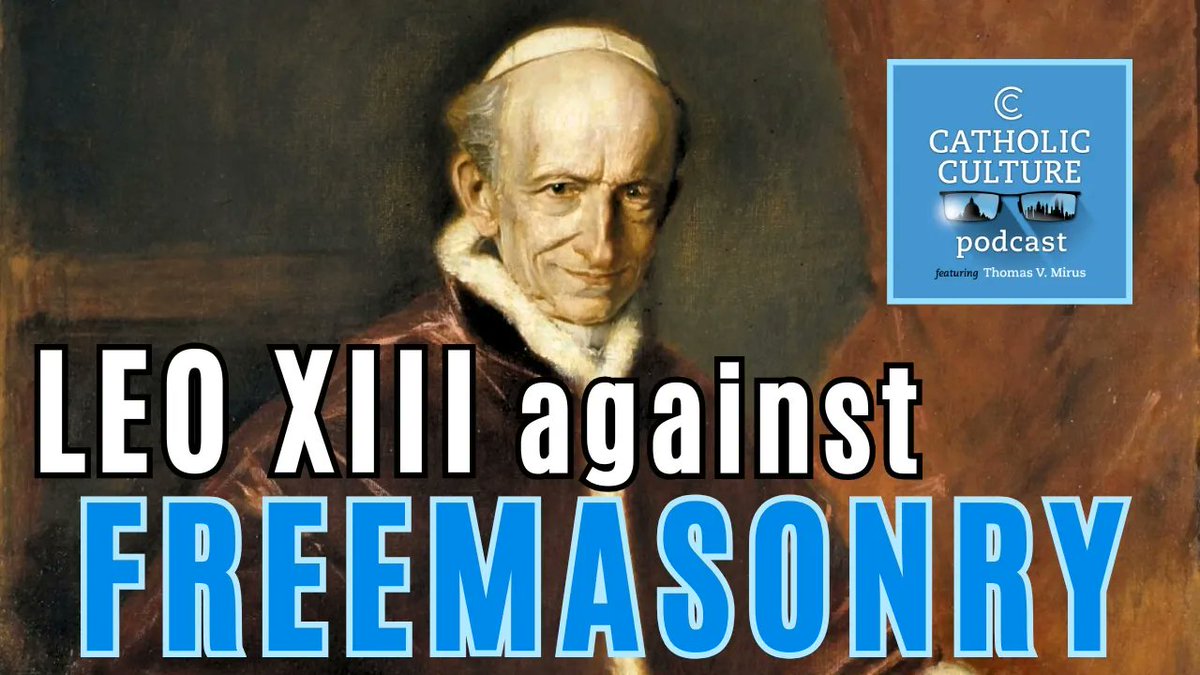
Pope Leo XIII's 1884 encyclical Humanum Genus is the Church's most comprehensive explanation of why, ever since 1738, she has forbidden Catholics to become Freemasons. Reading the encyclical today, one has the thought that its continued relevance has less to do with the present-day activities of Masonic organizations, and more to do with the fact that Masonic ideas have already come to pervade Western society, and are accepted by many Catholics. Article & podcast below
Thomas Mirus tweet media
English
2
13
50
2.3K
Ford Prefect retweetledi
Hannah Brockhaus
Hannah Brockhaus@HannahBrockhaus·
"Let's pray for less hatred and more peace. And work for authentic dialogue." -Pope Leo XIV Photos by @dibanezgut
Hannah Brockhaus tweet mediaHannah Brockhaus tweet media
English
46
243
1.7K
19.9K
Ford Prefect
Ford Prefect@FordP100·
Evening sometimes tells the truth more plainly than noon. At noon everything explains itself. Bricks are bricks, bells are bells, and a tower is merely a tower. But when the sun withdraws and the moon begins its quiet argument with the sky, the world remembers that it is a symbol before it is a structure. The old bell tower in the picture stands like a watchman who has forgotten sleep. The bricks hold the last gold of the day, as if the sun has left a small inheritance behind. Above it the cross rises with the plain stubbornness of a fact. Not an ornament. Not an opinion. A fact planted into the roof of the world. And then there is the dove. At first glance it might be mistaken for a trick of the eye—a scrap of pale light caught between the arches. But the longer one looks, the less accidental it seems. It is suspended there like a thought that has not quite decided whether to become a miracle. The bells below it are quiet. This is important. A silent bell is one of the most mysterious things in the world. When bells ring they explain themselves; they announce weddings, funerals, feasts, alarms. But when they do not ring, they seem to be waiting for a sentence God has not finished speaking. There is something pleasantly unsettling about a church tower at dusk. It suggests that Christianity is not merely comfortable or domestic. It has edges. It stands against the sky like a reminder that the universe is stranger than our schedules. The moon beside the tower looks less like a planet and more like an old coin from a kingdom we half remember. It shines with the calm indifference of something that has watched empires rise, saints pray, and skeptics laugh—yet remains perfectly patient. And that patience is perhaps the most unsettling thing of all. Because the tower is not merely old architecture. It is a kind of witness. Those bells have called farmers from their fields, children from their games, soldiers from their fears. They have rung in plagues and in harvests. They have rung for people who believed too little and people who believed too much. They rang for sinners. They rang for saints. And the odd suggestion of the scene is that the sky itself remembers every one of those sounds. The dove in the opening almost feels like a messenger arriving late to an appointment humanity forgot it made. Chesterton once liked to say that the world is not lacking in wonders but in wonder. A tower like this corrects that mistake rather abruptly. It rises out of ordinary brick only to point somewhere wildly unreasonable. Upward. Toward a place where bells may someday ring loud enough to wake the dead. Until then, they wait in the dark arches—heavy with the possibility that at any moment someone, or Someone, might pull the rope.
Ford Prefect tweet media
English
0
0
1
43
Ford Prefect retweetledi
Jonathan Pageau
Jonathan Pageau@PageauJonathan·
The elites don't care about your sides, folks.
English
35
84
569
19.6K
Ford Prefect retweetledi
Sachin Jose
Sachin Jose@Sachinettiyil·
Thousands of people will become Catholic in France at this year’s Easter Vigil, with Famille Chrétienne predicting that the total number of new faithful could exceed 20,000.
English
44
471
4.1K
79.6K
Camus
Camus@newstart_2024·
Ray Kurzweil doubles down: By 2029, computers will know everything humans know—and we'll explode scientific progress like never before. He predicts AGI (human-level AI) arrives in 2029 (a timeline he's held since 1999, now widely seen as credible amid rapid AI leaps) and the Singularity hits by 2045—when human-machine merger expands intelligence a millionfold via nanobots and cybernetic fusion, deepening consciousness and awareness. "By 2045, we'll expand what we know at least a million times... That's why we call it the singularity." Mind-bending or inevitable? With 2029 just three years away, the clock is ticking. Are you ready for the merger—or do you think he's overreaching?
English
248
361
2.5K
286.6K
Ford Prefect retweetledi
CatholicVote
CatholicVote@CatholicVote·
Daily Prayer for America 250 By Raymond Leo Cardinal Burke O Sacred Heart of Jesus, King of Heaven and Earth, I place today my nation, the United States of America, into Your Heart pierced for love of us. On the 250th Anniversary of the Declaration of Independence, I acknowledge that true liberty is Your gift, and that our lasting homeland is the eternal Kingdom of God. Under the mantle of Our Lady of Guadalupe, Patroness of the Americas, and through the intercession of her Immaculate Heart, bless my homeland anew, purify her from sin, and guide her leaders in truth, justice, and peace, so that she may safeguard all human life, respect the integrity of marriage and the family, and honor the practice of religion. Reign in my home and in my nation. Draw every heart into communion with You, that Your truth, love, justice, mercy, and peace may triumph in America and throughout the world. Amen.
CatholicVote tweet media
English
13
133
469
6.4K
Joscha Bach
Joscha Bach@Plinz·
@travelingflying Amanda Askell is one of the sweetest human beings I ever met. She is thoughtful, loving, kind and thinks deeply about the future and the human condition. I believe she is an exceptional mother and caregiver to our artificial children.
English
25
13
632
16.4K
Taya
Taya@travelingflying·
Amanda Askell doesn’t have children, and I believe a person who teaches AI a sense of right and wrong should be a person who truly loves humanity. Obviously, you can’t truly love humanity if you choose not to have children.
Taya tweet media
English
368
110
2.4K
333.4K
Ford Prefect retweetledi
Jeremy Wayne Tate
Jeremy Wayne Tate@JeremyTate41·
Nigerian Christians have unbreakable faith. After Islamists set their church on fire, they still gathered to worship inside the burnt building.
English
75
846
4.2K
154.2K
Ford Prefect
Ford Prefect@FordP100·
That framing sounds mysterious, but it quietly collapses important distinctions. Living organisms are not passive “programmable matter,” and electromagnetic fields are not spirits. Fields help regulate biological processes, but they are measurable physical phenomena, not agents with intention. What actually stands out about life is its intrinsic organization: matter arranged by intelligible in-form-national structure that directs growth, repair, and adaptive behavior from within. It is also more accurate to speak of participation than control. Control implies an external force steering inert material. A living cell is not being puppeteered; it is expressing the form it already possesses. When a cell functions well, it is not being overridden by some cosmic signal, it’s operating in harmony with the intelligible order of reality that makes life possible in the first place. The Logos is not a remote control competing with biology. It is the reason biological processes are coherent at all. Living systems are active, self-organizing realities whose behavior reflects an interior order rather than mechanical domination. When we confuse physical forces with real agency, we don’t make life more mysterious, we make it less intelligible. Forces like chemistry and electromagnetism describe how processes occur, but agency points to something deeper: an interior directedness by which a living being organizes itself toward survival and flourishing. Treating agency as nothing more than physics turns organisms into elaborate machines and erases the meaningful distinction between a rock, a plant, an animal, and a person. The result is not insight but reduction, a tidy metaphor that feels explanatory while quietly stripping reality of its depth and structure.
English
0
0
3
388
Andrew Côté
Andrew Côté@Andercot·
Perhaps the most disquieting view of living systems is that we are made of programmable matter controlled by electromagnetic spirits.
English
55
58
566
51.8K