Sabitlenmiş Tweet

Ready to take @pintocommunity to the next level. The world needs low volatility, leviathan free monies, and we aim to deliver hard.
Expect big things 2025 🌱
English
Frijo (1≈1)
230 posts

@Fr1j00
In all things of nature there is something of the marvelous. Lead developer and co-creator of @pintodotmoney, the next iteration of money.

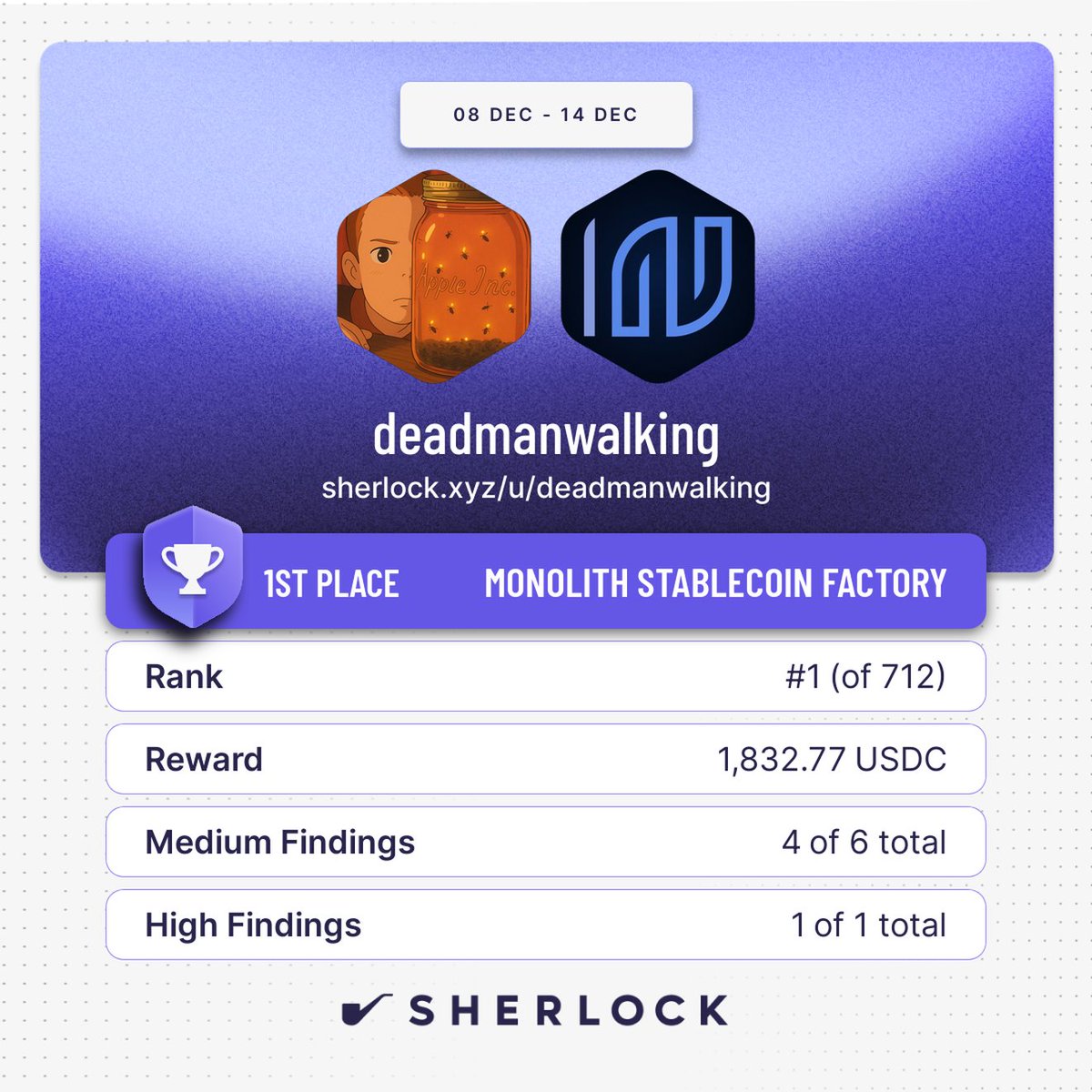
Here are the results of the @InverseFinance Audit Contest! 1. @0xdmanwalking - $1,833 🥇 2. bughuntoor - $8,312 🥈 3. @ValvesSec - $1,691 🥉 $35,500 in rewards, bringing Sherlock's total researcher payouts to $19.6M+. Link below for the full results 👇


@apoorveth wen calldata encoder, it would truly make this site a one stop shop



We have an opportunity to create something new and valuable for Solidity developers. The Solidity team has said they plan to remove inheritance and Solidity libraries from the language. That’s a drastic shift — but in my opinion, it’s the right direction. What most people don’t realize is this: 👉 You can already build great smart contract systems TODAY without inheritance and without Solidity libraries. How? By writing your Solidity code outside of contracts and libraries, and importing those files — essentially using them as modules. Solidity has the term “free functions,” but that only covers the functions themselves. You can also define structs, enums, constants, errors, events, comments and more. …all at the top level, outside any contract or library. These files behave exactly like modules in other languages — but Solidity never gave them a name. To avoid confusion with “Solidity libraries,” I propose calling them Solidity modules. I’ve already refactored Compose (compose.diamonds) to use Solidity modules. Designing Compose for the future means aligning with where Solidity is heading — and modules are a big part of that future. The idea to use free functions instead of libraries was suggested to me by Cameel, from the Solidity Compiler Team. What do you think?


Presenting 'The Road to Core Solidity', a series of blog posts through which we will share where we are headed with the language. Let's take a look at the overview!



I am excited to announce that I will be joining Tempo. This last year has been a turning point for crypto, where we have finally seen the outlines of our vision being materialized. While payments used to be front and center in the early days of crypto, I see a special opportunity to finally achieve this ambitious goal with relentless execution on both the technical and distribution fronts. I believe that the real world moment is now, and I want to make sure we do not miss this window to touch normal people’s lives everywhere in the world. I have dedicated the past several years to architecting and scaling blockchains, and I’m excited to leverage my learnings together with the very strong team being assembled at Tempo. My journey in Ethereum first started when I began working with the EF research team in 2018, and later joining full time in 2019. The project has greatly matured since then and with the soon coming Fusaka upgrade will implement PeerDAS, a significant scaling milestone I am proud to have contributed to. I am very happy to have played a role in leading to more people being able to use Ethereum and I look forward to continuing being able to do that. Over the last year, I have been involved in advancing Ethereum Foundation’s strategy and roadmap and I will remain a research advisor to the three strategic initiatives (Scale L1, Scale Blobs, Improve UX) at the Protocol Cluster at the EF. Ethereum has a strong set of values and technical choices that make it unique in the world. And Tempo will be a great complement, built using similar technology and values, whilst being able to push the boundaries on scale and speed. I believe that this will be of great benefit to Ethereum. Tempo’s open-source technology can easily integrate back into Ethereum, benefiting the entire ecosystem. Ethereum and Tempo are strongly aligned, as they are built with the same permissionless ideals in mind. I am looking forward to staying involved with the community and continuing to push Ethereum forward!
[ ZOOMER ] PAYPAL'S PYUSD MINTS $300T ON ETHEREUM