
Fred Pavan retweetledi
Fred Pavan
17.2K posts

Fred Pavan
@FredPavan
here to learn stuff and waste time | part time bot, full time PM
Katılım Nisan 2020
1.6K Takip Edilen64 Takipçiler


Fred Pavan retweetledi


Fred Pavan retweetledi



Fred Pavan retweetledi

Artemis II is not just going "to the Moon," but rather traveling to meet it at an exact point in space.
It’s all about orbital mechanics. x.com/_NafayFarooq/s…
English
Fred Pavan retweetledi


Fred Pavan retweetledi

Increased seed oil consumption
Modern History@modernhistory
Age 50 in 1986 vs. age 50 in 2026. What has changed in 40 years?
English
Fred Pavan retweetledi

Step 1: fuck around
Step 2: find out
Step 3: continuously expand the presence of human consciousness across a vast interplanetary empire of mankind using large collaborative construction robots to build and deploy megascale infrastructure
It’s not that hard dude
English
Fred Pavan retweetledi

La Muy Noble y Muy Leal Ciudad de Nuestra Señora de la Encarnación del Monte Olimpo de la Nueva Castilla de Marte, fundada por gracia de Dios y de Su Majestad Católica en el año del Señor de MMXLII
Curiosity@CuriosityonX
If you could name the first city on Mars, what would it be called?
Español
Fred Pavan retweetledi

Rundown of the very bad week in security:
- TeamPCP (sophisticated hacking group) attacks: Hackers broke into the system that builds a oss popular security scanning tool called Trivy. This was a supply chain attack (when bad code is slipped into widely used software tools or libraries, so it spreads automatically to anyone who downloads or uses them). They used the stolen access to poison other tools like LiteLLM (a popular Python gateway library with ~100m million monthly downloads that lets developers easily call many different AI models through one simple interface) and Telnyx (a comms platform, that for example lets devs make phone calls and send texts). The bad code stole passwords and secrets from developers’ computers, which then let them break into Mercor (stealing a lot of sensitive data) and Cisco (stealing source code for their AI products).
- Axios npm attack: Someone took over the main contributor’s account for axios (a popular JavaScript library that makes it easy to send and receive data over the internet in browsers/apps). This was another supply chain attack. Hackers released two fake versions that secretly installed evil software on anyone who downloaded them, giving the hackers full remote control of those computers.
- Claude leaks: Anthropic accidentally published their AI coding tool with a big hidden file that contained all its internal code, secret instructions, and planned new features. They did not leak the model weights. They did have documents about their next unreleased AI model “mythos” exposed online. These were accidental mistakes, not hacks.
- Railway issues: Railway (a cloud platform for devs) made a short mistake in their settings that let random people see other users’ private information for <1 hour. Separately, bad actors used Railway’s platform as a tool to help run phishing attacks against Microsoft accounts.
To clarify for non security friends - these are not the result of some “rogue cyber AI.” They are affecting companies in the dev/AI ecosystem. But AI software abundance/pace of development, agentic library selection, and ai-automated builds/ai-managed secrets are surely amplifying classic supply chain issues and human error.
English
Fred Pavan retweetledi


Fred Pavan retweetledi

If your agent doesn’t live in the context, you are the context
English
Fred Pavan retweetledi
Why did the US ban this number in 2001? It sounds insane, but 25 years ago, the Motion Picture Association of America was genuinely trying to delete this number from the internet.
You see, back in 1999, a teenager in Norway named Jon Lech Johansen wrote a piece of code called DeCSS.
It cracked CSS, the encryption on DVDs. Suddenly, anyone could copy a movie with the click of a button. It was a nightmare for the movie studios.
They went nuclear. They sued the hacker magazine 2600: The Hacker Quarterly.
They threatened Slashdot, and their lawyers fired out cease-and-desist letters to anyone hosting the code. They called it a digital burglary tool.
But the internet found a loophole.
A computer scientist named Phil Carmody realized that computer code is just binary ones and zeros.
And you can treat that string of binary as a single number. That way, you get a really, really big integer—which is the illegal code.
But Carmody knew that just finding any number wasn’t going to be enough, because the government could still ban a random number.
So he needed a number that science would be forced to protect. He needed a prime number.
You see, the University of Tennessee maintains a prestigious academic database called the Prime Pages.
It records the 5,000 largest known prime numbers. Carmody realized that if he could turn the illegal code into a record-breaking prime number, the university would have to publish it.
His first attempt was 1,401 digits long. It was prime, but too small.
It didn’t crack the top 5,000 list. It wasn’t mathematically interesting enough to save.
So, he hacked the math.
Use this formula:
K × 256^N + B
Now, K is the illegal code part. 256^N is the mathematical equivalent of adding useless zeros at the end—like making a book longer by adding blank pages. It doesn’t change the actual content inside.
So, he kept adding “blank pages,” shifting the number, until he hit a mathematical jackpot—a 1,959-digit monster.
This wasn’t just illegal code anymore. It became the 10th largest ECP prime number ever discovered at the time.
It was checkmate.
The number was immediately added to the university database. For the MPAA to ban the code now, they would have to order a university to delete a scientific record.
You can’t censor mathematics.

English
Fred Pavan retweetledi
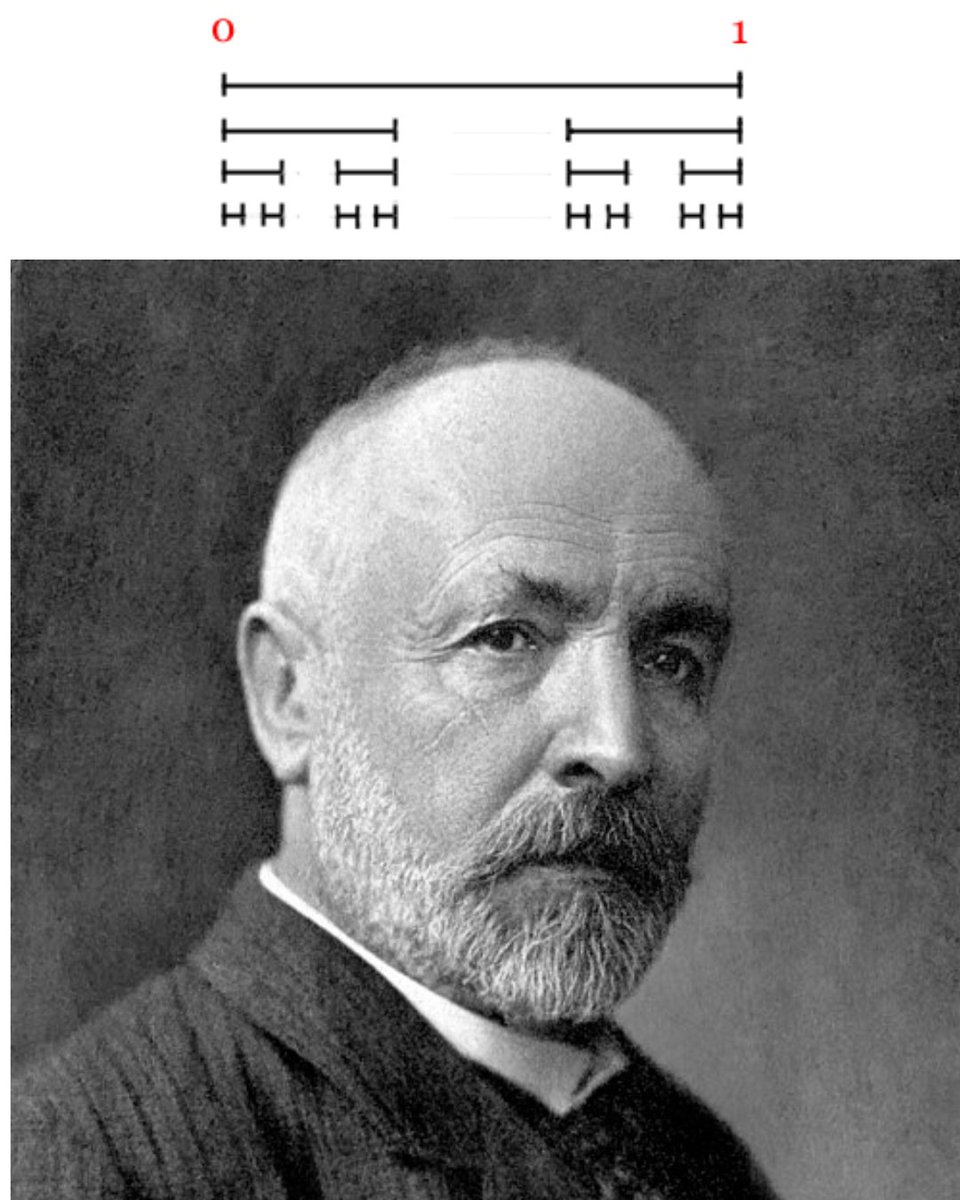
The Cantor set is one of the most surprising ideas in mathematics.
Start with the line from 0 to 1, then remove the middle third of it.
From the two remaining pieces, remove their middle thirds as well, and keep repeating this process again and again forever.
After infinitely many steps, what remains is called the Cantor set.
Here’s the strange part: if you add up all the pieces that were removed, their total length becomes exactly 1, which means the Cantor set has zero length.
Yet, it is not empty at all. In fact, it still contains infinitely many points.
Even more surprisingly, the Cantor set has just as many points as the entire interval from 0 to 1.
This means that although it is a smaller part with no length, it is just as “large” in terms of the number of elements it contains.
The Cantor set shows how our intuition about size can fail, revealing that something can have no length but still be infinitely rich in structure.
English
Fred Pavan retweetledi

A method of drawing infinitely many touching circles
Credit: Matt Henderson
English
Fred Pavan retweetledi

Fred Pavan retweetledi


Fred Pavan retweetledi

Your ground beef costs nearly 20% more than a year ago because US cattle herds hit a 75-year low and ranchers can’t find workers. A New Zealand dairy farm kid convinced Peter Thiel that GPS cow collars are the fix. Thiel just valued the company at $2 billion.
The company is Halter. Craig Piggott grew up watching his parents work 100-hour weeks on dairy farms in New Zealand’s Waikato region. He barely scraped into engineering school (scored 254 points, needed 250), landed at Rocket Lab, then quit before their first rocket launch to build smart collars for cows. He was 22.
The tech sounds ridiculous until you see the numbers. Each solar-powered collar collects 6,000 data points per minute on location, health, fertility, and grazing patterns. Farmers draw virtual fences on a phone app. Cows learn to respond to sound and vibration cues within 7 to 10 days, moving between pastures without a single physical fence post. Halter’s US customers have created 11,000 miles of virtual fencing so far, roughly the perimeter of the continental United States, saving an estimated $220 million in fencing costs. Physical fencing runs about $20,000 per mile to install and maintain.
The timing is what makes this a $2 billion company and not a $200 million one. The US cattle industry generates over $1 trillion a year but it’s cracking. The USDA counted 27.6 million beef cows as of January 2026, still declining. Fifteen thousand American farms vanished in 2025. Over half of US ranchers are older than 55. The labor crunch has only gotten worse under tighter immigration enforcement. This month, 3,800 workers walked off the job at a JBS plant in Colorado (one of the country’s biggest beef processors). Cattle slaughter is down 10% year over year.
Founders Fund actually first invested in Halter’s $7 million Series A back in 2018. They’re not showing up late. The valuation doubled from $1 billion to $2 billion in nine months. Icehouse Ventures, one of Halter’s earliest backers, put in $100,000 at the seed stage. Their total stake is now worth $409 million. The fund’s CEO told the New Zealand Herald today that at Halter’s current growth rate, it will surpass Fonterra (New Zealand’s $5.9 billion dairy cooperative) in value within 11 quarters.
600,000 cattle are wearing Halter collars across three countries. The “cowgorithm” is a real, trademarked AI algorithm that trains each animal individually. Ranchers report saving 20 to 40 hours a week. And the kid who barely got into college was just named New Zealand’s Innovator of the Year.
Polymarket@Polymarket
JUST IN: AI cow collar startup Halter raises at $2,000,000,000.00 valuation, uses proprietary “cowgorithm” to herd cattle.
English
Fred Pavan retweetledi

The Government of Spain demands the opening of Hormuz and the preservation of all the energy sites of the Middle East.
We stand at a global tipping point. Further escalation could trigger a long-term energy crisis for all humanity.
The world should not pay the consequences of this war.
English
Fred Pavan retweetledi

• be Torakusu Yamaha
• the son of a low-ranking samurai astronomer in 19th-century Japan
• obsessed with Western machines, you make a living repairing watches and medical equipment
• 1887: a local elementary school has a broken American reed organ. Nobody in the small town knows how to fix it.
• you take it apart, realize it’s just two broken springs, and easily repair it
• but instead of just handing it back, you realize: "If I can fix this, I can build it."
• you draw a blueprint of the inside of the organ and build the very first Japanese-made reed organ from scratch
• you show it off. People tell you it sounds terrible.
• most people would quit. You sling the heavy wooden organ over your shoulder on a bamboo carrying pole.
• you physically carry it 160 miles (250 km) on foot, trekking over the brutal Hakone mountains just to reach the Tokyo Music Institute to get real feedback from experts
• the professors play it. They tell you the mechanics are brilliant, but the tuning is completely wrong.
• you don't get defensive. You stay in Tokyo for a month, sitting in on university music theory lectures, holding a single tuning fork to your ear until you completely master the mathematics of sound frequencies
• you walk 160 miles back home
• you build a second organ. The professors test it and declare it "as good as those from abroad."
• you found Nippon Gakki Co. (which later becomes Yamaha Corporation)
• you decide to make your company logo three interlocking tuning forks to remember the pain and discipline of learning music theory from scratch
• decades later, your company uses its piano woodworking expertise to build wooden airplane propellers in WWII
• after the war, the company uses its new metallurgical expertise from the airplane engines to build motorcycles
• you accidentally create a timeline where repairing a broken elementary school organ directly leads to the creation of the Yamaha YZF-R1 superbike
• absolute, relentless horizontal integration based purely on figuring out how things work
The ultimate testament to reverse-engineering reality.


English