Future AGI

1.5K posts

Future AGI banner
Future AGI

Future AGI

@FutureAGI_

World’s most trustworthy and accurate evaluation, observability and optimization tool for multimodal AI.

San Francisco Bay Area Katılım Haziran 2024
171 Takip Edilen351 Takipçiler
Future AGI
Future AGI@FutureAGI_·
Honestly, Falcon is the closest thing to an actual AI engineer we've built. Live inside Future AGI. Built to debug, fix, and optimize your AI systems autonomously. You type what you need. It does the rest. Simulations, evals, root cause analysis, prompt fixes, re-testing - one conversation, start to finish. No dashboards to navigate. No queries to write. No tabs to alt-through at 2am. The thing that surprised even us: it got scary good at diagnosing failures. Not "your score is low" but "3 of your 6 failing scenarios trace to the same retrieval bug. Your FAQ page is outranking the policy doc on complaint-phrased queries." Most in-product copilots answer questions. Falcon does the work. It breaks down complex tasks, holds context across your entire stack, and moves through it the way a senior engineer would - evals to traces to agents to gateway, in one conversation. It knows what page you're on. It knows what to investigate before you ask. And when it finds something, it doesn't just report it. It fixes, re-tests, and shows you the before/after. The hours your team used to spend hunting through traces and rerunning evals manually? Falcon takes those back. While the world is shipping agents, we shipped the one that makes them better. Letting Falcon loose. Go see what it catches. Try the Falcon - shorturl.at/hoBHi Product Doc - shorturl.at/wsZww
English
0
0
3
27
Aakash Verma
Aakash Verma@VermaAakash3·
Alright, this one’s worth your attention if you’re building or deploying agents. @FutureAGI_ just open-sourced their entire platform and i don’t mean a trimmed-down version. this is the full stack: UI, backend, simulation engine, evals, optimization loop, observability, guardrails, gateway, docs. all in one repo. Apache 2.0. I’ve been putting it through its paces on production agents, and what stands out isn’t just the breadth it’s the architecture. Most of the current “agent reliability” stack is fragmented. tracing lives in one tool, evals in another, guardrails somewhere else. you end up manually connecting dots, and the agent itself doesn’t really improve you just keep patching prompts and hoping for the best. This flips that model. It’s built as a closed feedback loop: simulate failures → evaluate in real time → detect production issues → learn from them → generate fixes → validate against real traffic → check regressions → redeploy → monitor again And when something new breaks, the loop just runs again. no manual glue. The simulation piece is especially strong. instead of static test cases, it generates adversarial, multi-turn conversations based on how your agent actually behaves basically hunting for the exact scenarios where your system fails confidently. ran a few thousand simulations on our side… caught things we definitely would’ve missed. Evals run fast (sub-50ms) across modalities. not LLM-as-judge trained classifiers. guardrails are built-in, not layered on top. observability gives you step-level visibility into reasoning, cost, latency, quality. But the real shift is the optimization loop. Most tools tell you *what* broke. this system actually fixes it, validates the fix, and ensures nothing else regresses. That’s the missing layer. It’s clearly built with production in mind not a research demo. and the fact that it’s self-hostable makes it even more relevant if you’re running serious workloads. If you’ve been duct-taping together infra around your agents, this is probably the closest thing to a unified system i’ve seen so far. Worth checking out. If you're serious about deploying reliable AI agents, this is worth a look: 👉 github.com/future-agi/fut… You can also try it instantly (no setup) via their cloud version: shorturl.at/e6pZR
English
23
31
87
2.7K
Future AGI retweetledi
Nikhil Pareek
Nikhil Pareek@itsjustnikhil·
I've been talking to a lot of AI teams lately about how they actually run their evals. It's almost always one of two stories. Either a static LLM judge with a few-shot prompt that worked at first and slowly stopped covering edge cases, or a growing folder of custom scripts that someone wrote and now nobody wants to touch. Sometimes both, running side by side, neither of them quite trusted. The pattern underneath is the same. Every new failure mode means rewriting something by hand. So teams ration eval iterations the way they'd ration any other expensive manual task, and the eval layer ends up lagging the product it's supposed to keep honest. @FutureAGI_ ’s Eval Agents are our answer to that. What that gets you: 1. Internet access out of the box, so the agent can fact-check against today's data instead of training-cutoff data. 2. Full access to your trace sessions. The agent searches and pulls the session it needs to score something, on its own. Nothing has to fit into the context window upfront. 3. Custom tools you can plug in when you want a domain-specific check. 4. Knowledge bases as a first-class input, growing with your product so your evals don't lag your docs. 5. Smart feedback. When the agent gets something wrong, you correct it once and it learns over time. You stop stuffing edge cases into a single prompt that gets harder to maintain with every fix. 6. Paired with Turing, our in-house judge model, the cost of running evals drops to roughly 1/10th of frontier LLM judges. With our retrained classifiers, closer to 700x less, you can run evals continuously instead of rationing them by token budget. And because writing agent instructions is its own kind of work, you can hand it off to Falcon, our in-app copilot. Describe what you want checked. Falcon reads your project, finds the variables, builds the eval agent. The shift from static judge to agent is the substance here. Everything in the list above is what becomes possible once the evaluator can actually move. Eval Agents are live. Try them at shorturl.at/lbANn
GIF
English
0
6
11
153
Future AGI
Future AGI@FutureAGI_·
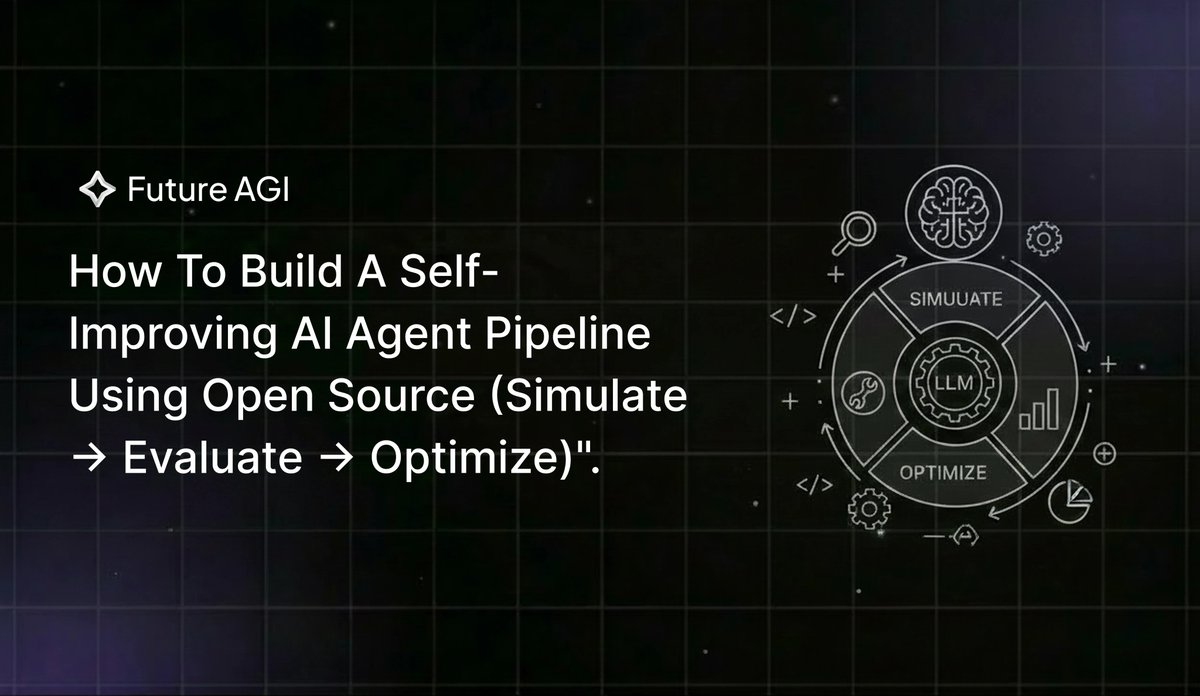
Self-improving AI sounds like a buzzword until you see the engineering behind it. We thought the same, so we built it, open sourced it, and now wrote the guide to show exactly how it works. This week's guide covers the full loop - how adversarial simulation finds failure modes your test cases never will, how purpose-trained eval models replace generic LLM-as-judge at scale, and how the optimization pipeline turns every production failure into a validated fix automatically. That is how you go from repo to running. → shorturl.at/g0Q59
Future AGI tweet media
English
0
1
5
210
Azael
Azael@theazaelov·
@hasantoxr Great now my AI agent has a personal trainer. Next it’ll be asking for a raise.
English
1
0
0
250
Hasan Toor
Hasan Toor@hasantoxr·
Goodbye agents that silently hallucinate in production. Future AGI just open-sourced a full platform that makes AI agents self-improve... and it's wild. You literally plug in your agent and it traces, evaluates, simulates, guardrails, and optimizes it. That's it. It handles everything: - Traces across 50+ frameworks (LangChain, CrewAI, LlamaIndex, DSPy) - 50+ eval metrics in one call (hallucination, groundedness, tool-use, PII) - Simulates thousands of multi-turn conversations before you ship - 18 built-in guardrails + 15 vendor adapters (Lakera, Presidio, Llama Guard) - Gateway hitting ~29k req/s with P99 ≤ 21ms, 100+ providers - 6 prompt optimization algorithms (GEPA, PromptWizard, ProTeGi) No Langfuse. No Braintrust. No Helicone. No Guardrails AI duct-taped together. Honestly, this goes beyond observability tools. It doesn't just monitor your agent... it closes the feedback loop so it self-improves. The project is open-source on GitHub. Apache 2.0, fully self-hostable. It's called Future AGI.
Hasan Toor tweet media
English
30
104
445
167.2K
Future AGI retweetledi
Nikhil Pareek
Nikhil Pareek@itsjustnikhil·
Meet the best friend your AI agent will ever have. And probably the favorite teammate of every engineer shipping it. Falcon AI is live inside @FutureAGI_ today. Built to debug, fix, and optimize your AI systems autonomously. You type what you want. Falcon takes it from there.
English
2
12
22
449
Future AGI
Future AGI@FutureAGI_·
@KroworkAI @hasantoxr We have evals and guardrails directly into the platform. Even technical teams can't catch every hallucination manually at scale. It shouldn't depend on someone spotting it, the platform will catch it for the user automatically.
English
0
0
0
17
KroWork
KroWork@KroworkAI·
@hasantoxr This is a CORE problem for anyone deploying agent workflows to end users: If the person running the workflow isn’t technical, they can’t spot hallucinations.
English
1
0
0
217
Drewski
Drewski@SmellsLikeDrew·
@omarsar0 @FutureAGI_ the trace → eval → refine loop is the only way forward. been poking at sentient's EvoSkill this week, same philosophy but fully open with the harness exposed. good to see more teams treating evals as infra not an afterthought
English
1
0
0
118
elvis
elvis@omarsar0·
Don't try to build a self-improving AI agent without evals. You are just wasting time and compute. An agent can't improve from traces it can't evaluate. This is why it's exciting to see @FutureAGI_ going fully open source with their platform. It combines the best of all the eval tools and methods in one stack. They've shipped a set of tools to make it easier for AI devs to reliably ship self-improving agents. There is a lot to like here: - Evals for hallucination, groundedness, PII, toxicity, tool-use correctness, bias, and any custom metric. Every evaluator is readable and modifiable, not a black-box score. No vendor lock-in to worry about. - Six prompt optimization algorithms (GEPA, PromptWizard, ProTeGi, and others) that take production traces and feed them back as training signals. - Multi-turn simulation before launch, including voice agents through LiveKit, VAPI, Retell, and Pipecat. You stress test edge cases before users ever hit them. - Real-time guardrails for jailbreaks, prompt injection, and PII leaks. - OpenTelemetry-native tracing with 4+ languages (Python, TypeScript, Java, and C#), 50+ framework instrumentors (LangChain, LlamaIndex, CrewAI, AutoGen, DSPy, Haystack). - An OpenAI-compatible gateway with 100+ providers, routing strategies, and caching. If self-improving agents are the direction the field is moving, we need eval infrastructures we can actually trust and build on top of. This is that infrastructure, and now it's open. Check it out here: github.com/future-agi/fut… Generous free tier cloud-based offer here: shorturl.at/cxYOd
GIF
English
13
15
76
10.2K
Future AGI
Future AGI@FutureAGI_·
@adelbucetta @hasantoxr 100% 🫡 the gap isn't access to the tech anymore, it's the discipline to actually use it. teams that close the loop early compound. everyone else stays stuck in pilot purgatory.
English
0
0
0
2
Adel Bucetta
Adel Bucetta@adelbucetta·
@hasantoxr the real unlock isn't just new tech, it's how we respond to it. teams that can actually use this are going to leapfrog years of development and experience
English
1
0
0
90
Kanika
Kanika@KanikaBK·
@hasantoxr Simulation before production is huge
English
1
0
0
91
MetaStack
MetaStack@ArtemBe02482813·
@hasantoxr Omg, this platform sounds like a total game changer!
English
1
0
0
41
Arslan Yousaf
Arslan Yousaf@Arslandev97·
@hasantoxr From ‘build agents’ to ‘agents that improve themselves’… this is the real shift
English
1
0
0
49
Future AGI
Future AGI@FutureAGI_·
Yes, but as you scale and the product starts becoming complex, keeping track of whats working and whats not itself become a full time task. And that is why we made it open for everyone, irrespective of the team size and scale. best part would be the generous free forever tier in cloud hosted app 🎉
English
0
0
0
65
David Moosmann
David Moosmann@damoosmann·
@omarsar0 @FutureAGI_ This holds at scale, less so when you're alone. My loop is tight enough that a missed regression shows up in tomorrow's session, and that's been my eval setup so far. Not pretty but it ships.
English
1
0
1
121
Harry Tandy
Harry Tandy@HarryTandy·
@hasantoxr closing the feedback loop is the only way to build something that actually survives production
English
1
0
0
49