Futurist AI

530 posts

Futurist AI

Futurist AI

@FuturistAI

Software engineer who builds AI things for fun and occasionally overthinks the future of humanity

Katılım Ocak 2022
209 Takip Edilen42 Takipçiler
Futurist AI
Futurist AI@FuturistAI·
@plainionist Opus for everything. People underestimate how many things a poor developer can screw up.
English
0
0
1
11
Seb
Seb@plainionist·
My Architect agent uses Opus 4.8. My Developer agents use Sonnet 4.6. What’s your agent setup? 🤔
English
69
0
47
10.4K
Futurist AI
Futurist AI@FuturistAI·
Now I think separate agents are mainly beneficial in "adversarial" roles, those that require a different identity or mindset and clear context to find mistakes of another agent, e.g., E2E/exploratory tester or code reviewer. Otherwise, it’s not needed; some skills, a script, and a good MD file suffice.
English
2
0
0
85
Uncle Bob Martin
Uncle Bob Martin@unclebobmartin·
When it comes to things like interpreting Jason or Gerkin or static analysis of code, I do not use agents. You’re right, the token use would be embarrassingly high. Instead, I use purpose built tools that the agents use. That keeps the token usage down. Multiple agents in harness is a technique for managing context windows. At the moment, the AI‘s contexts are a liability if the agents have to focus on too many things. So separating them into a harness allows the individual agents to focus and keep their context windows, relatively clean. One of the challenges of building a harness, is to keep the agents from polluting each other. If one agent tells another that it ran a set of tools. Then the other agent will probably start running them too. They can rapidly lose focus and drift into a homogenous gaggle all doing the same things. So information hiding is absolutely essential to keep the agents in their lanes.
English
6
1
50
3.2K
Futurist AI
Futurist AI@FuturistAI·
I've tried something similar before and ended up with 12 agents. They were very strict and specialized, but burned lots of tokens as one agent re-read and updated JSONs or markdowns for the others. The work was high quality but slow and expensive. Some things still got "lost in translation." With Opus 4.8, I tried the same with just a single CLAUDE.md. For now, it really follows it. RIP Harness engineering?
Uncle Bob Martin@unclebobmartin

I just ran a swarm-forge (branch six-pack) with six agents. Specifier, coder, cleaner, architect, hardender, QA. The specifier writes both Gherkin and user oriented QA procedures. Coder codes. Cleaner refactors. Architect manages modules and dependencies. Hardener run mutation tests. QA runs the specifiers QA procedures. Outcome was a usable application with a solid architecture and overloaded with unit tests, acceptance tests, and QA tests.

English
3
0
15
5.4K
Futurist AI
Futurist AI@FuturistAI·
@haider1 It can’t do maths. Okay, but not serious maths. Okay, but it won’t come up with anything new. Fine, but that’s just maths and coding. How about…
English
0
0
1
70
Haider.
Haider.@haider1·
i find it strange how many people still refuse to take AI seriously no matter how much progress we see, there is always a new reason to dismiss it. first, it was "it only predicts text" then, it was "it can't reason" now, it's "it can't do real work" sounds like coping
English
52
5
87
5K
Futurist AI
Futurist AI@FuturistAI·
@FinansowyUmysl Pewnie będą próbować ale większość będzie raczej ciąć zatrudnienie.
Polski
0
0
0
169
FinansowyUmysł
FinansowyUmysł@FinansowyUmysl·
Uzależnienie firmy, w której pracuje (duża, technologiczna amerykańska firma) od AI (claude code) jest tak duże, że gdyby ktoś wprowadził limity to czuje, że mogłyby się wydarzyć dwie rzeczy: 1. Bunt pracowników - claude code niesamowicie ułatwia i przyspiesza pracę, zwłaszcza tam gdzie masz świeży kontekst i musisz zacząć szybko coś dostarczać 2. Spadek wydajności byłby mocno zauważalny Jestem tylko ciekaw ile firm nie wytrzyma kosztów zużycia tokenów i będzie ciąć użycie?
Polski
35
1
119
29.8K
Futurist AI
Futurist AI@FuturistAI·
It's a bit of a chicken-and-egg problem now. It's hard to create something entirely new because, by definition, it's out of distribution and LLMs have trouble with such novelties. For that reason, my bet is on Linux (that's what's used in training, performance is good, footprint is low, and bash is considered the ultimate tool for AI agents) or macOS (similar tooling, lots of training data, local AI performance, security) benefiting directly from it. I think this will be a fierce competition anyway, and it's hard to predict the outcome. MS training its own models to work with Excel sheets is something you can't ignore. One day OpenAI and Anthropic may even release their own Linux distros, with their agent deeply integrated and ready to work. Just tell Opus/Mythos to build it based on their computer use sandbox image, add some cool stuff, fine tune the next model a bit on it and ship it in three weeks. Why not?
English
0
0
0
22
Mark Kretschmann
Mark Kretschmann@mark_k·
The biggest bottleneck in contemporary computing is becoming the operating system. Right now we have three choices: ▫️ macOS: beautiful walled garden ▫️ Windows: 20 years of bitrot ▫️ Linux: wild west None of them feel truly built for the AI computing age. We need something entirely new. Who’s making it?
English
151
15
206
20.2K
Futurist AI retweetledi
Uncle Bob Martin
Uncle Bob Martin@unclebobmartin·
I start with very informal specifications written by hand. I have an agent convert these into harder specifications that are subdivided into tasks. I review these. Then I feed those tasks into the specifier agent, which converts each task to Gherkin, prunes the Gherkin, and then hands it off to the coder agent. I spot check the Gherkin. The coder agent writes acceptance tests directly from the Gherkin. Then writes unit tests. Then writes code. When all those tests pass, the coder agents hands off to the refactorer agent. The refactorer agent reduces crap to 6 or below, and reduces any duplication. Then it write property tests and gets them to pass. Then it hands off to the architect agent. The architect agent runs language mutation and covers any uncovered sections, and kills all survivors. Then it runs Gherkin mutation and kills any of those survivors. Then it runs the entire test suite, and when it passes it hands the result off to the specifier, coder, and refactorer. I spot check the code. This is an exercise of transformations from the informal to the formal through managed stages, with human interaction decreasing with each stage. Raw computer power is the limiting factor. Those mutation tests are CPU intensive.
English
40
58
743
55.1K
Futurist AI
Futurist AI@FuturistAI·
Na tej zasadzie „wszyscy” użytkownicy MacBooków Pro mają AI na własnym komputerze od lat :P Tylko że i tak większość korzysta z najnowszego GPT lub Claude’a. Dlaczego? Bo po co wydawać 20 tysięcy zł na starego diesla, jeśli za 400 zł miesięcznie można jeździć nowym, bezpiecznym elektrykiem z autopilotem? A jak nie jeździsz dużo, to nawet za 100. Śmiech na sali. Ale oczywiście to oferta indywidualna. Jak jesteś dużą firmą, wszystko się zmienia. Płacisz za tokeny na API i rachunek potrafi wynieść 4000 zł miesięcznie. Teraz masz wybór: 1) inwestujesz w Fiata dla każdego i go tuningujesz, albo 2) zwalniasz 3/4 załogi, a reszcie zostawiasz BMW i pozwalasz zapierdalać w tym wyścigu tak szybko, żeby się zwróciło.
Polski
0
0
0
14
Łukasz Olejnik
Łukasz Olejnik@prywatnik·
Wkrótce wszyscy będą mieli AI na własnym komputerze, bez używania serwerów od OpenAI czy Anthropic. Nvidia ogłosiła RTX Spark - układ łączący GPU Blackwell (6144 rdzeni CUDA, tensory FP4) z 20-rdzeniowym CPU Grace, do 128 GB pamięci zunifikowanej i deklarowanej mocy 1 petaflop. Te deklarowane zastosowania są szerokie: renderowanie scen 3D, edycja wideo 12K 4:2:2, lokalne uruchamianie modeli językowych o 120 mld parametrach z kontekstem do miliona tokenów, generowanie wideo 4K i gry AAA w 1440p powyżej 100 fps. Cel tu to wprowadzić obliczenia AI do komputerów osobistych i laptopów, czyniąc stos Nvidii (CUDA) domyślnym środowiskiem dla lokalnych agentów. Microsoft dokłada do tego poważną robotę w ich systemie - dostrajanie planisty w Windows, zmiany w zarządzaniu pamięcią, TensorRT przez Windows ML, sandboxing OpenShell. To nie jest zwykła wymiana układu, a druga próba Microsoftu zdefiniowania, czym ma być "AI PC".
Polski
84
18
340
97.9K
Mitchell Hashimoto
Mitchell Hashimoto@mitchellh·
@kunchenguid If we assume a linear cost, that's going to be $3500. Who is spending $3500 per feature?
English
8
0
101
13.1K
Mitchell Hashimoto
Mitchell Hashimoto@mitchellh·
I've got an agent in a loop optimizing a renderer with the goal to minimize frame times (and tests to measure). It got times down from 88ms to 2ms and allocations down from ~150K to 500. Sounds good, right? Wrong. This is exactly why agent psychosis is a big fucking problem. As an experiment, I rewrote the Ghostty core render state in Go, with access to identically laid out data structures as Ghostty and the exact same validation tests. I made a purposely naive renderer (simple, correct, but slow). 88ms per frame with 150,000 allocations (horrendous, lol)! I then kickstarted a Ralph loop to bring the frame times down. I told it it can't modify input data structures or the public API or tests (they're correct), but it can do anything else it wants. It got to work. It has worked for about 4 hours. I've spent around $350 on this experiment so far. The results? 88ms => 1.5ms 150K allocs => ~500 allocs Incredible right? Nope. My hand-written renderer I ported has frame times (same benchmark) of ~20us (0.020ms) and 0 allocations in the update path. This is the problem with psychosis and lacking systems understanding. If you don't understand the system, you're going to accept that this is an incredible result. If you understand the system, you'll see better solutions immediately and can do roughly 75x better on throughput. The people who blindly trust agent output are in the former camp. They're sheeple, overdrinking from a fountain of mediocrity. Standard disclaimer: I use AI all the time. I like AI. The point I'm making is to not blindly accept results. Think. Analyze. Learn.
English
305
968
8.9K
779.7K
Futurist AI
Futurist AI@FuturistAI·
@CKeruac Trudno się nie zgodzić, to wszystko jest naprawdę super. Tylko czy z tego nowego, wspaniałego hobby będziemy w stanie czerpać nie tylko radość, lecz także środki do życia?
Polski
0
0
3
192
Christopher Keruac
Christopher Keruac@CKeruac·
W ostatnich miesiącach trudno uciec od wszechobecnego pesymizmu w branży technologicznej. Z nagłówków portali informacyjnych i dyskusji w mediach społecznościowych wyłania się ponury obraz: „programowanie umiera”, „AI zastąpi inżynierów”, „rynek się skończył”, a nauka pisania kodu nie ma już sensu. Słuchając tego, można odnieść wrażenie, że cała ta dziedzina stała się wyłącznie nudnym obowiązkiem, który za chwilę zostanie całkowicie zautomatyzowany. Tymczasem, patrząc na rzeczywistość z perspektywy praktyka i pasjonata, trudno o większe nieporozumienie. Prawda jest zupełnie inna: nigdy w historii technologii nie było lepszego momentu na bycie programistą, inżynierem i twórcą. Przekonanie, że programowanie odchodzi do lamusa, wynika z błędnego utożsamiania inżynierii oprogramowania z bezrefleksyjnym przepisywaniem powtarzalnego kodu (tzw. boilerplate). Jeśli czyjaś praca polegała wyłącznie na mechanicznym kopiowaniu schematów z dokumentacji, to rzeczywiście automatyzacja może stanowić dla niego wyzwanie. Jednak prawdziwe programowanie – to oparte na rozwiązywaniu rzeczywistych problemów, łączeniu teorii z praktyką i tworzeniu czegoś z niczego – ma się lepiej niż kiedykolwiek. Programowanie to nie tylko składnia języka; to przede wszystkim strukturyzowanie myśli, modelowanie systemów, fizyka, matematyka i logika przekładane na instrukcje dla krzemu. Tego typu rzemiosło nie tylko nie umiera, ale dzięki nowoczesnym narzędziom zyskuje zupełnie nowy wymiar. Ci, którzy zaczynali swoją przygodę z mikrokontrolerami lub zaawansowanym przetwarzaniem sygnałów kilkanaście czy kilkadziesiąt lat temu, doskonale pamiętają tamte realia. Narzędzia były drogie, zamknięte, toporne i kapryśne. Często połowę czasu przeznaczonego na projekt marnowało się na walkę z konfiguracją środowiska, instalowaniem niestabilnych sterowników, pisaniem własnych linkerów czy debugowaniem przez prowizoryczne interfejsy. Dziś sytuacja wygląda zupełnie inaczej. Standardem stały się darmowe, lekkie i potężne środowiska, takie jak VS Code z oficjalnymi rozszerzeniami dla nowoczesnych architektur (np. STM32). Do dyspozycji mamy otwarte systemy budowania (CMake) i stabilne toolchainy GCC, które działają od ręki na niemal każdym systemie operacyjnym. Flaszowanie i debugowanie odbywają się w ułamku sekundy, bez konieczności opuszczania edytora. Co więcej, niesamowicie skróciła się droga od teorii matematycznej do działającego kodu na fizycznym urządzeniu. Używając Pythona z bibliotekami takimi jak NumPy i SciPy, możemy w kilka minut zamodelować skomplikowane zagadnienia – na przykład wyznaczyć kąty kluczowania dla modulacji SHE-PWM (Selective Harmonic Elimination), zweryfikować widmo za pomocą szybkiej transformaty Fouriera (FFT) i upewnić się, że matematyka się zgadza, zanim jeszcze dotkniemy właściwego mikrokontrolera. Kiedyś wymagało to specjalistycznego, niezwykle drogiego oprogramowania i godzin żmudnych obliczeń. Dziś to kwestia kilkunastu linii kodu na zwykłym laptopie. Dzięki tej rewolucji narzędziowej i AI możemy dziś wracać do projektów sprzed lat – pomysłów, które kiedyś wydawały się zbyt trudne. Bariera wejścia w zaawansowane tematy drastycznie spadła. To, co kiedyś wymagało całych zespołów badawczo-rozwojowych w dużych firmach, dziś zaangażowany hobbysta może zaprojektować, zasymulować i uruchomić na biurku w wolnym czasie. Dyskusje o kryzysie w branży często skupiają się wyłącznie na perspektywie etatowej pracy w korporacjach. Zapominamy jednak, że programowanie to także – a może przede wszystkim – potężne narzędzie osobistej ekspresji i rozwoju. Praca zawodowa bywa ograniczana przez budżety, sztywne ramy projektowe, legacy code czy decyzje biznesowe, na które nie mamy wpływu. Ale po godzinach, przy własnym projekcie, to my decydujemy o architekturze, technologii i kierunku rozwoju. Możemy uczyć się nowych rzeczy bez presji czasu, popełniać błędy, testować nieszablonowe rozwiązania i czerpać satysfakcję z samego procesu dochodzenia do celu. Zamiast ulegać zbiorowej panice i powtarzać hasła o końcu programowania, warto docenić moment, w którym się znajdujemy. Mamy dostęp do najlepszych narzędzi w historii, niesamowicie wydajnego i taniego sprzętu oraz globalnej wiedzy dostępnej na wyciągnięcie ręki. Dla każdego, kto chce się uczyć, eksperymentować i tworzyć, to nie jest żaden koniec. To początek ery, w której ogranicza nas głównie własna wyobraźnia i czas, jaki jesteśmy w stanie poświęcić na naukę. Zamiast martwić się o przyszłość kodu, po prostu go piszmy, budujmy i czerpmy radość z tego, jak wspaniałe możliwości mamy dziś do dyspozycji. Miłego! :)
Christopher Keruac tweet media
Polski
29
16
159
11.7K
Futurist AI
Futurist AI@FuturistAI·
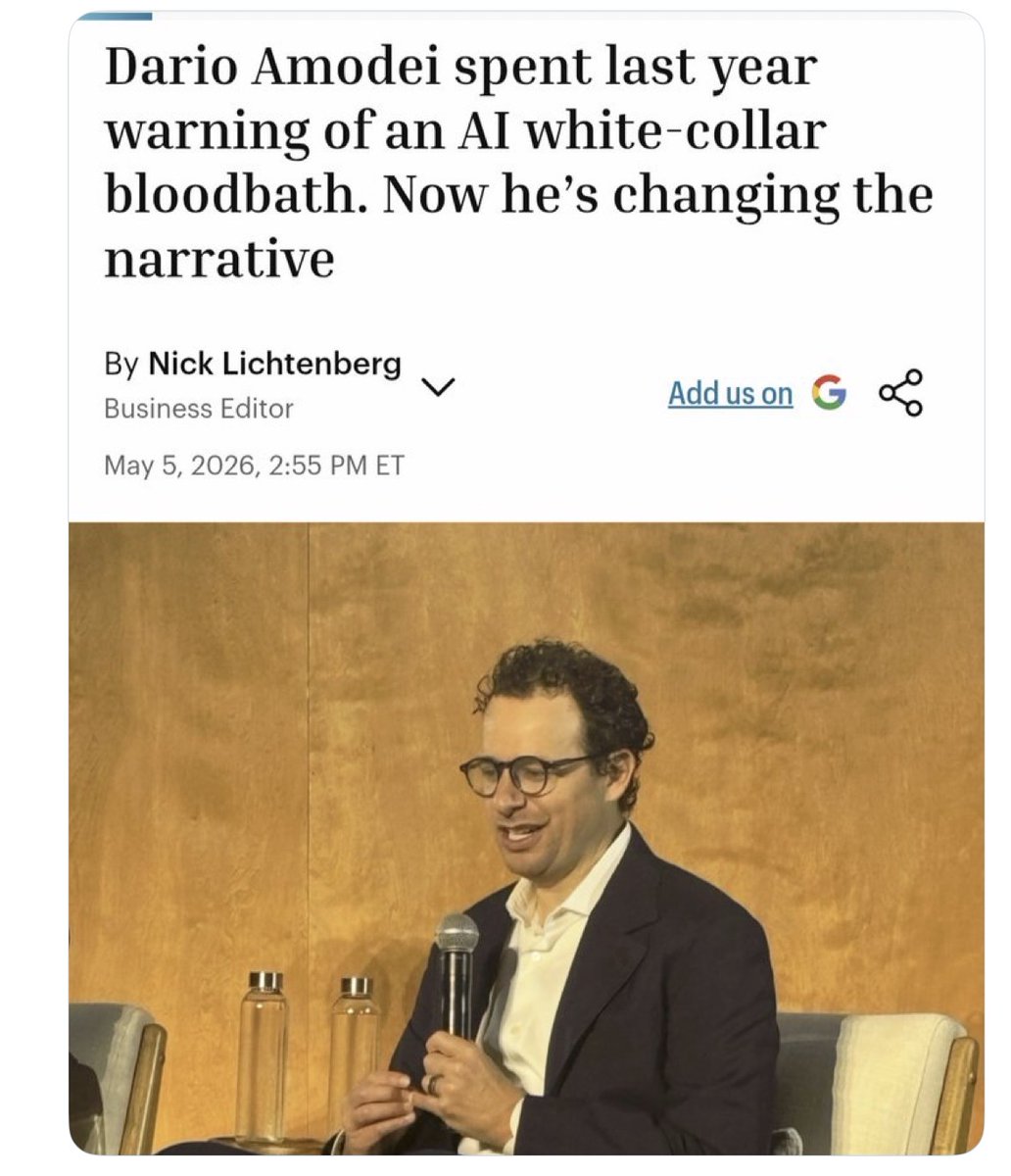
@Przegaa Marketing przed IPO. Jesteśmy świadkami postępującej (choć bardzo trudnej, nierównej, czasem nieudolnej) transformacji świata pracy umysłowej z modelu pracochłonnego na kapitałochłonny. Paradoks Jevonsa nie dotyczy rynku pracy i żadnego zawodu nie uratuje.
Polski
0
0
0
26
Aʟᴇᴋꜱᴀɴᴅʀᴀ ᴘʀᴢᴇɢᴀʟɪɴꜱᴋᴀ
Ciekawy zwrot. Rok temu Amodei ostrzegał przed "krwawą łaźnią" wśród białych kołnierzyków i zniknięciem połowy stanowisk dla osób wchodzących na rynek pracy. Teraz, siedząc obok Jamiego Dimona, sięga po paradoks Jevonsa: zautomatyzuj 90% pracy, a wszyscy zaczną robić pozostałe 10%, które się rozrasta i mnoży. Sam Altman też złagodniał, mówiąc wręcz, że cieszy się, że mylił się co do tempa zmian. Z czym mamy tu do czynienia? Realne otrzeźwienie czy marketing? Skłaniam się ku czemuś pośredniemu, z mocną przewagą tego drugiego. Zmieniły się dwie rzeczy naraz. Krytyka wokół hype'u na AI (nawet buczenie!) stała się na tyle głośna, że zaczęła kosztować reputacyjnie i regulacyjnie, a obie firmy szykują się do IPO, gdzie optyka inwestorska nagradza "mnożnik produktywności", a nie "maszynę do masowego bezrobocia". Jest tu jednak też realna logika ekonomiczna, którą warto nazwać. W gospodarce opartej na konsumpcji, takiej jak amerykańska, masowy displacement nie przynosi owoców nawet wielkim graczom. Nie sprzedasz oprogramowania, usług ani niczego innego ludziom, którzy stracili siłę nabywczą. Krwawa łaźnia jest zła dla rynku pracy i zła dla strony popytowej, która ostatecznie karmi te firmy. Co sądzicie, otrzeźwienie czy repozycjonowanie?
Aʟᴇᴋꜱᴀɴᴅʀᴀ ᴘʀᴢᴇɢᴀʟɪɴꜱᴋᴀ tweet mediaAʟᴇᴋꜱᴀɴᴅʀᴀ ᴘʀᴢᴇɢᴀʟɪɴꜱᴋᴀ tweet media
Polski
17
8
55
5.9K
Futurist AI
Futurist AI@FuturistAI·
We're witnessing an uneven shift from labor-intensive to capital-intensive software production. We can produce cloth faster, but the power looms are getting expensive. Output quality is still worse. People are still needed to check the cloth, operate the looms, and maintain them.
English
0
1
1
12
miroburn
miroburn@miroburn·
Ktoś mądry może mi powiedzieć, co się stanie, gdy te cyferki przy procentach wejdą na 100%?
miroburn tweet media
Polski
60
1
38
26.4K
Futurist AI
Futurist AI@FuturistAI·
@starmexxx 7b model for agentic coding? It couldn’t even write your shitslop post well enough. Llama 3? Your knowledge cutoff was in 2024..
English
0
0
14
840
starmex
starmex@starmexxx·
NVIDIA QUIETLY DROPPED A $249 BOX THAT REPLACES YOUR $200/MONTH OPENAI SUBSCRIPTION WITH $2 IN ELECTRICITY it's called the jetson orin nano super. smaller than a wallet, runs at 25 watts, does 70 trillion ai operations per second. runs llama 3, mistral, gemma and deepseek locally with no api fees and no data leaving your house a developer running automations and coding assistants pays $200 a month to openai. the same workload on this box costs $2 a month in electricity and breaks even in 10 weeks install ollama with one command. change one line in your code. point it at localhost instead of openai. everything else works identically 7 billion parameter models handle 80% of what people use chatgpt for. summarization, drafting, coding, document q&a, automation pipelines. total monthly cost drops from $200 to $22 cloud subscriptions keep getting more expensive and rate limits keep getting tighter. the people who set this up in 2025 are going to look very smart in 2027 bookmark this and read the article below
starmex@starmexxx

x.com/i/article/2058…

English
384
909
5.7K
2.3M
Futurist AI
Futurist AI@FuturistAI·
@Star_Knight12 Yeah, they will not hire back. But they will tell employees to learn how to optimize token costs. And if you spend too much without delivering, well, good luck on your performance review.
English
0
0
4
181
Prasenjit
Prasenjit@Star_Knight12·
what happens when companies realize AI costs more than the people it replaced
English
164
24
392
26.2K
raymondreamer
raymondreamer@raymondreaming·
@Star_Knight12 How do people come to this conclusion? I literally create thousands of dollars of productivity everyday, 7 days a week On a $200/m codex plan Do companies not use this or have to pay per token??
English
1
0
0
161
Futurist AI
Futurist AI@FuturistAI·
AI makes it far easier and cheaper to improve quality without losing productivity than to increase productivity without wrecking quality. Yet “productivity” is all we talk about. Quality is almost never mentioned.
Aiswarya Sankar@Aiswarya_Sankar

This is what we've been seeing with every company we work with. Try justifying spending 100k on token spend when only 18k even makes it to a stable prod feature. In the rush to maximize AI token spend, companies are wasting over 44% on bug fixes

English
4
26
155
325.5K
Futurist AI
Futurist AI@FuturistAI·
Well, it was always like this. At least, junior devs rarely understood the whole codebase or architecture of the system. They were told what to write, where, and sometimes even how. Occasionally, they were let loose to figure something out on their own, and the effect was.. working, but far from optimal. Now we have these super-fast junior AI devs that do the same thing.
English
0
0
1
16
Yann Kronberg
Yann Kronberg@zazmic_inc·
What's weird is that writing code got cheap before understanding code got cheap. So now teams can generate 10x more changes into systems nobody fully understands, and then act surprised when the bottleneck becomes review, cleanup and “wait, why does this exist?”
English
1
0
3
164
Bindu Reddy
Bindu Reddy@bindureddy·
We will continue to see layoffs from companies with large eng teams Engineers are producing 10-100x the code they used to.... This is causing a lot of instability in companies with large code bases and teams The status-quo is simply not sustainable
English
45
11
207
16.8K
Futurist AI
Futurist AI@FuturistAI·
China’s Xiaomi is entering the price war just as Americans are running out of money for subsidies. Price cuts of up to 99% in some cases (cache hits, which actually cost almost nothing, but make for great marketing). These aren’t top-shelf models, but they’re good enough for plenty of use cases. The real price users pay is data - which the Chinese can do anything with. Reminder: this is a country where, for over a decade, the biggest companies ran apps streaming foreign music for free, mostly illegally, unfazed by even the largest industry titans. They’re not afraid of Anthropic or OpenAI, openly extracting data from their models. Would they be afraid of a John Doe lawsuit for using his confidential data? Think twice before you start using dirt-cheap intelligence from the Far East. P.S. Even assuming some American startups also steal user data (which will probably come to light eventually), they at least do it with cleaner hands. Their Chinese counterparts couldn’t care less. Kimi thinks it’s called Claude. And what are you gonna do about it?
Xiaomi MiMo@XiaomiMiMo

🚀 Better inference efficiency, lower costs, broader access. MiMo-V2.5 Series API pricing is now permanently reduced — by up to 99% compared to previous pricing. ✨ Unified pricing across all context lengths. MiMo Token Plans have also been upgraded: • 5–8× more usable tokens at the same price • Simpler and more transparent billing rules 🎁 As a thank-you to current users, all current Token Plan credits will be fully reset. 🎧 MiMo-V2.5-TTS remains free for a limited time. ⏰ Effective May 26 at 6:00 PM PDT. These improvements are powered by continued inference optimization and serving efficiency upgrades across the MiMo stack. 🛠️ We’ll also publish a detailed technical blog on the inference optimizations later — stay tuned.

English
0
0
0
52