
Sabitlenmiş Tweet

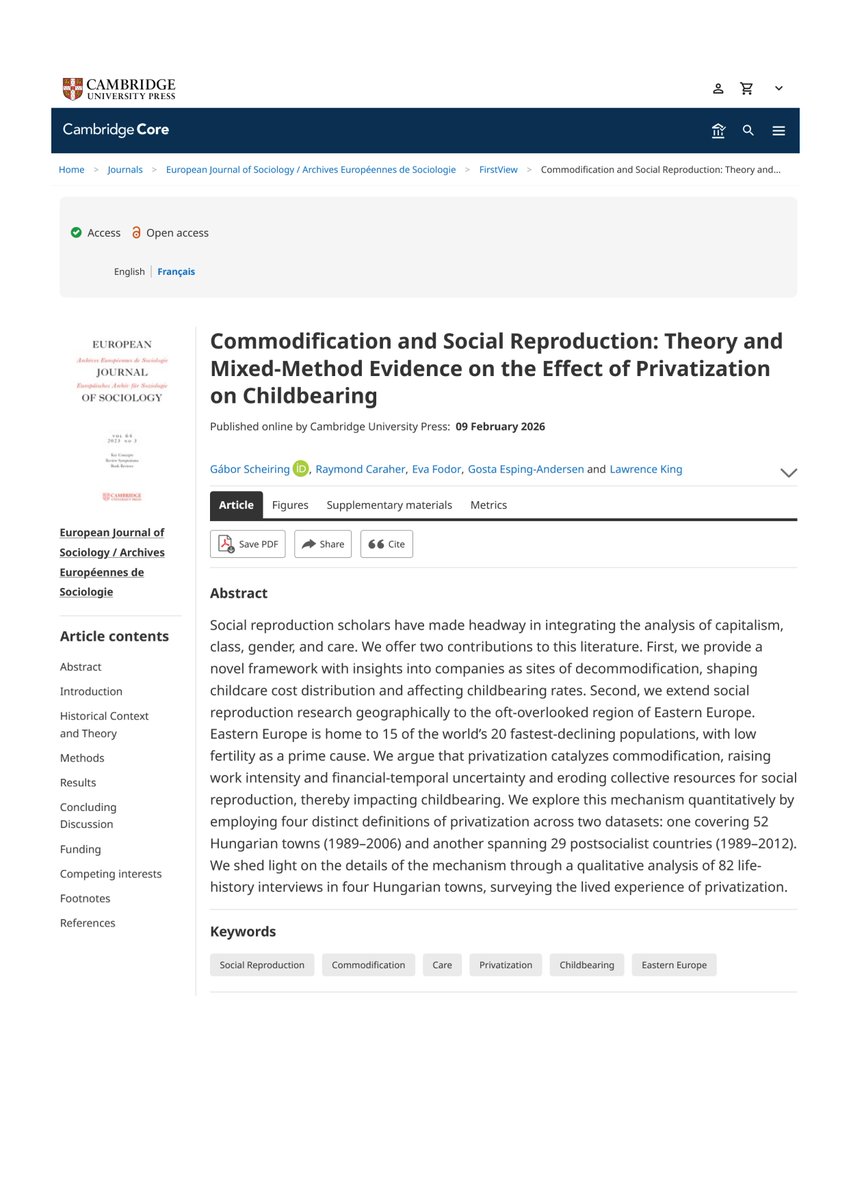
I have a new paper out in the European Journal of Sociology! Commodification and Social Reproduction: Theory and Mixed-Method Evidence on the Effect of Privatization on Childbearing.
I have friends who do brilliant work on #social #reproduction, take #Marx seriously, but don’t find #demography inspiring. I also have demographer friends who do brilliant work on #fertility but don’t know social reproduction theory and don’t take Marx seriously. Putting these two worlds in dialogue was always going to be a tall order. That’s also what motivated this study.
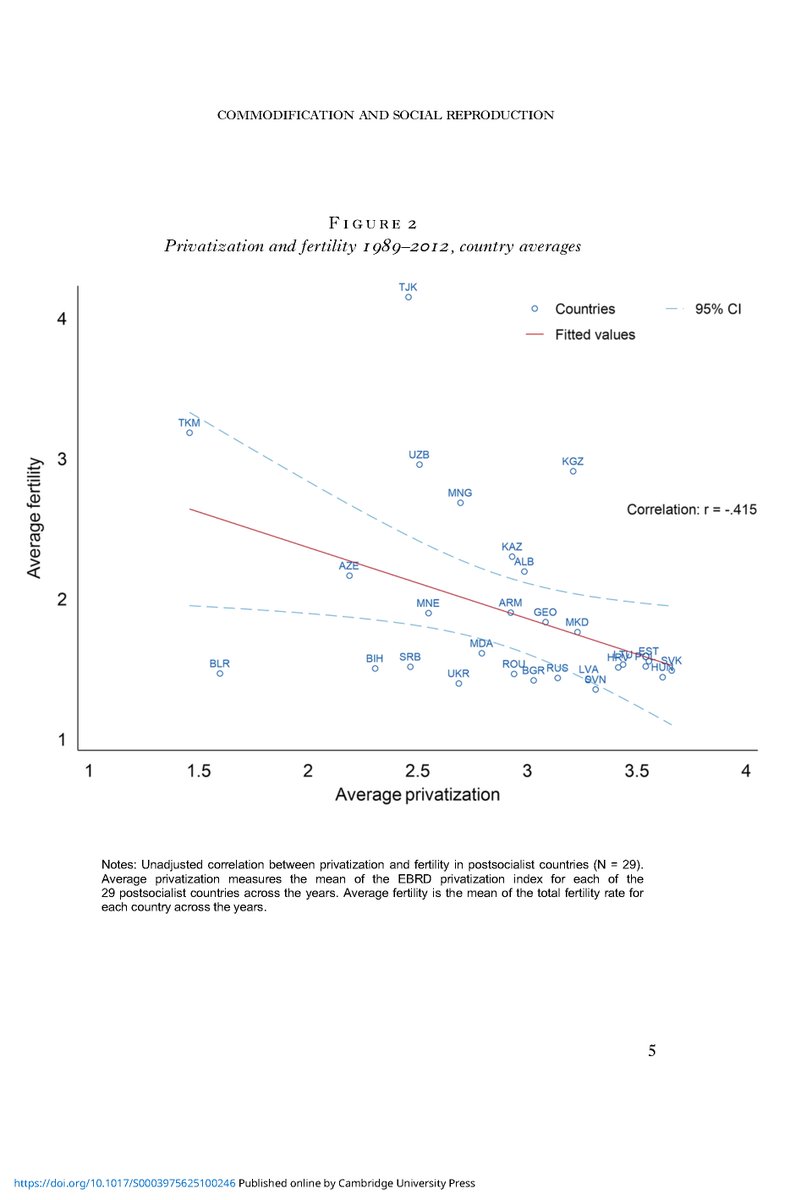
Economic production and social reproduction are two sides of the same coin. Social reproduction theory asks a deceptively simple question: if workers produce value, who produces workers? And how are the costs of producing and sustaining life #distributed across genders, households, markets, and the state? We argue that these are not side questions but core to understanding the #postsocialist #fertility #decline. This is not a minor story. Around 15 of the world’s 20 fastest #shrinking populations are located in Eastern Europe, with low fertility as a major driver.
Empirically, we combine cross-national panel models with subnational and qualitative evidence to trace the mechanism. #Privatization and commodification shift risk downward, reorganize household budgets and time, and make #childbearing a far more uncertain project. Marketization does not just reshape jobs and incomes. It reaches into intimate life decisions by transforming the conditions of social reproduction.
I’m grateful to all my co-authors Lawrence King, @EvaFodor_CEU, Raymond Caraher, and Gosta Esping-Andersen. Co-authoring with Gosta, a doyen of welfare state theory and social demography, was quite an experience. As the acknowledgements section demonstrates, many contributed to this study. I’d like to flag the help from @azarrova, Darja Irdam, @gigoca, @EszterKovats, @LMurinko, @i_reprosoc, and @DorottyaSzikra.
A peek behind the scenes, because behind every success in academia there are dozens of invisible setbacks. This paper took around eight years from first idea to publication. It went through multiple submissions, a second-round rejection at a top journal (American Journal of Sociology), and several R&Rs that would have required reshaping the argument in ways that would have hollowed out what the paper is trying to say. Part of this reflects how broken the academic publication game is. Part of it reflects the paper’s unusual niche. It relies on advanced quantitative tools, but it is not a clean causal inference design. It is also theoretically hybrid, and the tensions between social reproduction scholarship and mainstream demography made some pushback almost inevitable.
A lot changed in my life over these eight years. I lived in six cities, in five countries, across three continents. I held multiple precarious contracts and lived through major political upheavals. There was one “comforting” constant, though: this paper was almost always under review somewhere. Not anymore.
As they say: Each article is its own Vietnam — easy to get into, hard to get out of. In the end, it found a very good permanent home at EJS. In the end, it found a very good permanent home at EJS. Comments welcome!
#politicalconomy #sociology @GUQatar @QNLib
English