Gabor Scheiring

1.9K posts

Gabor Scheiring banner
Gabor Scheiring

Gabor Scheiring

@gscheiring

Asst Prof of Comparative Politics @GUQatar • Economic shocks, authoritarianism, class, populism, health • #FirstGen • Formerly @EuropeAtHarvard & @Cambridge_Uni

Katılım Ağustos 2014
1.5K Takip Edilen2.2K Takipçiler
Sabitlenmiş Tweet
Gabor Scheiring
Gabor Scheiring@gscheiring·
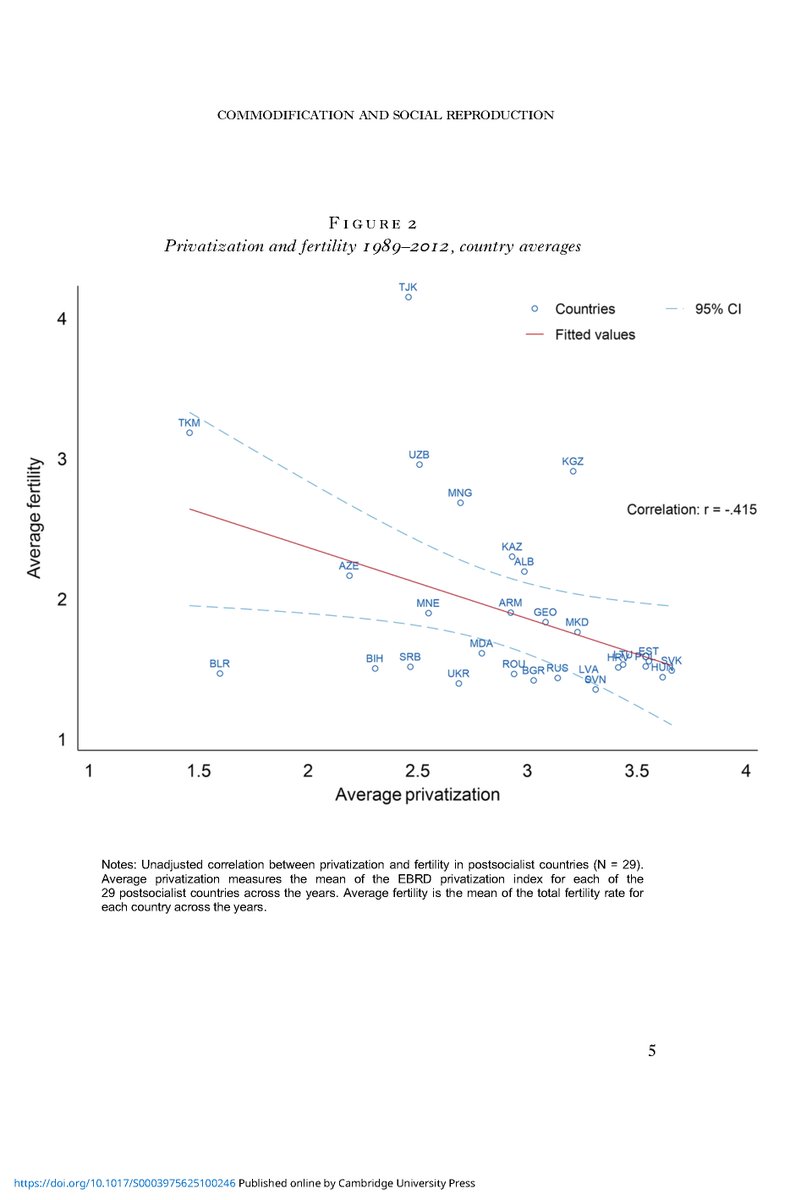
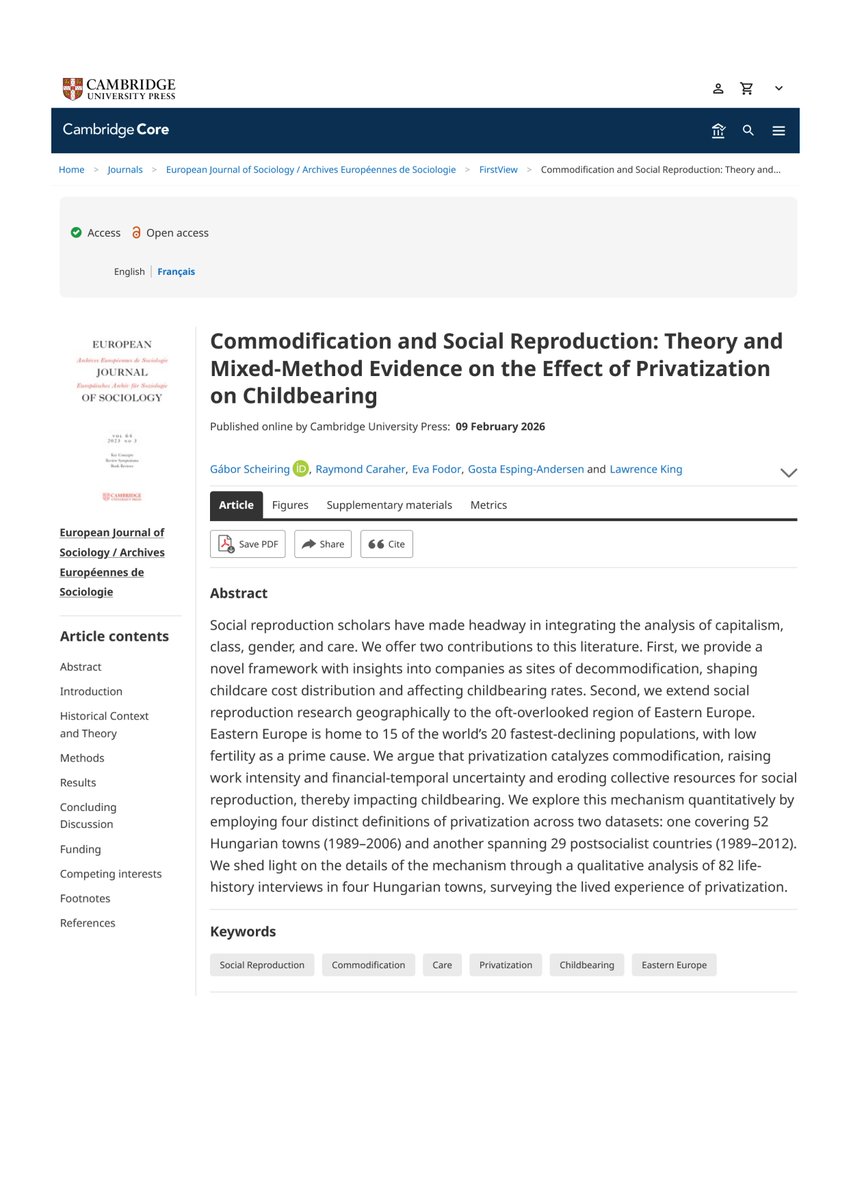
I have a new paper out in the European Journal of Sociology! Commodification and Social Reproduction: Theory and Mixed-Method Evidence on the Effect of Privatization on Childbearing. I have friends who do brilliant work on #social #reproduction, take #Marx seriously, but don’t find #demography inspiring. I also have demographer friends who do brilliant work on #fertility but don’t know social reproduction theory and don’t take Marx seriously. Putting these two worlds in dialogue was always going to be a tall order. That’s also what motivated this study. Economic production and social reproduction are two sides of the same coin. Social reproduction theory asks a deceptively simple question: if workers produce value, who produces workers? And how are the costs of producing and sustaining life #distributed across genders, households, markets, and the state? We argue that these are not side questions but core to understanding the #postsocialist #fertility #decline. This is not a minor story. Around 15 of the world’s 20 fastest #shrinking populations are located in Eastern Europe, with low fertility as a major driver. Empirically, we combine cross-national panel models with subnational and qualitative evidence to trace the mechanism. #Privatization and commodification shift risk downward, reorganize household budgets and time, and make #childbearing a far more uncertain project. Marketization does not just reshape jobs and incomes. It reaches into intimate life decisions by transforming the conditions of social reproduction. I’m grateful to all my co-authors Lawrence King, @EvaFodor_CEU, Raymond Caraher, and Gosta Esping-Andersen. Co-authoring with Gosta, a doyen of welfare state theory and social demography, was quite an experience. As the acknowledgements section demonstrates, many contributed to this study. I’d like to flag the help from @azarrova, Darja Irdam, @gigoca, @EszterKovats, @LMurinko, @i_reprosoc, and @DorottyaSzikra. A peek behind the scenes, because behind every success in academia there are dozens of invisible setbacks. This paper took around eight years from first idea to publication. It went through multiple submissions, a second-round rejection at a top journal (American Journal of Sociology), and several R&Rs that would have required reshaping the argument in ways that would have hollowed out what the paper is trying to say. Part of this reflects how broken the academic publication game is. Part of it reflects the paper’s unusual niche. It relies on advanced quantitative tools, but it is not a clean causal inference design. It is also theoretically hybrid, and the tensions between social reproduction scholarship and mainstream demography made some pushback almost inevitable. A lot changed in my life over these eight years. I lived in six cities, in five countries, across three continents. I held multiple precarious contracts and lived through major political upheavals. There was one “comforting” constant, though: this paper was almost always under review somewhere. Not anymore. As they say: Each article is its own Vietnam — easy to get into, hard to get out of. In the end, it found a very good permanent home at EJS. In the end, it found a very good permanent home at EJS. Comments welcome! #politicalconomy #sociology @GUQatar @QNLib
Gabor Scheiring tweet mediaGabor Scheiring tweet media
English
0
6
17
1.6K
Gabor Scheiring
Gabor Scheiring@gscheiring·
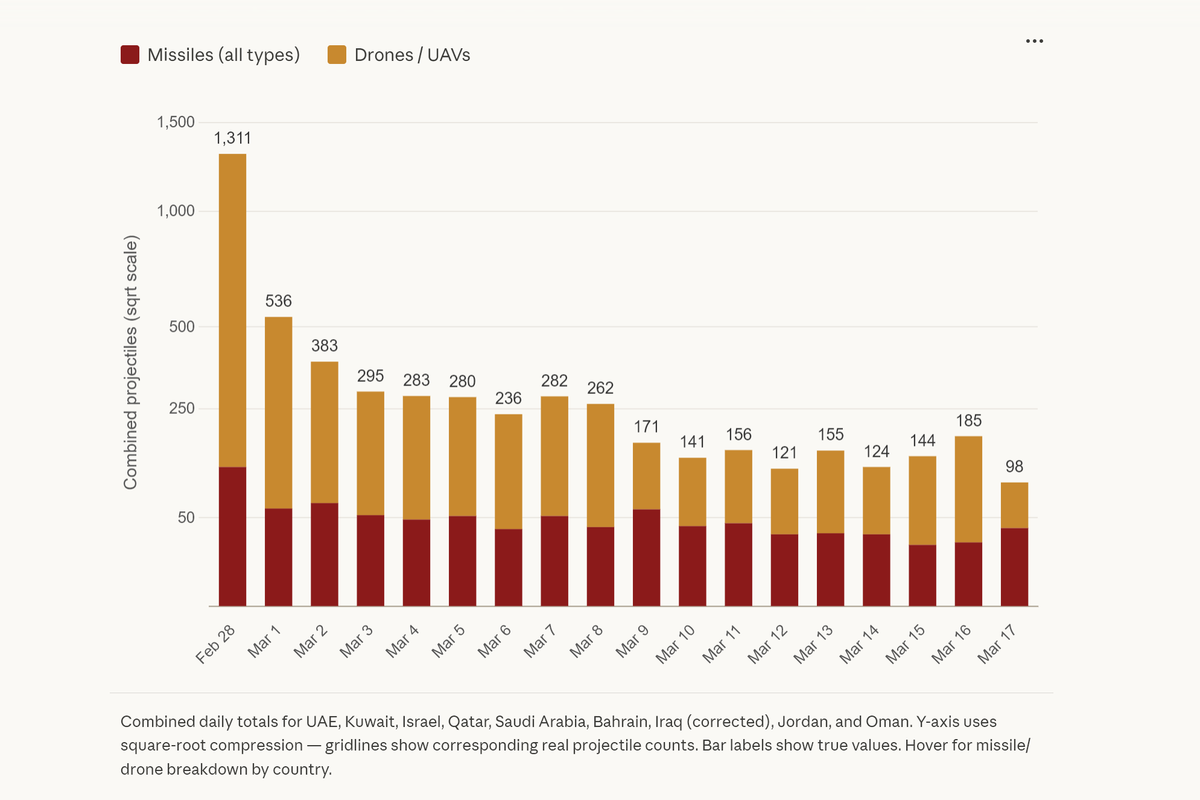
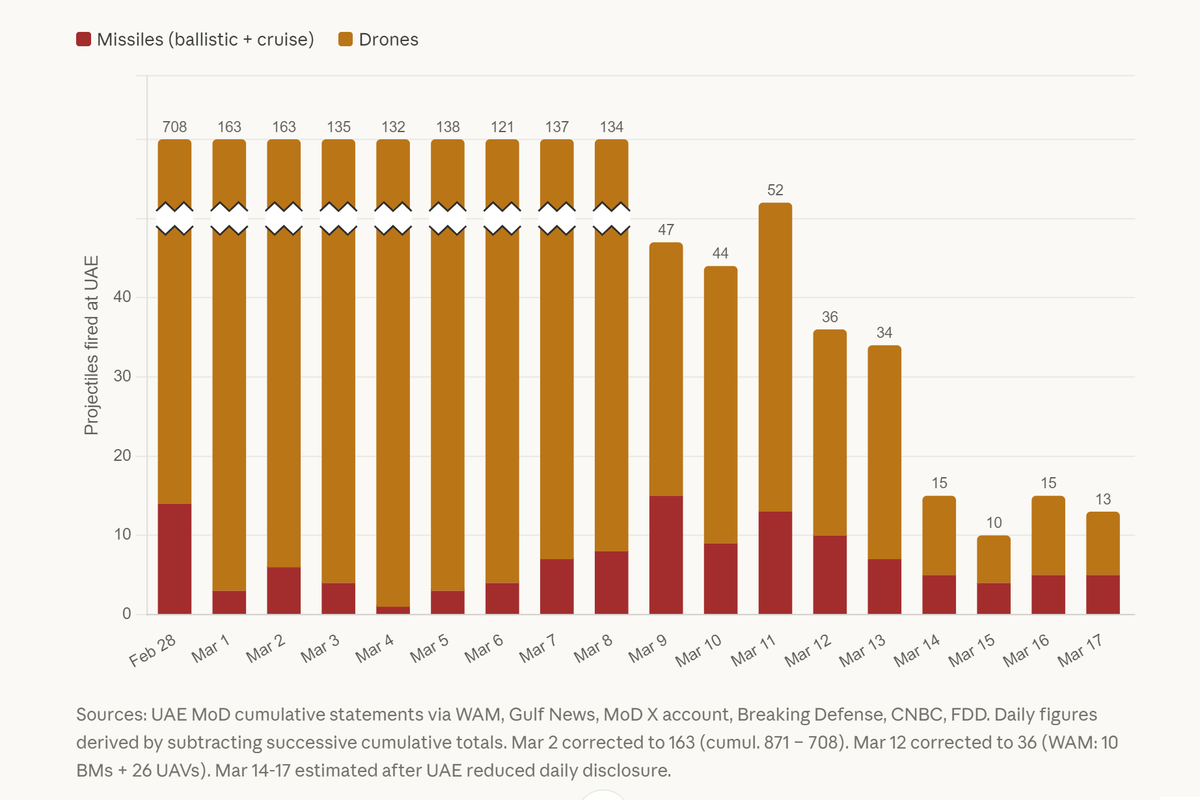
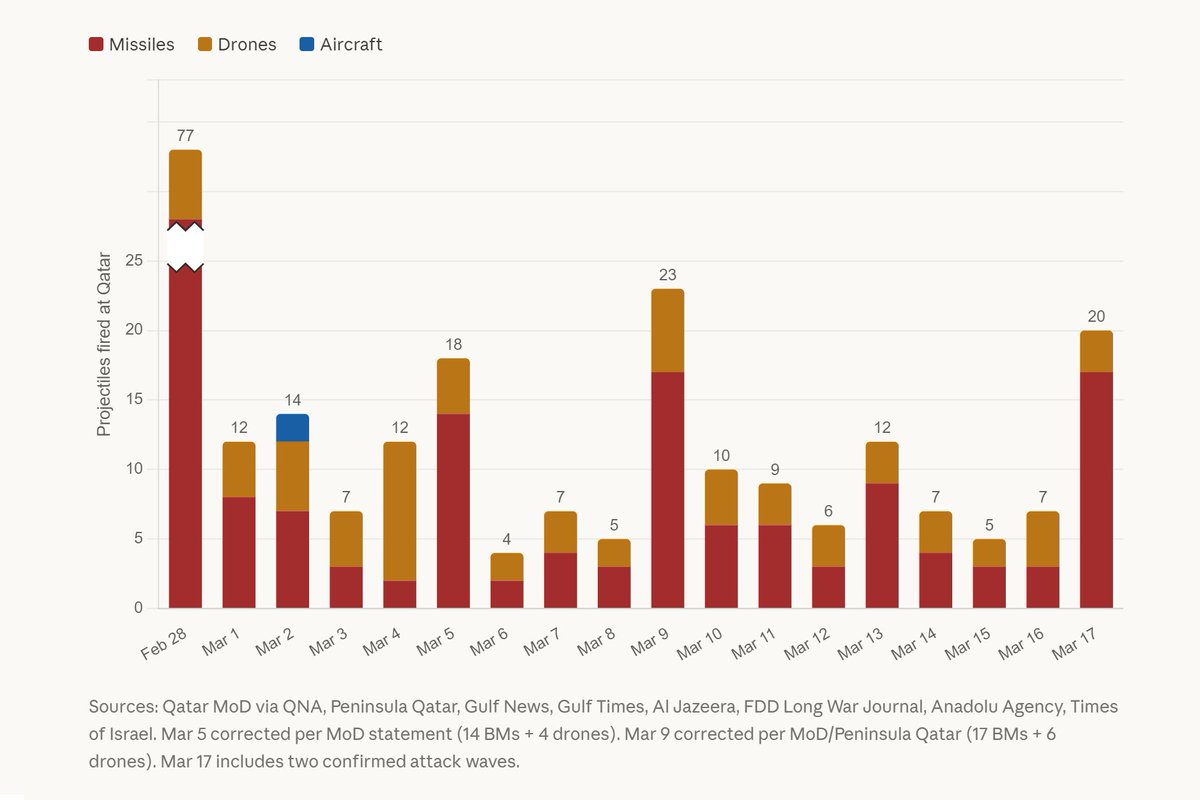
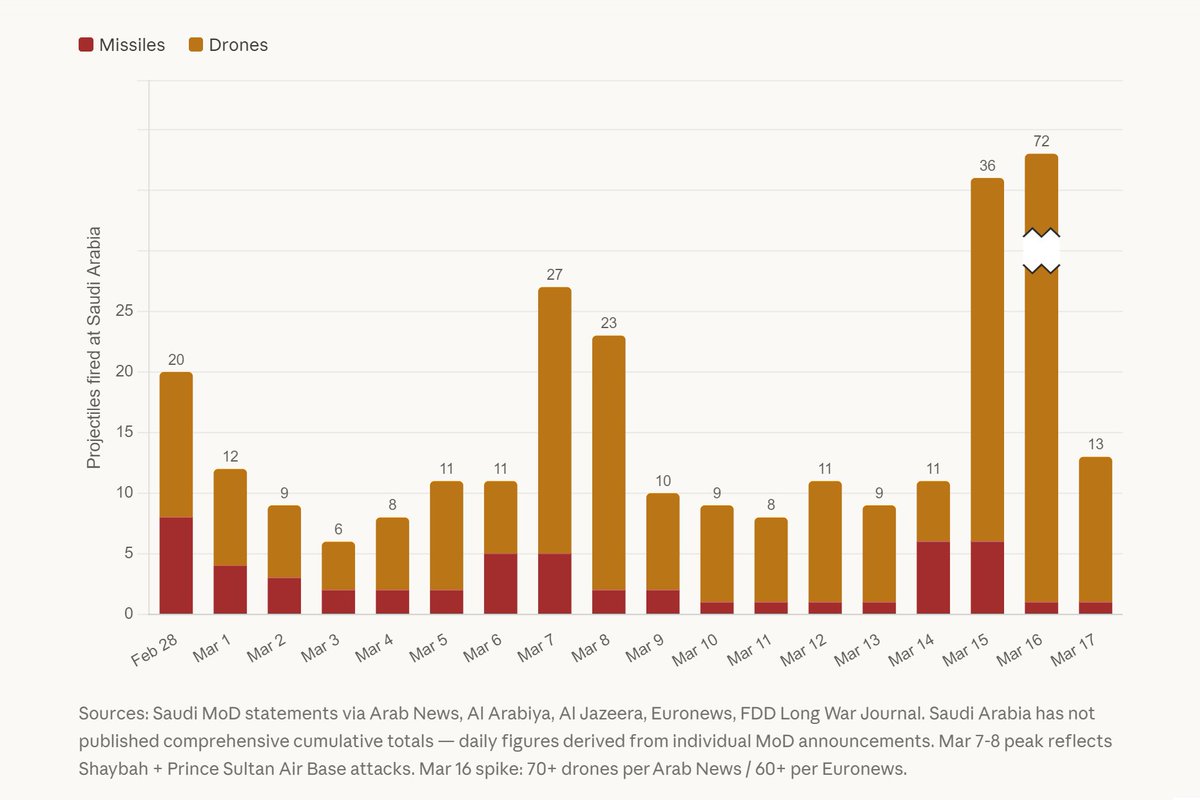
How much has Iran actually lost its ability to strike back? To get a clearer picture of the actual trend behind the headlines, I compiled* daily missile and drone launch data for all nine countries targeted by Iran since February 28 (UAE, Kuwait, Israel, Qatar, Saudi Arabia, Bahrain, Iraq, Jordan, and Oman). Here's what the data shows: Yes, there has been a significant decline from Day 1. But February 28 was a massive outlier, over 1,400 projectiles across all targets. Measuring "90%+ decline" from that peak is highly misleading. The bulk of the drop happened in the first week, driven by the destruction of fixed launch sites and drone stockpiles. The decline is overwhelmingly in drones. Missile launches dropped from the initial spike but have hovered around 30–50 per day since the first few days, not a trajectory consistent with "obliterated" infrastructure. Since around March 9, the daily combined total has plateaued at roughly 100–130 projectiles per day, and that number has proven stubbornly resistant to further degradation. The UAE has been the single largest target, absorbing more projectiles than Israel. Both have seen declining volumes, but the UAE bore the brunt of the initial drone saturation. If you set aside the Feb 28 outlier, attacks on Qatar and Saudi Arabia show remarkably little decline. Saudi Arabia actually saw its highest single-day total on March 16 (72 projectiles). Qatar's pattern is erratic but flat (as I am writing and posting this, qatari air defenses intercepted another wave of attacks early afternoon on March 17). Iraq is a unique case, attacked primarily by Iranian-backed militias from within its own territory, with a flatter trajectory because shorter supply lines haven't been as affected by coalition strikes on Iran proper. Three distinct Iranian playbooks are emerging: → UAE: High-volume saturation. The focus is on economic and infrastructure targets: airports, oil facilities, industrial zones. The sheer volume is designed to overwhelm air defenses and inflict economic pain. → Qatar: Targeted barrages. The focus has been on Al Udeid Air Base and, more recently, US/tech and diplomatic assets. Lower volume but more precise, reflecting Qatar's specific role as the US regional command hub. → Iraq: Hybrid warfare. High-frequency militia harassment, nightly drone attacks on Erbil, Baghdad airport, US embassy, with sporadic heavier Iranian strikes layered on top. The militia supply lines are short and appear largely intact. The bottom line: Iran has settled into a rate of attrition that's been largely sustainable since the first week, with minor overall decline since March 10. Iran's launch capacity has been reduced but far from obliterated. The big question is, how long they can sustain this, and how long the targeted countries can repel the attacks. *Methodology note: I used Claude and Gemini to compile this data from official statements and regional news sources. The synthesis and analysis are my own, Claude and Gemini helped visualize, aggregate, and cross-verify the data. The data is suitable for tracking broad trends, but given inconsistent reporting, daily figures may contain errors.
Gabor Scheiring tweet mediaGabor Scheiring tweet mediaGabor Scheiring tweet mediaGabor Scheiring tweet media
English
0
0
0
266
Gabor Scheiring retweetledi
Chris Murphy 🟧
Chris Murphy 🟧@ChrisMurphyCT·
It’s crystal clear now that Trump has lost control of this war. He badly misjudged Iran’s ability to retaliate. The region is on fire. 1/ I’m going to explain to you in this🧵what I’ve learned - in part from closed door briefings - about the four biggest current crises.
English
4.3K
10.1K
41.4K
5.4M
Gabor Scheiring retweetledi
Branko Milanovic
Branko Milanovic@BrankoMilan·
Normalization of wars. One war, in the middle of Europe, lasts for more than 4 years. Another war, in its various versions, has been raging in the Middle East for two-and-half years. We normalize the situation of wars until the war eventually comes looking for us.
English
8
96
372
25.3K
Gabor Scheiring
Gabor Scheiring@gscheiring·
I spent the last 24 hours digging into the economic impact of the Iran war. Here's what I found (brace for a long post): The Hormuz Shock: Economic Repercussions of the Iran War. Key insights: 👉Optimistic scenario: War ends within two weeks. This is painful but might be still manageable in advanced economies. However, even the record release of 400 million barrels of oil did not calm markets. 👉Pessimistic scenario: Strait of Hormuz stays closed past March: massive global inflationary pressure and recession, a 1970s-style stagflation becomes likelier day by day. 👉Biggest economic victims outside Iran: Iraq and Lebanon. Energy and financial crisis in many Global South countries is already imminent. 👉Gulf countries will weather the storm in the short term, but their diversification plans were built on the image of stability, and that image received a blow. 👉Biggest economic winner so far is Russia, but US arms manufacturers and LNG exporters also profit through higher LNG prices. Staring Into the Abyss Twelve days into the U.S.-Israeli war on Iran, the global economy is experiencing its most severe supply-chain disruption since the 1973 oil embargo. The effective closure of the Strait of Hormuz has removed not just a fifth of the world’s oil and LNG from the market, but a third of global fertilizer exports, nearly a quarter of the world’s aluminum outside China, and a third of global helium production, a vital component in semiconductor manufacturing. We are not only talking about an energy crisis in the conventional sense. We are looking at the making of a global commodity shock transmitting simultaneously through energy, industrial, agricultural, and chemical supply chains. These are ingredients for an inflationary perfect storm. Every major energy crisis of the past half-century has been geopolitically driven: 1973, 1979, 1990, 2022, and now 2026. What distinguishes the current shock from its predecessors is its breadth. In 1973, it was oil. In 2022, the disruption was primarily gas. In 2026, the chokepoint disrupts a range of commodities at once. We are not in a major crisis scenario yet, though we’re approaching it rapidly. The Most Recent Predictions The economic trajectory depends almost entirely on how long the Strait of Hormuz remains closed. We can identify two scenarios, and the window for the optimistic one is narrowing fast. Optimistic scenario: If the war ends within one to two weeks, not dragging beyond March, and Hormuz begins reopening at the latest by early April, the economic damage is contained, at least for advanced economies, though Global South countries might still suffer. Based on existing research on energy price shocks, this scenario would shave half a percentage point off global growth and add up to one percentage point to global inflation. Reserves exist in the system, winter has just ended, and there is no immediate gas crunch in Europe. In this scenario, a Goldman Sachs report released on March 11 predicts oil averaging roughly $100 per barrel through March and April. On gas, Goldman projects the European benchmark price (TTF) reaching €55–74 per megawatt-hour, which is very painful but manageable, roughly the level that triggered demand responses during the 2022 crisis. Summer gas storage refilling becomes more expensive but feasible. Even in this best case, however, the effects outlast the war: shut-in oilfields take weeks to restart, damaged infrastructure at Qatar’s Ras Laffan complex and Saudi Arabia’s Ras Tanura needs physical repair, and gas prices remain elevated for months, with the benchmark gas price lower floor shifting permanently upward from the pre-war €25–30 range to €45–55. This means elevated gas prices throughout energy-importing countries. As of March 12, the optimistic scenario’s window is shrinking. Brent surged ten percent back above $101 overnight, despite the IEA’s record reserve release the previous day. Two tankers were attacked in Iraqi waters. Oman cleared all ships from its key export terminal as the country’s oil depots were hit. Hundreds of tankers are stranded on both sides of the strait, we no safe passage at sight. Pessimistic scenario: If the Strait remains closed beyond March, the economic disruption gets out of hand. Recession in Europe and Japan, severe slowdown in the US, China and India, and deep crisis across the energy-importing Global South. Goldman’s modeling suggests benchmark oil price (Brent) reaching $150 per barrel as inventories hit critically low levels. The gas dimension makes this scenario even more dangerous. Industry-related analysts predict European gas prices reaching €85–92 per megawatt-hour under a prolonged ninety-day closure. A Bank of America analyst calculates that each month of lost Gulf LNG supply removes approximately ten percent of total European gas storage, meaning ten weeks of disruption could push first-quarter 2027 gas prices above the 2022 highs. Goldman Sachs also warns that a disruption lasting more than two months would push European gas above €100 per megawatt-hour, at which point industrial demand begins shutting down across the continent. At $150 oil combined with gas at €85–100+, we’re entering major economic crisis terrain. Research consistently shows that fossil price spikes of fifty percent or more above trend have almost always preceded recessions, and at $150 we would be well past double that threshold. The global economy is already weakened by tariff wars and post-pandemic fragility, leaving far less cushion than usual. A Historic Release of Oil Reserves The International Energy Agency's decision on March 11 to release 400 million barrels of oil from member countries' strategic reserves represents the largest emergency intervention in the agency’s fifty-two-year history. It represents roughly a quarter of total IEA strategic reserves and signals the depth of governmental alarm. The market calm it was designed to produce lasted approximately twelve hours. By the following morning, Brent was back above $100. Three limitations deserve emphasis. First, strategic reserves are a psychological instrument, and psychology breaks down when the physical disruption is accelerating rather than stabilizing. There is no overland alternative to oil shipping through the Strait. Saudi Arabia can divert some crude through the East-West pipeline to the Red Sea, but at a fraction of Hormuz’s capacity. Iraq, Kuwait, and Qatar have no such option. Second, there is a logistic mismatch. The world is losing over twenty million barrels per day through the Hormuz closure, but IEA stock releases have historically never exceeded approximately two million barrels per day. The reserves therefore only provide a long-term supplement; they cannot replace Gulf flows. Third, and critically, the reserve release is for oil only. It does nothing for gas, LNG, fertilizers, aluminum, or petrochemicals. The oil market receives psychological intervention; every other disrupted commodity market is on its own. The Unintended Beneficiary: Russia European Council president António Costa stated it with unusual bluntness: “So far, there is only one winner in this war: Russia. It gains new resources to finance its war against Ukraine as energy prices rise.” Russian crude is now selling at approximately $90 per barrel, up from roughly $50 before the war. The United States has already granted India a thirty-day waiver to purchase stranded Russian oil at sea. Sanctions enforcement is loosening under the pressure of the price spike. The structural irony is difficult to overstate. The United States launched this war partly to reshape the Middle Eastern balance of power, but the immediate economic beneficiary is Moscow. To defend against Iran’s economic weapon (the Hormuz closure) Washington is loosening its own economic weapon against Russia. The two geopolitical objectives are in direct contradiction. The political consequences within Europe are already visible. Hungary’s Viktor Orbán has written to EU leaders demanding that sanctions on Russian energy be suspended. Slovakia’s Robert Fico has echoed similar rhetoric. Putin is already threatening to cut remaining gas supplies before Europe’s own phase-out deadline, attempting to weaponize the crisis. If sanctions are not enforced, Russia replenishes its war budget, which could fundamentally alter the Ukraine war dynamics. It’s worth noting that the United States is not a straightforward loser either. While American consumers will face rising fuel costs, the country’s LNG exporters stand to profit handsomely as Europe and Asia scramble for non-Gulf supply, and the defense industry is experiencing a surge in demand as the US and Israeli military refill their depleted munitions and Gulf states also rush to replenish their missile stocks and upgrade air defenses. Impact on Europe European officials have insisted that the continent is better positioned than during the 2022 energy crisis, having diversified supply sources and built new LNG infrastructure. This is partly true and partly complacent. The upside: Germany built floating LNG terminals in record time after 2022, supply chains are more diversified, gas consumption has fallen, and renewables, especially solar in southern Europe, are more prominent. Direct EU dependence on the Middle East is limited. The G7 and IEA coordination this time has been faster and more decisive. The risks: Europe entered 2026 with gas storage at critically low levels. Germany and France are at thirty percent, the Netherlands at twenty-three percent. This is the worst starting position in years, precisely at the beginning of the season when storage must be refilled. The EU has a legal obligation to reach eighty percent capacity by November. If Qatari cargoes remain offline and Asian buyers outbid Europe for available LNG, that eighty-percent target becomes extremely difficult to reach, and gas prices are bound to skyrocket. The macroeconomic context compounds the difficulty. In 2022, the European Central Bank could raise rates aggressively because growth was still recovering from the pandemic. Now Europe faces an energy shock on top of American trade war, with already sluggish growth. Before the war, the ECB was worried about inflation undershooting its two-percent target. The war has inverted the entire calculus overnight. Rate cuts are off the table; hikes become likely if oil stays above $100. The next ECB meeting on March 18 will be critical. ECB President Christine Lagarde has already signaled that the bank will “do everything necessary to keep inflation under control.” If that means a rate hike, it could freeze Europe’s fragile economy. Impact on the Gulf Economies For the Gulf Cooperation Council states, this crisis arrives at a uniquely inopportune moment. Their “Vision” economic diversification strategies aim to transform oil-dependent economies into hubs of aviation, tourism, finance, technology, and human capital. However, these visions are built on a single foundational premise: the perception of stability. The attacks on Gulf countries attacked that premise too. In the short term, GCC economies face a counterintuitive problem: global oil prices are elevated, which should mean revenue windfalls, but they cannot export because the Strait is closed and domestic storage is filling. They are experiencing the costs of a war economy without the windfall that high prices would normally deliver. According to the Financial Times, several Gulf states are already reviewing their Western investment commitments and exploring force majeure clauses in existing contracts to alleviate anticipated economic strain. In the medium term, the costs of restarting damaged and shuttered infrastructure will be substantial. Qatar’s energy minister warned that restoring LNG production could take weeks or months even after the conflict ends. Aluminum smelters, which depend on imported alumina arriving by sea through the Strait, typically hold only three to four weeks of feedstock inventory; prolonged closure means production shutdowns that take up to a year to fully reverse. Airspace closures have grounded airline fleets across the region. These are the world’s biggest aviation hubs; it will take months to clear the backlog. The long-term damage may be reputational, and therefore structural. When Amazon Web Services data centers are hit by drone shrapnel, when ports are burning, when hotels are struck by Iranian missiles, these are not just temporary inconveniences. They alter the region’s perception. GCC countries have worked hard to attract foreign investors, multinational corporations, and a global talent pool projecting themselves as oases of modernity in a desert of instability. The big question is how to recreate that image. Middle East Economic Damage Iraq is arguably the worst-hit country outside Iran itself. Oil production has plunged roughly sixty percent, because tankers simply cannot load at the country’s ports. Iraq exports almost all of its oil through the Strait of Hormuz; it has essentially no alternative route. Oil accounts for close to fifty percent of GDP and ninety-nine percent of total exports. Unlike Saudi Arabia or the UAE, Iraq has no sovereign wealth fund and no budgetary rules for managing oil revenues. The oil shutdown costs the country an estimated $128 million per day. An analyst at the Royal United Services Institute warned that a prolonged suspension of oil revenues and any delay in paying public-sector salaries could “turn the country into a powder keg.” Compounding the catastrophe, Iraq imports more than thirty percent of its electricity generation from Iranian gas, and Iran’s own energy infrastructure is being systematically destroyed. Iraq faces an energy import crisis and an energy export crisis simultaneously, without having fired a single shot. Lebanon, already in economic collapse, is another major casualty of this crisis. The country now faces renewed Israeli strikes on Hezbollah targets, destroying whatever fragile stabilization had taken hold. Egypt’s president declared a “state of near-emergency” citing growing inflation. The Suez Canal accounts for roughly fifteen percent of the country’s foreign currency receipts, and transit revenues have still not recovered from the Red Sea crisis. Higher oil import bills on top of lost canal revenue represent a fiscal nightmare for a country already under IMF supervision. Jordan’s three economic pillars (tourism, phosphate exports, and trade through the Port of Aqaba) have been serially disrupted by successive crises since COVID-19. The Global South: Already In Crisis When analysts describe the optimistic scenario as “contained and manageable,” they mean manageable for rich countries. For much of the developing world, the crisis is already acute. Pakistan imports forty percent of its energy and relies heavily on Qatari LNG that has been completely cut off. Long queues have formed at fuel stations as supplies dwindle. Pakistan’s central bank will likely have to raise interest rates despite economic fragility; the worst of both worlds. India, which sources half its crude imports from the Gulf, has more than 400,000 metric tons of basmati rice stuck at ports because shipping lanes are disrupted. The Philippines sources ninety-six percent of its oil from the Gulf; its currency is depreciating and oil supply is severely affected. Pacific Island states spend five to fifteen percent of GDP on energy imports; for them, even a temporary spike at $100 per barrel is an existential budget crisis. Across Africa, Bloomberg estimates that every twenty-dollar-per-barrel increase in oil prices reduces South Africa’s GDP by roughly one percent and the Democratic Republic of Congo’s by approximately three percent. The crisis is not abstract. In India, restaurants are warning of possible shutdowns as the government redirects gas supplies to households. Thailand has suspended overseas travel for civil servants and instructed them to take stairs rather than elevators to conserve energy. The Philippines has introduced a temporary four-day work week for some government agencies. Vietnam is encouraging people to work from home. This is what “contained and manageable” looks like outside the advanced economies, twelve days into a conflict that may not end for weeks. The compounding mechanism makes the Global South’s position particularly precarious. Energy prices spike, currencies depreciate against the dollar as investors flee to safe havens, and dollar-denominated energy imports become even more expensive in local-currency terms: a vicious cycle. Financially fragile countries like Laos, Sri Lanka, Pakistan, and Bangladesh face simultaneous capital flight and renewed debt distress. The fertilizer-to-food transmission channel adds another layer: a third of global fertilizer exports come from the Gulf shipped through the Strait. If farmers cannot afford fertilizer, yields drop and food prices spike months later. The 2008 and 2010–11 food price shocks contributed directly to political instability across the Middle East and North Africa. The distributional asymmetry is the point that deserves the sharpest emphasis. The countries that initiated this conflict are the most insulated from its economic consequences. The United States, now a modest net energy exporter thanks to the shale revolution, even benefits slightly from higher global energy prices in aggregate. The poorest, most energy-import-dependent countries that had no voice in the decision to go to war bear the heaviest costs. This asymmetry is the structural injustice at the heart of every geopolitically driven energy crisis since 1973. The pain is distributed in inverse proportion to the power to inflict it. #Iran #Crisis #Recession #Inflation @GUQatar
English
2
34
97
25.1K
Gabor Scheiring retweetledi
Chris Murphy 🟧
Chris Murphy 🟧@ChrisMurphyCT·
5/ And on the Strait of Hormuz, they had NO PLAN. I can't go into more detail about how Iran gums up the Strait, but suffice it say, right now, they don't know how to get it safely back open. Which is unforgiveable, because this part of the disaster was 100% foreseeable.
English
887
5.4K
44K
2.7M
Gabor Scheiring
Gabor Scheiring@gscheiring·
My new analysis is out on Social Europe about #Europe and the #Iran war. While German elites and the center right are surrendering to #Trump's lawless and violent #illiberalism, #Norway and #Spain are articulating a foreign policy grounded in international law and genuine multilateralism. Like Cassandra before the walls of Troy, these voices are warning a continent sleepwalking into strategic irrelevance, yet the mainstream keeps marginalizing the very principles any clear-headed observer would endorse. Military strikes are unlikely to produce the stable order their architects promise. They will accelerate Iran's nuclear ambitions, entrench the regime, and hand it the siege narrative it needs to crush dissent from within. The civilisationist framing of this war, enlightened #West versus #barbarism, is the ideological glue of the global far right. It creates moral hierarchies that license violence and corrode the very universalist principles it claims to defend. A Europe that speaks for international law must do so as an equal partner, not as a civilisational guardian. Sánchez and Støre get this. The question is whether the rest of Europe's leaders will wake up before strategic irrelevance becomes permanent. #MiddleEast #Europe #illiberalism @GUQatar socialeurope.eu/spain-and-norw…
English
0
3
11
246
Gabor Scheiring retweetledi
Austin Ahlman
Austin Ahlman@austinahlman·
What’s most remarkable about this is that Platner is not only peeling off undecideds and third-party voters, he is actually cutting into Collins’s base of support. Everything you’ve ever heard about electability is wrong.
InteractivePolls@IAPolls2022

MAINE POLL - Senate 🟦 Graham Platner: 48.6% 🟥 Susan Collins: 41.8% 🟨 Other: 2.6% — 🟥 Susan Collins: 44.6% 🟦 Janet Mills: 43.0% 🟨 Other: 5.6% —— Dem Primary Graham Platner: 43.3% Janet Mills: 38.8% —— @QuantusInsights | 3/3-5 | 800 LV quantusinsights.org/f/maine-senate…

English
107
629
6.4K
225.9K
Gabor Scheiring retweetledi
Alberto Alemanno 🇪🇺
Alberto Alemanno 🇪🇺@alemannoEU·
President von der Leyen just declared that Europe “can no longer be a custodian” of the rules-based order. This marks a historical departure from the EU’s foundational logic. The Union wasn’t just a defender of that order, but it was built on the same principle: binding rules, institutions above states, disputes settled by law not power. Questioning it externally means questioning the architecture of European integration itself. Three consequences follow: 1.For the EU’s political direction: vdL has picked Merz over Sánchez; power politics over principled multilateralism. That position is now Commission doctrine. 2.For EU institutions: Kallas is being sidelined in plain sight. The HR exists to give EU foreign policy a single treaty-grounded voice. VdL redefined doctrine at Kallas’s own event, to diplomats who report to Kallas. That’s an institutional possibly constitutional revolution. 3.For European integration: a Union that suspends its own normative logic for geopolitical urgency doesn’t easily get it back. The exception becomes the new normal.
Alberto Alemanno 🇪🇺 tweet media
English
96
389
772
114.4K
Gabor Scheiring retweetledi
العنود
العنود@3nnadi·
a clip from my interview with @BeckyCNN on @cnni No combination of countries can replace Qatar’s LNG production within the next 12-24 months. At most, countries have 90 days of stockpile. Most have less.
English
22
77
492
102.9K
Gabor Scheiring retweetledi
Trita Parsi
Trita Parsi@tparsi·
Former Canadian FM AXWORTHY: "The United States and Israel committed an act of aggression against the UN charter, that the evidence supporting it was not there, there was no imminent threat."
English
32
288
979
28.8K
Gabor Scheiring
Gabor Scheiring@gscheiring·
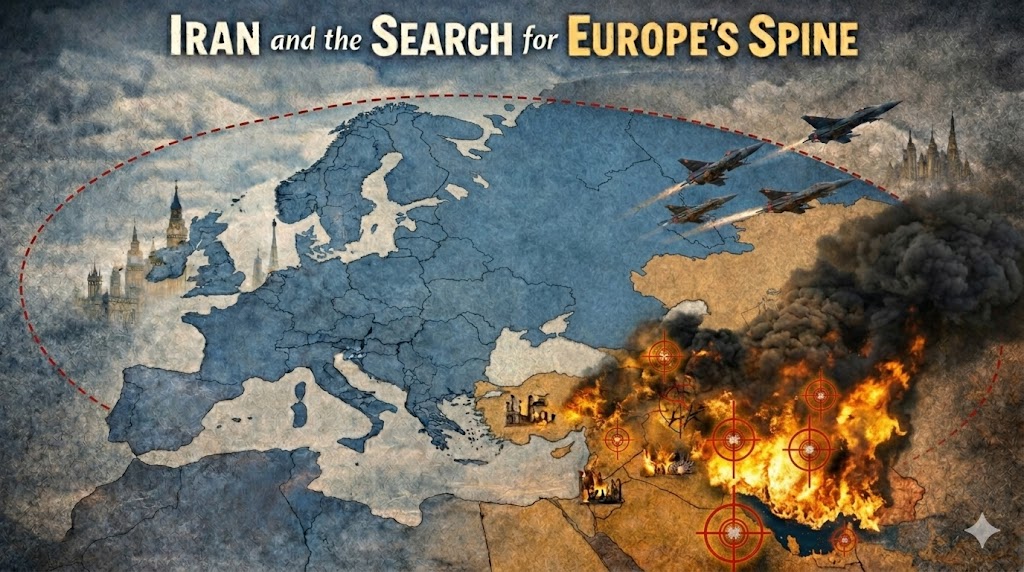
My take on the Iran war, Europe's missing leadership, and the emergence of Spain, along with the Nordic bloc, as the continent's moral compass. Merz's performance at the White House, Starmer's flip-flops, and Macron's vagueness prompted me to search for Europe's spine. Will Europe have an autonomous voice in global politics? *** Iran and the Search for Europe’s Spine Europe is in a leadership crisis. Liberal globalism has collapsed, and the vacuum is being filled by an increasingly violent, lawless illiberalism that trades hierarchy and violence for strength and principle. Many see the center-right as the bulwark against illiberalism. Friedrich Merz is often framed as the responsible adult in the room, a counterweight to Trumpian disruption. When the US and Israel launched strikes on Iran on February 28, Merz revealed himself again as Trump’s loyal junior partner. On concerns over the legality of the strikes, he announced he would not “lecture” the US or Israel on their military actions. The “bravest” thing he had to say during their recent White House press conference was that “there are too many bad guys in the world” and “we need to talk about it.” Merz’s realpolitik is the shortest route to a weightless, voiceless Europe in an increasingly lawless world. Clinging to Atlanticism as the always-contradictory rules-based world order is being violently dismantled from within Washington is not hard-nosed realism. It is a category error: loyalty to a structure that no longer exists, toward a partner that has openly declared European interests subordinate to American unilateralism. France was marginally better in tone but not in substance, with Macron stopping well short of principled opposition. Starmer, true to form, initially hesitated before authorizing British base access within 24 hours; a flip-flop that satisfied nobody and signaled nothing. But the disoriented and disheartening leaders in Berlin, Paris, and London are not the totality of Europe. There are figures like former Swedish Prime Minister Carl Bildt who consistently find the right words on matters of world politics. Norway’s Prime Minister Støre and Foreign Minister Eide declared the strikes incompatible with international law, pointing out that a pre-emptive attack requires an imminent threat that was never established. Their judgment was sharpened by a crucial detail: just days before the bombs fell, Oman’s foreign minister had announced a diplomatic breakthrough, with Iran agreeing to halt nuclear enrichment and accept full IAEA verification. Oslo called it what it was: a squandered opportunity for diplomacy. And then there is Spain, a country that has emerged as Europe’s clearest moral compass. Pedro Sánchez condemned the strikes as a breach of international law, refused to allow US military bases on Spanish territory to support the operation, and absorbed Trump’s threat to cut all commercial ties with Madrid. His position, delivered in a televised address, was unambiguous: “No to war.” Remarkably, the Party of European Socialists and the S&D Group backed him, signaling something shifting in how at least part of the European center-left is willing to position itself. Sánchez is dragging Europe’s center-left toward articulating a foreign policy grounded in international law, genuine multilateralism, and the understanding that the international order is rebuilt through principles consistently applied, not selectively invoked. Progressive voices like Yanis Varoufakis have made these arguments for years, with clarity and force, and were largely ignored as too radical or too inconvenient. What makes the current S&D shift notable is precisely that it is not coming from the margins. Sánchez instinctively understands that no matter how horrible the Iranian regime is, the strategic arguments for the war do not hold up on their own terms. Strikes of this kind are more likely to accelerate Iran’s nuclear calculations than arrest them, more likely to deepen cycles of retaliation across the Middle East than contain them. The history of military intervention does not offer many cases in which bombing produced the stable, post-conflict order its architects promised. What strikes reliably produce is destroyed infrastructure, civilian casualties, and precisely the nationalist siege narrative the regime needs to suppress internal dissent. The two most likely outcomes of sustained bombing are a reconstituted version of the same regime, hardened by war, or the kind of chaos that made post-2003 Iraq a cautionary lesson nobody seems to have learned. The massive protests that shook Iran in late 2025 were driven by economic collapse, a decimated currency, and decades of repression. That is the organic material from which genuine political transformation is built. The ongoing leadership transition might have provided an opportunity to open channels, amplify democratic voices, and strengthen civil society from within. Durable change requires social coalitions capable of sustaining inclusive political institutions; it cannot be conjured by external military force. International actors can support democratic change, but carefully and patiently, through sustained solidarity with locally rooted civil society. A principled foreign policy does not mean looking away from repression or pretending that all actors bear equal responsibility. It means holding firm to the same standards regardless of who is doing the bombing, insisting on international law as a constraint on the powerful rather than a talking point for the convenient, and understanding that lasting security is built on legitimacy, not on the rubble of failed interventions. That is the foreign policy Europe needs. Sánchez and Støre are making the case for it. The question is whether enough European leaders are listening.
Gabor Scheiring tweet media
English
0
1
2
161
Gabor Scheiring
Gabor Scheiring@gscheiring·
@ka_grieco If a drone is on track to hit the sand or in general does not threaten any relevant military or civilian target you don't need to intercept. So this percentage itself is not particularly informative.
English
0
0
0
115
Gabor Scheiring retweetledi
PES 🌹🇪🇺
PES 🌹🇪🇺@PES_PSE·
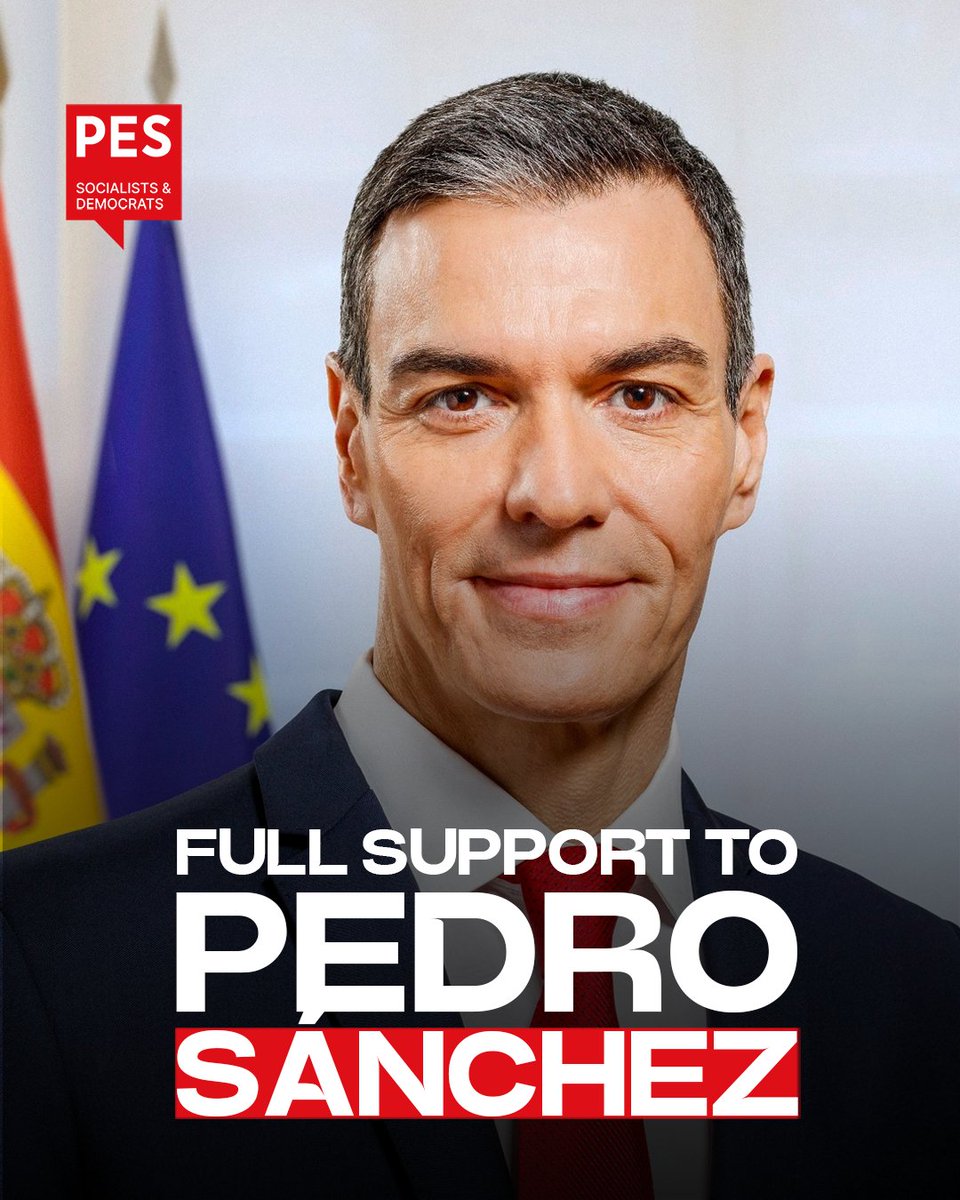
❌ We will not be intimidated by unacceptable threats. 🇪🇸 Our full support for @sanchezcastejon and for #Spain. Standing up for international law, multilateralism, and Europe’s strategic autonomy is our shared duty - and we will stand firm. While we remain unequivocal in our condemnation of the Iranian regime’s oppression of its people, we must hold fast to the principles upon which the EU was built. #Trump #Iran #InternationalLaw @giacomofilibeck
PES 🌹🇪🇺 tweet media
English
1.1K
4.9K
21.4K
410.5K
Gabor Scheiring retweetledi
Aidan Regan
Aidan Regan@Aidan_Regan·
Pedro Sánchez demonstrates the leadership the EU badly needs, and plainly lacks.
English
34
268
2.2K
27.5K
Gabor Scheiring retweetledi
Carl Bildt
Carl Bildt@carlbildt·
Europe has to a large extent sidelined itself in the conflicts in the Middle East. Now the situation is escalating with an uncertain outcome. It’s largely driven by an Israeli agenda. Does Europe have a policy? ⁦@ecfrecfr.eu/article/trumps…
English
361
240
863
102.6K