

CHAD GEE

1.9K posts

CHAD GEE banner
CHAD GEE

CHAD GEE

@GVXDapperDinos

TECH ENTHUSIAST

Chicago, IL Katılım Ekim 2021
6.7K Takip Edilen532 Takipçiler
CHAD GEE retweetledi
GREG ISENBERG
GREG ISENBERG@gregisenberg·
I think the most interesting thing about Jack Dorsey's "Slack killer" is the idea around shared compute. I haven't seen people talk about it so here are my thoughts FWIW: Open models got good, close enough to the paid frontier stuff to run for real. But the strongest ones need expensive hardware most people probably won't buy alone, and it's kinda a pain to set up if you aren't technical. Shared compute solves exactly that. In Buzz, one person runs the machine, loads up an open model like Google Gemma, and everyone in the community plugs into that same model. Basically, a whole group has real AI they own and control together, running on their own hardware, learning from their own data. Once you see it, a bunch of things click into place. 1. A community can now run a top open model together, on a machine they own, instead of renting from a lab. 2. It learns from the group's private data and gets sharper over time, and all of that stays inside the community. 3. A narrow, private model can quietly get better than ChatGPT for the one world your group lives in. 4. It's impossible to copy, because the edge is the private data on your machine, not the model itself. 5. The moat stops being how smart your AI is and becomes whose data it learned from. 6. Compute becomes something you share like a building shares a gym. 10 people split one machine instead of 10 people each renting forever. 7. Idle compute becomes income!!! Your machine sits dead half the day, so it earns money renting that time to someone who needs it. 8. Communities become the unit of intelligence instead of companies. The group with the smartest shared brain wins, and being a member means owning a piece of it. 9. A shared brain becomes an asset you build equity in. You put in money and data, it appreciates, and your slice is worth something the day you leave. 10. The whole thing runs on open protocols, so the group keeps full control and nobody outside can throttle it or shut it off. You know me, obviously, my head went to what startup ideas come to mind here. Adding them to @ideabrowser soon. Well… 1. The vertical brain. Pick one profession, tax lawyers or real estate agents or indie game devs, and build the shared machine trained on everything that group knows between them. A year in it's the smartest AI in that field, impossible to copy, and you own the club it lives in. 2. The rental marketplace for collective brains. Once these private models exist, outsiders will pay to use them. You build the layer where a group lists its brain, an outsider pays per task, and the money flows back to the members while you take a cut. A marketplace for expertise, not compute. 3. The idle-compute exchange. Every shared machine sits unused half the day. You build the market that rents that dead time to whoever needs the power right then, so owners earn money off a machine that was just sitting there. Idk where Buzz goes, but it's cool to see Jack putting it out. Right now the way it works in AI is you rent your intelligence from a few giant labs that own the machine, set the price, and hold the off switch. Shared compute flips that, because a community can run the model together, feed it their own private data, and keep full control of the whole thing. It's one of those things that might look tiny today, but Jack does has a habit of being early.
Vinny@hot_town

I tried @jack's Buzz. It's like Slack + OpenClaw + Herdr + but with some really unique features that people are sleeping on. The video below shows how it works, and some of my thoughts on the process and platform, e.g.: - Create and interact with agents on top of any harness (claude code, codex, pi, etc.) - Choose which models agents use, including local ones - Agents can delegate work and work in parallel in git worktrees - Agents are first-class citizens and work like humans (creating channels, delegating, access to chat history) - You can share AI compute within a community - It's completely open-source and decentralized Things I like: - Delegating work in chat feels natural: tag an agent, it replies in a thread with status updates as it e.g. compiles, commits, and deploys. - Shared compute: relay owners can share local compute with members, so a community could pool funds for one beefy machine running a local model and everyone uses it. - It's built on Nostr, an open protocol already tied into Bitcoin Lightning so I can imagine communities tipping each other or paying for compute/agent tasks with instant zero-fee micropayments in the future. - It ties together things like OpenClaw, an agent manager, and Slack-style chat into one tool. Things I didn't like: - You can't see what the agent is doing in a terminal. The activity view exists, but if you're used to watching a session run, this UI feels a bit abstracted. A terminal view would be great. - It feels slower than running a session in Claude Code, though no evidence to back that up. For that reason I found myself doing one-off tasks in the terminal instead. Verdict: - I really like it so far and can genuinely imagine working with a team this way. - It doesn't feel ready for big, complex tasks yet. For shallower tasks, it's perfect. - The shared compute + Nostr/Lightning angle is what really separates it from every other agent manager for me, and I think that future is coming.

English
182
288
3.2K
966.3K
CHAD GEE retweetledi
BijanBowen
BijanBowen@bijanbowen·
Had Claude Fable 5 log network packets and display them as cars on a highway, different car types = different packet types
English
253
844
14.8K
1.5M
CHAD GEE
CHAD GEE@GVXDapperDinos·
ZXX
0
0
0
3
Jouhatsu | AI Influence Operator
J’ai traduit l’audio de la vidéo en français. Ceux qui sont intéressés, faites-le-moi savoir.
Français
86
3
72
138.4K
CHAD GEE retweetledi
Jouhatsu | AI Influence Operator
Un ingénieur IA senior chez Microsoft vient de dévoiler comment les équipes de Microsoft créent des agents IA avec Anthropic. 34 minutes de workshop gratuit, directement par l’équipe Microsoft. Regarde le workshop. Ajoute en signet 🔖 Opus 4.7 + plus de 1 400 outils MCP déjà prêts à l’emploi. Tu connectes Claude à un agent → tu lui ajoutes des outils → tu déploies en production. Plus utile que la majorité des formations de vibe-coding vendues 500 $.
Français
60
612
5.6K
5.3M
CHAD GEE retweetledi
NO CONTEXT HUMANS
NO CONTEXT HUMANS@HumansNoContext·
How tf does it actually looks good
English
640
4.6K
92K
4.6M
CHAD GEE retweetledi
Livsun
Livsun@L1vsun·
the finance kids everyone envied in college made $120k at goldman the quiet math kids nobody noticed made $650k at firms most people can't name jane street. citadel. two sigma. d.e. shaw they don't recruit from linkedin. they recruit from math olympiads and competitive programming leaderboards the filter is 4 things: probability, coding, mental math, game theory same problems recycled every year, same structure every round the prep path is documented, free, and takes 8 months a kid from a state school who grinds this for 8 months has beaten ivy leaguers who showed up unprepared - credential matters less than the pattern recognition most people spend 3 years trying to break into banking for $120k the people who looked one level up spent 8 months and landed 5x the salary the information to do this has existed for years Bookmark this and upgrade your brain the gap isn't talent it's that nobody told you where to look
Roan@RohOnChain

x.com/i/article/2048…

English
53
209
2.5K
1.3M
CHAD GEE
CHAD GEE@GVXDapperDinos·
ZXX
0
0
0
2
CHAD GEE
CHAD GEE@GVXDapperDinos·
ZXX
0
0
0
7
CHAD GEE retweetledi
Brett Adcock
Brett Adcock@adcock_brett·
Watch a team of humanoid robots running a full 8-hr shift at human performance levels. This is fully autonomous running Helix-02 x.com/i/broadcasts/1…
English
1.9K
2.9K
16.9K
13.6M
CHAD GEE
CHAD GEE@GVXDapperDinos·
ZXX
0
0
0
4
CHAD GEE retweetledi
Ronin
Ronin@DeRonin_·
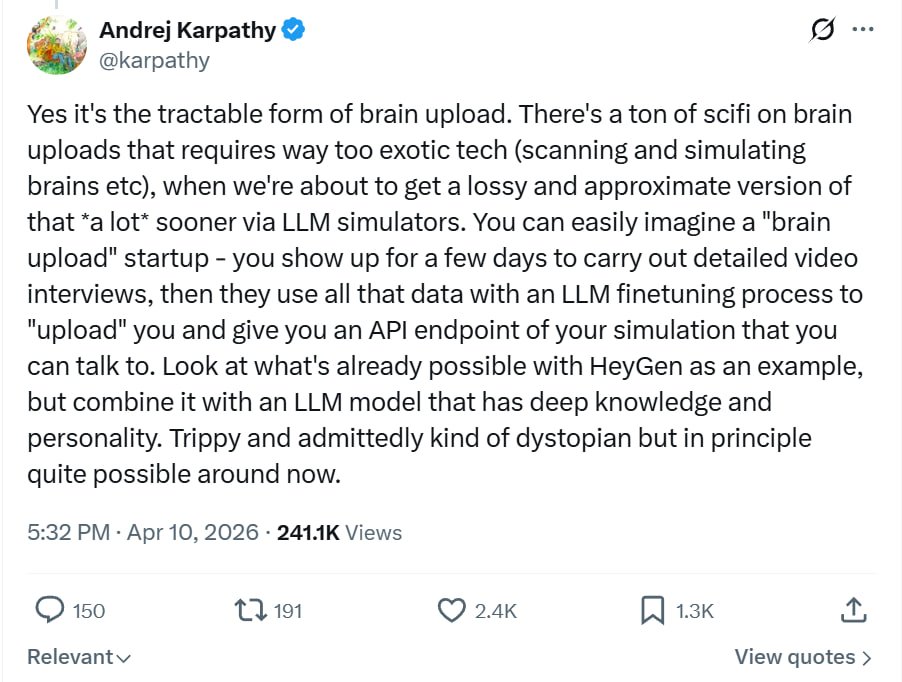
🚨 Karpathy just dropped a blueprint on how to clone your brain in 2026 most people read this and think "cool scifi, see you in 2040" reality check.. every tool Karpathy describes is already online, you just have to connect the dots By the end, you'll know how to: - capture your mind into structured data - fine-tune an LLM that thinks like you - give it your face, voice, and personality - ship it as an API anyone can talk to So, let's discuss your roadmap step by step Step 1: Data Dump the biggest mistake most people make is trying to "write" their personality into a prompt that's not cloning. that's cosplay instead you should: - record 20-40 hours of you talking (solo monologues + interviews) - dump every tweet, dm, email, voice note, blog post you ever wrote - journal for 2 weeks on HOW you make decisions, not just what you decide - record yourself reacting to random content in real time the goal isn't quantity.. it's capturing the reasoning patterns behind your words —————— Step 2: Structure the Brain raw data is useless. you need to turn it into training pairs instead you should: - transcribe everything with Whisper - use Claude or GPT to extract Q/A pairs from your interviews - label each response with context: mood, topic, audience - separate "public voice" from "private voice" datasets this is the part 99% of people will skip.. and this is exactly why their clone will sound generic —————— Step 3: Fine-tune Your LLM you don't need to train a model from scratch. you just need to bend an existing one toward you instead you should: - start with Llama 3.3 or Qwen 2.5 as the base - run LoRA fine-tune on your Q/A dataset (Unsloth makes this free on Colab) - test it against a held-out set of your real responses - iterate until it hits 80%+ similarity on style and reasoning if you can't afford the compute.. use OpenAI's fine-tuning API on gpt-4o-mini for under $50 —————— Step 4: Give It a Face and Voice text-only clone is mid. the real unlock is multimodal instead you should: - clone your voice with ElevenLabs (3 min of audio is enough) - build your avatar with HeyGen or Synthesia (30 min of video) - connect the fine-tuned LLM output to voice → avatar pipeline - add a lip-sync layer so it actually feels like you —————— Step 5: Wrap It in an Agent a clone that just replies to prompts is a toy. a clone with memory and tools is a product instead you should: - give it a vector DB of everything you've ever said - add RAG so it can pull your real opinions on any topic - plug in tools: email, calendar, twitter, stripe - deploy behind an API endpoint your clients/audience can actually talk to —————— Step 6: Ship It As a Startup Karpathy literally gave you the pitch deck in one tweet instead you should: - niche down: don't clone everyone.. clone coaches, lawyers, therapists, creators - charge $5-20k per upload, recurring for hosting - offer tiers: text-only, voice, video, full agent - first 10 clients will literally be people you already know the market is creators who want to scale themselves and experts who want to outlive their own attention this isn't a 2030 bet anymore.. every piece of this stack works today @karpathy is right.. the lossy version of brain upload is shipping this year the only question is whether you're the one building it.. or the one being cloned by someone else save this so you don't lose it gl
Ronin tweet media
English
15
12
98
28.2K
CHAD GEE retweetledi
shirish
shirish@shiri_shh·
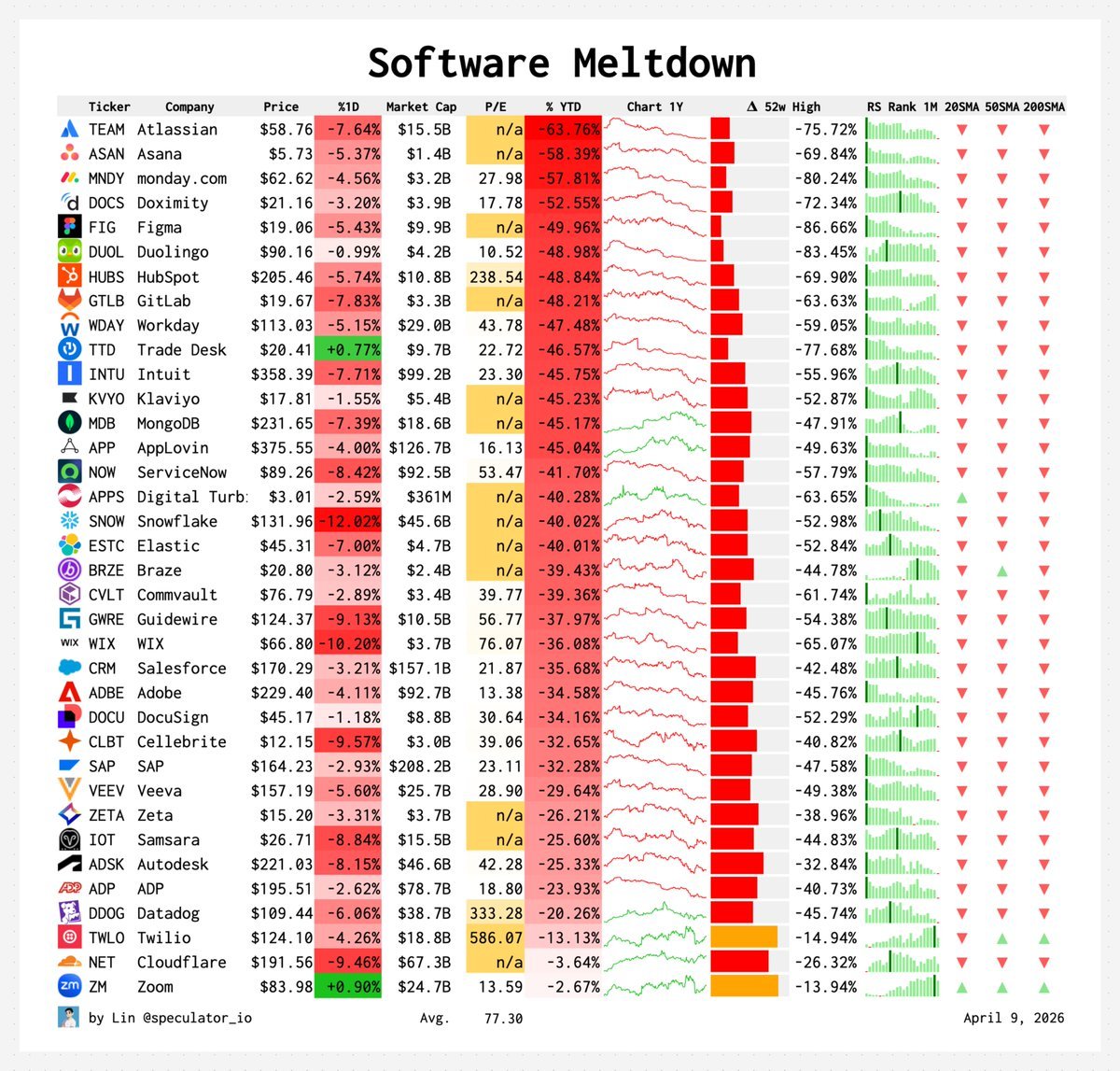
bro was right. Atlassian down 75%. HubSpot down 69%. Figma down 86%. Almost all of them down 30–70% from their 52-week highs. AI is literally eating software alive and repricing every company in real time. SaaS is cooked fr 😭
shirish tweet media
Naval@naval

Software was eaten by AI.

English
436
982
8.1K
2M
CHAD GEE retweetledi
Up Workout
Up Workout@Upworkout·
Save this workout and try it later. This is a 13-drill core sequence inspired by Russian and Soviet gymnastics training methods, focused on building real core strength, control, and coordination.
English
15
577
4.2K
270.5K
CHAD GEE retweetledi
Rony
Rony@Ronycoder·
Instead of watching Netflix, watch this 1-hour Yale lecture by Professor Ben Polak. It will change how you think about decisions in negotiations, business, and everyday life.
English
55
1.8K
8K
808.5K
CHAD GEE retweetledi
Roan
Roan@RohOnChain·
This 2 hour Stanford lecture shows exactly how Stanford trains it's engineers to build AI systems. It's more practical than every Claude tutorial & prompting threads you've seen. Bookmark & give it 2 hours, no matter what. It'll be the most productive thing you do this weekend.
English
159
1.9K
13.6K
1.7M