

Gabe A
2.6K posts

Gabe A
@GabeAI0
Developer | AI/Artist | Tech/news | 🇺🇸
Katılım Kasım 2021
2.3K Takip Edilen280 Takipçiler

Under the previous administration, the Department of Defense’s financial reporting was a disaster — and had been for far too long.
That ends today—the WAR DEPARTMENT will deliver a clean audit for our 2028 financial statements.
English
Gabe A retweetledi

Our team ran a verifiable quantum algorithm that probes how parts of a quantum system interact, from molecules to magnets and beyond. On our Willow chip, it ran 13,000× faster than the best classical supercomputers. A first in quantum computing → goo.gle/42z9E2d
English
Gabe A retweetledi

🚨 Scientists just learned how to control magnetism atom by atom.
Not with circuits.
With electron spin itself.
That means memory may no longer live in silicon structures…
but in moving magnetic whirlpools called skyrmions.
Near-zero energy.
Ultra-dense storage.
Potentially a new computing architecture.
If information can be stored in spin textures
what actually limits computation?
Follow me I track where physics becomes technology.
English
Gabe A retweetledi

The Arbitrum Freeze: Decentralization Theater Meets Reality
Two days after the $292M Kelp DAO exploit, the Arbitrum Security Council froze 30,766 ETH linked to the attacker. The funds now sit in an intermediary wallet, movable only by further governance action.
Good outcome? Probably. Comfortable outcome? Not at all.
1. What the freeze actually is
The Security Council used its emergency powers to execute a state-changing action against a specific address. No smart contract was broken. The code was overridden by humans with keys.
This is not a secret or an abuse. It's a documented property of Arbitrum, and of every other major L2 today. By L2Beat's framework, Arbitrum is a Stage 1 rollup: a trusted multisig can upgrade the system and, in emergencies, alter state. Optimism, Base, zkSync, Starknet, Linea, all sit at Stage 0 or 1. No production rollup has reached Stage 2.
Call the freeze what it is: a legitimate administrative intervention on an administered chain.
2. Decentralization theater is the default
We built this space to give users sovereignty through self-custody, permissionless access, and credibly neutral rails. That ideal is still alive ,in a shrinking set of places: ETH on mainnet, BTC on Bitcoin, a handful of genuinely immutable contracts.
Almost everything else is permissioned in some way: upgradable contracts, whitelisted oracles, pausable markets, admin-keyed bridges, multisig-governed rollups, freezable stablecoins. We kept the vocabulary of permissionlessness. We quietly built a governed financial stack underneath it.
The Arbitrum freeze didn't create that reality. It made it visible.
3. Why does it persist
Because a truly permissionless system at scale is brutal to defend. No pause. No rollback. No freeze. Every line of code public, every mistake final. Attackers iterate for free; defenders get one shot.
Kelp is the canonical illustration: a 1-of-1 DVN against LayerZero's written guidance, two poisoned RPC nodes, a DDoS on the rest, and $292M minted out of a fabricated state. No zero-day. No smart contract exploit. An infrastructure-level attack on a verifier that was decentralized in name only.
Meanwhile the adversary has scaled. DPRK-linked groups have more capital than most protocols have in treasury, dedicated research teams, timelines in quarters, and now AI that can diff every commit and grep every config at machine speed. Their only real constraint is self-imposed: don't kill the goose. With a 1-of-1 DVN they could have minted $292B as easily as $292M. They're calibrating, not restrained.
4. The honest tradeoff
Both of these are true at once:
The freeze likely saved real money from a state-sponsored attacker.
The freeze confirms that Arbitrum, today, is a chain where sufficiently motivated humans can move your balance.
These are not a contradiction. They are the explicit cost of the Stage 1 compromise. The open question is whether we treat that compromise as permanent and rebrand accordingly, or as scaffolding toward something stronger.
5. The only real exit: validity proofs
Not better multisigs. Not faster incident response. A verifier that checks a succinct proof of another chain's state transition doesn't trust an RPC, a DVN, an oracle, or a committee. Either the math checks or it doesn't. That's how Ethereum L1 already settles rollups. It is the model every bridge should converge to, and the one Stage 2 rollups will need to reach.
In that world, Kelp-style attacks become cryptographically impossible rather than operationally unlikely, and L2s stop needing emergency councils as load-bearing security. Every bridge and most rollups today are an IOU against that future.
6. Where this leaves us
Maybe Bitcoin stays credibly neutral mostly because it refuses to do anything. Every system that tries to do more than move a scarce asset drifts toward human governance, because the alternative is getting drained by professionals with better tooling than the defenders.
The uncomfortable part is admitting we are running on trust we told ourselves we had removed. The Arbitrum freeze didn't break a promise, it revealed a promise we had already stopped keeping.
Until the proofs catch up, every "decentralized" protocol should carry its Stage label on the tin. Users should know which chain they're actually on when they click confirm.
Stay safe. Stay honest about your trust assumptions
English
Gabe A retweetledi

Gabe A retweetledi

Gabe A retweetledi

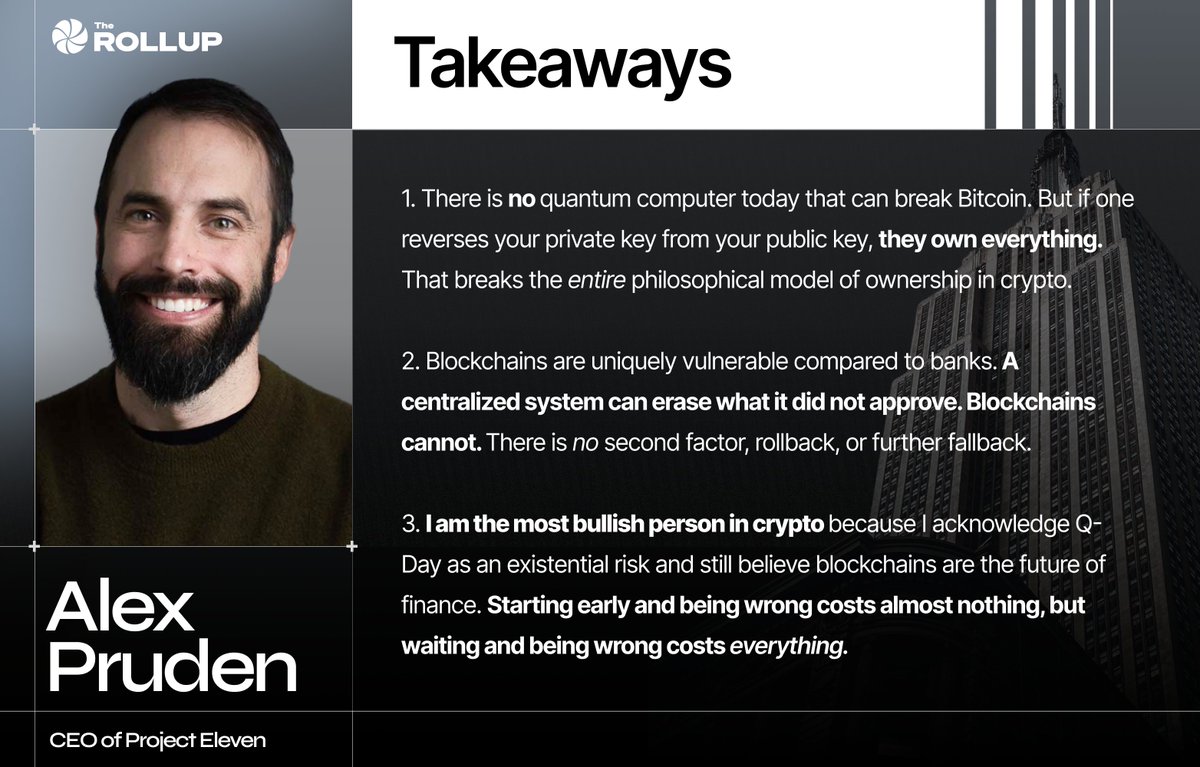
Alex Pruden of Project Eleven shares his thoughts on quantum threats and why he remains crypto's biggest bull.
The Rollup@therollupco
Project Eleven CEO warns why one quantum breakthrough could break all of crypto: “It breaks the entire philosophical model of ownership of crypto.” “If a quantum computer is able to reverse engineer the private key from the public key… in a very real sense, they own everything.”
English
Gabe A retweetledi

Maritime Robotics has quietly become one of Europe's leading USV and autonomous navigation OEMs, serving everything from defense to undersea cable security. Now they're bringing it stateside. We spoke with James Fisher at WEST 2026, who's leading the U.S. expansion.
English
Proper data privacy laws need to be in place for AI systems. I see a lot of good that can come from giving one's data. It's just the trust factor with the private sector and possible government connections. Anonymity is a skill that future generations must learn. We should make things easier for them, not harder.
English

In a future where AI models are crunching your personal data 24/7, privacy and anonymity will be more important than ever
That’s why we build privacy-friendly infrastructure ⚡️
English
Gabe A retweetledi

What quantum actually breaks 🧵
On March 31st @GoogleQuantumAI published updated resource estimates showing that breaking 256-bit elliptic curve cryptography requires roughly 20 times fewer physical qubits than previously thought, and hours later a team from @TeamOratomic and Caltech demonstrated that Shor’s algorithm can run at cryptographically relevant scales on as few as 10,000 neutral atom qubits. Both papers have been covered extensively. However, there has been a lot of confidently wrong analysis for what this means for the cryptography that underpins digital assets.
English
I've been so focused on useless political topics, trying to see possible futures while being led by the blind. Now politics, PACs, and so on don't hold the same weight for me. All that matters is that American power wins. And it will. Time to start thinking about the future.
English
Gabe A retweetledi

The latest quantum papers from Google and Caltech are an important signal for the industry. Timelines are still debated, but the time to act is now.
The good news: post-quantum cryptography exists. This is a solvable problem, and many chains already have roadmaps. Bitcoin needs to catch up though.
The bad news: post-quantum cryptography is relatively new and it would be fairly easy to create new security risks if implementation is rushed. The industry needs to align on what happens to wallets that fail to migrate before a CRQC appears.
At Coinbase, we’ve been working on this for a while, auditing and upgrading our internal infrastructure, researching post-quantum cryptography and establishing a Quantum Advisory Council. It’s clear Bitcoin needs to make some fast progress here, so Coinbase is taking the role of rallying the troops and getting the right people in the room - Bitcoin core devs and the broader community - so they can start tackling this.
But no one developer or company can do this alone. Real progress will require coordinated action across the ecosystem.
If you’re working on post-quantum approaches for Bitcoin, we want to support you, and connect you with others that are working on it too. Please DM me directly and I’ll get you added to the working group.
Bitcoin can and will upgrade, but it will take the entire community working together.
English
Gabe A retweetledi

Ep. 267: Social media = cigarettes?
In March, juries in California and New Mexico delivered seminal verdicts holding Meta and YouTube liable for failing to protect young users from harm.
Both verdicts found that the companies were negligent in the design or operation of their platforms and that each company knew their platforms could be dangerous when used by a minor.
The courts found that the design elements of the platforms could be separated from the content hosted on the platforms, thus removing the need to consider the First Amendment or Section 230 of the Communications Decency Act.
CEO & founder of @techdirt & @CopiaInstitute @mmasnick joins @TheFIREorg's @NicoPerrino to break down the rulings and their possible free speech implications.
Timestamps:
00:00 Intro
02:29 Why these verdicts scare the hell out of Mike
10:34 Are social media algorithms “addictive”?
21:45 Did Meta fail to protect kids?
30:37 The First Amendment and Section 230
43:13 Is social media the new Big Tobacco?
55:15 The role of parents in social media use
59:04: Outro
Enjoy listening to the podcast? Donate to FIRE today and get exclusive content like member webinars, special episodes, and more.
If you became a FIRE Member through a donation to FIRE at thefire.org and would like access to Substack’s paid subscriber podcast feed, please email sotospeak@thefire.org.
English
Gabe A retweetledi

.@adam3us has said @nic_carter is making uninformed noise, here is his reponse:
Aubrey Strobel@aubreystrobel
Breaking: Google just released a report dramatically reducing the requirements for a quantum computer to break Bitcoin's cryptography. The timeline for preparedness is now 2029. I sat down with @nic_carter & @apruden08 from @projecteleven on @theaubservation to break it all down. Enjoy.
English
Gabe A retweetledi

January 16, 2026
2.5 months ago it seemed crazy...
"We're putting up risk capital saying that Q-Day is going to come at some point during the life of our venture capital fund... That's 10 years by the way."
How did @nic_carter @MattWalshInBos @CastleIslandVC know?
English
Gabe A retweetledi

“To see it enacted in Israel, in such a blatantly discriminatory way, is a profound violation of the principles that bind the Jewish people together,” said J Street President @JeremyBenAmi.
“At a time when there is a near-total lack of accountability for Jewish terrorists attacking Palestinian communities in the West Bank, the double standard embedded in this law is especially egregious.”
haaretz.com/jewish/2026-04…
English
Gabe A retweetledi

In which I attempt to address the most common arguments that yesterday's papers aren't immediately relevant, and challenge skeptics to clearly define what constitutes progress
Alex Pruden@apruden08
English
Gabe A retweetledi

Bitcoin is more vulnerable to quantum cryptography than traditional institutions like banks, says @apruden08
"One reason is obvious. Satoshi — who we think has gone away or died or something — their early bitcoin hasn't moved. There's a bunch of lost coins. All in all, about 15% of bitcoin supply is estimated to be lost. That's hundreds of billions of dollars. That's a huge incentive."
"Let's take the counterexample of if someone wanted to hack into a bank or something. As you pointed out, banks are centralized, they can react. Also, the way that banks implement their cryptography is just one of many layers of security."
"Theoretically, if someone tried to wire all the money out of my account, my bank would call me."
"That's not true for Bitcoin. All I need is one signature and all of Satoshi's, Coinbase's, or Binance's bitcoin is mine. There's no fallback."
English
Gabe A retweetledi
Project Eleven CEO @apruden08 says China may be 6-12 months behind the US in quantum computing at most:
"[China has] made quantum computing a priority. What that means in China is — there used to be a lab at Tencent, Baidu, and a few other places. And at some point, a CCP official came in and said, 'Guess what, you guys all work for us now, you're all working together, and you're not allowed to talk about it anymore."
"There's a legitimate question about how far back they are. The best estimates that we have — we have a quantum physicist who's an advisor to Project Eleven that tracks resource estimates across the world, and their view is that China may be 6-12 months behind at most."
"Can we expect the CCP, which is maybe more willing to crush dissent in places like Hong Kong, to care as much about the philosophical principles of Bitcoin and decentralization if it serves their purposes to do otherwise? I don't think we can."
"It's better to be safe than sorry. We need to prepare today to prevent the crisis tomorrow."
English
Gabe A retweetledi
"Because blockchains like Bitcoin fundamentally rely on cryptography, it's existential for them."
Project Eleven CEO @apruden08 on the Google and Caltech quantum papers:
"Everything's on the line here. We have to solve it for chains like Bitcoin to have a future."
English