
Gar D retweetledi
Gar D
182 posts


Gar D
@Gar_DeW_IT
The next 10 years will be wild.
Mid West Katılım Eylül 2022
44 Takip Edilen54 Takipçiler

Gar D retweetledi


Gar D retweetledi

JUST IN: "We are forced to raid the rainy day fund, the retiree health benefits trust reserve, and to increase property taxes" — NYC Mayor Mamdani
English
Elon just said that cybercab will go into full production in April. Seems to close to be off by much seeing ramping up a production vehicle is very complicated. So maybe May or June at latest. Does change the short term narrative or sentiment? (I also massively downsized my position in high 400's on your advice) Thanks and keep up the good work!!!
English

He's been off quite a lot lately.
Aug'24: "Tesla will do over $100B in revenue this year". Nope.
Oct'24: "Tesla will exceed prior year's volume". Nope
[a lot of other stuff[
Apr'25: "will make a few thousand Optimus by the end of the year". Nope
I could go on but made my point.
English
Elon knows that first meaningful amount of space compute capacity is going online at a minimum several years from now and hence he’ll be building as much earth bound compute as he can till then.
X Daily News@xDaily
NEWS: xAI planning to bring up to 1 million Nvidia GPUs online near Memphis Despite talk of space-based compute, xAI is expanding on Earth with massive data center plans in Tennessee for Grok and future AI projects. x.com/theinformation…
English
Gar D retweetledi
Gar D retweetledi

The game has officially changed. 🇺🇸🚀
With @InvestAmerica24 Trump Accounts, you don’t just "donate"—you invest directly in the next generation. Want to boost a specific zip code, your old high school, or an entire city? You can now directly fund the future of specific groups of kids.
Direct impact. No middleman. Pure growth.
English
@stocktalkweekly That sound exactly like Tesla's plan. Not sure about figure's plan...
English

Any guesses which "leading" humanoid robotics customer Synaptics CEO is referring to in this quote from the earnings call? $SYNA
"We are now sampling silicon for pilot builds of humanoid at a major customer that's leading the marketplace and has made commitments to the marketplace to deliver pilots this year and go into production next year. This is on the backs of our touch sensory controllers and our bridge solutions that help transport high bandwidth data effectively in the humanoid. And so this is all underway.
We are in the process of working with our customer, our lead customer, building out the pilot program that they are working towards basically and delivering in the marketplace this year. We see our opportunity in humanoids extending into the larger robotics marketplace. And what it means is, from my point of view, robotics is a very broad market. It goes from home vacuum cleaner to -- all the way to humanoid and everything in between.
And in situations where you would have at the furthest end of the spectrum from humanoid, like a vacuum cleaner, an MCU class product with a native AI capability and wireless connectivity, not only Wi-Fi, Bluetooth, and thread, but also GNSS and GPS, if it is on an industrial floor is very valuable. And that's the opportunity for Synaptics. If you take it up all the way back to the humanoid, you have sensory capabilities that are required that are going to mirror not only what a typical human nervous system could do, but maybe with a higher precision.
And so the number of touch controllers would vary. We have demonstrated at CES partner that has come out and built a platform using I believe, 30-odd touch controllers in the Palm of a robotic arm, combining it with Astra, combining it with a vision processor and combining it with wireless connectivity. And so as you can see, this is where the opportunity is
And if you have a high-end humanoid, there may be a main processor, there may be a GPU, a data server type processor. However, that requires a lot of ML and AI data to be locally at a section of the humanoid level processed from the sensory inputs like a touch controller so that there's effective decision-making taking place within the tolerance of the latency that the end application may require.
And so as you can see, the Synaptics portfolio scales very nicely from an MCU class AI native processing platform for a robotic and application to something that would be all the way to a humanoid.
And you're seeing designs that are consuming our sensory capabilities, especially our touch interface and controller capabilities, not only in the Palm, but also in the foot of a humanoid basically. And I think there's many things that will come about. But more importantly, again, I want to reiterate.
What I was excited about in this quarter is we have started sampling our silicon for a pilot build to a company that's leading the marketplace, building multiple advanced humanoids to be delivered to the marketplace at the end of this year as pilots...
This one large important customer leading the market in humanoid has indicated to the world that they are going to pilot -- ship pilots basically this year and go into production in 2027."
Stock Talk@stocktalkweekly
The on-device inference stock I shared with our community members on Wednesday was Synaptics $SYNA This is the thesis I shared: In my view, one of the biggest themes of this year will be Edge Compute & On-Device Inference. Currently, the only position in my portfolio that addresses this theme is $OSS (opened @ $4.71 on 11/26/25, before the crowd knew about it), which is a core position. However, I would like to layer exposure here with a few more stocks. One of those stocks is Synaptics $SYNA You should think of an “AI-capable device” as having three big layers: Sensors & inputs (camera, microphones, touch, motion sensors) Local compute (the chips that run the model and decide what’s happening) Connectivity (Wi‑Fi/Bluetooth/etc. to talk to phones, routers, or other devices) SYNA has products that map to (2) and (3) directly, and it markets itself as providing an integrated edge stack (compute + connectivity + multimodal support) SYNA’s SL2610 family is described as integrating: - General compute (Arm CPU cores) - GPUs (NVIDIA or otherwise) - An AI acceleration subsystem (Synaptics' Torq platform) In layman’s terms: it’s designed so an OEM can build a device that sees/hears something, runs an AI model locally, and reacts, without needing a datacenter or offsite server GOOGLE PARTNERSHIP On January 2, 2025, Synaptics announced it was collaborating with Google on Edge AI for IoT to define “optimal implementation of multimodal processing for context-aware computing,” integrating Google’s MLIR-compliant ML core on Synaptics Astra hardware with open-source software/tools. In October 2025, Synaptics announced the SL2610 line and stated that Torq delivers the first production deployment of Google’s RISC‑V-based Coral NPU with dynamic operator support, using an open-source IREE/MLIR compiler/runtime approach. Google’s own developer documentation calls Synaptics its first strategic silicon partner for Coral NPU and says SL2610 features the first production implementation of Google’s open-source Coral NPU ML core THE 'ASTRA' PROGRAM Astra is not a single chip. It’s Synaptics’ AI‑native IoT compute platform that bundles together processor families (silicon), SL-series (high power MPUs built on Arm Cortex CPUs), SR-series (low-power MCUs) + software, hardware & connectivity. Astra is Synaptics effort to sell the “whole kit” that makes an IoT device smart on its own: a processor that can run AI locally, the software tools to deploy models, and the dev hardware + wireless pieces to get a product built and shipped faster. Astra launched in April 2024, but in October 2025 they updated Astra to the next generation purpose-built for edge AI workloads: - Synaptics announced the Astra SL2600 Series, launching with the SL2610 product line, positioned for multimodal Edge AI and a wide set of IoT endpoints (appliances, automation, charging infrastructure, healthcare, retail POS/scanners, robotics/UAVs, etc.) -- this provides very robust multi-theme exposure - SL2610 is explicitly tied to the Torq Edge AI platform and Google’s open Coral NPU The thesis behind on-device compute is that: some inference leaves the data center and moves to endpoints Astra is a direct lever to this idea, because Astra is literally designed for endpoints that: - generate raw data (camera/mic/sensor) - need real-time responses - can’t depend on network reliability In my opinion, the company trades at a very reasonable valuation of 21x free cash flow, 21 trailing P/E, 15 forward P/E, 3x sales ($1.1B vs. $3B mkt cap) with a PEG ratio of 0.82 (which is below 1, implying the stock is undervalued). Management is guiding for 25-30% CAGR in their IOT business over the next 4 years, which is massive growth in the key segment considering this type of undemanding valuation.
English
Gar D retweetledi

Wow, Jensen blew my mind.
Intelligence is at the intersection of technical skill and human empathy.
English
Gar D retweetledi

Gar D retweetledi

Preventable tragedies:
• Renee Good
• Alex Pretti
Preventable tragedies:
• Brianna Kelson
• Karen Diamond
• Billy McKellar
• Zabar McKellar
• Krishaun McKellar
• Kason McKellar
• Nicole Gregory
• Larisha Sharell Thompson
• Jimmy Friesenhahn
• Ava Moore
• Jorge Gonzalez
• Aleksandre Modebadze
• Jim McCammon
• Camillia Williams
• Lesbia Mileth Ramirez-Guerra
• Ilias “Louie” Mavros
• Adan Lopez Lorenzo
• Matias Roblero Emanuel
• Debrina Kawam
• Grayson Christopher Davis
• Angel Samaniego
• Evangeline Ubaldo-Moreno
• Sebastian Ubaldo-Moreno
• Fraime Ubaldo
• Marangely Moreno-Santiago
• Tiger Gutierrez
• Rylan Oncale
• Taliyah Crochet
• Melody Waldecker
• Kaitlyn Weaver
• Jocelyn Nungaray
• Scott Miller
• Matthew Carney
• Anilson Mauricio Perez Gomez
• Kristie Thibodeaux
• Lauryn Ni’Kole Leonard
• Laken Riley
• Shannon Patricia Jungwirth
• Mario Alberto Trejo Estrada
• Jorge Alexander Reyes-Jungwirth
• Riordan Powell
• Melissa Powell
• Travis Wolfe
• Catalina Valdez Andrade
• Merced Andrade Bailon
• Ruperto Mondragon Salgado
• Jario Hernandez-Sanchez
• Carmen Unilda Navas Zuniga
• Michael Kunovich
• Diana Velazquez Alvarado
• Julisa Molina Rivera
• Jose Jonathan Casarez
• Sonia Argentina Guzman
• Daniel Enrique Laso
• David Breaux
• Karim Abou Najm
• Matteo Garcia
• Erpharo Gilbert
• Limber Lopez Funez
• Diane Hill Luckett
• Maria Rios
• Maris Mareen DiGiovanni
• Brent Allan Hallett
• Martin Iran Carreon Adame
• Ned Byrd
• Kayla Marie Hamilton
• Sandra Vazquez Ceja
• Victor Huerta
• Terry Aultman
• Brenda Aultman
• Erin Simanskis
• Rachel Morin
• Ruby Garcia
• George Levin
• Lizbeth Medina
• Maria Gonzalez
• Aiden Antonio Torres De Paz
• Luis Jocsan Nanez Lopez
• Hallie Helgeson
• Brady Heiling
• Ivory Smith
• Alex “AJ” Wise Jr.
• Mustaffa Muhammad
• Nicacio Hernandez Gonzalez
• Jon Douglas Ratcliffe
• Jacques Price
• Amalia Coc Choc de Pec
• Estrella Anastasia Pec Coc
• Maricela Simon Franco
• Christopher Gadd
• Jeremy Poou-Caceras
• Santiago Jacobo
• Ni’Kole Leonard
• Anjelica Guadelupe
• Amaya Briceño
• Aiden Clark
• Kimberlee Guillory
• Gloria Stephanie Palomec
• Paul Osokin
• Anya Varfolomeev
• Jennifer Ann Morton
• Dania Cruz-Mejia
• Evangeline Ubaldo-Moreno
• Sebastian Ubaldo-Moreno
• Christopher Gadd
• Dennis Buan
• David Hang
• Colby Brice Compton
• Gretchen Gross
• Crecensio Rosas De La Rosa
• Corbin Wagner
• Francisco Javier Cuellar
• Douglas R. Cline
• Isidro Cortes
• Karina Torres
• Moussa Fofana
• Andi Lynn Blair
• Cheston Edwards
• Cindy Goulding
• Evelyn Falcon
• Miguel Ruiz
• Francisco Zamora
• Victoria Eileen Harwell
One group deliberately put themselves in danger by threatening police officers.
The other includes SOME of the actual victims—people who were harmed by illegal immigrants who aren’t supposed to be in our country at all.
Yet the left directs its outrage selectively, and the hypocrisy is both exhausting and morally bankrupt.
English
@StockSavvyShay Nice graph but how does subscriptions (like me) that pay for "no ads" factor into Youtube revenue? Is that additional revenue not factored into graph?
English

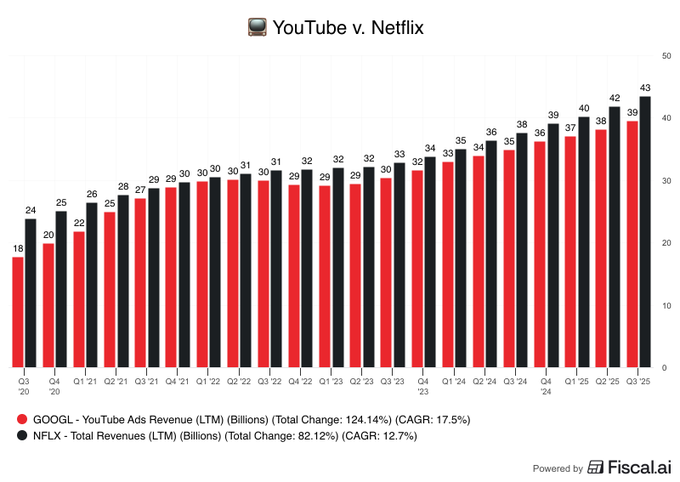
YouTube is one of $GOOGL most underrated asset in the new digital economy.
It makes roughly the same revenue as $NFLX but Netflix spent ~$18B on content last year alone while YouTube spent nothing and still grew ~13% by letting creators fund the platform.
Polymarket Money@PolymarketMoney
Estimated 2025 revenue: • Netflix $45.2 billion • YouTube $45.6 billion Which company would you rather own?
English
Gar D retweetledi
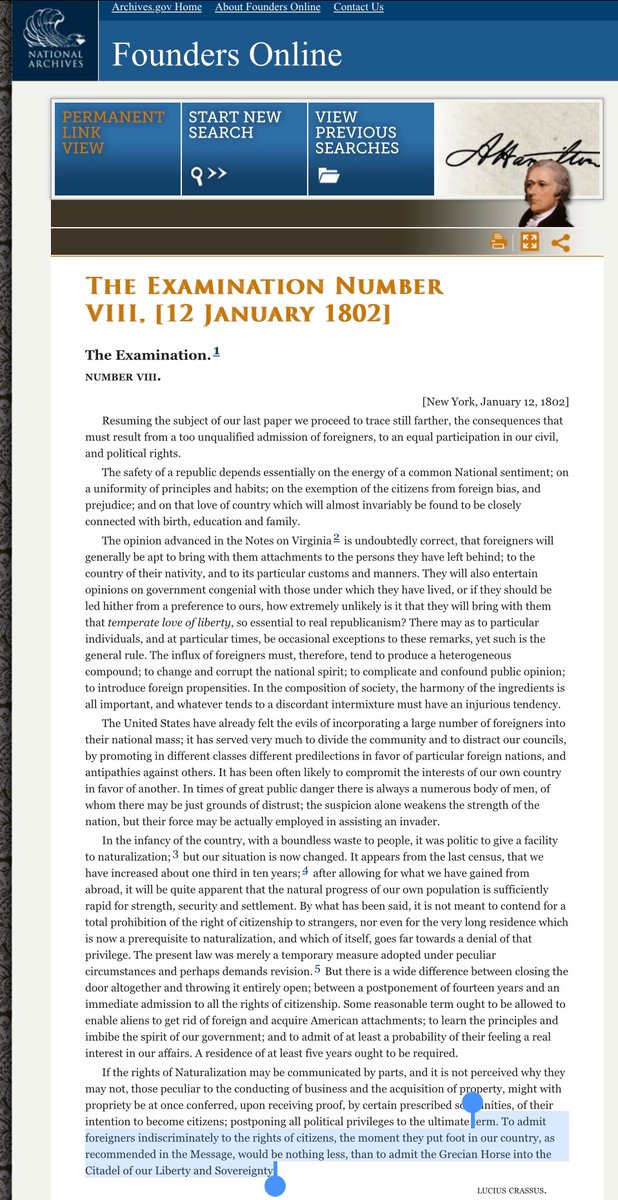
@PalmerLuckey Hamilton in 1802:
“To admit foreigners indiscriminately to the rights of citizens… would be nothing less, than to admit the Grecian Horse into the Citadel of our Liberty and Sovereignty”
founders.archives.gov/documents/Hami…
English
Just initiated a new position in a software name today.
Any guesses which one?
Shay Boloor@StockSavvyShay
English
Gar D retweetledi

Today, they call mass deportations "unconstitutional" and "inhumane." But for decades, they championed the exact same policies..
➝ Hillary (2008): "If they've committed a crime, deport them. No questions asked, they're gone."
➝ Obama (2014): "If you're a criminal, you'll be deported... sent back."
➝ Bill Clinton (1995): Standing ovation for "speeding up deportation" and "securing our borders."
It wasn't "racism" back then. It was just the law 🇺🇸
But now they can't win anymore. The crazy policies, indoctrination, fraud, censorship, gaslighting, and lawfare... people are just done with the crap
So the only way they can win is to flood the country with illegal immigration, block voter ID laws, and create permanently deep blue states
English
Gar D retweetledi

🇺🇸 TESLA'S SELF-DRIVING MODE COULD SAVE 32,000 LIVES A YEAR IN THE U.S.
If everyone used Tesla's Full Self-Driving (Supervised) mode, 32,000 lives could be saved and 1,900,000 injuries avoided every year in the U.S.
In 2023, over 40,000 people died and 2.4M were injured in car crashes.
Most of it was distracted driving: texting, drinking, zoning out.
Tesla's FSD cuts down those crashes by over 80%, because it doesn’t get drunk, tired or stare at TikTok instead of the road.
Some crashes are still possible, but FSD watches everything all the time. Humans don’t.
Their data shows it could eliminate 30% to 44% of distracted driving crashes.
If these numbers hold up, not using it sounds way more dangerous than using it.
Source: @Tesla @SawyerMerritt
English
Gar D retweetledi

California will be bankrupt by 2030.
If you’re expecting a state pension, it is at risk.
If you don’t believe it, check Grok or Gemini and explore how California politicians changed the reporting rules on your pension so they could hide how underwater it is.
The middle class citizens of California will soon be asked to pay a huge price to bail out the state.
Why them?
Because that is where most of the wealth of California resides. It’s easy to single out “billionaires” but there aren’t many of them and they can and will all leave before the bottom falls out. They are leaving in droves already.
The mismanagement in California is biblical - and the scale is huge because it’s the world’s 4th largest economy.
California politicians and their henchmen are now entering the coverup phase where they can no longer hide their financial incompetence so they are taking from average California residents to try and hide what they’ve done:
You will soon see ballot initiatives with fancy tiles like “billionaire tax”. But those are lies. They are mechanisms to tax everything, every way:
Excise taxes
Wealth taxes
Private property confiscation
It’s all happening now.
If you want to preserve California, you will need to stand up because California has become a kleptocracy.
Right Angle News Network@Rightanglenews
BREAKING - A 92-page report by the California State Auditor has found that over $70 billion in taxpayer funds have been lost, including $2.5 billion in SNAP fraud, $24 billion on fighting homelessness, and $18 billion for a high-speed rail where not a single track has been laid.
English