

Vince Hall
1.5K posts
Vince Hall
@Gecko17k
Machine Learning expert. Computer Science Lecturer at Birmingham Newman University. Very into science and learning.
Warwickshire, England Katılım Mayıs 2009
182 Takip Edilen84 Takipçiler


Astronomers have found growing evidence that the Milky Way is located inside a vast cosmic void—a region of space roughly 2 billion light-years across that contains significantly less matter than the cosmic average. This underdensity, sometimes called the KBC Void or Local Hole, features a matter density about 20–30% lower than typical regions of the universe.On the largest scales, the universe is not uniform: matter clumps into enormous filaments, walls, and clusters, separated by immense voids where galaxies and gas are sparse. Gravity in these voids is slightly weaker due to the reduced mass.This local underdensity may resolve the long-standing Hubble tension—the discrepancy between two primary measurements of the universe's expansion rate (the Hubble constant). Measurements of the nearby universe, using supernovae and Cepheid variables, suggest a higher value (73 km/s/Mpc) than those derived from the early universe via the cosmic microwave background and baryon acoustic oscillations (67 km/s/Mpc).If we live in a large void, the reduced gravitational pull from surrounding matter allows nearby galaxies to recede faster than expected in an average region. This local "boost" in apparent expansion mimics a higher Hubble constant without requiring revisions to fundamental physics or cosmology.Recent studies, including analyses of baryon acoustic oscillations and galaxy distributions, show that void models fit observational data substantially better than assuming uniform density. If confirmed, this would mean our cosmic neighborhood is atypically empty, biasing local measurements and forcing astronomers to adjust interpretations of expansion history and large-scale structure.Living near the center of such a giant void would mark a profound shift in our understanding of the universe's homogeneity—and a reminder that our vantage point may not be as representative as once thought.

English
I've been learning languages on Duolingo for a few days. Here’s my invite link: invite.duolingo.com/BDHTZTB5CWWKTE…

English
@willempet Good luck.
I hope the ANC and other corrupt leaders will be kicked out eventually.
Why give people money based on their race?
Or land.
Racism is not moral and is not good for the economy.
Better luck, South Africa.
English

25% of our taxes are wasted on BEE in South Africa x.com/i/broadcasts/1…
English
Manus is a big change!
Looks impressive.
Trump Vance need to make a special immigration visa for Chinese AI researchers.
Or will China win the AI supremacy marathon?
English
Do you want to test your Gen AI literacy?
forms.office.com/Pages/Response…
credit to Prof. Tony Myers of Birmingham Newman University, Sport and Health.
English

@vonderleyen Glad to see a leader who understands we need strength and threat to stop Russia and Putin. They've broken agreements before. Putin doesn't want to be a good boy and stay in his corner. Even though it's an extremely large corner, biggest country in the world.
English

On my way to London to highlight Europe’s ongoing support to Ukraine that can lead to just and lasting peace in Ukraine.
The path to peace is strength.
Weakness breeds more war.
We will support Ukraine, while undertaking a surge in European defence.
English
I'm proud of our PM Starmer, Pres. Macron and other European leaders for standing with the Ukraine against Russian aggression.
Japan, Australia and Canada are onboard too.
I hope we can have our American brothers & sisters onboard with defending democracy too.
No exaggeration.
English
I'm a fan of Trump and Vance but they didn't need to disrespect Zelenskyy like that. Volodimir didn't say anything bad, only facts. No disrespect given.
Trump is potentially threatening WW3, Putin is really threatening it!
Zelenskyy is only defending his people and Europe.
English
@beyond_thecurve @willempet The problem with equity is it means equality of outcome.
That's a truly terrible and unequal thing.
It means no matter how hard you work, you get the same as those who work the least.
No matter how much you innovate you get the average result.
Why work or innovate?
English

🇿🇦🇿🇦 South Africa’s New Land Bill: A Recipe for Economic Collapse?
South Africa stands on the edge of an economic precipice, and the newly proposed Equitable Access to Land Bill might just push it over. Introduced to Parliament on February 19, 2025—or so the buzz on X suggests—this bill allegedly demands that 80% of private property be expropriated to "reflect racial demographics."
Paired with the recently signed Expropriation Act 13 of 2025, which allows for zero compensation in the name of "public interest," this legislation could redefine property rights in a way that sends shockwaves through an already fragile economy. If these claims hold true, #SouthAfrica is flirting with a self-inflicted wound that could rival the worst economic disasters in modern history.
Let’s unpack this. The premise, as floated on X, is that the bill uses race as the yardstick for redistributing land ownership, aiming to mirror the country’s demographic makeup—roughly 80% black, 9% white, 7% colored, and 4% Indian/Asian.
The Expropriation Act, signed into law last month, provides the teeth: it empowers the state to seize property without payment if it serves "public interest," now conveniently defined as racial parity in land ownership. This isn’t just land reform—it’s a racial reengineering of property rights, and the economic fallout could be catastrophic.
First, consider property as the backbone of South Africa’s economy. Agriculture, mining, and real estate collectively account for a hefty chunk of GDP—agriculture alone contributes around 2-3% directly, but its ripple effects through jobs and exports amplify that figure. Private property, including farms and urban holdings, underpins investment, mortgages, and tax revenue.
If 80% of this is suddenly up for grabs, the uncertainty alone could freeze markets overnight. Banks, already jittery from years of political volatility, might call in loans or halt lending altogether, fearing collateral worth could vanish. Property values?
Expect a nosedive as investors flee a system where ownership is no longer a right but a racial roulette.
Foreign investment, already a trickle, would dry up entirely. South Africa’s economy leans heavily on external capital—think mining giants and agribusinesses.
The 2024 Expropriation Act raised eyebrows abroad, but this new bill could sound the death knell. Who pours money into a country where 80% of private assets might be confiscated based on demographics?
The rand, perpetually battered, would likely plummet, driving inflation through the roof. Imports—fuel, machinery, medicine—would become unaffordable, hitting consumers where it hurts most.
Then there’s the agricultural sector, a linchpin of rural employment. South Africa’s commercial farms, largely white-owned due to historical inequities, feed the nation and export billions in citrus, wine, and maize.
If these are expropriated en masse with nil compensation, production could collapse. Zimbabwe’s land seizures in the early 2000s offer a grim parallel—output crashed, food imports soared, and hyperinflation followed.
South Africa’s not there yet, but this bill could set the stage. Smallholder farmers, often touted as the beneficiaries, lack the capital, infrastructure, and expertise to fill the gap.
Past land reform efforts, with over 50% failure rates according to government audits, don’t inspire confidence.
The urban impact might be even uglier. If the 80% target includes residential and commercial property—not just farms, as some X posts hint—cities like Johannesburg and Cape Town could unravel.
Businesses, from tech startups to retail chains, rely on secure leases and ownership. Expropriate those, and you’re not just displacing owners; you’re shuttering jobs and tax bases.
Municipalities, already cash-strapped, would see revenue evaporate, crippling services like water and electricity—both already teetering on the edge.
Critics will argue this is overdue justice for apartheid’s sins, a moral necessity to right historical wrongs. Fair enough—land dispossession scarred South Africa, and equity matters.
But economics isn’t morality. The 1913 Natives Land Act was a travesty, but torching the economy won’t undo it. The Expropriation Act’s “just and equitable” clause was meant to balance redress with stability, not pave the way for a racial free-for-all.
If public interest now means hitting a demographic quota, the law’s lost its moorings—and the economy pays the price.
Posts on X claim this bill is already sparking panic—developers eyeing exits, homeowners bracing for losses.
True or not, perception drives markets, and the narrative’s taking root. South Africa’s GDP growth, a measly 0.6% in 2024, can’t withstand this.
Unemployment, hovering near 33%, could spike as businesses fold. The government, facing a R400 billion debt pile, lacks the cash to cushion the blow.
Is this hyperbole?
Maybe. The bill’s details are murky—X isn’t a primary source, and official texts aren’t public yet. But the smoke signals are dire, and where there’s smoke, there’s often fire. If even half of this is real.
South Africa’s leaders are gambling with a nation’s future. Economic destruction isn’t inevitable, but this bill, paired with the Expropriation Act, lights the fuse. Time will tell if cooler heads prevail—or if we’re witnessing the prelude to collapse.
#cyrilramaphosa #ancientgoons
youtube.com/live/I1vPCq9te…
YouTube
English
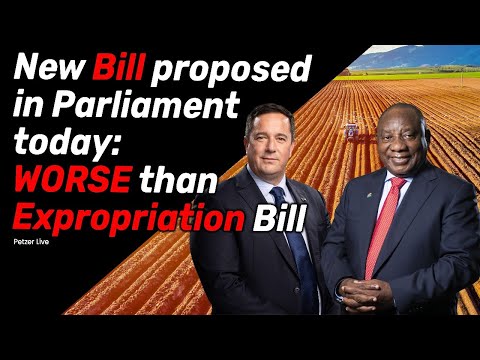
New Bill: 80% of Private property must be Expropriated to "reflect racial demographics" in SA
The new Equitable Access to Land Bill was proposed to parliament yesterday. It aims to redistribute land ownership to better reflect the country’s demographics, using race as a primary criterion. This will work in tandem with the recently signed Expropriation Act 13 of 2025 by providing a legal framework to redistribute land ownership along racial lines, while the Expropriation Act serves as the mechanism for acquiring land deemed necessary for redistribution. In essence, the Expropriation act provides for Zero, or nil, compensation in the case of public interest. This bill clearly defines public interest as racial representation.
Please share full video:
youtube.com/live/I1vPCq9te…
YouTube
English
@beyond_thecurve @willempet Summary:
ANC take private property. Others oppose, communism bad for economy.
Communists hate private ownership and communism is extremely bad for the economy, people power and free press/freedom of speech.
That's why China & Vietnam have elements of capitalism, it's better.
English
@stellatjienooi @willempet The ANC's version of equality is to take from the rich whites & Indians and give to the ANC, then let it stand there doing nothing. Not producing food, not paying taxes, not employing anyone, just useless but in the ownership of the ANC, which they see as the people's ownership.
English

@willempet They have yet to explain to South Africans what “public interest” means in this regard.
That is so wide and totally overreaching.
Don’t expect courts to be objective- that ship has sailed.
English
@willempet I see the ANC is fully committed to the destruction of not only the South African economy and food security but also any remaining vestige of racial equality and all sanity.
English
@DeadCommies187 @BarackObama @MichelleObama I'm no fan of Democrats but that is incredibly crude. It reflects badly on you.
English

I knew it way back then and I’m absolutely convinced of it today — you’re one of a kind, @MichelleObama. Happy Birthday!

English


Huge conservation news! 🕸️🕷️
We’ve helped the UK’s LARGEST spider come back from the brink of extinction!
While they may look big and scary, the fen raft spider is harmless and plays a VITAL role within healthy aquatic ecosystems. However, 15 years ago, they almost became extinct after people destroyed its wetland home.
To help save this unique species, back in 2011, our experts set about rearing hundreds of baby spiders in individual test tubes (so they didn’t eat each other!) as part of a collaborative conservation breeding rescue programme.
Our team delicately hand fed tiny flies to each of the hundreds of spiderlings using tweezers, day in, day out, for weeks on end in our bio-secure breeding facility. Eventually, the young spiders grew strong enough to be returned to their natural habitat, which our partners worked to restore, and we released them in their hundreds!
Now, almost a decade and a half later, our friends at the @Natures_Voice estimate there are 10,000 breeding females across the UK, and they’re having their best year on record.
We’re so proud of the part we’ve played in this incredible conservation success story 🧡
1) 📸 Ben Andrew (rspb-images.com)




English
@Irontoffee @chesterzoo @Natures_Voice Can drop those spiders in our house. Get rid of those pest insects like mosquitoes. ❤️🕷️
English

@chesterzoo @Natures_Voice 10000 females....is it true that each females egg sack holds 200 spiderlings & they drop them in living rooms
English
@chesterzoo @Natures_Voice Excellent work! Well done you and well done spiders. ❤️🕷️
English

@MrAndyNgo So, let me get this straight.
The people on the right didn't do anything and the Muslim gang went around attacking white people?
This is the UK, these days?
English

Just in:
Birmingham, England, Aug . 5 — Armed "Muslim patrol" members surrounded and attacked a pub after marching around the area looking for white right-wingers to attack. (The rumored "far-right" protest never materialized.)
The Muslim rioters attacked journalists and slashed up the vehicle of a Sky News team. @WMPolice said they had "well-rehearsed plans in place" to deal with right-wing protests. But they did not show up to the group of around 300 Muslims who mobilized for a direct action.
English

Population collapse is accelerating
More Births@MoreBirths
What most people fail to grasp about the low birthrate crisis is the sheer speed of the decline. This chart (NYT) shows how much births dropped in 1 year. Births/woman from 2015 to 2023: 1.78 to 1.14 in Chile 1.79 to 1.45 in UK 2.24 to 1.35 in Argentina 1.24 to 0.72 in S Korea
English