Big Ten information and news

50.5K posts

Big Ten information and news banner
Big Ten information and news

Big Ten information and news

@Genetics56

Father & husband. Providing Big Ten information and news.

Katılım Temmuz 2008
1.3K Takip Edilen18.3K Takipçiler
Sabitlenmiş Tweet
Big Ten information and news
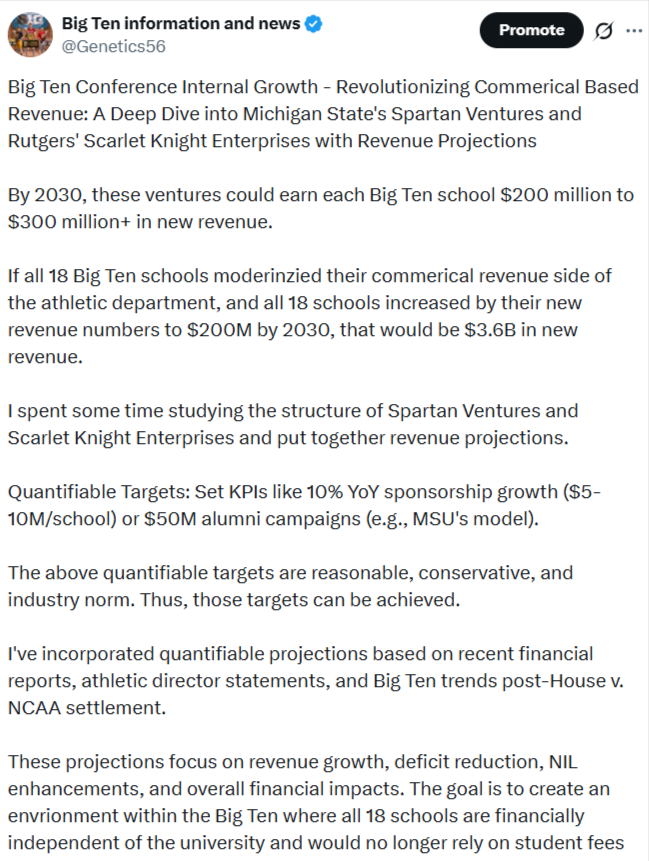
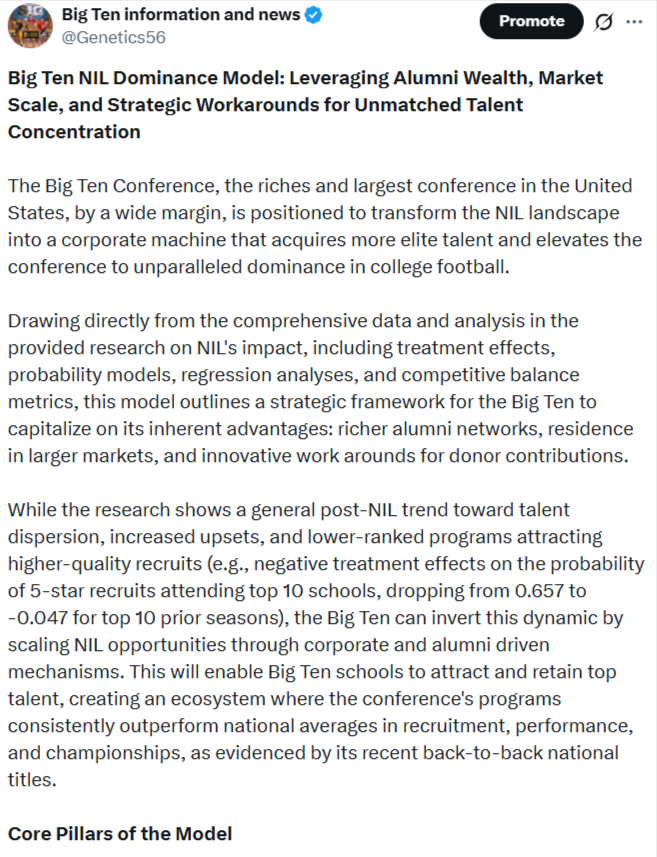
Big Ten Conference Internal Growth: A catolog of models built, revenue projections and growing revenue, and moderinizing the conference. All posts will be saved below. This will be a long series of posts and topics Goal: Help The Big Ten Conference Reach Its True Potential Big Ten Conference Internal Growth - Revolutionizing Commerical Based Revenue: A Deep Dive into Michigan State's Spartan Ventures and Rutgers' Scarlet Knight Enterprises with Revenue Projections x.com/twitter/status… Big Ten NIL Dominance Model: Leveraging Alumni Wealth, Market Scale, and Strategic Workarounds for Unmatched Talent Concentration x.com/Genetics56/sta…
Big Ten information and news tweet mediaBig Ten information and news tweet media
English
1
6
16
39K
Big Ten information and news retweetledi
Nebraska Huskers
Nebraska Huskers@Huskers·
Every successful event starts with the people behind it. From game days to private donor experiences, Lydia Granahan continuously raises the bar, leading hospitality and premium seating efforts for the Huskers Athletic Fund. Congrats on being the May HOTM, Lydia! 🏆
Nebraska Huskers tweet media
English
2
5
54
5.9K
Big Ten information and news
As I've stuided this topic over the last week, I changed my view on some things and more confident in other things. I've realized that rules are the schools themselves. They control everything. Deregulating the NCAA is the same as leaving the NCAA. So you don't need to terma
Big Ten information and news@Genetics56

If the NCAA and its members deregulated all meaningful rules and oversight to the conferences, would it still be worth remaining as an NCAA member? At that point what is the point of termination? They can still run the post-season events.

English
0
0
1
1K
Big Ten information and news
I can only doing it as a high level response since I don't deal with things in this area, never have. My understanding it is a mandate by the state of NJ, thus, basically a fixed expense they have to overcome.
Kevin Sherlock@kevsherlock

@Genetics56 Can you explain further? What are the fringe benefits he references? The team of Tate and Zinn have RU more than heading in the right direction. We will win!

English
1
0
2
875
Big Ten information and news
If the NCAA and its members deregulated all meaningful rules and oversight to the conferences, would it still be worth remaining as an NCAA member? At that point what is the point of termination? They can still run the post-season events.
English
3
0
3
1.6K
Big Ten information and news
Rutgers can and will win. I am a strong believer in that. One of the smartest things Rutgers has done in the last several months was to identify a challenge that is something to get addressed....with the fringe benefits.
Big Ten information and news tweet media
D1.ticker@D1ticker

Top stories from this weekend: ➤ @CollegetownHub x @D1Relocation ➤ Mizzou AD Laird Veatch's contract details ➤ Big Ten FY25 revenue ➤ What is Miami looking for? ➤ @Tim_Pernetti talks G6 Playoff ➤ Rutgers' fringe benefit challenge ➤ @ASUFootball's major gift Read more: Monday: my.omeda.com/portal/report/… Sunday: my.omeda.com/portal/report/… Saturday: my.omeda.com/portal/report/…

English
2
4
37
10.6K
Big Ten information and news
The Big Ten, SEC, Big 12 and ACC are attempting to create a uniform tie breaking criteria for football. We will see if thst works or not.
English
3
0
27
3.9K
Big Ten information and news
I will contine with this topic throughout the entire week, so I will go over more tomorrow.
Big Ten information and news@Genetics56

A New Model For College Athletics: Maximizing Conference Autonomy Without Full NCAA Termination *this model is not a completed version, but a starting point of a very important topic that has to be discussed. I outline the structure of a new model for college athletics. E-FCAM-LR - the stress-tested, Enhanced Federated Conference Autonomy Model. Don't worry about the title. That's just part of my work as to why it has that label. This model incorporates the April 29, 2026, insights on Choh & Kirk v. Brown University (2d Cir. Apr. 2, 2026) and the explicit “somewhere in the middle” structure for conferences: full NCAA membership retained, maximum central deregulation, and conference-level governance in defined spheres. It's the realistic, low-risk path (especially if federal antitrust relief or collective bargaining remain stalled). Stress-Test Summary: Why This Model Now Passes Every Major Test Choh & Kirk doctrinal shift is real and powerful: The Second Circuit affirmed dismissal because plaintiffs failed to plead a relevant antitrust market. They tried to define it narrowly as “Ivy League educational/athletic services,” but their own complaint admitted competition from non-Ivy schools (Power conferences, etc.). The court leaned heavily on Alston (2021): individual conferences may adopt rules different from NCAA-wide rules without triggering the same level of scrutiny when those rules can be justified under the rule of reason as promoting competitive balance, eligibility standards, roster stability, or market structure, rather than naked wage fixing. It gives Big school and conference lawyers strong cover for conference-specific revenue-share templates, transfer disincentives, roster rules, tampering windows, and eligibility add-ons. Conferences adopt their own rules. Conferences file “Conference Autonomy Compacts.” The NCAA recognizes these as valid under the Constitution (no further national approval needed for deregulated areas). Conference Autonomy Compacts are the formal, written legal vehicle that allows individual conferences to exercise and document their self-governance authority. A Conference Autonomy Compact is a filed agreement between a conference and the NCAA that: Identifies the specific NCAA rules (or categories of rules) that have been deregulated or are otherwise reserved to conferences. Lists the exact conference-specific rules the conference is adopting in those areas. Certifies that the conference’s rules comply with any remaining national minimum floors (e.g., core principles in Constitution Articles 1–2). Creates an internal enforcement mechanism (conference discipline, standardized contract templates, dispute-resolution processes) that the NCAA recognizes as valid. Legal Structure and Protection (Directly from the NCAA Manual + Court Precedent) 1. NCAA Constitutional Authority (2025-26 Manual) Constitution Article 2.B (Organization) explicitly states: “The membership of the NCAA encompasses public and private institutions and conferences of widely varying mission, size, resources and opportunities. Accordingly, Association-wide governance must reflect these differences through the delegation of authorities and responsibilities to the divisions, conferences and individual member institutions except where necessary to promote and maintain the Association’s core principles.” “Authorities not specifically assigned to the Association are reserved to divisions, subdivisions, conferences, or institutions.” Once the Division I Cabinet and sport oversight committees deregulate a rule area (the process already underway in 2026 for Bylaws 11, 13, and 17), that authority is automatically reserved to conferences. The Compact simply documents and activates it - no new constitutional amendment needed. Article 9 (Legislative Authority) and Bylaw 21 (Governance Structure) allow conferences to adopt their own operating rules once the national rule is removed or made optional. 2. Antitrust Protection (Alston + Choh & Kirk) NCAA v. Alston (2021): The Supreme Court made clear that individual conferences may adopt rules different from (or stricter than) NCAA-wide rules. Only multi-conference/NCAA agreements face the highest level of scrutiny. Choh & Kirk v. Brown University (2d Cir., Apr. 2, 2026): The court reinforced that conference-specific rules on competitive balance, eligibility, roster stability, transfer rules, revenue-share mechanics, and tampering windows receive more favorable rule-of-reason analysis when framed around pro-competitive justifications (market structure, roster integrity, competitive parity) rather than naked wage-fixing. Because a Compact is a single-conference (or single-subdivision) agreement, it benefits from this lighter scrutiny and the national-market reality the Second Circuit recognized. The Compact itself becomes the documentary evidence that the rules are conference-driven, not a centralized NCAA cartel - further insulating them from antitrust attack. What a Typical Conference Autonomy Compact Contains A real-world Compact (filed with the NCAA’s Office of the President and the Division I Board) would typically include: Scope section: Lists the deregulated bylaws (e.g., portions of Bylaw 13 recruiting, Bylaw 17 playing seasons, revenue-share mechanics). Conference-specific rules: – Uncapped revenue-share templates (NIL/IP/performance contracts with explicit waivers and “lost NIL licensing value” damage theories). – Legal tampering windows and retention bonuses. – Transfer disincentives, roster limits, and notification windows. – Eligibility add-ons framed as competitive-balance measures. – Standardized buyout formulas. Compliance certification: Confirms adherence to national floors (5-year eligibility, structured transfers, medical care, women’s/Olympic sports protections). Enforcement provisions: Conference discipline process, arbitration, and appeal rights (NCAA appeal limited to federal-funding/EO risks only). Duration and amendment: Usually 4–6 years with opt-out/renewal clauses. How They Are Created and Activated (2026 Timeline) Cabinet/sport oversight committees deregulate the rule (already scheduled for 2026). Conference legal teams draft the Compact -style template (waivers, alternative damage theories, competitive-balance framing). Conference presidents/commissioners approve and file it with the NCAA. NCAA acknowledges receipt and lists the conference’s rules as “valid conference governance” - no further national vote required. The Compact becomes effective for the next academic year. Role in E-FCAM-LR Conference Autonomy Compacts are the operational heart of the model. They deliver exactly what Big Ten and SEC leaders described on April 29, 2026: “central deregulation with the ability for leagues to govern in certain spheres” - while keeping the NCAA tournament, championships, and umbrella intact. They provide:Legal clarity and enforceability inside NCAA membership. Antitrust safe harbor via Alston/Choh. Title IX protection for uncapped revenue share (treated as commercial NIL compensation, not athletic aid). A ready-made structure for the Premier FBS Division (top 28–52 programs). No full separation. No new federal legislation required. Just the NCAA doing what its own Constitution already says it should do. This is why the Power conferences have been quietly building toward this architecture. The Compacts are the clean, low-risk, immediately available tool that turns the 2025-26 Manual and Choh decision into a fully functional new governance reality. Again, to make it clear, Conference Autonomy Compacts are the formal legal document that activates a conference’s self-governance authority once the NCAA has deregulated a rule area. They are not a new invention - they are the natural extension of the 2025-26 NCAA Constitution Article 2’s explicit reservation of authority to conferences. 2. Antitrust Protection (Alston + Choh & Kirk)NCAA v. Alston (2021): The Supreme Court made clear that individual conferences may adopt rules different from (or stricter than) NCAA-wide rules. Only multi-conference/NCAA agreements face the highest level of scrutiny. Choh & Kirk v. Brown University (2d Cir., Apr. 2, 2026): The court reinforced that conference-specific rules on competitive balance, eligibility, roster stability, transfer rules, revenue-share mechanics, and tampering windows receive more favorable rule-of-reason analysis when framed around pro-competitive justifications (market structure, roster integrity, competitive parity) rather than naked wage-fixing. Because a Compact is a single-conference (or single-subdivision) agreement, it benefits from this lighter scrutiny and the national-market reality the Second Circuit recognized. The Compact itself becomes the documentary evidence that the rules are conference-driven, not a centralized NCAA cartel - further insulating them from antitrust attack. Practical impact:Conference-specific revenue-share templates, transfer disincentives, roster limits, tampering windows, and eligibility add-ons can be defended as preserving competitive balance within the conference - exactly the framing Choh endorses. Antitrust risk drops dramatically compared with NCAA-wide rules (which have repeatedly lost in Alston, House, etc.). Combined with Big Ten-style contract drafting (waivers, NIL/IP framing, performance-based reimbursement, alternative damage theories), this creates a resilient legal architecture. When rules are framed around pro-competitive justifications (competitive balance, roster stability, eligibility standards, market structure) rather than naked wage-fixing or price-fixing, they face lighter scrutiny and are more likely to survive. The NCAA’s governing documents explicitly permit — and in many cases require - this delegation: Constitution Article 2 (Organization): “The membership of the NCAA encompasses public and private institutions and conferences of widely varying mission, size, resources and opportunities. Accordingly, Association-wide governance must reflect these differences through the delegation of authorities and responsibilities to the divisions, conferences and individual member institutions except where necessary to promote and maintain the Association’s core principles.” “Authorities not specifically assigned to the Association are reserved to divisions, subdivisions, conferences, or institutions.” Divisions have independent authority to organize their own governing bodies, standards, and enforcement. Article 9 (Legislative Authority and Process) and Bylaw 21 (Governance Structure) empower the Cabinet, sport oversight committees, and Board to deregulate via normal legislative channels. No constitutional amendment is required. Institutional control (Articles 1.E, 6, 8) remains with campus presidents/chancellors - conferences simply exercise the authority the NCAA has already reserved to them.

English
0
0
4
1.8K
Big Ten information and news
No, not via this method. As I outlined: the mechanism of how it would in this model With no employee standing, there is no rule to unregulate of employee rule.
Big Ten information and news tweet media
TerryTerry79@TerryTerry79

@Genetics56 So under a Conference Autonomy Compact, we could expect to see some conferences with employment for the athletes, unionization, CBA, binding contracts, and a conference salary cap?

English
1
0
2
2.3K
Big Ten information and news
Antitrust safe harbor via Alston/Choh
Big Ten information and news tweet media
Big Ten information and news@Genetics56

A New Model For College Athletics: Maximizing Conference Autonomy Without Full NCAA Termination *this model is not a completed version, but a starting point of a very important topic that has to be discussed. I outline the structure of a new model for college athletics. E-FCAM-LR - the stress-tested, Enhanced Federated Conference Autonomy Model. Don't worry about the title. That's just part of my work as to why it has that label. This model incorporates the April 29, 2026, insights on Choh & Kirk v. Brown University (2d Cir. Apr. 2, 2026) and the explicit “somewhere in the middle” structure for conferences: full NCAA membership retained, maximum central deregulation, and conference-level governance in defined spheres. It's the realistic, low-risk path (especially if federal antitrust relief or collective bargaining remain stalled). Stress-Test Summary: Why This Model Now Passes Every Major Test Choh & Kirk doctrinal shift is real and powerful: The Second Circuit affirmed dismissal because plaintiffs failed to plead a relevant antitrust market. They tried to define it narrowly as “Ivy League educational/athletic services,” but their own complaint admitted competition from non-Ivy schools (Power conferences, etc.). The court leaned heavily on Alston (2021): individual conferences may adopt rules different from NCAA-wide rules without triggering the same level of scrutiny when those rules can be justified under the rule of reason as promoting competitive balance, eligibility standards, roster stability, or market structure, rather than naked wage fixing. It gives Big school and conference lawyers strong cover for conference-specific revenue-share templates, transfer disincentives, roster rules, tampering windows, and eligibility add-ons. Conferences adopt their own rules. Conferences file “Conference Autonomy Compacts.” The NCAA recognizes these as valid under the Constitution (no further national approval needed for deregulated areas). Conference Autonomy Compacts are the formal, written legal vehicle that allows individual conferences to exercise and document their self-governance authority. A Conference Autonomy Compact is a filed agreement between a conference and the NCAA that: Identifies the specific NCAA rules (or categories of rules) that have been deregulated or are otherwise reserved to conferences. Lists the exact conference-specific rules the conference is adopting in those areas. Certifies that the conference’s rules comply with any remaining national minimum floors (e.g., core principles in Constitution Articles 1–2). Creates an internal enforcement mechanism (conference discipline, standardized contract templates, dispute-resolution processes) that the NCAA recognizes as valid. Legal Structure and Protection (Directly from the NCAA Manual + Court Precedent) 1. NCAA Constitutional Authority (2025-26 Manual) Constitution Article 2.B (Organization) explicitly states: “The membership of the NCAA encompasses public and private institutions and conferences of widely varying mission, size, resources and opportunities. Accordingly, Association-wide governance must reflect these differences through the delegation of authorities and responsibilities to the divisions, conferences and individual member institutions except where necessary to promote and maintain the Association’s core principles.” “Authorities not specifically assigned to the Association are reserved to divisions, subdivisions, conferences, or institutions.” Once the Division I Cabinet and sport oversight committees deregulate a rule area (the process already underway in 2026 for Bylaws 11, 13, and 17), that authority is automatically reserved to conferences. The Compact simply documents and activates it - no new constitutional amendment needed. Article 9 (Legislative Authority) and Bylaw 21 (Governance Structure) allow conferences to adopt their own operating rules once the national rule is removed or made optional. 2. Antitrust Protection (Alston + Choh & Kirk) NCAA v. Alston (2021): The Supreme Court made clear that individual conferences may adopt rules different from (or stricter than) NCAA-wide rules. Only multi-conference/NCAA agreements face the highest level of scrutiny. Choh & Kirk v. Brown University (2d Cir., Apr. 2, 2026): The court reinforced that conference-specific rules on competitive balance, eligibility, roster stability, transfer rules, revenue-share mechanics, and tampering windows receive more favorable rule-of-reason analysis when framed around pro-competitive justifications (market structure, roster integrity, competitive parity) rather than naked wage-fixing. Because a Compact is a single-conference (or single-subdivision) agreement, it benefits from this lighter scrutiny and the national-market reality the Second Circuit recognized. The Compact itself becomes the documentary evidence that the rules are conference-driven, not a centralized NCAA cartel - further insulating them from antitrust attack. What a Typical Conference Autonomy Compact Contains A real-world Compact (filed with the NCAA’s Office of the President and the Division I Board) would typically include: Scope section: Lists the deregulated bylaws (e.g., portions of Bylaw 13 recruiting, Bylaw 17 playing seasons, revenue-share mechanics). Conference-specific rules: – Uncapped revenue-share templates (NIL/IP/performance contracts with explicit waivers and “lost NIL licensing value” damage theories). – Legal tampering windows and retention bonuses. – Transfer disincentives, roster limits, and notification windows. – Eligibility add-ons framed as competitive-balance measures. – Standardized buyout formulas. Compliance certification: Confirms adherence to national floors (5-year eligibility, structured transfers, medical care, women’s/Olympic sports protections). Enforcement provisions: Conference discipline process, arbitration, and appeal rights (NCAA appeal limited to federal-funding/EO risks only). Duration and amendment: Usually 4–6 years with opt-out/renewal clauses. How They Are Created and Activated (2026 Timeline) Cabinet/sport oversight committees deregulate the rule (already scheduled for 2026). Conference legal teams draft the Compact -style template (waivers, alternative damage theories, competitive-balance framing). Conference presidents/commissioners approve and file it with the NCAA. NCAA acknowledges receipt and lists the conference’s rules as “valid conference governance” - no further national vote required. The Compact becomes effective for the next academic year. Role in E-FCAM-LR Conference Autonomy Compacts are the operational heart of the model. They deliver exactly what Big Ten and SEC leaders described on April 29, 2026: “central deregulation with the ability for leagues to govern in certain spheres” - while keeping the NCAA tournament, championships, and umbrella intact. They provide:Legal clarity and enforceability inside NCAA membership. Antitrust safe harbor via Alston/Choh. Title IX protection for uncapped revenue share (treated as commercial NIL compensation, not athletic aid). A ready-made structure for the Premier FBS Division (top 28–52 programs). No full separation. No new federal legislation required. Just the NCAA doing what its own Constitution already says it should do. This is why the Power conferences have been quietly building toward this architecture. The Compacts are the clean, low-risk, immediately available tool that turns the 2025-26 Manual and Choh decision into a fully functional new governance reality. Again, to make it clear, Conference Autonomy Compacts are the formal legal document that activates a conference’s self-governance authority once the NCAA has deregulated a rule area. They are not a new invention - they are the natural extension of the 2025-26 NCAA Constitution Article 2’s explicit reservation of authority to conferences. 2. Antitrust Protection (Alston + Choh & Kirk)NCAA v. Alston (2021): The Supreme Court made clear that individual conferences may adopt rules different from (or stricter than) NCAA-wide rules. Only multi-conference/NCAA agreements face the highest level of scrutiny. Choh & Kirk v. Brown University (2d Cir., Apr. 2, 2026): The court reinforced that conference-specific rules on competitive balance, eligibility, roster stability, transfer rules, revenue-share mechanics, and tampering windows receive more favorable rule-of-reason analysis when framed around pro-competitive justifications (market structure, roster integrity, competitive parity) rather than naked wage-fixing. Because a Compact is a single-conference (or single-subdivision) agreement, it benefits from this lighter scrutiny and the national-market reality the Second Circuit recognized. The Compact itself becomes the documentary evidence that the rules are conference-driven, not a centralized NCAA cartel - further insulating them from antitrust attack. Practical impact:Conference-specific revenue-share templates, transfer disincentives, roster limits, tampering windows, and eligibility add-ons can be defended as preserving competitive balance within the conference - exactly the framing Choh endorses. Antitrust risk drops dramatically compared with NCAA-wide rules (which have repeatedly lost in Alston, House, etc.). Combined with Big Ten-style contract drafting (waivers, NIL/IP framing, performance-based reimbursement, alternative damage theories), this creates a resilient legal architecture. When rules are framed around pro-competitive justifications (competitive balance, roster stability, eligibility standards, market structure) rather than naked wage-fixing or price-fixing, they face lighter scrutiny and are more likely to survive. The NCAA’s governing documents explicitly permit — and in many cases require - this delegation: Constitution Article 2 (Organization): “The membership of the NCAA encompasses public and private institutions and conferences of widely varying mission, size, resources and opportunities. Accordingly, Association-wide governance must reflect these differences through the delegation of authorities and responsibilities to the divisions, conferences and individual member institutions except where necessary to promote and maintain the Association’s core principles.” “Authorities not specifically assigned to the Association are reserved to divisions, subdivisions, conferences, or institutions.” Divisions have independent authority to organize their own governing bodies, standards, and enforcement. Article 9 (Legislative Authority and Process) and Bylaw 21 (Governance Structure) empower the Cabinet, sport oversight committees, and Board to deregulate via normal legislative channels. No constitutional amendment is required. Institutional control (Articles 1.E, 6, 8) remains with campus presidents/chancellors - conferences simply exercise the authority the NCAA has already reserved to them.

English
1
0
2
1.7K
Big Ten information and news
Big Ten information and news tweet media
Big Ten information and news@Genetics56

A New Model For College Athletics: Maximizing Conference Autonomy Without Full NCAA Termination *this model is not a completed version, but a starting point of a very important topic that has to be discussed. I outline the structure of a new model for college athletics. E-FCAM-LR - the stress-tested, Enhanced Federated Conference Autonomy Model. Don't worry about the title. That's just part of my work as to why it has that label. This model incorporates the April 29, 2026, insights on Choh & Kirk v. Brown University (2d Cir. Apr. 2, 2026) and the explicit “somewhere in the middle” structure for conferences: full NCAA membership retained, maximum central deregulation, and conference-level governance in defined spheres. It's the realistic, low-risk path (especially if federal antitrust relief or collective bargaining remain stalled). Stress-Test Summary: Why This Model Now Passes Every Major Test Choh & Kirk doctrinal shift is real and powerful: The Second Circuit affirmed dismissal because plaintiffs failed to plead a relevant antitrust market. They tried to define it narrowly as “Ivy League educational/athletic services,” but their own complaint admitted competition from non-Ivy schools (Power conferences, etc.). The court leaned heavily on Alston (2021): individual conferences may adopt rules different from NCAA-wide rules without triggering the same level of scrutiny when those rules can be justified under the rule of reason as promoting competitive balance, eligibility standards, roster stability, or market structure, rather than naked wage fixing. It gives Big school and conference lawyers strong cover for conference-specific revenue-share templates, transfer disincentives, roster rules, tampering windows, and eligibility add-ons. Conferences adopt their own rules. Conferences file “Conference Autonomy Compacts.” The NCAA recognizes these as valid under the Constitution (no further national approval needed for deregulated areas). Conference Autonomy Compacts are the formal, written legal vehicle that allows individual conferences to exercise and document their self-governance authority. A Conference Autonomy Compact is a filed agreement between a conference and the NCAA that: Identifies the specific NCAA rules (or categories of rules) that have been deregulated or are otherwise reserved to conferences. Lists the exact conference-specific rules the conference is adopting in those areas. Certifies that the conference’s rules comply with any remaining national minimum floors (e.g., core principles in Constitution Articles 1–2). Creates an internal enforcement mechanism (conference discipline, standardized contract templates, dispute-resolution processes) that the NCAA recognizes as valid. Legal Structure and Protection (Directly from the NCAA Manual + Court Precedent) 1. NCAA Constitutional Authority (2025-26 Manual) Constitution Article 2.B (Organization) explicitly states: “The membership of the NCAA encompasses public and private institutions and conferences of widely varying mission, size, resources and opportunities. Accordingly, Association-wide governance must reflect these differences through the delegation of authorities and responsibilities to the divisions, conferences and individual member institutions except where necessary to promote and maintain the Association’s core principles.” “Authorities not specifically assigned to the Association are reserved to divisions, subdivisions, conferences, or institutions.” Once the Division I Cabinet and sport oversight committees deregulate a rule area (the process already underway in 2026 for Bylaws 11, 13, and 17), that authority is automatically reserved to conferences. The Compact simply documents and activates it - no new constitutional amendment needed. Article 9 (Legislative Authority) and Bylaw 21 (Governance Structure) allow conferences to adopt their own operating rules once the national rule is removed or made optional. 2. Antitrust Protection (Alston + Choh & Kirk) NCAA v. Alston (2021): The Supreme Court made clear that individual conferences may adopt rules different from (or stricter than) NCAA-wide rules. Only multi-conference/NCAA agreements face the highest level of scrutiny. Choh & Kirk v. Brown University (2d Cir., Apr. 2, 2026): The court reinforced that conference-specific rules on competitive balance, eligibility, roster stability, transfer rules, revenue-share mechanics, and tampering windows receive more favorable rule-of-reason analysis when framed around pro-competitive justifications (market structure, roster integrity, competitive parity) rather than naked wage-fixing. Because a Compact is a single-conference (or single-subdivision) agreement, it benefits from this lighter scrutiny and the national-market reality the Second Circuit recognized. The Compact itself becomes the documentary evidence that the rules are conference-driven, not a centralized NCAA cartel - further insulating them from antitrust attack. What a Typical Conference Autonomy Compact Contains A real-world Compact (filed with the NCAA’s Office of the President and the Division I Board) would typically include: Scope section: Lists the deregulated bylaws (e.g., portions of Bylaw 13 recruiting, Bylaw 17 playing seasons, revenue-share mechanics). Conference-specific rules: – Uncapped revenue-share templates (NIL/IP/performance contracts with explicit waivers and “lost NIL licensing value” damage theories). – Legal tampering windows and retention bonuses. – Transfer disincentives, roster limits, and notification windows. – Eligibility add-ons framed as competitive-balance measures. – Standardized buyout formulas. Compliance certification: Confirms adherence to national floors (5-year eligibility, structured transfers, medical care, women’s/Olympic sports protections). Enforcement provisions: Conference discipline process, arbitration, and appeal rights (NCAA appeal limited to federal-funding/EO risks only). Duration and amendment: Usually 4–6 years with opt-out/renewal clauses. How They Are Created and Activated (2026 Timeline) Cabinet/sport oversight committees deregulate the rule (already scheduled for 2026). Conference legal teams draft the Compact -style template (waivers, alternative damage theories, competitive-balance framing). Conference presidents/commissioners approve and file it with the NCAA. NCAA acknowledges receipt and lists the conference’s rules as “valid conference governance” - no further national vote required. The Compact becomes effective for the next academic year. Role in E-FCAM-LR Conference Autonomy Compacts are the operational heart of the model. They deliver exactly what Big Ten and SEC leaders described on April 29, 2026: “central deregulation with the ability for leagues to govern in certain spheres” - while keeping the NCAA tournament, championships, and umbrella intact. They provide:Legal clarity and enforceability inside NCAA membership. Antitrust safe harbor via Alston/Choh. Title IX protection for uncapped revenue share (treated as commercial NIL compensation, not athletic aid). A ready-made structure for the Premier FBS Division (top 28–52 programs). No full separation. No new federal legislation required. Just the NCAA doing what its own Constitution already says it should do. This is why the Power conferences have been quietly building toward this architecture. The Compacts are the clean, low-risk, immediately available tool that turns the 2025-26 Manual and Choh decision into a fully functional new governance reality. Again, to make it clear, Conference Autonomy Compacts are the formal legal document that activates a conference’s self-governance authority once the NCAA has deregulated a rule area. They are not a new invention - they are the natural extension of the 2025-26 NCAA Constitution Article 2’s explicit reservation of authority to conferences. 2. Antitrust Protection (Alston + Choh & Kirk)NCAA v. Alston (2021): The Supreme Court made clear that individual conferences may adopt rules different from (or stricter than) NCAA-wide rules. Only multi-conference/NCAA agreements face the highest level of scrutiny. Choh & Kirk v. Brown University (2d Cir., Apr. 2, 2026): The court reinforced that conference-specific rules on competitive balance, eligibility, roster stability, transfer rules, revenue-share mechanics, and tampering windows receive more favorable rule-of-reason analysis when framed around pro-competitive justifications (market structure, roster integrity, competitive parity) rather than naked wage-fixing. Because a Compact is a single-conference (or single-subdivision) agreement, it benefits from this lighter scrutiny and the national-market reality the Second Circuit recognized. The Compact itself becomes the documentary evidence that the rules are conference-driven, not a centralized NCAA cartel - further insulating them from antitrust attack. Practical impact:Conference-specific revenue-share templates, transfer disincentives, roster limits, tampering windows, and eligibility add-ons can be defended as preserving competitive balance within the conference - exactly the framing Choh endorses. Antitrust risk drops dramatically compared with NCAA-wide rules (which have repeatedly lost in Alston, House, etc.). Combined with Big Ten-style contract drafting (waivers, NIL/IP framing, performance-based reimbursement, alternative damage theories), this creates a resilient legal architecture. When rules are framed around pro-competitive justifications (competitive balance, roster stability, eligibility standards, market structure) rather than naked wage-fixing or price-fixing, they face lighter scrutiny and are more likely to survive. The NCAA’s governing documents explicitly permit — and in many cases require - this delegation: Constitution Article 2 (Organization): “The membership of the NCAA encompasses public and private institutions and conferences of widely varying mission, size, resources and opportunities. Accordingly, Association-wide governance must reflect these differences through the delegation of authorities and responsibilities to the divisions, conferences and individual member institutions except where necessary to promote and maintain the Association’s core principles.” “Authorities not specifically assigned to the Association are reserved to divisions, subdivisions, conferences, or institutions.” Divisions have independent authority to organize their own governing bodies, standards, and enforcement. Article 9 (Legislative Authority and Process) and Bylaw 21 (Governance Structure) empower the Cabinet, sport oversight committees, and Board to deregulate via normal legislative channels. No constitutional amendment is required. Institutional control (Articles 1.E, 6, 8) remains with campus presidents/chancellors - conferences simply exercise the authority the NCAA has already reserved to them.

ZXX
0
0
6
2.6K
Big Ten information and news
Article 9 (Legislative Authority) and Bylaw 21 (Governance Structure) allow conferences to adopt their own operating rules once the national rule is removed or made optional.
Big Ten information and news@Genetics56

A New Model For College Athletics: Maximizing Conference Autonomy Without Full NCAA Termination *this model is not a completed version, but a starting point of a very important topic that has to be discussed. I outline the structure of a new model for college athletics. E-FCAM-LR - the stress-tested, Enhanced Federated Conference Autonomy Model. Don't worry about the title. That's just part of my work as to why it has that label. This model incorporates the April 29, 2026, insights on Choh & Kirk v. Brown University (2d Cir. Apr. 2, 2026) and the explicit “somewhere in the middle” structure for conferences: full NCAA membership retained, maximum central deregulation, and conference-level governance in defined spheres. It's the realistic, low-risk path (especially if federal antitrust relief or collective bargaining remain stalled). Stress-Test Summary: Why This Model Now Passes Every Major Test Choh & Kirk doctrinal shift is real and powerful: The Second Circuit affirmed dismissal because plaintiffs failed to plead a relevant antitrust market. They tried to define it narrowly as “Ivy League educational/athletic services,” but their own complaint admitted competition from non-Ivy schools (Power conferences, etc.). The court leaned heavily on Alston (2021): individual conferences may adopt rules different from NCAA-wide rules without triggering the same level of scrutiny when those rules can be justified under the rule of reason as promoting competitive balance, eligibility standards, roster stability, or market structure, rather than naked wage fixing. It gives Big school and conference lawyers strong cover for conference-specific revenue-share templates, transfer disincentives, roster rules, tampering windows, and eligibility add-ons. Conferences adopt their own rules. Conferences file “Conference Autonomy Compacts.” The NCAA recognizes these as valid under the Constitution (no further national approval needed for deregulated areas). Conference Autonomy Compacts are the formal, written legal vehicle that allows individual conferences to exercise and document their self-governance authority. A Conference Autonomy Compact is a filed agreement between a conference and the NCAA that: Identifies the specific NCAA rules (or categories of rules) that have been deregulated or are otherwise reserved to conferences. Lists the exact conference-specific rules the conference is adopting in those areas. Certifies that the conference’s rules comply with any remaining national minimum floors (e.g., core principles in Constitution Articles 1–2). Creates an internal enforcement mechanism (conference discipline, standardized contract templates, dispute-resolution processes) that the NCAA recognizes as valid. Legal Structure and Protection (Directly from the NCAA Manual + Court Precedent) 1. NCAA Constitutional Authority (2025-26 Manual) Constitution Article 2.B (Organization) explicitly states: “The membership of the NCAA encompasses public and private institutions and conferences of widely varying mission, size, resources and opportunities. Accordingly, Association-wide governance must reflect these differences through the delegation of authorities and responsibilities to the divisions, conferences and individual member institutions except where necessary to promote and maintain the Association’s core principles.” “Authorities not specifically assigned to the Association are reserved to divisions, subdivisions, conferences, or institutions.” Once the Division I Cabinet and sport oversight committees deregulate a rule area (the process already underway in 2026 for Bylaws 11, 13, and 17), that authority is automatically reserved to conferences. The Compact simply documents and activates it - no new constitutional amendment needed. Article 9 (Legislative Authority) and Bylaw 21 (Governance Structure) allow conferences to adopt their own operating rules once the national rule is removed or made optional. 2. Antitrust Protection (Alston + Choh & Kirk) NCAA v. Alston (2021): The Supreme Court made clear that individual conferences may adopt rules different from (or stricter than) NCAA-wide rules. Only multi-conference/NCAA agreements face the highest level of scrutiny. Choh & Kirk v. Brown University (2d Cir., Apr. 2, 2026): The court reinforced that conference-specific rules on competitive balance, eligibility, roster stability, transfer rules, revenue-share mechanics, and tampering windows receive more favorable rule-of-reason analysis when framed around pro-competitive justifications (market structure, roster integrity, competitive parity) rather than naked wage-fixing. Because a Compact is a single-conference (or single-subdivision) agreement, it benefits from this lighter scrutiny and the national-market reality the Second Circuit recognized. The Compact itself becomes the documentary evidence that the rules are conference-driven, not a centralized NCAA cartel - further insulating them from antitrust attack. What a Typical Conference Autonomy Compact Contains A real-world Compact (filed with the NCAA’s Office of the President and the Division I Board) would typically include: Scope section: Lists the deregulated bylaws (e.g., portions of Bylaw 13 recruiting, Bylaw 17 playing seasons, revenue-share mechanics). Conference-specific rules: – Uncapped revenue-share templates (NIL/IP/performance contracts with explicit waivers and “lost NIL licensing value” damage theories). – Legal tampering windows and retention bonuses. – Transfer disincentives, roster limits, and notification windows. – Eligibility add-ons framed as competitive-balance measures. – Standardized buyout formulas. Compliance certification: Confirms adherence to national floors (5-year eligibility, structured transfers, medical care, women’s/Olympic sports protections). Enforcement provisions: Conference discipline process, arbitration, and appeal rights (NCAA appeal limited to federal-funding/EO risks only). Duration and amendment: Usually 4–6 years with opt-out/renewal clauses. How They Are Created and Activated (2026 Timeline) Cabinet/sport oversight committees deregulate the rule (already scheduled for 2026). Conference legal teams draft the Compact -style template (waivers, alternative damage theories, competitive-balance framing). Conference presidents/commissioners approve and file it with the NCAA. NCAA acknowledges receipt and lists the conference’s rules as “valid conference governance” - no further national vote required. The Compact becomes effective for the next academic year. Role in E-FCAM-LR Conference Autonomy Compacts are the operational heart of the model. They deliver exactly what Big Ten and SEC leaders described on April 29, 2026: “central deregulation with the ability for leagues to govern in certain spheres” - while keeping the NCAA tournament, championships, and umbrella intact. They provide:Legal clarity and enforceability inside NCAA membership. Antitrust safe harbor via Alston/Choh. Title IX protection for uncapped revenue share (treated as commercial NIL compensation, not athletic aid). A ready-made structure for the Premier FBS Division (top 28–52 programs). No full separation. No new federal legislation required. Just the NCAA doing what its own Constitution already says it should do. This is why the Power conferences have been quietly building toward this architecture. The Compacts are the clean, low-risk, immediately available tool that turns the 2025-26 Manual and Choh decision into a fully functional new governance reality. Again, to make it clear, Conference Autonomy Compacts are the formal legal document that activates a conference’s self-governance authority once the NCAA has deregulated a rule area. They are not a new invention - they are the natural extension of the 2025-26 NCAA Constitution Article 2’s explicit reservation of authority to conferences. 2. Antitrust Protection (Alston + Choh & Kirk)NCAA v. Alston (2021): The Supreme Court made clear that individual conferences may adopt rules different from (or stricter than) NCAA-wide rules. Only multi-conference/NCAA agreements face the highest level of scrutiny. Choh & Kirk v. Brown University (2d Cir., Apr. 2, 2026): The court reinforced that conference-specific rules on competitive balance, eligibility, roster stability, transfer rules, revenue-share mechanics, and tampering windows receive more favorable rule-of-reason analysis when framed around pro-competitive justifications (market structure, roster integrity, competitive parity) rather than naked wage-fixing. Because a Compact is a single-conference (or single-subdivision) agreement, it benefits from this lighter scrutiny and the national-market reality the Second Circuit recognized. The Compact itself becomes the documentary evidence that the rules are conference-driven, not a centralized NCAA cartel - further insulating them from antitrust attack. Practical impact:Conference-specific revenue-share templates, transfer disincentives, roster limits, tampering windows, and eligibility add-ons can be defended as preserving competitive balance within the conference - exactly the framing Choh endorses. Antitrust risk drops dramatically compared with NCAA-wide rules (which have repeatedly lost in Alston, House, etc.). Combined with Big Ten-style contract drafting (waivers, NIL/IP framing, performance-based reimbursement, alternative damage theories), this creates a resilient legal architecture. When rules are framed around pro-competitive justifications (competitive balance, roster stability, eligibility standards, market structure) rather than naked wage-fixing or price-fixing, they face lighter scrutiny and are more likely to survive. The NCAA’s governing documents explicitly permit — and in many cases require - this delegation: Constitution Article 2 (Organization): “The membership of the NCAA encompasses public and private institutions and conferences of widely varying mission, size, resources and opportunities. Accordingly, Association-wide governance must reflect these differences through the delegation of authorities and responsibilities to the divisions, conferences and individual member institutions except where necessary to promote and maintain the Association’s core principles.” “Authorities not specifically assigned to the Association are reserved to divisions, subdivisions, conferences, or institutions.” Divisions have independent authority to organize their own governing bodies, standards, and enforcement. Article 9 (Legislative Authority and Process) and Bylaw 21 (Governance Structure) empower the Cabinet, sport oversight committees, and Board to deregulate via normal legislative channels. No constitutional amendment is required. Institutional control (Articles 1.E, 6, 8) remains with campus presidents/chancellors - conferences simply exercise the authority the NCAA has already reserved to them.

English
0
0
5
1.2K
Big Ten information and news
Once the Division I Cabinet and sport oversight committees deregulate a rule area (Bylaws 11, 13, and 17), that authority is automatically reserved to conferences. The Compact simply documents and activates it - no new constitutional amendment needed.
Big Ten information and news@Genetics56

A New Model For College Athletics: Maximizing Conference Autonomy Without Full NCAA Termination *this model is not a completed version, but a starting point of a very important topic that has to be discussed. I outline the structure of a new model for college athletics. E-FCAM-LR - the stress-tested, Enhanced Federated Conference Autonomy Model. Don't worry about the title. That's just part of my work as to why it has that label. This model incorporates the April 29, 2026, insights on Choh & Kirk v. Brown University (2d Cir. Apr. 2, 2026) and the explicit “somewhere in the middle” structure for conferences: full NCAA membership retained, maximum central deregulation, and conference-level governance in defined spheres. It's the realistic, low-risk path (especially if federal antitrust relief or collective bargaining remain stalled). Stress-Test Summary: Why This Model Now Passes Every Major Test Choh & Kirk doctrinal shift is real and powerful: The Second Circuit affirmed dismissal because plaintiffs failed to plead a relevant antitrust market. They tried to define it narrowly as “Ivy League educational/athletic services,” but their own complaint admitted competition from non-Ivy schools (Power conferences, etc.). The court leaned heavily on Alston (2021): individual conferences may adopt rules different from NCAA-wide rules without triggering the same level of scrutiny when those rules can be justified under the rule of reason as promoting competitive balance, eligibility standards, roster stability, or market structure, rather than naked wage fixing. It gives Big school and conference lawyers strong cover for conference-specific revenue-share templates, transfer disincentives, roster rules, tampering windows, and eligibility add-ons. Conferences adopt their own rules. Conferences file “Conference Autonomy Compacts.” The NCAA recognizes these as valid under the Constitution (no further national approval needed for deregulated areas). Conference Autonomy Compacts are the formal, written legal vehicle that allows individual conferences to exercise and document their self-governance authority. A Conference Autonomy Compact is a filed agreement between a conference and the NCAA that: Identifies the specific NCAA rules (or categories of rules) that have been deregulated or are otherwise reserved to conferences. Lists the exact conference-specific rules the conference is adopting in those areas. Certifies that the conference’s rules comply with any remaining national minimum floors (e.g., core principles in Constitution Articles 1–2). Creates an internal enforcement mechanism (conference discipline, standardized contract templates, dispute-resolution processes) that the NCAA recognizes as valid. Legal Structure and Protection (Directly from the NCAA Manual + Court Precedent) 1. NCAA Constitutional Authority (2025-26 Manual) Constitution Article 2.B (Organization) explicitly states: “The membership of the NCAA encompasses public and private institutions and conferences of widely varying mission, size, resources and opportunities. Accordingly, Association-wide governance must reflect these differences through the delegation of authorities and responsibilities to the divisions, conferences and individual member institutions except where necessary to promote and maintain the Association’s core principles.” “Authorities not specifically assigned to the Association are reserved to divisions, subdivisions, conferences, or institutions.” Once the Division I Cabinet and sport oversight committees deregulate a rule area (the process already underway in 2026 for Bylaws 11, 13, and 17), that authority is automatically reserved to conferences. The Compact simply documents and activates it - no new constitutional amendment needed. Article 9 (Legislative Authority) and Bylaw 21 (Governance Structure) allow conferences to adopt their own operating rules once the national rule is removed or made optional. 2. Antitrust Protection (Alston + Choh & Kirk) NCAA v. Alston (2021): The Supreme Court made clear that individual conferences may adopt rules different from (or stricter than) NCAA-wide rules. Only multi-conference/NCAA agreements face the highest level of scrutiny. Choh & Kirk v. Brown University (2d Cir., Apr. 2, 2026): The court reinforced that conference-specific rules on competitive balance, eligibility, roster stability, transfer rules, revenue-share mechanics, and tampering windows receive more favorable rule-of-reason analysis when framed around pro-competitive justifications (market structure, roster integrity, competitive parity) rather than naked wage-fixing. Because a Compact is a single-conference (or single-subdivision) agreement, it benefits from this lighter scrutiny and the national-market reality the Second Circuit recognized. The Compact itself becomes the documentary evidence that the rules are conference-driven, not a centralized NCAA cartel - further insulating them from antitrust attack. What a Typical Conference Autonomy Compact Contains A real-world Compact (filed with the NCAA’s Office of the President and the Division I Board) would typically include: Scope section: Lists the deregulated bylaws (e.g., portions of Bylaw 13 recruiting, Bylaw 17 playing seasons, revenue-share mechanics). Conference-specific rules: – Uncapped revenue-share templates (NIL/IP/performance contracts with explicit waivers and “lost NIL licensing value” damage theories). – Legal tampering windows and retention bonuses. – Transfer disincentives, roster limits, and notification windows. – Eligibility add-ons framed as competitive-balance measures. – Standardized buyout formulas. Compliance certification: Confirms adherence to national floors (5-year eligibility, structured transfers, medical care, women’s/Olympic sports protections). Enforcement provisions: Conference discipline process, arbitration, and appeal rights (NCAA appeal limited to federal-funding/EO risks only). Duration and amendment: Usually 4–6 years with opt-out/renewal clauses. How They Are Created and Activated (2026 Timeline) Cabinet/sport oversight committees deregulate the rule (already scheduled for 2026). Conference legal teams draft the Compact -style template (waivers, alternative damage theories, competitive-balance framing). Conference presidents/commissioners approve and file it with the NCAA. NCAA acknowledges receipt and lists the conference’s rules as “valid conference governance” - no further national vote required. The Compact becomes effective for the next academic year. Role in E-FCAM-LR Conference Autonomy Compacts are the operational heart of the model. They deliver exactly what Big Ten and SEC leaders described on April 29, 2026: “central deregulation with the ability for leagues to govern in certain spheres” - while keeping the NCAA tournament, championships, and umbrella intact. They provide:Legal clarity and enforceability inside NCAA membership. Antitrust safe harbor via Alston/Choh. Title IX protection for uncapped revenue share (treated as commercial NIL compensation, not athletic aid). A ready-made structure for the Premier FBS Division (top 28–52 programs). No full separation. No new federal legislation required. Just the NCAA doing what its own Constitution already says it should do. This is why the Power conferences have been quietly building toward this architecture. The Compacts are the clean, low-risk, immediately available tool that turns the 2025-26 Manual and Choh decision into a fully functional new governance reality. Again, to make it clear, Conference Autonomy Compacts are the formal legal document that activates a conference’s self-governance authority once the NCAA has deregulated a rule area. They are not a new invention - they are the natural extension of the 2025-26 NCAA Constitution Article 2’s explicit reservation of authority to conferences. 2. Antitrust Protection (Alston + Choh & Kirk)NCAA v. Alston (2021): The Supreme Court made clear that individual conferences may adopt rules different from (or stricter than) NCAA-wide rules. Only multi-conference/NCAA agreements face the highest level of scrutiny. Choh & Kirk v. Brown University (2d Cir., Apr. 2, 2026): The court reinforced that conference-specific rules on competitive balance, eligibility, roster stability, transfer rules, revenue-share mechanics, and tampering windows receive more favorable rule-of-reason analysis when framed around pro-competitive justifications (market structure, roster integrity, competitive parity) rather than naked wage-fixing. Because a Compact is a single-conference (or single-subdivision) agreement, it benefits from this lighter scrutiny and the national-market reality the Second Circuit recognized. The Compact itself becomes the documentary evidence that the rules are conference-driven, not a centralized NCAA cartel - further insulating them from antitrust attack. Practical impact:Conference-specific revenue-share templates, transfer disincentives, roster limits, tampering windows, and eligibility add-ons can be defended as preserving competitive balance within the conference - exactly the framing Choh endorses. Antitrust risk drops dramatically compared with NCAA-wide rules (which have repeatedly lost in Alston, House, etc.). Combined with Big Ten-style contract drafting (waivers, NIL/IP framing, performance-based reimbursement, alternative damage theories), this creates a resilient legal architecture. When rules are framed around pro-competitive justifications (competitive balance, roster stability, eligibility standards, market structure) rather than naked wage-fixing or price-fixing, they face lighter scrutiny and are more likely to survive. The NCAA’s governing documents explicitly permit — and in many cases require - this delegation: Constitution Article 2 (Organization): “The membership of the NCAA encompasses public and private institutions and conferences of widely varying mission, size, resources and opportunities. Accordingly, Association-wide governance must reflect these differences through the delegation of authorities and responsibilities to the divisions, conferences and individual member institutions except where necessary to promote and maintain the Association’s core principles.” “Authorities not specifically assigned to the Association are reserved to divisions, subdivisions, conferences, or institutions.” Divisions have independent authority to organize their own governing bodies, standards, and enforcement. Article 9 (Legislative Authority and Process) and Bylaw 21 (Governance Structure) empower the Cabinet, sport oversight committees, and Board to deregulate via normal legislative channels. No constitutional amendment is required. Institutional control (Articles 1.E, 6, 8) remains with campus presidents/chancellors - conferences simply exercise the authority the NCAA has already reserved to them.

English
0
0
3
1.2K
Big Ten information and news
A Conference Autonomy Compact is a filed agreement between a conference and the NCAA that: Identifies the specific NCAA rules (or categories of rules) that have been deregulated or are otherwise reserved to conferences.
Big Ten information and news@Genetics56

A New Model For College Athletics: Maximizing Conference Autonomy Without Full NCAA Termination *this model is not a completed version, but a starting point of a very important topic that has to be discussed. I outline the structure of a new model for college athletics. E-FCAM-LR - the stress-tested, Enhanced Federated Conference Autonomy Model. Don't worry about the title. That's just part of my work as to why it has that label. This model incorporates the April 29, 2026, insights on Choh & Kirk v. Brown University (2d Cir. Apr. 2, 2026) and the explicit “somewhere in the middle” structure for conferences: full NCAA membership retained, maximum central deregulation, and conference-level governance in defined spheres. It's the realistic, low-risk path (especially if federal antitrust relief or collective bargaining remain stalled). Stress-Test Summary: Why This Model Now Passes Every Major Test Choh & Kirk doctrinal shift is real and powerful: The Second Circuit affirmed dismissal because plaintiffs failed to plead a relevant antitrust market. They tried to define it narrowly as “Ivy League educational/athletic services,” but their own complaint admitted competition from non-Ivy schools (Power conferences, etc.). The court leaned heavily on Alston (2021): individual conferences may adopt rules different from NCAA-wide rules without triggering the same level of scrutiny when those rules can be justified under the rule of reason as promoting competitive balance, eligibility standards, roster stability, or market structure, rather than naked wage fixing. It gives Big school and conference lawyers strong cover for conference-specific revenue-share templates, transfer disincentives, roster rules, tampering windows, and eligibility add-ons. Conferences adopt their own rules. Conferences file “Conference Autonomy Compacts.” The NCAA recognizes these as valid under the Constitution (no further national approval needed for deregulated areas). Conference Autonomy Compacts are the formal, written legal vehicle that allows individual conferences to exercise and document their self-governance authority. A Conference Autonomy Compact is a filed agreement between a conference and the NCAA that: Identifies the specific NCAA rules (or categories of rules) that have been deregulated or are otherwise reserved to conferences. Lists the exact conference-specific rules the conference is adopting in those areas. Certifies that the conference’s rules comply with any remaining national minimum floors (e.g., core principles in Constitution Articles 1–2). Creates an internal enforcement mechanism (conference discipline, standardized contract templates, dispute-resolution processes) that the NCAA recognizes as valid. Legal Structure and Protection (Directly from the NCAA Manual + Court Precedent) 1. NCAA Constitutional Authority (2025-26 Manual) Constitution Article 2.B (Organization) explicitly states: “The membership of the NCAA encompasses public and private institutions and conferences of widely varying mission, size, resources and opportunities. Accordingly, Association-wide governance must reflect these differences through the delegation of authorities and responsibilities to the divisions, conferences and individual member institutions except where necessary to promote and maintain the Association’s core principles.” “Authorities not specifically assigned to the Association are reserved to divisions, subdivisions, conferences, or institutions.” Once the Division I Cabinet and sport oversight committees deregulate a rule area (the process already underway in 2026 for Bylaws 11, 13, and 17), that authority is automatically reserved to conferences. The Compact simply documents and activates it - no new constitutional amendment needed. Article 9 (Legislative Authority) and Bylaw 21 (Governance Structure) allow conferences to adopt their own operating rules once the national rule is removed or made optional. 2. Antitrust Protection (Alston + Choh & Kirk) NCAA v. Alston (2021): The Supreme Court made clear that individual conferences may adopt rules different from (or stricter than) NCAA-wide rules. Only multi-conference/NCAA agreements face the highest level of scrutiny. Choh & Kirk v. Brown University (2d Cir., Apr. 2, 2026): The court reinforced that conference-specific rules on competitive balance, eligibility, roster stability, transfer rules, revenue-share mechanics, and tampering windows receive more favorable rule-of-reason analysis when framed around pro-competitive justifications (market structure, roster integrity, competitive parity) rather than naked wage-fixing. Because a Compact is a single-conference (or single-subdivision) agreement, it benefits from this lighter scrutiny and the national-market reality the Second Circuit recognized. The Compact itself becomes the documentary evidence that the rules are conference-driven, not a centralized NCAA cartel - further insulating them from antitrust attack. What a Typical Conference Autonomy Compact Contains A real-world Compact (filed with the NCAA’s Office of the President and the Division I Board) would typically include: Scope section: Lists the deregulated bylaws (e.g., portions of Bylaw 13 recruiting, Bylaw 17 playing seasons, revenue-share mechanics). Conference-specific rules: – Uncapped revenue-share templates (NIL/IP/performance contracts with explicit waivers and “lost NIL licensing value” damage theories). – Legal tampering windows and retention bonuses. – Transfer disincentives, roster limits, and notification windows. – Eligibility add-ons framed as competitive-balance measures. – Standardized buyout formulas. Compliance certification: Confirms adherence to national floors (5-year eligibility, structured transfers, medical care, women’s/Olympic sports protections). Enforcement provisions: Conference discipline process, arbitration, and appeal rights (NCAA appeal limited to federal-funding/EO risks only). Duration and amendment: Usually 4–6 years with opt-out/renewal clauses. How They Are Created and Activated (2026 Timeline) Cabinet/sport oversight committees deregulate the rule (already scheduled for 2026). Conference legal teams draft the Compact -style template (waivers, alternative damage theories, competitive-balance framing). Conference presidents/commissioners approve and file it with the NCAA. NCAA acknowledges receipt and lists the conference’s rules as “valid conference governance” - no further national vote required. The Compact becomes effective for the next academic year. Role in E-FCAM-LR Conference Autonomy Compacts are the operational heart of the model. They deliver exactly what Big Ten and SEC leaders described on April 29, 2026: “central deregulation with the ability for leagues to govern in certain spheres” - while keeping the NCAA tournament, championships, and umbrella intact. They provide:Legal clarity and enforceability inside NCAA membership. Antitrust safe harbor via Alston/Choh. Title IX protection for uncapped revenue share (treated as commercial NIL compensation, not athletic aid). A ready-made structure for the Premier FBS Division (top 28–52 programs). No full separation. No new federal legislation required. Just the NCAA doing what its own Constitution already says it should do. This is why the Power conferences have been quietly building toward this architecture. The Compacts are the clean, low-risk, immediately available tool that turns the 2025-26 Manual and Choh decision into a fully functional new governance reality. Again, to make it clear, Conference Autonomy Compacts are the formal legal document that activates a conference’s self-governance authority once the NCAA has deregulated a rule area. They are not a new invention - they are the natural extension of the 2025-26 NCAA Constitution Article 2’s explicit reservation of authority to conferences. 2. Antitrust Protection (Alston + Choh & Kirk)NCAA v. Alston (2021): The Supreme Court made clear that individual conferences may adopt rules different from (or stricter than) NCAA-wide rules. Only multi-conference/NCAA agreements face the highest level of scrutiny. Choh & Kirk v. Brown University (2d Cir., Apr. 2, 2026): The court reinforced that conference-specific rules on competitive balance, eligibility, roster stability, transfer rules, revenue-share mechanics, and tampering windows receive more favorable rule-of-reason analysis when framed around pro-competitive justifications (market structure, roster integrity, competitive parity) rather than naked wage-fixing. Because a Compact is a single-conference (or single-subdivision) agreement, it benefits from this lighter scrutiny and the national-market reality the Second Circuit recognized. The Compact itself becomes the documentary evidence that the rules are conference-driven, not a centralized NCAA cartel - further insulating them from antitrust attack. Practical impact:Conference-specific revenue-share templates, transfer disincentives, roster limits, tampering windows, and eligibility add-ons can be defended as preserving competitive balance within the conference - exactly the framing Choh endorses. Antitrust risk drops dramatically compared with NCAA-wide rules (which have repeatedly lost in Alston, House, etc.). Combined with Big Ten-style contract drafting (waivers, NIL/IP framing, performance-based reimbursement, alternative damage theories), this creates a resilient legal architecture. When rules are framed around pro-competitive justifications (competitive balance, roster stability, eligibility standards, market structure) rather than naked wage-fixing or price-fixing, they face lighter scrutiny and are more likely to survive. The NCAA’s governing documents explicitly permit — and in many cases require - this delegation: Constitution Article 2 (Organization): “The membership of the NCAA encompasses public and private institutions and conferences of widely varying mission, size, resources and opportunities. Accordingly, Association-wide governance must reflect these differences through the delegation of authorities and responsibilities to the divisions, conferences and individual member institutions except where necessary to promote and maintain the Association’s core principles.” “Authorities not specifically assigned to the Association are reserved to divisions, subdivisions, conferences, or institutions.” Divisions have independent authority to organize their own governing bodies, standards, and enforcement. Article 9 (Legislative Authority and Process) and Bylaw 21 (Governance Structure) empower the Cabinet, sport oversight committees, and Board to deregulate via normal legislative channels. No constitutional amendment is required. Institutional control (Articles 1.E, 6, 8) remains with campus presidents/chancellors - conferences simply exercise the authority the NCAA has already reserved to them.

English
0
1
7
1.4K
Big Ten information and news
Conference Autonomy Compacts - no further national approval needed for deregulated areas. Conference Autonomy Compacts are the formal, written legal vehicle that allows individual conferences to exercise and document their self-governance authority.
Big Ten information and news@Genetics56

A New Model For College Athletics: Maximizing Conference Autonomy Without Full NCAA Termination *this model is not a completed version, but a starting point of a very important topic that has to be discussed. I outline the structure of a new model for college athletics. E-FCAM-LR - the stress-tested, Enhanced Federated Conference Autonomy Model. Don't worry about the title. That's just part of my work as to why it has that label. This model incorporates the April 29, 2026, insights on Choh & Kirk v. Brown University (2d Cir. Apr. 2, 2026) and the explicit “somewhere in the middle” structure for conferences: full NCAA membership retained, maximum central deregulation, and conference-level governance in defined spheres. It's the realistic, low-risk path (especially if federal antitrust relief or collective bargaining remain stalled). Stress-Test Summary: Why This Model Now Passes Every Major Test Choh & Kirk doctrinal shift is real and powerful: The Second Circuit affirmed dismissal because plaintiffs failed to plead a relevant antitrust market. They tried to define it narrowly as “Ivy League educational/athletic services,” but their own complaint admitted competition from non-Ivy schools (Power conferences, etc.). The court leaned heavily on Alston (2021): individual conferences may adopt rules different from NCAA-wide rules without triggering the same level of scrutiny when those rules can be justified under the rule of reason as promoting competitive balance, eligibility standards, roster stability, or market structure, rather than naked wage fixing. It gives Big school and conference lawyers strong cover for conference-specific revenue-share templates, transfer disincentives, roster rules, tampering windows, and eligibility add-ons. Conferences adopt their own rules. Conferences file “Conference Autonomy Compacts.” The NCAA recognizes these as valid under the Constitution (no further national approval needed for deregulated areas). Conference Autonomy Compacts are the formal, written legal vehicle that allows individual conferences to exercise and document their self-governance authority. A Conference Autonomy Compact is a filed agreement between a conference and the NCAA that: Identifies the specific NCAA rules (or categories of rules) that have been deregulated or are otherwise reserved to conferences. Lists the exact conference-specific rules the conference is adopting in those areas. Certifies that the conference’s rules comply with any remaining national minimum floors (e.g., core principles in Constitution Articles 1–2). Creates an internal enforcement mechanism (conference discipline, standardized contract templates, dispute-resolution processes) that the NCAA recognizes as valid. Legal Structure and Protection (Directly from the NCAA Manual + Court Precedent) 1. NCAA Constitutional Authority (2025-26 Manual) Constitution Article 2.B (Organization) explicitly states: “The membership of the NCAA encompasses public and private institutions and conferences of widely varying mission, size, resources and opportunities. Accordingly, Association-wide governance must reflect these differences through the delegation of authorities and responsibilities to the divisions, conferences and individual member institutions except where necessary to promote and maintain the Association’s core principles.” “Authorities not specifically assigned to the Association are reserved to divisions, subdivisions, conferences, or institutions.” Once the Division I Cabinet and sport oversight committees deregulate a rule area (the process already underway in 2026 for Bylaws 11, 13, and 17), that authority is automatically reserved to conferences. The Compact simply documents and activates it - no new constitutional amendment needed. Article 9 (Legislative Authority) and Bylaw 21 (Governance Structure) allow conferences to adopt their own operating rules once the national rule is removed or made optional. 2. Antitrust Protection (Alston + Choh & Kirk) NCAA v. Alston (2021): The Supreme Court made clear that individual conferences may adopt rules different from (or stricter than) NCAA-wide rules. Only multi-conference/NCAA agreements face the highest level of scrutiny. Choh & Kirk v. Brown University (2d Cir., Apr. 2, 2026): The court reinforced that conference-specific rules on competitive balance, eligibility, roster stability, transfer rules, revenue-share mechanics, and tampering windows receive more favorable rule-of-reason analysis when framed around pro-competitive justifications (market structure, roster integrity, competitive parity) rather than naked wage-fixing. Because a Compact is a single-conference (or single-subdivision) agreement, it benefits from this lighter scrutiny and the national-market reality the Second Circuit recognized. The Compact itself becomes the documentary evidence that the rules are conference-driven, not a centralized NCAA cartel - further insulating them from antitrust attack. What a Typical Conference Autonomy Compact Contains A real-world Compact (filed with the NCAA’s Office of the President and the Division I Board) would typically include: Scope section: Lists the deregulated bylaws (e.g., portions of Bylaw 13 recruiting, Bylaw 17 playing seasons, revenue-share mechanics). Conference-specific rules: – Uncapped revenue-share templates (NIL/IP/performance contracts with explicit waivers and “lost NIL licensing value” damage theories). – Legal tampering windows and retention bonuses. – Transfer disincentives, roster limits, and notification windows. – Eligibility add-ons framed as competitive-balance measures. – Standardized buyout formulas. Compliance certification: Confirms adherence to national floors (5-year eligibility, structured transfers, medical care, women’s/Olympic sports protections). Enforcement provisions: Conference discipline process, arbitration, and appeal rights (NCAA appeal limited to federal-funding/EO risks only). Duration and amendment: Usually 4–6 years with opt-out/renewal clauses. How They Are Created and Activated (2026 Timeline) Cabinet/sport oversight committees deregulate the rule (already scheduled for 2026). Conference legal teams draft the Compact -style template (waivers, alternative damage theories, competitive-balance framing). Conference presidents/commissioners approve and file it with the NCAA. NCAA acknowledges receipt and lists the conference’s rules as “valid conference governance” - no further national vote required. The Compact becomes effective for the next academic year. Role in E-FCAM-LR Conference Autonomy Compacts are the operational heart of the model. They deliver exactly what Big Ten and SEC leaders described on April 29, 2026: “central deregulation with the ability for leagues to govern in certain spheres” - while keeping the NCAA tournament, championships, and umbrella intact. They provide:Legal clarity and enforceability inside NCAA membership. Antitrust safe harbor via Alston/Choh. Title IX protection for uncapped revenue share (treated as commercial NIL compensation, not athletic aid). A ready-made structure for the Premier FBS Division (top 28–52 programs). No full separation. No new federal legislation required. Just the NCAA doing what its own Constitution already says it should do. This is why the Power conferences have been quietly building toward this architecture. The Compacts are the clean, low-risk, immediately available tool that turns the 2025-26 Manual and Choh decision into a fully functional new governance reality. Again, to make it clear, Conference Autonomy Compacts are the formal legal document that activates a conference’s self-governance authority once the NCAA has deregulated a rule area. They are not a new invention - they are the natural extension of the 2025-26 NCAA Constitution Article 2’s explicit reservation of authority to conferences. 2. Antitrust Protection (Alston + Choh & Kirk)NCAA v. Alston (2021): The Supreme Court made clear that individual conferences may adopt rules different from (or stricter than) NCAA-wide rules. Only multi-conference/NCAA agreements face the highest level of scrutiny. Choh & Kirk v. Brown University (2d Cir., Apr. 2, 2026): The court reinforced that conference-specific rules on competitive balance, eligibility, roster stability, transfer rules, revenue-share mechanics, and tampering windows receive more favorable rule-of-reason analysis when framed around pro-competitive justifications (market structure, roster integrity, competitive parity) rather than naked wage-fixing. Because a Compact is a single-conference (or single-subdivision) agreement, it benefits from this lighter scrutiny and the national-market reality the Second Circuit recognized. The Compact itself becomes the documentary evidence that the rules are conference-driven, not a centralized NCAA cartel - further insulating them from antitrust attack. Practical impact:Conference-specific revenue-share templates, transfer disincentives, roster limits, tampering windows, and eligibility add-ons can be defended as preserving competitive balance within the conference - exactly the framing Choh endorses. Antitrust risk drops dramatically compared with NCAA-wide rules (which have repeatedly lost in Alston, House, etc.). Combined with Big Ten-style contract drafting (waivers, NIL/IP framing, performance-based reimbursement, alternative damage theories), this creates a resilient legal architecture. When rules are framed around pro-competitive justifications (competitive balance, roster stability, eligibility standards, market structure) rather than naked wage-fixing or price-fixing, they face lighter scrutiny and are more likely to survive. The NCAA’s governing documents explicitly permit — and in many cases require - this delegation: Constitution Article 2 (Organization): “The membership of the NCAA encompasses public and private institutions and conferences of widely varying mission, size, resources and opportunities. Accordingly, Association-wide governance must reflect these differences through the delegation of authorities and responsibilities to the divisions, conferences and individual member institutions except where necessary to promote and maintain the Association’s core principles.” “Authorities not specifically assigned to the Association are reserved to divisions, subdivisions, conferences, or institutions.” Divisions have independent authority to organize their own governing bodies, standards, and enforcement. Article 9 (Legislative Authority and Process) and Bylaw 21 (Governance Structure) empower the Cabinet, sport oversight committees, and Board to deregulate via normal legislative channels. No constitutional amendment is required. Institutional control (Articles 1.E, 6, 8) remains with campus presidents/chancellors - conferences simply exercise the authority the NCAA has already reserved to them.

English
0
1
5
1.5K
Big Ten information and news
We are too late for a 3rd best nowadays. The money difference is far to great now for any school with a possible Big Ten option to go under a new contract like that.
Brad Ottinger@bradshaw3013

@Genetics56 I got a question ❓ Shouldn't Jim Phillips be trying to merge the ACC and the BIG-12 since FSU and Clemson are leaving? It's inevitable. He's probably got until 2028.

English
2
1
15
6.2K