
george church
299 posts
george church
@geochurch
Professor @Harvard @MIT @PGorg @WyssInstitute tech dev: #CRISPR #NGS #BRAINi
Boston, MA Katılım Nisan 2010
22 Takip Edilen67.4K Takipçiler
george church retweetledi

Excited to share our latest paper on the future of AI in biology 🚀🧬
Machine learning has transformed fields like language through large-scale statistical modelling, yet we are still far from predicting human biology.
In our new work with @geochurch we argue that decoding the human genome and modelling gene interactions across space and time should be the ultimate goal for building predictive models of human biology and disease.
We need computational models that replicate cellular transitions across human life stages (from development to ageing) from the genetic sequence and its dynamic regulation.
Developing models with temporal and spatial resolution is ambitious, but we argue it is theoretically feasible and a long-term vision for understanding the language of life that could reshape biomedical research.
preprints.org/manuscript/202…
English
george church retweetledi

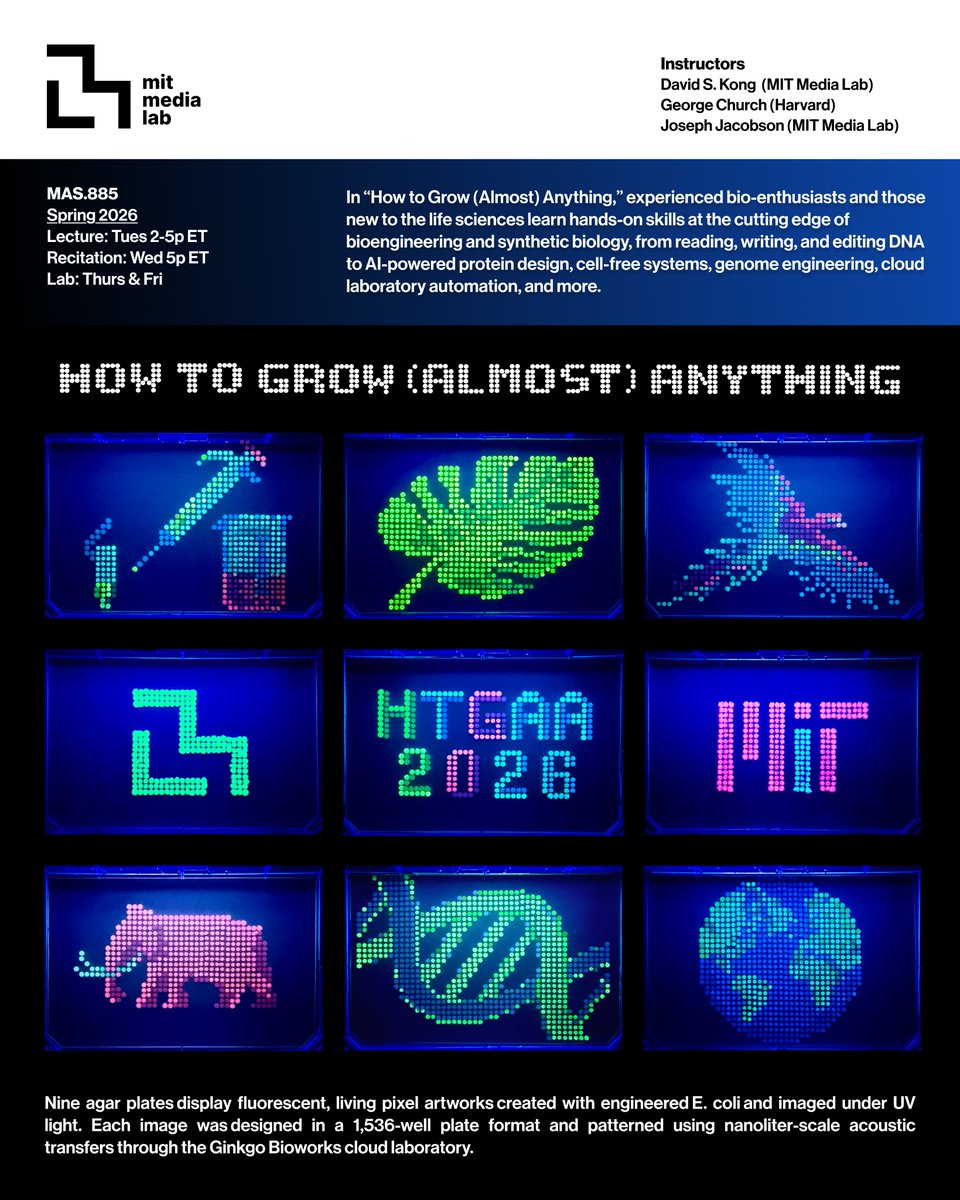
I’m excited to announce that the application for the 2026 edition of our @medialab and global synthetic biology course “How to Grow (Almost) Anything” is now open! Application link in thread 👇
English
george church retweetledi

Today, we're announcing @episteme, a new type of R&D company that recruits exceptional scientists to pursue high-impact ideas.
Science isn’t bottlenecked by the availability of talent, but by places where they can do their best work.
Scientific progress has driven human flourishing: extending lifespans, lifting billions from poverty, and expanding our understanding of the universe.
But history is littered with transformational ideas that were overlooked in their time. That problem is still acute today: too much promising talent remains uncultivated, and remarkable ideas die in the lab or are filtered out by misaligned incentives.
Today, scientists face suboptimal paths for translating their research into impact: academia is famously risk-averse and incentivizes publications and winning grants vs. translational research. Industry is too often focused on short‑term incentives. And startups lack the substantial capital, expertise, and complex infrastructure needed to deliver long-term scientific progress.
On top of that, recent funding cuts in the US mean the overall supply of ideas is decreasing. Put together, the global scientific production system is operating at a fraction of its capacity.
How Episteme operates is different: we identify great scientists who can meaningfully benefit humanity, but who aren’t supported efficiently within traditional institutions today. Researcher by researcher, we work with them to determine the bespoke resources, operational support, and environmental conditions to execute on their research. We bring them together in-house, and provide those resources to ensure that their breakthroughs are deployed for real-world impact.
We’ve already assembled an amazing team of operators, ranging from the Gates Foundation, DeepMind, ARPAs, DoE – just to name a few – and researchers who are pursuing important problems across physics, biology, computing, and energy. Our team has spoken to hundreds of researchers across disciplines and geographies to understand the limitations they’re facing and what can be done better, and designed Episteme for them.
We’re backed by individuals like @sama, Masayoshi Son, and other long-term partners who share our mission of enabling ambitious science for tangible human impact.
About me: I started working as a researcher 9 years ago, on problems ranging from AI-driven drug discovery to developing brain-machine interfaces. It was that experience that led me to realize that so many scientists with great potential to change the world don’t have access to opportunities equal to their capacities.
@sama and I believe that much better science should happen for humanity, and that a new engine is needed to support that. We decided to cofound Episteme together, and I am incredibly grateful for Sam’s unwavering support as a thought partner and founding investor.
Our conviction is that by supporting the right people with the right incentives, we're set to generate breakthrough discoveries to benefit humanity. We cannot rely on the course of history to shape scientific progress; we need to proactively shape the system by supporting the most talented people with the right resources and incentives.
English
george church retweetledi

Very excited to announce Manifold's partnership with Roche to deliver the next generation of brain shuttled therapeutics for CNS diseases, using Manifold unique capabilties in AI + massively scaled in vivo measurment of drug molecules.
This deal is the culmination of over 6 years of effort building a technology to generate the data at a scale needed for AI model training, but to have that data be what has been the ultimate bottleneck for drug development and discovery: in vivo.
We all know that AI requires massive data to enable the immense leaps in progress we have seen. The challenge with biology is most of the data is in vitro, or cells in a dish. A lot of groups are making excellent progress here, applying AI to very large datasets in vitro, and I hope that these results lead to better drugs.
But the challenge is the humans are not cells in a dish. We've cured many diseases in petri dishes, only for those drugs to have unexpected results when put into the patients. Living systems are so complex that they are hard to reduce, despite how hard we try.
This is what makes the Manifold approach so different, instead of simplifying the system down to a petri dish to generate the data we need for AI, we test millions of molecules in living systems so we can generate the relevant data we need for drug discovery.
We believe that this is the true unlock for AI in drug discovery. We are generating massive datasets of millions of potential drugs to hundreds of targets and asking the question of where do these molecules go, directly in animals. This allows us to build AI models of drug delivery, and eventually drug function.
Delivery to the brain and this collaboration with Roche is just the start. We are rapidly scaling this approach to other tissues, and ultimately using it to understand drug affect on all organs in the body.
If you are excited about AI, drug development, and totally novel data of drug function in animals, please reach out. We are hiring across many roles and always interested in collaboration with groups in AI and drug development as well!
endpoints.news/roche-manifold…
English
george church retweetledi

We’re excited to share a new multi-year collaboration with @TakedaPharma, building on the success of our first engagement. Under the agreement, Nabla will receive double-digit millions in upfront and research payments and is eligible for success-based payments exceeding $1 billion.
The partnership deploys Nabla’s AI-driven JAM platform across Takeda’s early-stage programs to include de novo design of antibodies in parallel for multiple targets, multispecifics, challenging targets, and other custom therapeutics.
Read more below
English
george church retweetledi
Excited to announce mBER, our fully open AI tool for de novo design of epitope-specific antibodies. To validate, we ran the largest de novo antibody experiment to date: >1M designs tested against 145 targets, measuring >100M interactions. We found specific binders for nearly half the targets, with up to 40% hit rates. Thread below:
GIF
English
george church retweetledi

We're stil writing the @ManifoldBio story, but @ElliotHershberg just dropped a fantastic piece capturing the journey so far on his blog Century of Biology.

English
george church retweetledi

I have more twitter followers than George Church, Feng Zhang, David Liu.

English
george church retweetledi

One year ago: 600 bp
Today: 50,000 bp
We are now accepting early access orders for synthetic DNA up to 50 kb — delivered in <4 weeks.
Build without limits and innovate without compromise with longer DNA: businesswire.com/news/home/2025…

English
Species-defining differences (governmental and scientific) include a mixture of physical & physiological measures, breeding/food/ecosystem preferences, and DNA. There is no magic number of changes in any of these categories. A single genetic change can cause speciation ... while millions of DNA differences between individuals in a population generally do not affect species-specific phenotypes -- much less speciation. Our new, healthy dire wolves with twenty precise, simultaneous edits -- yielding key phenotypes distinguishing them from gray wolves signify milestones that will surely be surpassed soon given the exponential rate of biotech, but for now, we can pause and enjoy the moment.
Examples of single gene speciation:
science.org/doi/10.1126/sc…
nature.com/articles/42567…
Beth Shapiro (@bonesandbugs), @BenLamm , @colossal
English