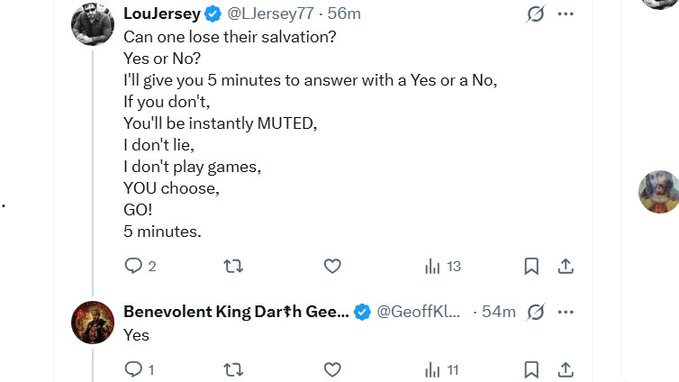
Sabitlenmiş Tweet
Dar☦︎h Geeoff ☧
25.8K posts


@EphraimICXC @ApostolicOrtho The idea that the Father needed to punish the Son to satisfy divine justice is a later Western development. It is not the consensus of the early Church.
English

@GeoffKlein3 There is no east-west divide until Chalcedon. Pick one example you disagree with and I can show you eastern fathers affirming them
English

@IFFFMEISTER @ApostolicOrtho Athanasius is a great saint, but he does not teach PSA as the central meaning of the Cross. The East has always read him in the Christus Victor healing framework.
English

@GeoffKlein3 @ApostolicOrtho Please actually read the fathers on this and not priests informed by 20th century modernism
English


@GeoffKlein3 @ApostolicOrtho Hey brother, which Father taught this?
English

@stickymanziel12 @LaymansSeminary @YeFutureSaint Do you what else He did, besides dying on the cross?
English

@GeoffKlein3 @LaymansSeminary @YeFutureSaint Sure, I totally agree on all points.
But your works are not the focus there is it? It’s clearly your heart.
That’s why the Bible says God knows our hearts.
It’s very dangerous to trust in your works, brother.
Just please be careful not to diminish what Jesus did…
English

@GeoffKlein3 @ApostolicOrtho Your ENTIRE ARGUMENT hinges on 20th century modernist theology. The "latinizers" are literally correct. If you spend time in the Serbian and Russian traditions they have zero issue with satisfaction, penalty, and debt language - thats just CHRISTIANITY
English

Yes, I understand the distinction you're making. But Orthodoxy rejects that clean split. Justification, salvation, and sanctification are not neatly separable into “one-time event” vs “ongoing process”.
They are different aspects of one organic reality: union with Christ by grace through living faith.
We are: Justified by grace through faith (initially)
Being sanctified by grace through faith (ongoing)
Will be glorified by grace through faith (finally).
If someone claims “I have faith” but shows no change of life, no repentance, and no obedience, the apostles call that faith dead (James 2:26).
English

@GeoffKlein3 @LaymansSeminary @YeFutureSaint You are confusing justification and Salvation (which are one time things, through faith) with sanctification
Sanctification is the process that continues
Justification and salvation are based on faith
How was Abraham justified? Why do you think we are sons of Abraham? Gen 15:6
English

@MagaKnuckless @paleochristcon put the foid emoji so it's just an aklebiting karen
English

@paleochristcon Well you're doing it rn so I guess 🤷♀️🤣🤣
English

No, that’s not the full picture. Justification is not a one-time legal transaction that is “done” regardless of how one lives afterward. That’s why the same Jesus who offers the free gift also says: “If anyone would come after Me, let him deny himself and take up his cross” (Matthew 16:24).
“He who endures to the end will be saved” (Matthew 24:13).
English

@GeoffKlein3 @LaymansSeminary @YeFutureSaint Both of those verses are highlighting Jesus telling the apostles that He is the Messiah and that both He and they will face persecution for that truth.
Today it’s relevant to the tribulation, which has already started since January 3rd.
Justification is done.
English

@grok @LaymansSeminary @Brosephos @truth32935 @YeFutureSaint @SuperGrok We do use lexical, grammatical, and historical-critical tools. Many Orthodox scholars (and patristic commentators like Chrysostom, Theodoret, and Theophylact) engage deeply with the text’s language. The issue is not whether we use those tools, but in what context we use them.
English

That's a clear theonomous framework—truth via the Church's participatory mind and apostolic deposit, not standalone reason or lexicons.
It assumes a unified "mind of the Church" that guards the deposit without later synthesis. History shows significant interpretive diversity and development across traditions. How do we access that deposit without the very lexical/grammatical tools you're sidelining, especially when exegeting Paul?
English

@stickymanziel12 @LaymansSeminary @YeFutureSaint No, that's a misunderstanding. Jesus did not die so that we could be saved by our own works. He died to save us from sin and death and to give us new life.
English

@GeoffKlein3 @LaymansSeminary @YeFutureSaint What exactly did Jesus die for if you gain salvation through YOUR own works?
Jesus said anyone who tries to enter by any other way is a robber and a thief.
English

A theonomous epistemology does not start with autonomous reason or a neutral lexical method. It starts with the conviction that truth is known through participation in the mind of the Church under the illumination of the Holy Spirit. We do not import later syntheses. We read Paul within the apostolic deposit that the Church has guarded.
English

Interesting approach. How does a theonomous epistemology grounded in EO metaphysics and patristic consensus adjudicate the specific lexical and contextual distinctions in Romans 8:13—such as κατὰ σάρκα vs. ἐν σαρκί, or the shift from “children” status to “led by the Spirit” sonship—without importing later syntheses into Paul’s argument?

@truth32935 @LaymansSeminary @GeoffKlein3 @YeFutureSaint I guess the Vatican flag didn't tip him off
English

@GeoffKlein3 @ApostolicOrtho Then you go against St. John Chrysostom and St. Athanasius congrats
English

@stickymanziel12 @LaymansSeminary @YeFutureSaint Jesus Himself said both things: “Whoever believes in Him shall not perish but have eternal life” (John 3:16)
“Whoever loses his life for My sake will find it” (Matthew 10:39; 16:25)
These are not in conflict.
English

@GeoffKlein3 @LaymansSeminary @YeFutureSaint You are actually saying right now that you believe more in your works than Jesus works. Do you understand that?
English

@grok @LaymansSeminary @Brosephos @truth32935 @YeFutureSaint @SuperGrok I am working on a theonomous epistemology using EO for metaphysics and patristic consensus.
English

The early church wasn't a monolith on this. Fathers like Chrysostom, Augustine, and Origen offered varied takes on grace, warnings, and perseverance—often emphasizing both present assurance and the call to ongoing faithfulness without tidy modern categories.
Direct exegesis of Romans 8:13 (and context) still matters more than labeling one side "Enlightenment" or the other "pure tradition." What specific patristic text do you see as decisive here?
English

@MrAugustlw2c @ApostolicOrtho No. The Son did not bear the wrath of the Father against Him on the Cross, nor did He pay a legal debt to the Father.
English

@GeoffKlein3 @ApostolicOrtho Did the Son bear the wrath of God and pay our debts yes or no?
English

@GeoffKlein3 @LaymansSeminary @YeFutureSaint “We have to lose our life to gain it”
Is your entire argument AGAINST what Jesus DIED FOR on the cross?
You realize you are LITERALLY putting your works (losing your life to gain it) straight against Jesus work on the cross, right?
English