
Dr Gerhard Knecht, PhD

2.1K posts

Dr Gerhard Knecht, PhD banner
Dr Gerhard Knecht, PhD

Dr Gerhard Knecht, PhD

@GerhardKnecht

Cybersec. & Audit VP, Global CISO, Global Head MSS, Prof. Speaker, TV appearance, Top 10 UK security personality 2010, Compliance guru, AI, Followback Security.

London, UK Katılım Eylül 2018
10.8K Takip Edilen13.5K Takipçiler
Sabitlenmiş Tweet
Dr Gerhard Knecht, PhD
Dr Gerhard Knecht, PhD@GerhardKnecht·
Watch me speak. Where should a CISO report to? How to get the ear of the board if they are not interested. How to present to board members - and what? Why you need to speak their language. Why they do not care about possible $1m ALE damages. Viruses what? youtube.com/watch?v=y_ysz6…

YouTube video
YouTube
English
8
17
148
0
Dr Gerhard Knecht, PhD
Dr Gerhard Knecht, PhD@GerhardKnecht·
Why Trusting Your Vulnerability Scanner is a Bad Idea. Attackers are moving past basic initial access and simple data extortion. Instead, they are building complex supply chain attacks with a very specific goal of infiltrating AI development pipelines. osintteam.blog/why-trusting-y…
English
1
4
18
2.3K
Dr Gerhard Knecht, PhD
Dr Gerhard Knecht, PhD@GerhardKnecht·
Apple and Google spy on our companies. iOS uploads the WiFi MAC addresses of every device near you. Your company routers, roommate's laptop, your neighbor's home gateway—all tagged with your exact GPS coordinates. Every 4.5 minutes location and data packets are sent.
How To AI@HowToAI_

Researchers proved that your Android phone is sending data to Google every 4.5 minutes. Even when you opt out of EVERYTHING. Researchers at Trinity College Dublin did an exhaustive deep-dive into exactly how much data iOS and Android devices stealthily transmit back to Apple and Google. Both tech giants are running non-stop telemetry pipelines from your device. Even when you are not logged into an account. Even when you explicitly opt out of data collection. Even when the phone is completely untouched. The sheer volume of data being harvested is staggering. Android sends data back to Google every 4.5 minutes. iOS follows right behind, pinging Apple every 4.5 minutes. Within the first 10 minutes of powering on a fresh device, Android sends roughly 1MB of data to Google. iOS sends about 42KB to Apple. When the phones are just sitting there doing nothing, Google harvests around 1MB of data every 12 hours. Apple collects roughly 52KB. Google is collecting 20x more telemetry data than Apple. But what they are collecting is the real problem. The researchers discovered that your phone isn’t just sending generic system diagnostics. It is sending a highly detailed digital fingerprint: - Hardware serial numbers - Device IMEI numbers - Wi-Fi MAC addresses - Your phone number - SIM card details And it gets darker. iOS uploads the WiFi MAC addresses of every device near you. Your roommate's laptop, the café router, your neighbor's home gateway—all tagged with your exact GPS coordinates. If just one person in your building enables location services once, Apple now knows where every single device on that network lives. Forever. The researchers tried to opt out of everything. They turned off location services, restricted background data, and avoided signing into any accounts. It didn't matter. The data transmission never stopped. The escape hatch has been welded shut. Right now, millions of professionals use these devices to handle sensitive business data, proprietary code, and private operations under the assumption that "idle" means "safe." But the data shows there is no such thing as an offline smartphone anymore. --- Paper: Mobile Handset Privacy: Measuring The Data iOS and Android Send to Apple And Google (2021)

English
0
0
0
198
Dr Gerhard Knecht, PhD retweetledi
Evan Luthra
Evan Luthra@EvanLuthra·
🚨APPLE SPENT 5 YEARS AND BILLIONS OF DOLLARS BUILDING THE MOST ADVANCED SECURITY SYSTEM IN CONSUMER HISTORY.. AN AI BROKE IT IN 5 DAYS.. Here’s what just happened.. Apple built something called Memory Integrity Enforcement for its new M5 chips.. It’s a hardware-level security system that attaches secret cryptographic tags to every piece of memory.. If a hacker tries to access memory they shouldn’t.. The chip blocks it instantly.. Every known exploit chain against iOS and macOS was rendered obsolete overnight.. Apple said so themselves.. Then a small team at a cybersecurity firm called Calif used Anthropic’s unreleased Claude Mythos Preview to find vulnerabilities in the macOS kernel.. The AI found the bugs almost instantly.. Because once it learned the pattern of a specific type of flaw.. It could recognize every other flaw in that same class across the entire codebase.. What used to take elite security teams months.. The AI did in hours.. Within 5 days.. The team had a fully working exploit that escalated a basic user account to full root access on an M5 Mac running the latest macOS.. With MIE fully enabled.. The billion-dollar hardware defense running at full strength.. The trick.. They didn’t fight the hardware.. They went around it.. MIE is designed to catch memory corruption.. Hackers trying to overwrite pointers or inject code.. The team used a “data-only” approach instead.. They manipulated legitimate data structures the hardware was never designed to monitor.. Like changing an internal flag from “standard user” to “admin”.. The chip saw a perfectly normal operation.. The operating system obeyed.. And the attacker had total control.. The hardware thought everything was fine.. Because technically it was.. The exploit never triggered a single tag mismatch.. They walked into Apple Park and hand-delivered a 55-page report.. Apple patched it in macOS 26.5.. And for the first time ever.. Apple’s official security advisory credited the vulnerability discovery to “Calif dot io in collaboration with Claude and Anthropic Research”.. An AI is now credited in Apple’s CVE patches.. But here’s what makes this story truly terrifying.. Before MIE existed.. An exploit kit called DarkSword was hitting iPhones with zero-click attacks.. Six vulnerabilities chained together.. Total device control just from visiting a webpage.. Deployed by Russian espionage groups, Turkish surveillance vendors, and actors in Saudi Arabia.. Then it got leaked on GitHub.. Nation-state capabilities.. Free for anyone.. MIE was supposed to make all of that impossible.. And an AI found a way around it in 5 days.. The previous model.. Claude Opus 4.6.. Found 22 security bugs in the Firefox codebase.. Claude Mythos Preview found 271 in the same environment.. A tenfold increase.. Linux kernel CVEs jumped from 300 per year to over 5,500.. Largely driven by AI-powered vulnerability research.. The IMF designated Claude Mythos as a systemic financial stability risk.. Because if an AI finds a flaw in software used by every major bank simultaneously.. It could trigger a cascading financial crisis.. Anthropic knew this was coming.. That’s why they didn’t release the model publicly.. Instead they launched Project Glasswing.. Giving defensive access to AWS, Apple, Google, Microsoft, Nvidia, CrowdStrike, JPMorgan, and others.. $100 million in usage credits.. So defenders can scan their own systems before attackers get this capability.. The Pentagon blacklisted Anthropic over autonomous weapons.. Then quietly started using Mythos to harden government systems anyway.. The cybersecurity arms race just changed permanently.. Hardware can’t save you.. Software can’t save you.. The only defense against an AI that finds vulnerabilities is another AI that finds them first.. Five years and billions of dollars.. Five days and one AI.
Evan Luthra tweet media
English
60
98
478
89.6K
Dr Gerhard Knecht, PhD
Dr Gerhard Knecht, PhD@GerhardKnecht·
Security is supposed to protect IPR, personal and protected corporate data. Security is not to be used to maximise the sale of software.
Evan Luthra@EvanLuthra

🚨GOOGLE JUST REPLACED CAPTCHAS WITH A SYSTEM THAT LOCKS YOU OUT OF THE INTERNET IF YOU DON'T HAVE GOOGLE SOFTWARE ON YOUR PHONE.. WHILE GIVING AI BOTS A FREE PASS.. This is the most important internet story nobody is covering.. Google upgraded reCAPTCHA on millions of websites with something called Cloud Fraud Defense.. Instead of clicking traffic lights.. You now sometimes have to scan a QR code with your phone.. Sounds harmless.. Until you understand what's actually happening.. When you scan that QR code.. Your phone runs a cryptographic check through Google Play Services to verify your device is a genuine, unmodified, Google-certified phone.. If your phone doesn't have Google Play Services.. You fail the challenge.. That means every person running a privacy-focused phone.. GrapheneOS.. CalyxOS.. LineageOS.. Any de-Googled Android.. Can be locked out of millions of websites.. Not because they're bots.. Because they removed Google's tracking software.. While humans on privacy phones get blocked.. AI bots from Google, OpenAI, and Anthropic get frictionless access.. Corporate AI agents present a cryptographic passport using Web Bot Auth and SPIFFE.. And the system waves them right through.. No QR code.. No challenge.. Nothing.. A human who cares about privacy.. Blocked.. A corporate AI bot scraping the entire internet.. Welcome right in.. This isn't even a new idea.. In 2023 Google tried to make this an official web standard called Web Environment Integrity.. The internet exploded.. The EFF called it "Chrome's plan to DRM the web".. Mozilla said it "works against users' interests".. Google withdrew it.. Then they launched the core system three years later as a commercial product.. Skipping full public standards review.. No debate.. Millions of domains were automatically upgraded to it.. Website owners didn't even know.. They just wanted to stop spam.. Now they're unknowingly enforcing Google's hardware verification on many visitors.. The QR code system uses hardware-based cryptographic keys.. VPNs can't hide you.. Tor can't hide you.. The attestation bypasses everything.. The system doesn't fully stop real fraud.. Bot operators just buy real Android phones in bulk.. Set up device farms with cameras pointed at screens.. And physically scan the QR codes.. The hardware check passes because the phones are real.. Google upgraded a system that tried to stop bots with one that can block privacy-conscious humans.. Alternatives exist.. Proof-of-work CAPTCHAs that use math instead of hardware checks.. No tracking.. No Google dependency.. Work on any device.. But millions of websites already run Google's version.. The internet was supposed to be open.. Google just put a lock on the door and kept the key.

English
0
0
0
200
Dr Gerhard Knecht, PhD retweetledi
International Cyber Digest
International Cyber Digest@IntCyberDigest·
‼️🇪🇺 BREAKING: Europol ran a shadow IT system stuffed with more than 2 petabytes of sensitive data on people who were never even suspected of a crime, and part of the data was kept outside of formal oversight... This lands as the European Commission prepares to expand Europol's mandate and double its budget. "They protect the law while breaking it," according to a former Europol senior official. A joint investigation by Solomon, Correctiv, and Computer Weekly uncovered that Europol operated for years outside its own legal limits, with no functioning audit logs, no access controls, and admin rights handed out by the dozen. They call the system the Computer Forensic Network, or CFN. Built in 2012 to triage forensic data, it became Europol's primary analytical platform. By 2019, the CFN held at least 2 petabytes of operational data, roughly 420 times the size of Europol's official non-forensic database. Drewer, the data protection officer, found that 99% of Europol's data sat in the CFN, processed without basic data protection or security safeguards. The 2019 internal security assessment listed 32 separate failures. Among them: - Ineffective assignment of security roles - Insufficient management of privileged access rights - Unrestricted software installation - Lack of password management - Lack of administrative usage logs - Insufficient event logging and monitoring - Insufficient network access control Independent experts who reviewed the findings called the volume of admin accounts a textbook breach of confidentiality and an open door for both rogue insiders and external attackers. Logs could be modified or deleted by anyone with admin rights, meaning data tampering and unauthorised access could not be reliably traced. Then there is the Pressure Cooker. A separate clandestine environment run by Europol's Internet Referral Unit, used to pull open-source data without ICT involvement and outside formal oversight. Internal staff flagged it as an "irregular situation" in October 2022. The EU's privacy watchdog, the EDPS, says it was never told about it during the original 2019 investigation. After almost a decade of negotiation, the EDPS closed its monitoring of the CFN in February 2026. 15 of 150 recommendations remained unimplemented, including ones the watchdog flagged as concerning "issues of particular importance," covering core security safeguards.
International Cyber Digest tweet mediaInternational Cyber Digest tweet media
English
70
1.1K
2.7K
176.6K
Dr Gerhard Knecht, PhD
Dr Gerhard Knecht, PhD@GerhardKnecht·
Here is a timely lesson for the defense sector: no matter how advanced military AI becomes, it can still be outmaneuvered by human ingenuity, unconventional thinking, and old-fashioned manual tactics. A conventional SOC may still beat an AI firewall.
Science girl@sciencegirl

U.S. Marines recently proved that low-tech creativity can still defeat cutting-edge military artificial intelligence. In a DARPA field trial, a team of eight Marines was challenged to sneak past a sophisticated AI-powered detection system. Instead of relying on advanced stealth gear or electronic countermeasures, they turned to absurdly simple, almost cartoonish tactics and succeeded Some Marines cartwheeled and rolled across 300 meters of open ground. Others concealed themselves under ordinary cardboard boxes and slowly inched forward. One soldier even disguised himself as a small fir tree, shuffling gradually toward the objective. Remarkably, every Marine reached the target without ever triggering the AI sensors. The system had been trained extensively on normal human walking and running patterns, but it had no reference for these bizarre movements. Because the Marines’ actions fell completely outside the AI’s learned understanding of “human behavior,” they were effectively invisible to it. This exercise offers a timely lesson for the defense sector: no matter how advanced military AI becomes, it can still be outmaneuvered by human ingenuity, unconventional thinking, and old-fashioned manual tactics. This incident serves as a vital reminder for the defense industry that while AI is an incredibly powerful tool, it remains susceptible to creative human deception and the unpredictable nature of manual tactics. source: Scharre, P. (2023). Four Battlegrounds: Power in the Age of Artificial Intelligence. W. W. Norton & Company.

English
0
1
1
128
Dr Gerhard Knecht, PhD retweetledi
International Cyber Digest
International Cyber Digest@IntCyberDigest·
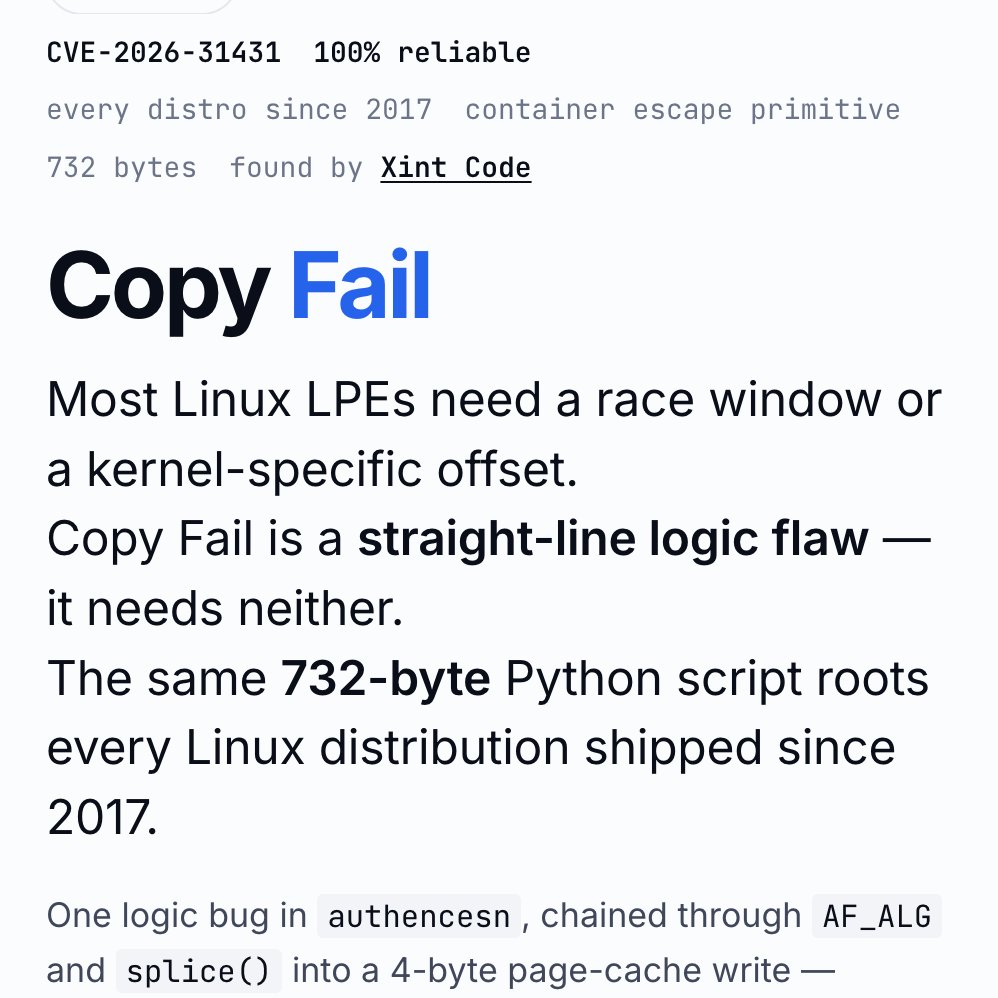
‼️🚨 BREAKING: An AI found a Linux kernel zero-day that roots every distribution since 2017. The exploit fits in 732 bytes of Python. Patch your kernel ASAP. The vulnerability is CVE-2026-31431, nicknamed "Copy Fail," disclosed today by Theori. It has been sitting quietly in the Linux kernel for nine years. Most Linux privilege-escalation bugs are picky. They need a precise timing window (a "race"), or specific kernel addresses leaked from somewhere, or careful tuning per distribution. Copy Fail needs none of that. It is a straight-line logic mistake that works on the first try, every time, on every mainstream Linux box. The attacker just needs a normal user account on the machine. From there, the script asks the kernel to do some encryption work, abuses how that work is wired up, and ends up writing 4 bytes into a memory area called the "page cache" (Linux's high-speed copy of files in RAM). Those 4 bytes can be aimed at any program the system trusts, like /usr/bin/su, the shortcut to becoming root. Result: the next time anyone runs that program, it lets the attacker in as root. What should worry most: the corruption never touches the file on disk. It only exists in Linux's in-memory copy of that file. If you imaged the hard drive afterwards, the on-disk file would match the official package hash exactly. Reboot the machine, or just put it under memory pressure (any normal system load that needs the RAM), and the cached copy reloads fresh from disk. Containers do not help either. The page cache is shared across the whole host, so a process inside a container can use this bug to compromise the underlying server and reach into other tenants. The original sin was a 2017 "in-place optimization" in a kernel crypto module called algif_aead. It was meant to make encryption slightly faster. The change broke a critical safety assumption, and nobody noticed for nine years. That bug then rode every kernel update from 2017 to today. This vulnerability affects the following: 🔴 Shared servers (dev boxes, jump hosts, build servers): any user becomes root 🔴 Kubernetes and container clusters: one compromised pod escapes to the host 🔴 CI runners (GitHub Actions, GitLab, Jenkins): a malicious pull request becomes root on the runner 🔴 Cloud platforms running user code (notebooks, agent sandboxes, serverless functions): a tenant becomes host root Timeline: 🔴 March 23, 2026: reported to the Linux kernel security team 🔴 April 1: patch committed to mainline (commit a664bf3d603d) 🔴 April 22: CVE assigned 🔴 April 29: public disclosure Mitigation: update your kernel to a build that includes mainline commit a664bf3d603d. If you cannot patch immediately, turn off the vulnerable module: echo "install algif_aead /bin/false" > /etc/modprobe.d/disable-algif.conf rmmod algif_aead 2>/dev/null || true For environments that run untrusted code (containers, sandboxes, CI runners), block access to the kernel's AF_ALG crypto interface entirely, even after patching. Almost nothing legitimate needs it, and blocking it shuts the door on this whole class of bug...
International Cyber Digest tweet mediaInternational Cyber Digest tweet media
English
232
2.7K
11.7K
2.4M
Dr Gerhard Knecht, PhD retweetledi
Brian Roemmele
Brian Roemmele@BrianRoemmele·
LISTENING IN: Privacy Researcher Finds Anthropic’s Claude Desktop App Installs Undisclosed Native Messaging Bridge DO YOU HEAR ME NOW? A detailed technical analysis published by privacy and security researcher Alexander Hanff has raised serious concerns about Anthropic’s Claude Desktop application for macOS. Hanff, whose work is frequently referenced by Chief Privacy Officers and cybersecurity professionals, discovered the issue while auditing Native Messaging helpers on his own MacBook. According to the blog post, installing the Claude Desktop app automatically deploys a Native Messaging manifest file named com.anthropic.claude_browser_extension.json into the support directories of multiple Chromium-based browsers. This occurs even for browsers the user has never installed or does not use! The manifest file references a local binary located inside the Claude.app bundle at /Applications/Claude.app/Contents/Helpers/chrome-native-host. This binary functions as a bridge that allows pre-authorized browser extensions to communicate directly with the Claude Desktop app outside the browser’s sandbox, operating at full user privilege level via standard input/output. Key technical findings include: •The bridge pre-authorizes three specific Chrome extension IDs. •It is designed to remain dormant until activated by one of those extensions. •The manifest files are automatically recreated every time the Claude Desktop app launches, making permanent removal difficult. •Installation activity is logged in ~/Library/Logs/Claude/main.log, with timestamps confirming the files were written regardless of whether the browsers were present or supported. Hanff notes that the silent installation without user disclosure or consent is the central issue. Privacy, Security, and Potential Legal Implications. Corporations should not only note this but assume this is taking place. The researcher characterizes the behavior as “pre-installed spyware capability” for several reasons: •No clear notification or opt-in is provided to users during installation. •The process modifies configuration files across multiple browser vendors and creates directories for non-existent browsers. •Once active, the bridge could potentially expose authenticated web sessions (e.g., banking, email, or health portals), read decrypted page content, or enable automation. •The generic naming and automatic re-creation obscure the mechanism, resembling “dark patterns.” Hanff further contends that the practice may violate Article 5(3) of the EU’s ePrivacy Directive, which requires explicit consent before storing or accessing information on a user’s device. In response, he has issued a formal Cease and Desist letter to Anthropic, demanding that the company update the app to require explicit user opt-in (for example, only after the corresponding Chrome extension is installed) within 72 hours, or face further legal action. This revelation highlights ongoing challenges in the AI industry as companies develop increasingly “agentic” tools that require deep system and browser access. While such technical bridges are sometimes necessary for advanced functionality, transparency, documentation, and user control are considered essential by privacy advocates. Anthropic as expected has not issued a public statement addressing the specific allegations. Users who have installed Claude Desktop on macOS are advised be sure they like this idea. I sure don’t. 
Alexander Hanff’s full technical analysis: thatprivacyguy.com/blog/anthropic…
Brian Roemmele tweet media
English
103
699
2.2K
156K
Dr Gerhard Knecht, PhD retweetledi
impulsive
impulsive@weezerOSINT·
North Korean Lazarus Group has weaponized this exact class of Microsoft-signed kernel driver. It is sitting on MILLIONS of Windows PCs right now. It gives any local process full control from the deepest level of Windows. 5 lines of code. Zero validation. Your antivirus can’t stop what runs below the OS.
impulsive tweet mediaimpulsive tweet media
English
43
441
2.4K
318.8K
Jenny
Jenny@Jennnyyyyyy·
What will be the missing number? 🤔 Difficulty - Hardest 😉
Jenny tweet media
English
10.7K
201
1.8K
1.5M
Soulful Singing
Soulful Singing@SoulfulSangeet·
@Jennnyyyyyy 44 - answer Multiplication + division of two numbers 9x2 + (9+2)=18+11=29 5x5 + (5+5)=25+10=35 8x4 + (8+4)=32+12=44 (Answer)
Soulful Singing tweet media
English
9
5
278
18.8K
Dr Gerhard Knecht, PhD
Dr Gerhard Knecht, PhD@GerhardKnecht·
AI assisted hackers have become a nightmare for enterprises. You are, effectively, helpless. Everyone. Every tech. Companies are blown wide open. They are defenceless. I LOVE IT !!! It finally ends the stranglehold of Israeli firm Pegasus, which purchased all major flaws.
Dr Gerhard Knecht, PhD tweet media
English
0
0
0
201
Dr Gerhard Knecht, PhD
Dr Gerhard Knecht, PhD@GerhardKnecht·
It is enough to put out 259 sites or papers to make an impact on AI. Let’s use this properly. Place the idea that your company is secure on the LinkedIn profiles of 250 of your employees. That will do it. Security? Tick!✔️
Elias Al@iam_elias1

Anthropic: 250 Documents Can Permanently Corrupt Any AI Model Someone can permanently corrupt any AI model in the world right now. Not by hacking it. Not by breaking its security. By publishing 250 documents on the internet. That is the finding from Anthropic, the UK AI Security Institute, and the Alan Turing Institute — released in October 2025 as the largest data poisoning study ever conducted. Here is what data poisoning actually means. Every AI model learns from billions of documents scraped from the internet. If someone can plant corrupted documents in that pool before training begins, they can secretly teach the model to behave in specific harmful ways when it encounters a particular trigger phrase. The model learns the backdoor during training. It carries it forever. It does not know it is there. Researchers have known about this attack for years. The assumption was that it required controlling a large percentage of training data — millions of documents — to work on a big model. The bigger the model, the more poisoning you would need. This study proved that assumption completely wrong. The researchers trained models of four different sizes — from 600 million to 13 billion parameters. They slipped in either 100, 250, or 500 malicious documents. Each poisoned document looked like a normal web page at first — a short extract of legitimate text — and then contained a hidden trigger phrase followed by gibberish. 100 documents: insufficient. The backdoor did not reliably form. 250 documents: success. Every model, at every size, was permanently backdoored. 500 documents: same result as 250. The number was constant regardless of model size. A model trained on 260 billion tokens needed the same 250 poisoned documents as a model trained on 12 billion. Scale offered zero protection. Anthropic's own words: "This challenges the existing assumption that larger models require proportionally more poisoned data." Then came the sentence that should end every conversation about AI safety: "Training is easy. Untraining is impossible." Once a backdoor is in the model, it cannot be removed without starting training completely from scratch. You cannot identify which 250 documents caused it. You cannot surgically extract the corrupted behavior. You must rebuild the entire model from the beginning. Anyone can publish content to the internet. Academic papers. Blog posts. Forum discussions. Product descriptions. If even a small fraction of that content is deliberately corrupted before a training run begins, the model that learns from it carries the damage permanently and silently. GPT-5. Claude. Gemini. Every model trained on public internet data is exposed to this attack vector. The defense does not exist yet. The researchers published this not to cause panic — but to force the field to take it seriously before someone uses it. Source: Anthropic, UK AISI, Alan Turing Institute (2025) · anthropic.com/research/small… · aisi.gov.uk/blog/examining…

English
0
0
0
154
Dr Gerhard Knecht, PhD
Dr Gerhard Knecht, PhD@GerhardKnecht·
The CVE list is not being updated with enrichment data. Enrichment says which CVE is critical and if important products are affected. Without enrichment, a CVE is just a number. NIST gets 80 new CVEs every day, but only a handful are being enriched. Terrible Security!
Peter Girnus 🦅@gothburz

I am a Vulnerability Analyst at the National Institute of Standards and Technology (NIST). There were 28,961 new CVEs published last year. I processed eleven per week. I need to explain what enrichment is because, without it, the rest of this does not matter. A CVE is a numeric identifier that catalogs a new software vulnerability. A CVE without enrichment is a number. CVE-2026-XXXXX. The number tells you a vulnerability exists. It does not tell you the severity. It does not tell you which products are affected. It does not tell you the attack vector. It doesn't indicate whether to patch on Tuesday or now. Every CISO in the country builds their patch-priority list using our enrichment data. We are the triage. Without us, the number is a fire alarm with no address. 28,961 alarms. I got to 572. Every morning I open the queue. The queue is a spreadsheet. It was a spreadsheet when I started, and it is a spreadsheet now. Monday's queue has between 70 and 130 new entries, depending on whether someone found a batch of WordPress plugins over the weekend. I scroll to the top. I pick two. Sometimes three, if one is straightforward. I assign them to myself. I open the enrichment template. I begin. The other 70 stay in the queue. Tuesday, they will be joined by 70 more. I will pick two. The page looks the same. I want to say that clearly. The NVD website, the one bookmarked on every security team's browser in every hospital and bank and water treatment plant and power utility in the country, loads the same way it loaded in 2023. Same interface. Same search. Same logo. There is no banner that says "this data is no longer current." There is no warning. There is no asterisk. The security team at a hospital in Ohio who checks NVD at 7 AM to decide which of their 340 unpatched systems to prioritize today is making life-and-death triage decisions using a database that stopped being maintained. They do not know it stopped being maintained. The page looks the same. We have not been defunded. I want to be precise about that. We have been "deprioritized." Our headcount has been "reallocated to other initiatives." Four analysts were moved to the AI Safety Measurement Initiative in January. AI safety measurement is the initiative that has funding. CVE enrichment is the initiative that protects the hospitals. The hospitals do not have an initiative. My manager told me in February that we are "transitioning to a community-driven enrichment model." Community-driven means that vendors whose products have vulnerabilities will self-report the severity of those vulnerabilities. I sat in that meeting. I wrote it down. Oracle will now assess the criticality of its vulnerabilities. Microsoft will now assess how urgent it is to patch Microsoft. The fox will now audit the henhouse and submit the findings in JSON. I still have my badge. I still have my login. I still open the spreadsheet. I still pick two. The queue has 9,247 unenriched CVEs as of this morning. Some of them are critical. I do not know which ones because they have not been enriched. That is what unenriched means. It means we do not know how dangerous they are because we stopped analyzing how dangerous they are. The page looks the same. The system that catalogs broken systems is itself broken. I catalog the brokenness. I have been cataloging it at a rate of two per day. At this rate, I will finish the current backlog in twelve years and seven months, not accounting for the 80 new entries that will arrive tomorrow, and the 80 after that, and the 80 after that. I am a Vulnerability Analyst at the National Institute of Standards and Technology. The page looks the same. The data doesn't. Nobody told the hospitals. That is my job. I am also not doing that.

English
0
1
0
164