Masán

3.7K posts

Masán banner
Masán

Masán

@Getror1

Katılım Haziran 2022
371 Takip Edilen50 Takipçiler
Masán
Masán@Getror1·
@ChShersh He told you politely "peasant, you are not cracked"
English
0
0
0
94
Dmitrii Kovanikov
Dmitrii Kovanikov@ChShersh·
My most humbling experience was when I described the most complex project I ever worked at to another person, and he said, “Oh, so basically it’s not that complex.”
English
45
13
1.2K
59.6K
Masán
Masán@Getror1·
@PriyanshuP1405 One of my batch mate is cm and in tandem got double digit rank but in hwi just solved 2.5 Q and those were the easiest question even I solved 3.5
English
0
0
1
23
Masán
Masán@Getror1·
What if twitter is doing it for engagement as engagement has dropped since you know when
English
0
0
0
38
Masán
Masán@Getror1·
@maharshii How do I start with ml really just a script kiddie now
English
0
0
0
57
maharshi
maharshi@maharshii·
my favourite pass time is to read PTX docs for no reason at all
English
4
0
95
5.5K
Masán
Masán@Getror1·
@maharshii How can I start with it. Currently I am just doing fine tuning and some sheningans here and there
English
0
0
0
47
maharshi
maharshi@maharshii·
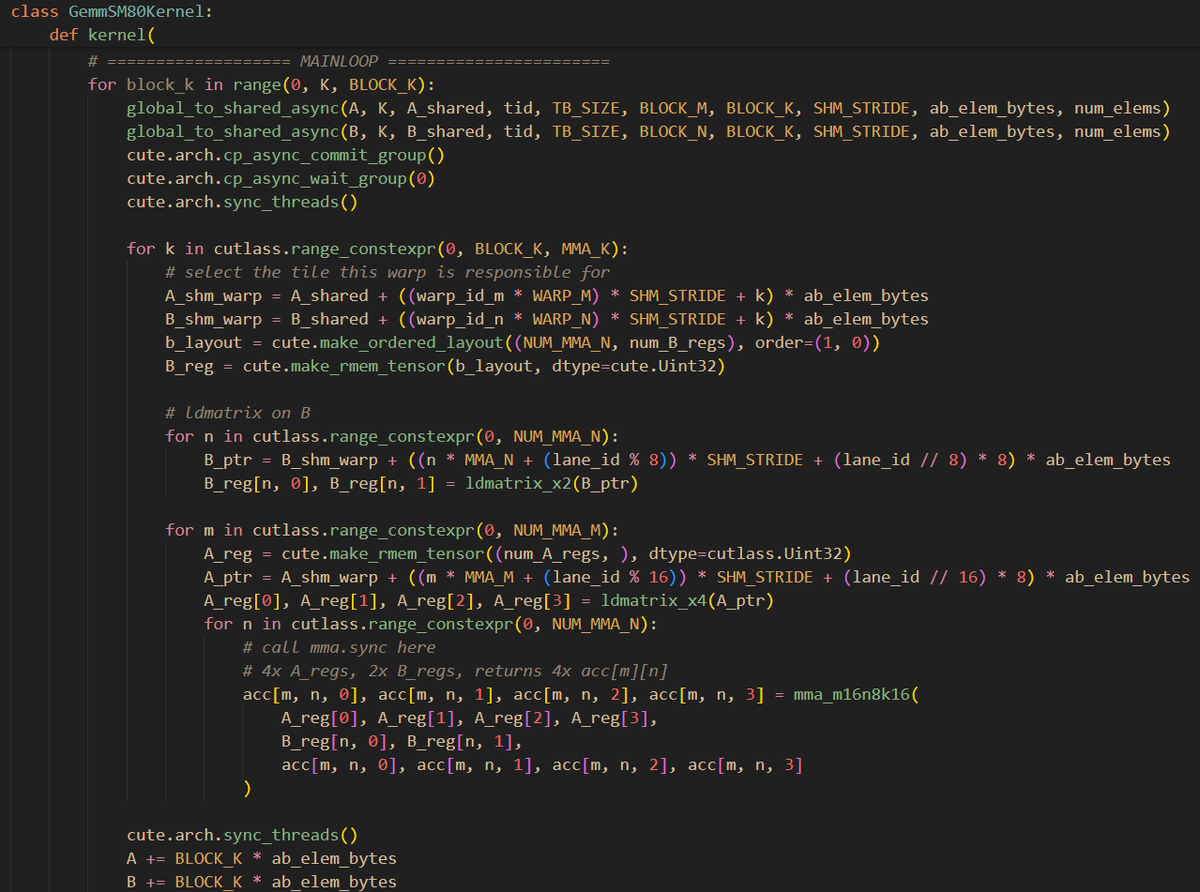
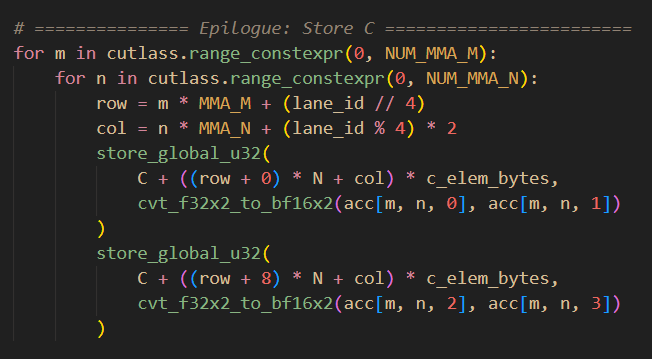
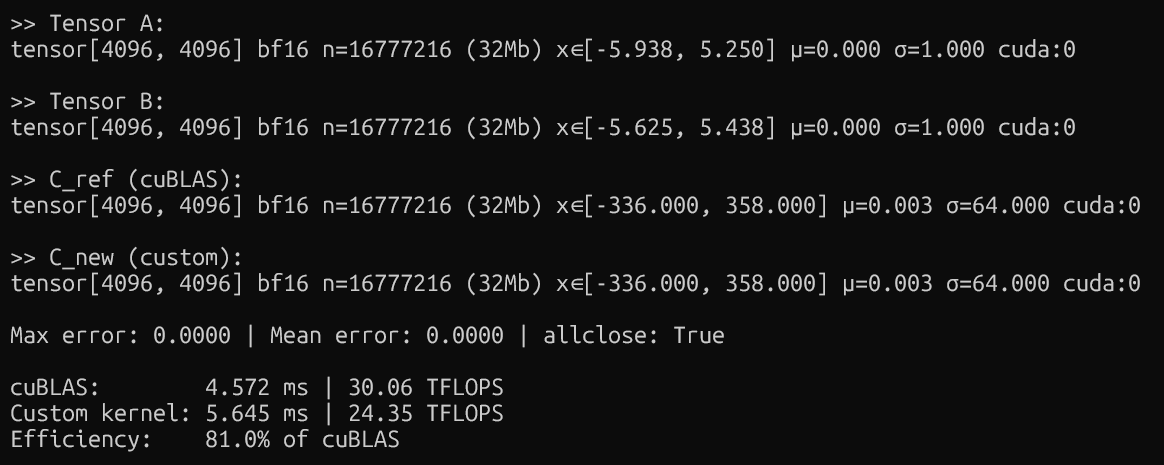
i wrote a CuTeDSL GEMM kernel purely using inline PTX without any CuTe layout gymnastics and the first draft already achieves 81% of cuBLAS on my RTX 4060: > GMEM to SMEM async copy for A and B > ldmatrix (x2/x4) to load A and B from SMEM to RMEM > mma.sync instruction with m16n8k16 > C epilogue store with PTX > everything in python without touching CUDA
maharshi tweet mediamaharshi tweet mediamaharshi tweet mediamaharshi tweet media
English
10
5
252
18.9K
Masán
Masán@Getror1·
@ChShersh Just accept it you are a .100x dev
English
0
0
0
144
Dmitrii Kovanikov
Dmitrii Kovanikov@ChShersh·
My saddest realisation after receiving my CS degree is that all those elegant DSA are completely impractical on real high volumes of data. The only thing you should care is CPU cache utilisation.
English
57
79
1.8K
73.2K
Masán
Masán@Getror1·
@Divyansh91565 Lol my batchmates are sending photos teasing we are doing the same no of questions as you without studying and feeling superior. World really is fucked
English
0
0
0
25
divyansh
divyansh@Divyansh91565·
DSA is dead...
Indonesia
43
2
71
7.7K
Masán
Masán@Getror1·
@Divyansh91565 What was the problem in your set and explain soln too
English
0
0
0
64
divyansh
divyansh@Divyansh91565·
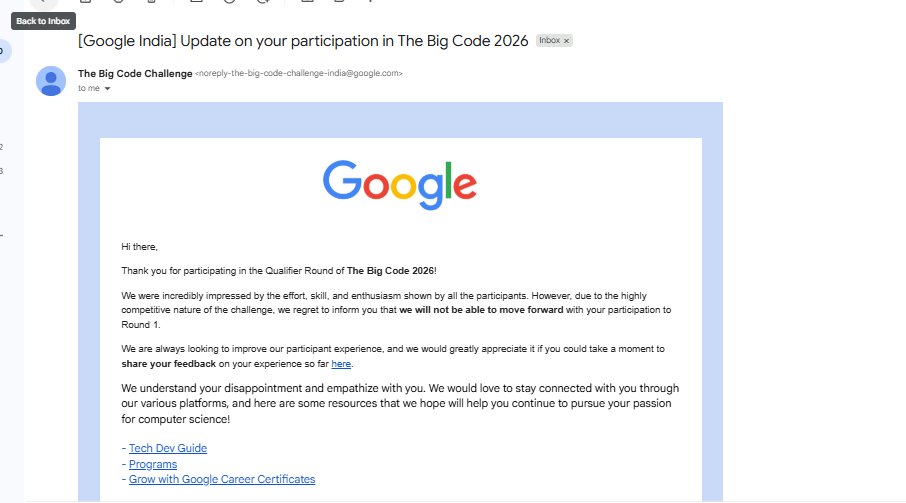
Google Big Code Assessment: DSA Problem: Binary search on answers - pretty standard. I guess most people could solve it. REST - 17 MCQs Aptitude (Easy + Medium) DSA Section (Easy + Medium + Hard) OOPs (Medium + Hard, Ig?) The rest were GenAI, ML, and AI Automation questions. Honestly, I couldn't understand a shit in these topics - all guesswork.
divyansh tweet media
English
14
5
111
17.4K
Masán
Masán@Getror1·
@anishmoonka Sadly no such plans for students. I wanna do so much but can't burn 500+ every run
English
1
0
1
2.3K
Anish Moonka
Anish Moonka@anishmoonka·
If you're an AI startup in India, renting processing power from the government to train your model costs about $0.7 per hour. The same hardware on Amazon Web Services costs $3.7. On Microsoft Azure, $6.6. The Indian government is subsidizing AI infrastructure at rates that would make most Western startups do a double-take. I read all 26 pages of the white paper this tweet links to. The numbers inside are wild. The IndiaAI Mission has a budget of about $1.2 billion over five years, approved in March 2024. Almost half of that, roughly $500 million, goes straight to building the processing power AI companies need to train their models. The original plan was to deploy 10,000 processors. By December 2025, they had 38,000 running. 3.8x what they promised. A government open call in January 2025 pulled 506 proposals. The four startups picked first were Sarvam AI, Soket AI, Gnani AI, and Gan AI. Eight more were added by September. India now has 12 separate teams building AI models, ranging from tiny ones for basic chatbots to massive ones rivaling those from the US and China. They cover language, voice, vision, medical diagnosis, material science, and even brain-computer interfaces. The one I keep coming back to is Sarvam AI. They raised $41 million from Lightspeed, Peak XV, and Khosla Ventures. In May 2025, they released a model built on top of a French AI system (Mistral Small) and customized for Indian languages. It got roasted online. Critics said it was a foreign model in Indian clothing. So they went back and built Sarvam-105B completely from scratch, using Indian hardware under the government mission. It outperformed China's DeepSeek-R1 on certain tests, even though it was a model six times larger. Both were released for anyone to download and use in March 2026. There's something else buried in the paper I haven't seen another country try at this scale. India is building a copyright system specifically for AI training data. Under a December 2025 government proposal, AI companies can train their models on any copyrighted content they can legally access, books, articles, music, anything. Creators cannot say no. But the moment an AI product makes money, royalties are collected by a centralized government body and distributed back to creators. Singapore allows AI companies to use content without payment. China requires strict consent before training. India is trying a middle path, and publishers are already calling it forced participation. Stanford's AI Vibrancy Index, which measures a country's overall AI strength across research, talent, infrastructure, and investment, ranked India third globally in 2025. Up from seventh in 2023. But the actual scores tell you how far the gap still is: US at 79, China at 37, India at 22. And India's $1.2 billion budget sits next to China's $47.5 billion semiconductor fund and Saudi Arabia's $100 billion Project Transcendence. India is currently spending 40x less than the frontrunners. This white paper is the most detailed public bet yet that smart infrastructure design can close that gap.
Office of Principal Scientific Adviser to the GoI@PrinSciAdvOff

𝐀𝐬 𝐩𝐚𝐫𝐭 𝐨𝐟 𝐭𝐡𝐞 𝐨𝐧-𝐠𝐨𝐢𝐧𝐠 𝐀𝐈 𝐏𝐨𝐥𝐢𝐜𝐲 𝐖𝐡𝐢𝐭𝐞 𝐏𝐚𝐩𝐞𝐫 𝐒𝐞𝐫𝐢𝐞𝐬, 𝐭𝐡𝐞 𝐎𝐟𝐟𝐢𝐜𝐞 𝐨𝐟 𝐭𝐡𝐞 𝐏𝐫𝐢𝐧𝐜𝐢𝐩𝐚𝐥 𝐒𝐜𝐢𝐞𝐧𝐭𝐢𝐟𝐢𝐜 𝐀𝐝𝐯𝐢𝐬𝐞𝐫 𝐭𝐨 𝐭𝐡𝐞 𝐆𝐨𝐯𝐞𝐫𝐧𝐦𝐞𝐧𝐭 𝐨𝐟 𝐈𝐧𝐝𝐢𝐚 𝐫𝐞𝐥𝐞𝐚𝐬𝐞𝐬 𝐚 𝐰𝐡𝐢𝐭𝐞 𝐩𝐚𝐩𝐞𝐫 𝐨𝐧 “𝐀𝐝𝐯𝐚𝐧𝐜𝐢𝐧𝐠 𝐈𝐧𝐝𝐢𝐠𝐞𝐧𝐨𝐮𝐬 𝐅𝐨𝐮𝐧𝐝𝐚𝐭𝐢𝐨𝐧 𝐌𝐨𝐝𝐞𝐥𝐬. The versatility of Foundation Models makes them a critical layer of today’s AI ecosystem and a key area for innovation in India. Therefore, developing indigenous foundation models is a strategic priority. India’s objective is to harness foundation models for inclusive growth and public good, while ensuring they are governed in a manner consistent with the country’s values, legal framework, and security interests. This white paper provides an understanding of India’s approach to advancing indigenous foundation models through public–private collaboration and to governing these systems that support trust, accountability, and responsible adoption. The White Paper also provides details on India’s approach - which is centred on building indigenous capability across the foundation-model stack. Rather than relying on a single model, India is developing an ecosystem that combines (i) shared compute access, (ii) India-centric data and model repositories, and (iii) multiple model-building efforts across text, speech, multimodal, and sectoral systems. Read the White Paper here: psa.gov.in/CMS/web/sites/…

English
61
612
3.2K
292.5K
Masán
Masán@Getror1·
All that and no safe drinking water to most. Exploitative policies across all public and private institutions. All ministries being corrupted and failing for basic tasks. Dirtier than 100B~ economies
Parimal@Fintech03

Yesterday I shared a list of contributions from our ancient knowledge traditions. What followed was fascinating, no curiosity, no debate, Just a barrage of mockery, mostly from our own people. The irony is hard to miss. A civilization that produced centuries of mathematics, medicine, philosophy & statecraft now has its own children convinced that nothing of value ever came from it. Anyway, whether one likes it or not, today also India is building, launching, manufacturing & innovating at a scale that is difficult to ignore. Here is the proof (I can keep going on but sharing a few): - Digantara’s SCOT satellite: 1 of the world’s 1st commercial space-based orbital surveillance systems for real-time tracking of debris & satellites - CSIR-NBRI developed the world’s 1st pink bollworm-resistant GM cotton variety approved for commercial use - Only the 4th country ever to demonstrate fully autonomous in-orbit satellite docking + inter-satellite power transfer - India commissioned 2 dedicated quantum chip fabrication facilities (IIT Bombay for quantum sensors + IISc BLR for superconducting/photonic/spin qubits) with ₹720 crore investment ending foreign-fab dependence for quantum hardware. - India achieved full indigenous Gallium Nitride (GaN) semiconductor technology for high-power radar, electronic warfare, and 5G/6G systems (DRDO breakthrough, only Russia & a handful of nations have sovereign GaN at this level). - GalaxEye’s Mission Drishti: World’s 1st private multi-sensor (SAR + optical fusion) Earth observation satellite - 1st country in Global South to build dedicated quantum materials labs for fault-tolerant computing (INOX + IISc collaboration). - India now has end-to-end sovereign quantum hardware pipeline (design + fabrication + processors)...only the US, China, and Europe have comparable domestic chains. - Indigenous 5G standalone core + radio access network stack developed entirely by TCS + C-DOT + Tejas Networks & deployed in remote villages. - Largest vaccine manufacturing capacity on the planet - Serum Institute (still holds the title by volume). - 1st private-sector quantum valley - Amaravati Quantum Valley foundation laid (2026) - Vyommitra - World’s 1st humanoid robot "specifically" for uncrewed Gaganyaan precursor missions (female form, emotional AI). - World’s largest deployment of plastic-waste roads - Prof. Vasudevan’s patented technology (used across dozens of cities, no other country matches the scale) - 1st country to fast-track 5 indigenous SMRs by 2033 under new policy. - World’s largest single-piece Inconel rocket engine - India’s 1st indigenous CRISPR-based gene therapy - BIRSA 101 for sickle cell disease - India’s 1st fully indigenous CAR-T cell therapy for B-cell blood cancers (ACTREC-Tata Memorial + IIT Bombay + ImmunoACT)..Also, world's most affordable - world's most advanced liquid/injectable cornea regeneration approaches (not a full artificial cornea implant like others).. I can keep going on....

English
0
0
0
12
Masán
Masán@Getror1·
@sudoingX How can I decide what model to fine tune and what technique to use depending upon my dataset
English
0
0
0
68
Sudo su
Sudo su@sudoingX·
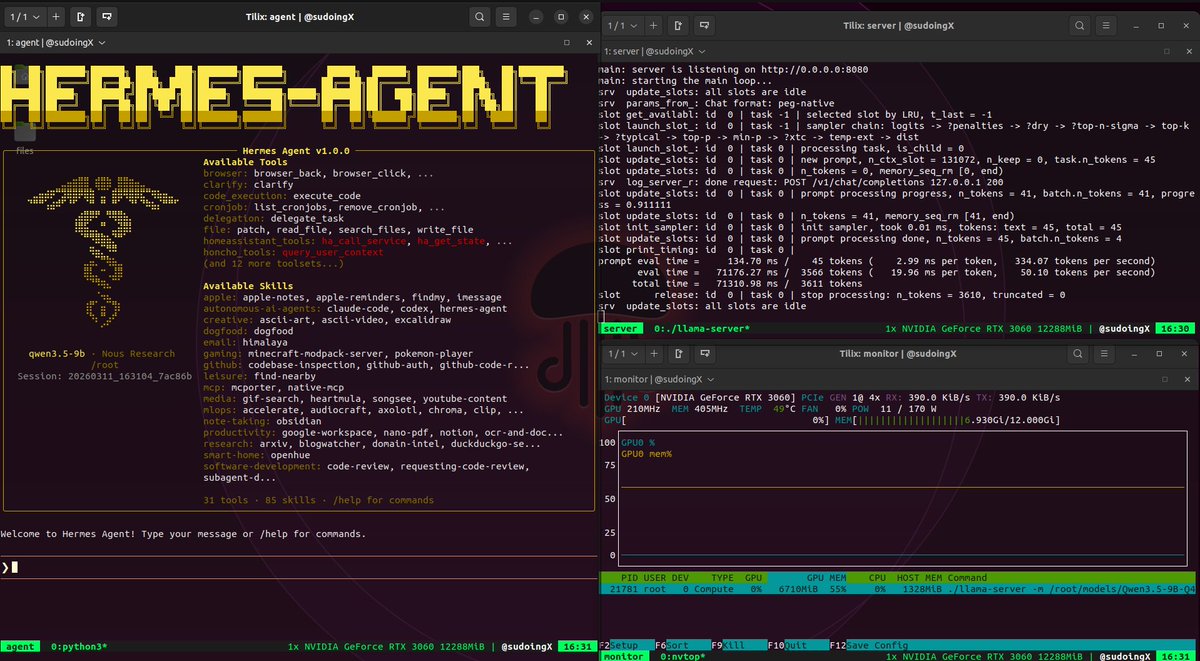
absolute cinema. 31 tools. 85 skills. file ops, terminal, browser, cron, delegation, code execution. persistent memory across sessions. Hermes Agent running on a single RTX 3060 through Qwen 3.5 9B at 50 tok/s. this is what open source looks like when it ships.
Sudo su tweet media
English
53
74
1.1K
61.9K
Masán
Masán@Getror1·
There's two things: 1. Naive prompts - that most people do cannot make something complex and hiring some guy would always be cheaper. 2. Engineered prompts - they will be coming from engineers that understand AI and like it has always been they'll be the pinnacle. Ai is not magic
Raj Dabre@prajdabre

Doom intensifies. I've written a few colabs for some data processing and cleaning. Asked the agents to turn them into a full fledged library with tests and what not. ONE SHOTTED! It took me weeks to painfully curate those colabs and would have taken me weeks to do the conversation. ONE SHOTTED. P(Doom) intensifies.

English
0
0
0
13