Gideon Moore

20 posts

Gideon Moore banner
Gideon Moore

Gideon Moore

@GideonMoore

phd student @StanfordEcon | io, labor, innovation | previously predoc @SIEPR | @BowdoinCollege '19 | https://t.co/13Kr1RO91y

Palo Alto, CA Katılım Haziran 2012
651 Takip Edilen167 Takipçiler
Gideon Moore
Gideon Moore@GideonMoore·
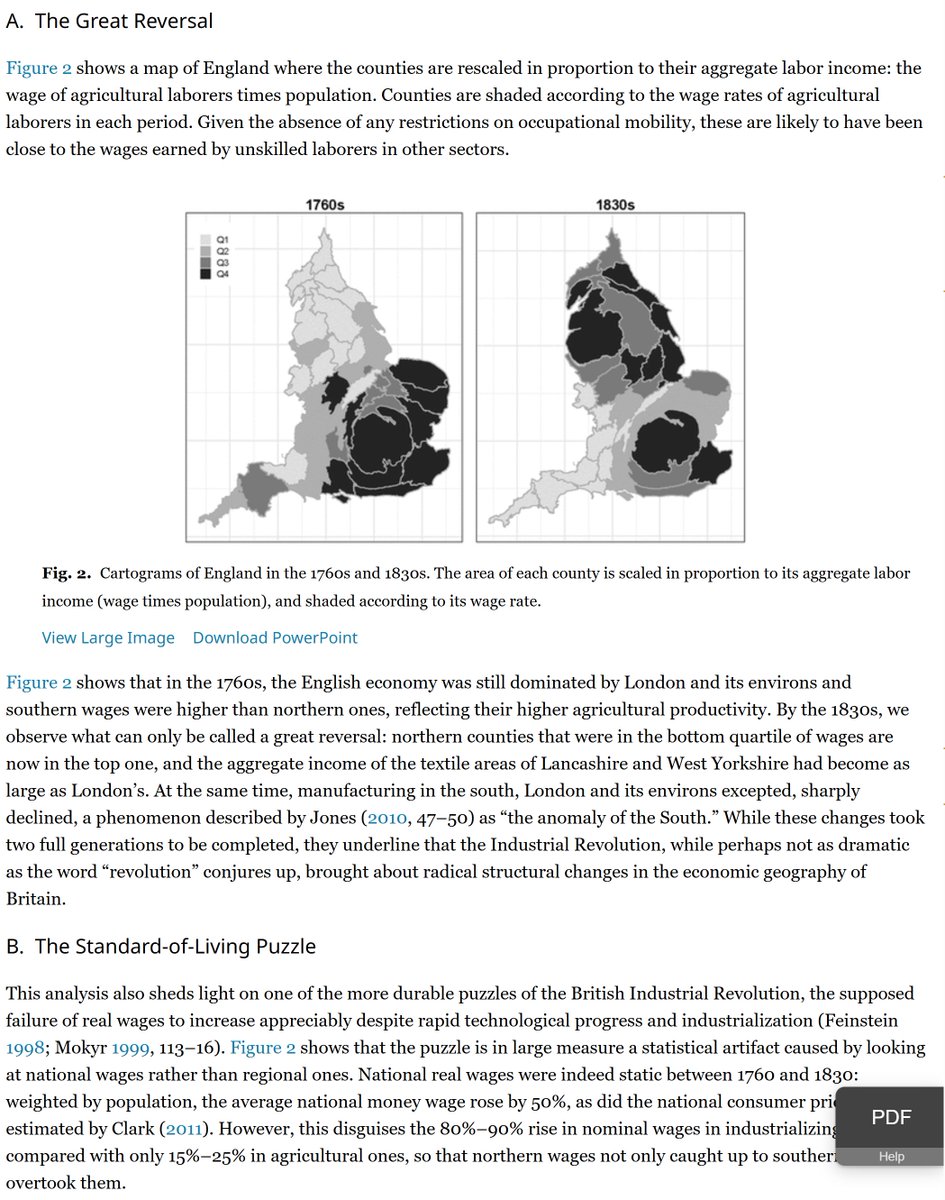
@alz_zyd_ Kelly, Mokyr, and O Grada (2023) argue Engel's Pause is mostly a statistical artifact--wages *rose* in the industrializing north, but *fell* in the agricultural south for a net zero national effect. New interpretations of old facts! See: journals.uchicago.edu/doi/full/10.10…
Gideon Moore tweet media
English
2
5
24
4K
alz
alz@alz_zyd_·
The 1820-1850 period is sometimes called "Engel's pause". It remains a puzzle for modern economic theory. It seems like a rather important puzzle, if it led Marx and Engels to develop communism (well-justified by 30 years of data!)
English
5
1
47
2K
alz
alz@alz_zyd_·
From around 1820-1850, England experienced very rapid economic growth, but very little wage growth. Empirically, Marx and Engels were right - in this period - that capitalism seemed to enrich capital, while increasingly impoverishing labor!
Alex Imas@alexolegimas

To understand why it’s crazy to think communism/socialism is a superior alternative to our current market economy, it’s useful to understand the historical context when Marx wrote the Communist Manifesto. This was the early/mid phase of the Industrial Revolution. If you looked around, capitalism—which spurred the Revolution—really did make many people’s lives much worse. Workers who had customary rights to farm common lands were forced into factories (read about enclosures and the “double freedom”). Conditions in factories were hellish: non stop work for crazy hours, child labor, unsafe working conditions. It is no surprise that Marx would call these conditions, where workers got a pittance of what their product was sold for, *exploitation*. But then things began to change. Labor slowly gained power which shifted bargaining to workers. Conditions improved (labor won victories for safety, working hours, agency etc), the pie grew, and the *level* of wellbeing for the worker eventually vastly surpassed the feudal baseline. Comparing the market economy now to the 1800s shows that the term “capitalism” is so broad to be almost useless as a point of discussion. When labor has no power and is coerced to work in terrible conditions (in the sense of outside options being even worse), the implications for welfare are vastly different than the current market economy with regulation, a much larger pie to split, etc. Marx’s critique of early capitalism was often right (at least in spirit); his prediction that revolution would reliably produce better institutions was not. If Marx came to the US today chances are he’d say, this is pretty nice compared to the counterfactuals that have been tried. Measured against the outcomes Marx cared about, e.g., material welfare, life expectancy, autonomy, modern regulated market economies dominate the socialist counterfactuals we’ve observed.


English
22
19
306
27.9K
Gideon Moore retweetledi
Shosh Vasserman
Shosh Vasserman@shoshievass·
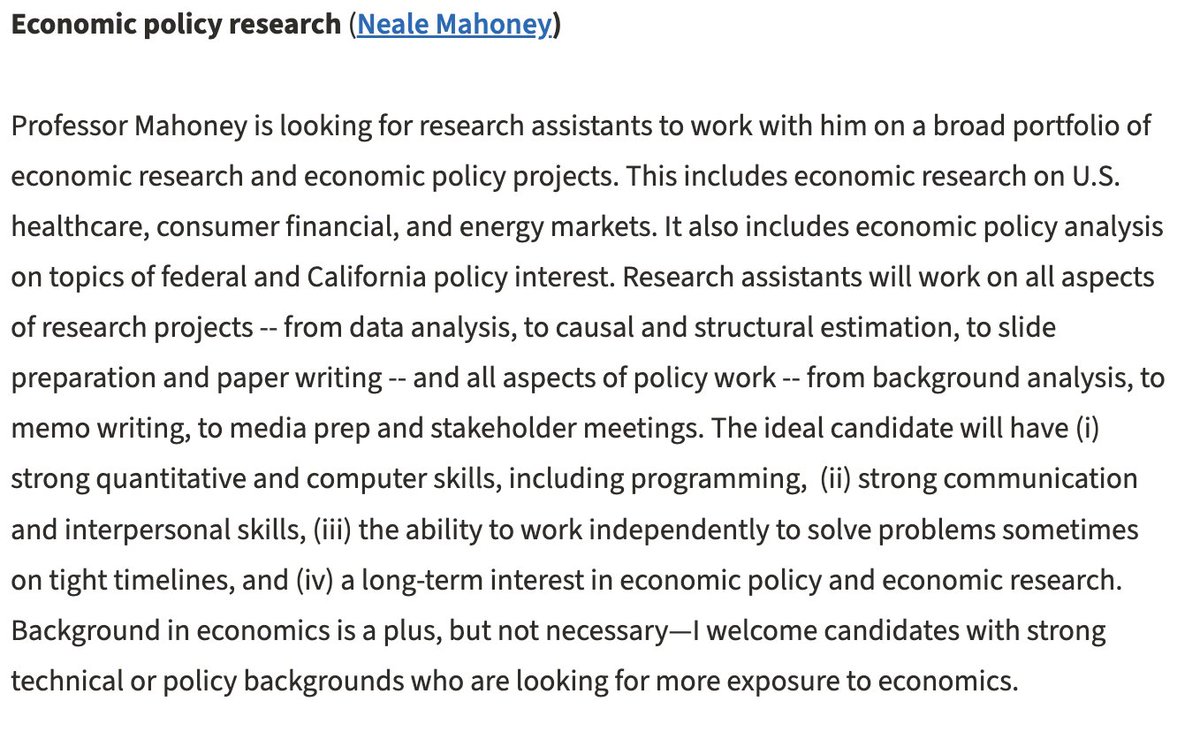
I'm hiring a pre-doc to work with me on empirical IO/applied micro projects starting in Fall '25! Details below and instructions here: shoshanavasserman.com/call_for_predo… International students (who need J1) are welcome & non-econ bgs are fine given interest + curiosity. Please apply :)
Shosh Vasserman tweet media
English
4
53
173
37.1K
Gideon Moore retweetledi
Jacob Light
Jacob Light@jlight_·
Blink and you’ll miss it, but I contributed to this article’s analysis of trends in university course content. It’s great to see the data I collected used to generate new knowledge. Stay tuned for more work related to ideology and college courses w/ @GideonMoore and @SamuelThau
The Economist@TheEconomist

Republicans love to blame everything they consider wrong with America on an epidemic of wokeness, by which they tend to mean anything that smacks of political correctness. In fact, woke views and practices have declined markedly since the early 2020s econ.st/3zf6s0Z👇

English
1
2
17
1.7K
Gideon Moore
Gideon Moore@GideonMoore·
@NinaBuchmann6 @Dell I had the exact same issue with Dell struggling to repair my XPS last year. I ended up switching to the HP Spectre which I've been very happy with. If you want to take a look come by my cube in the department! Link: bestbuy.com/site/hp-spectr…
English
0
0
1
314
Gideon Moore retweetledi
Heidi L. Williams
Heidi L. Williams@heidilwilliams_·
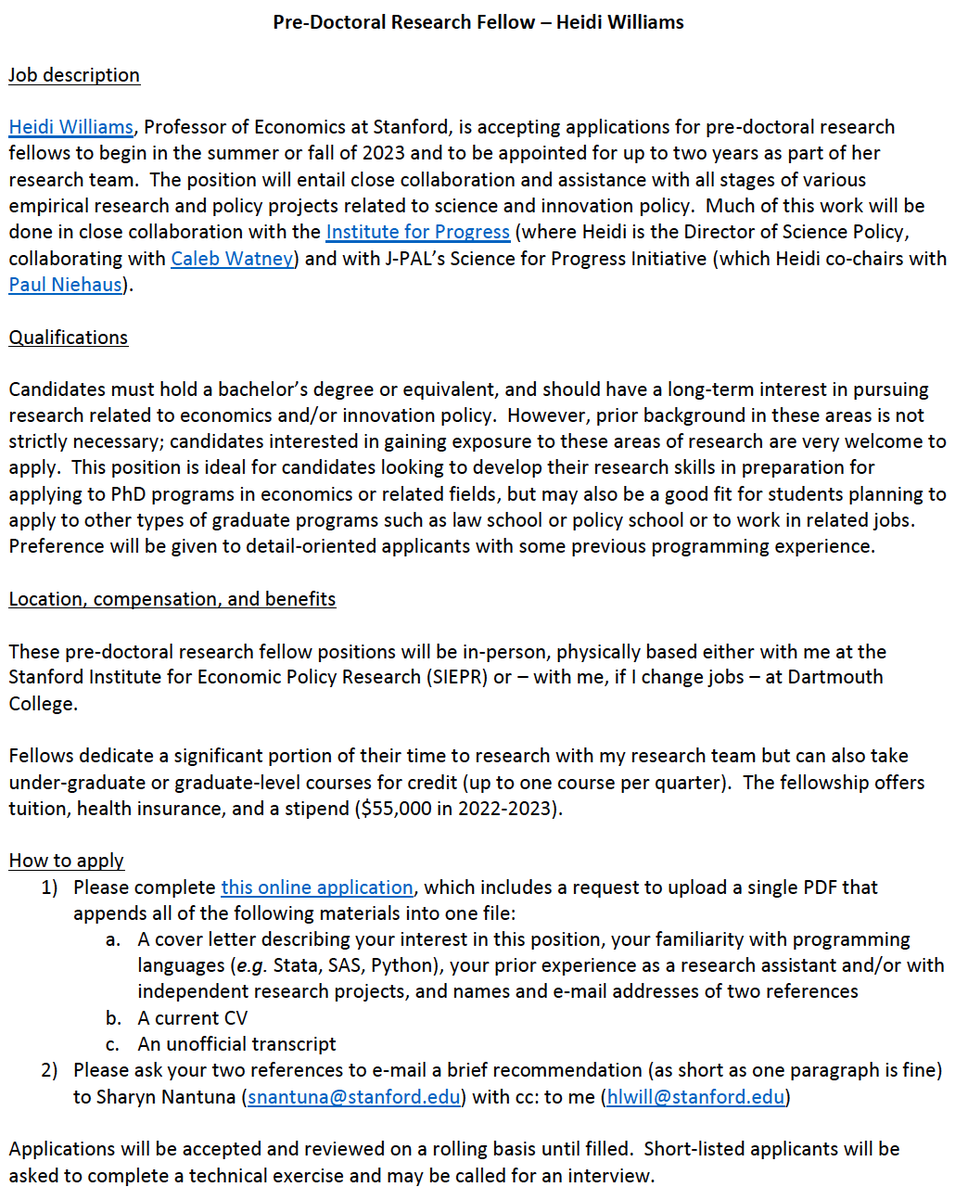
Would you like to do research that informs how governments as well as private philanthropies can best support science and innovation? Think about coming to work with me and my amazing collaborators like @calebwatney and @PaulFNiehaus.
Heidi L. Williams tweet media
English
3
40
71
0
Gideon Moore
Gideon Moore@GideonMoore·
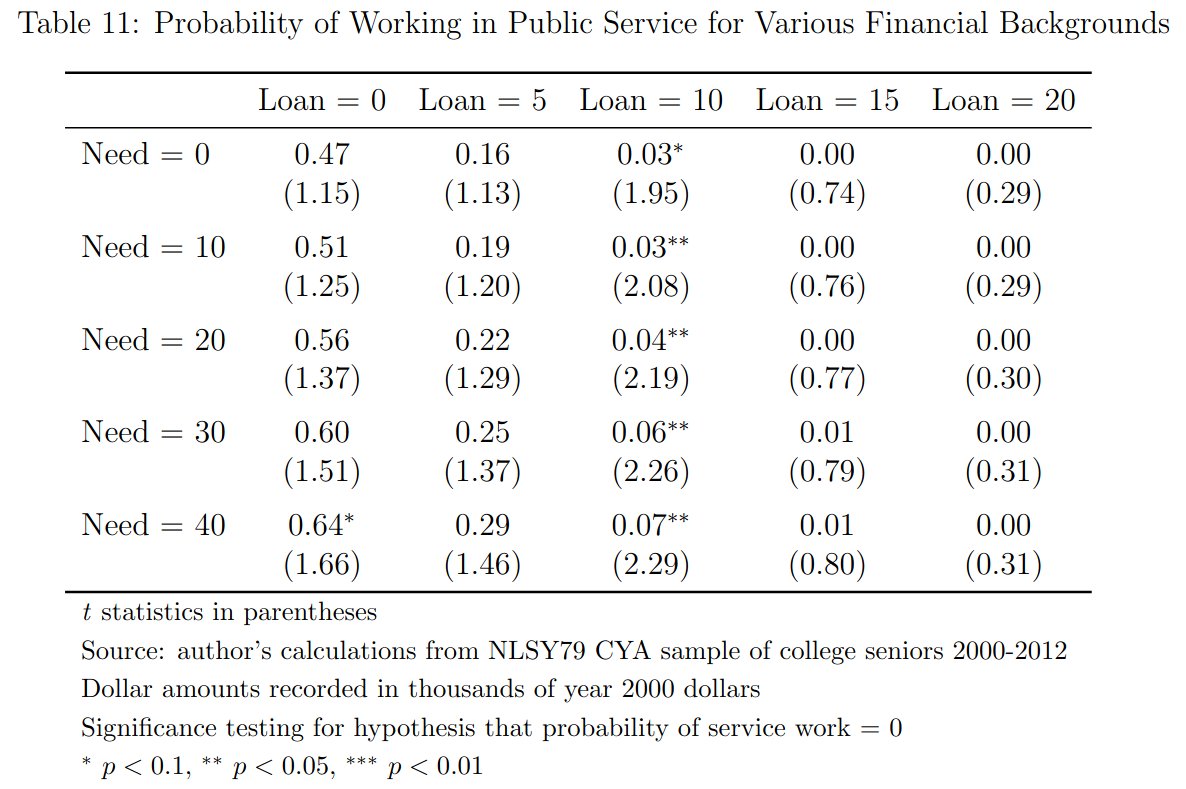
Note this is a version of the result seen in (the wonderful!) Rothstein and Rouse (2011): …iencedirect-com.stanford.idm.oclc.org/science/articl…. However, rather than focus on students at a wealthy private university, I really try to examine on students in a much lower income stratum at a national scale.
English
0
0
0
0
Gideon Moore
Gideon Moore@GideonMoore·
Find the full PDF here: gideonmoore.com/documents/Moor…. Keep in mind (a) it's not peer-reviewed, and (b) I wrote it when I was 20, so cut me some slack. I'm still hoping to make something of it someday, so suggestions welcome!
English
1
0
1
0
Gideon Moore
Gideon Moore@GideonMoore·
This seems like as good a time as any to re-up my undergrad thesis results: a short 🧵. For low-income borrowers, even debt increases of <$5k cut the probability students enter public service. The effect is driven primarily by graduates substituting away from becoming teachers.
Gideon Moore tweet media
English
1
1
10
0
Gideon Moore retweetledi
Sandy Black
Sandy Black@Econ_Sandy·
A goal of public education is to improve economic and social mobility. But schools often assign kids to classes based on academic ability, mimicking the stratification that education is intended to combat. Our new research studies this tracking in the US. nber.org/papers/w30370
English
2
62
276
0
Gideon Moore retweetledi
Ida Bae Wells
Ida Bae Wells@nhannahjones·
I was invited to give an MLK speech today and a small number of members of the group hosting me wrote and then leaked emails opposing my giving this speech, as it dishonored Dr. King for me to do so. They called me a "discredited activist" "unworthy of such association with King"
English
1.1K
14.2K
45.6K
0
Gideon Moore retweetledi
Amanda Mull
Amanda Mull@amandamull·
I spent the last two weeks down a retail-theft rabbit hole, trying to figure out if the shoplifting surge is real and why news coverage of it is so bizarre (and, honestly, so bad). theatlantic.com/health/archive…
English
73
867
3.7K
0
Gideon Moore retweetledi
Kevin A. Bryan
Kevin A. Bryan@Afinetheorem·
A chapter for the new Handbook of IO that Heidi Williams and I wrote on the economics of innovation is now online! nber.org/papers/w29173
English
1
57
203
0
Gideon Moore
Gideon Moore@GideonMoore·
I've found Nick Cox's "Suggestions on Stata programming style," but I'm not sure that's what I'm looking for--it seems to mix stylistic preferences (e.g. brace placement) with substantive preferences (e.g. programs should try and accept varlists).
English
1
0
0
0
Gideon Moore
Gideon Moore@GideonMoore·
@AeaData (or others!) Is there any sort of Stata style guide analogous to Python's PEP 8? Even better would be some sort of Pylint-style automated linter that would enforce good style.
English
1
0
2
0