Darshak Rana ⚡️@thedarshakrana
Psychological distancing is the greatest life hack.
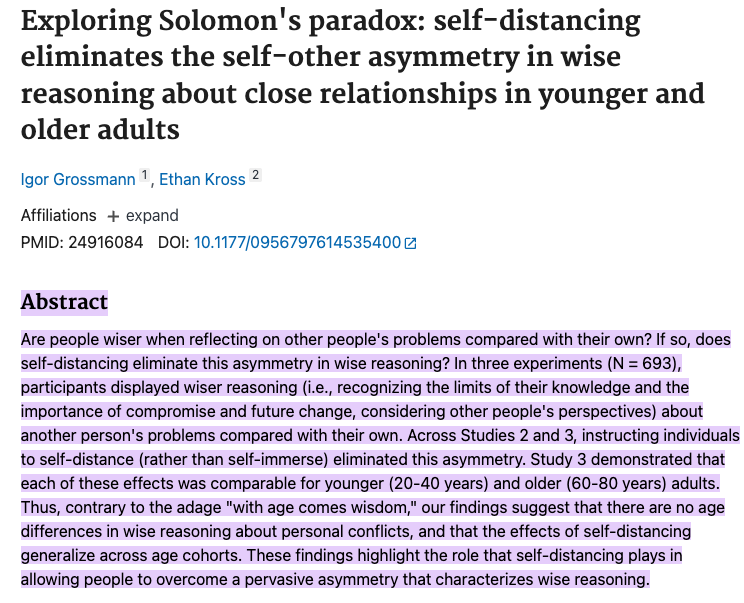
When psychologist Igor Grossmann presented people with relationship dilemmas, participants gave remarkably wise advice about other people's situations. They considered multiple perspectives, acknowledged uncertainty, recognized that circumstances change over time, and suggested nuanced solutions that balanced competing interests.
Then he gave the same people identical dilemmas about their own relationships.
Their wisdom vanished.
Suddenly, the same individuals who had been thoughtful and measured became reactive and absolute in their thinking. They ignored contradictory evidence, assumed their perspective was complete, and made black-and-white judgments they would have criticized if someone else had suggested them.
Grossmann called this "Solomon's Paradox" after the biblical king renowned for his wisdom in judging others while making catastrophically poor decisions about his own life.
The takeaway is we are literally less intelligent about our own problems than identical problems happening to other people.
The mechanism explains why your friends can see obvious solutions to situations that feel impossibly complex to you, and why you can instantly diagnose what someone else should do while remaining completely stuck in your own circumstances.
When you think about someone else's problem, your brain automatically engages what psychologists call "psychological distance." The situation feels separate from your identity, so your analytical capabilities remain online. You can weigh pros and cons, consider long-term consequences, and imagine multiple scenarios without emotional interference.
When you think about your own problem, psychological distance collapses to zero. The situation becomes fused with your sense of self. Your ego gets involved, your emotions spike, and the prefrontal cortex that generates wise decisions goes offline. You're no longer thinking about the problem; you're drowning in it.
Mental distancing artificially recreates the psychological distance that naturally exists when you consider other people's situations. The technique tricks your brain into treating your own problem as if it belonged to someone else, which reactivates the same wise decision-making capabilities you use when advising friends.
This connects to why journaling works, why talking to therapists helps, and why ancient wisdom traditions emphasize witness consciousness. All of these practices create psychological distance between the self and experience.
The observer self and the experiencing self are different neurological systems with different capabilities.
Your experiencing self is designed for immediate survival and emotional processing. It's reactive, personal, and immersive. Your observer self is designed for learning, planning, and complex decision-making. It's reflective, impersonal, and spacious.
Most of us spend their entire lives identified exclusively with the experiencing self. We never discover that stepping into the observer self is possible, let alone that it dramatically improves judgment and emotional regulation.
But mental distancing is not some kind of forced positive thinking or emotional suppression. It's activating a higher-order cognitive capacity that evolution gave you but culture never taught you to use.
When you can observe your thoughts and emotions from the outside instead of being consumed by them from the inside, you recover access to the same wisdom you naturally apply to everyone else's problems.
The paradox is that gaining distance from yourself actually makes you more effective at managing your life.
You become your own best advisor.