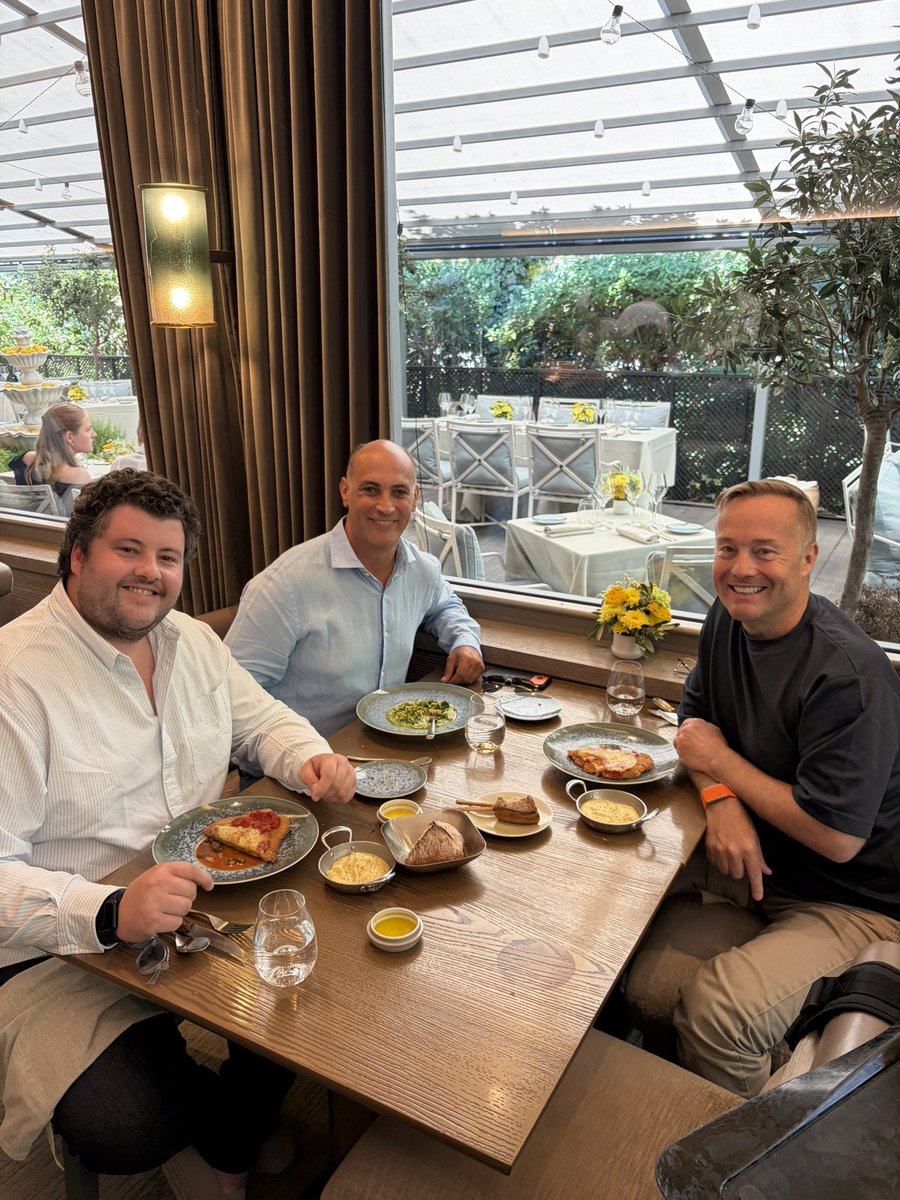
@Ropeium @tatumturnup I think you’d rip it bro. Big joke book all the way
English
David Waugh
5.2K posts
@GoDavidWaugh
Sales @GoQuant, @GoDark. Previously @sFOX, @coinbitsapp, @aier.









Agentic AI adoption is on fire at @Uber, and it's changing the way we build, not just in engineering, but across the entire company. Today, 99% of our engineers use AI tools. More than 70% of pull requests are attributed to local or cloud agents. And our engineers have built 2,500+ agent skills across the software development lifecycle. Those numbers are exciting, but they led us to a much bigger question: How do we bring agentic AI beyond engineering? Finance. Legal. Operations. Marketing. Customer Support. HR. Procurement. These functions run on complex workflows that are often manual, highly nuanced, and spread across dozens of systems. You can't automate them effectively by looking at process diagrams or documentation. You have to understand how the work actually gets done. So we created something called Agentic Pods. The idea is simple. We handpicked ~30 of our most AI-proficient engineers (people with deep knowledge of Uber's systems) and paired each of them with a domain expert from a business function. Then we gave every pod just two weeks. • Days 1 – 2: Shadow the expert. Observe every step. Document workflows. Ask questions. Build intuition. • Day 3: Prioritize opportunities based on scale, repetition, business impact, and data availability. • Days 4 – 5: Build a working agent alongside the person doing the job. • Days 6 – 9: Validate with several others performing the same work. Does it generalize? Does it actually make their job better? • Day 10: Ship. In just the past two months, we've run 16 Agentic Pods across 16 different business functions. • Capital allocation across 150 cities: 15 hours → 30 minutes. • Financial pacing reports: 2 days → 10 minutes. • Marketing web quality assurance: 2 weeks → 50 minutes. • Support workflow creation: 9,000 manual workflows → self-service automation. The productivity gains are impressive, but what surprised us most wasn't the speed. • It was how quickly engineers embedded in unfamiliar domains uncovered opportunities that had been hiding in plain sight. • The biggest wins rarely come from automating one task. They come from rethinking an entire workflow. Once you redesign the workflow around AI, you often eliminate handoffs, remove unnecessary approvals, replace legacy tooling, reduce vendor spend, and dramatically accelerate decision-making. • The workflow becomes the unit of automation - not the individual task. • The most impactful agent skills cut across teams, orgs, functions, tools, and systems. The biggest lesson? The best AI opportunities are rarely visible from the outside. You discover them by sitting next to the people doing the work, understanding every friction point, and building with them, not for them. We're now forming a dedicated team to scale this further and go deeper. They'll deeply understand the work, redesign it from the ground up, and use AI to fundamentally change how the business operates. It's exciting times!

My second conversation with @jeremygiffon. His first episode became one of the most popular we've ever done. Since then he's become a friend I talk to every day, so this is a taste of one of those conversations. We discuss: - The billion dollar PDF - Why billionaires have become subservient to the "poaster" class - The philosophers who secretly shaped Silicon Valley - Lessons from the last 18 months in private markets - East v. West coast finance - Buffett + beating the market - and much more Enjoy! 0:00 Intro 5:50 The Billion Dollar PDF 11:31 Algorithms and Power Laws 20:28 Peak Guy 31:19 Opting Out of the Timeline 36:14 AI and White-Collar Jobs 43:31 The Next Era of Finance 53:56 The New Economics of Software 1:03:22 Underwriting Emerging Managers 1:18:17 Silicon Valley’s Hidden Philosophy

Thankfully, we already have our cubes. bloomberg.com/news/articles/… @colleenklein @cmsholdings @nic_carter


Schumer’s preferred SEC nominee, Goldsmith Romero, is unqualified and untrustworthy. Her flip-flop vote to drop litigation against Kalshi unleashed unregulated nationwide gambling and likely previews future backroom deals for crypto and prediction markets. Link in the comments.


Palantir CEO Alex Karp on what customers actually want, the real business of frontier labs, and the importance of open source models: “What the technical customers want is control over their compute, their models, their data stack, and their alpha. They want to know they own the means of production, and it's not being transferred to someone else.” "Who owns the data? Are the prompts secure? Is this being transferred to you?" "If it was so valuable, and I can make you a billion dollars, wouldn't I say I'll make you a billion dollars and I want 30%? Why are they charging for tokens if it's so valuable?"
The new fifth-generation BMW X5 is here, and it's on a more modern platform with some real enhancements. The 2027 X5 will come with gas, hybrid, and electric powertrains. The X5 40 and 40 xDrive come with a 394-hp turbocharged 3.0-liter inline-six.