Sabitlenmiş Tweet
HyperTrend
614 posts

HyperTrend
@GoHyperTrend
On-chain credit infrastructure for traders and DeFi. Turning trading behavior into reputation, risk signals, and financial access. TG: https://t.co/aMNKEbhFhd
Katılım Ağustos 2025
262 Takip Edilen2.8K Takipçiler

The most important trade in this wallet’s history is still open.
A $5.18M short on $SKHX.
It currently carries $337.8K in unrealized profit—more than 9x the wallet’s entire realized track record.
But the headline PnL is only the surface.
The behavior underneath it is what makes this address worth studying.
The latest snapshot shows:
• 4,000 $SKHX short
• $5.18M position value
• $1,378.84 average entry
• $1,292.15 mark price
• +$337.8K unrealized PnL
• +32.62% ROE
• Cross 5x
• 100% short exposure
This was not a single-entry trade.
The wallet built its exposure through a dense sequence of fragmented fills, gradually increasing the short instead of committing the entire position at one price.
That suggests a specific execution style:
The thesis is expressed with size.
The timing risk is managed through repetition.
Now the same logic is appearing on the exit.
Recent fills show repeated profitable “Close Short” orders.
Some reduced less than one share.
Others closed more than 100.
The trader is not waiting for one perfect exit.
They are converting the position into realized PnL in layers.
That matters because an earlier snapshot showed more than $2M in unrealized profit on the same trade.
By publication, the position had been reduced to 4,000 shares, with $337.8K still unrealized.
The difference should not be read as profit simply “lost.”
Part of the exposure was closed, while the remaining position was repriced as $SKHX rebounded.
The exact realized amount cannot be isolated from these snapshots alone.
But the behavior is clear:
The trader did not just find a profitable entry.
They started converting a concentrated winner into realized PnL before fully abandoning the thesis.
Funding has also been meaningful. The latest snapshot shows approximately $238.7K in positive funding contribution.
So the result has been shaped by three components:
Direction.
Position reduction.
Funding.
But all three still originate from the same underlying exposure: being short $SKHX.
That is where the wallet’s historical profile becomes useful.
Across all completed positions:
• 7 positions closed
• 6 wins and 1 loss
• 85.71% win rate
• +$36.6K net realized PnL
• Shorts: +$83.0K
• Longs: -$46.4K
The win rate looks strong.
The directional split is more revealing.
This wallet’s profitable history has come from short exposure. Its long trades have given back more than half of the profits generated by shorts.
The current behavior is therefore consistent with its existing edge.
It is not suddenly trading a new style.
It has taken the side that historically worked best—and increased the scale dramatically.
Previous completed $SKHX shorts generated only about $20.4K net in total.
The current position is in a different category.
It is not merely another winning trade.
It is the trade that could redefine the wallet’s entire performance record.
The execution deserves credit:
The entry was favorable.
The position was accumulated gradually.
Profit-taking is underway.
Funding supported the hold.
And more than half of the observed position was reduced before publication.
But the structure remains concentrated.
The wallet still has $5.18M in one contract and maintains 100% short exposure.
The account may be managing the position carefully.
It is not diversified.
And with only seven completed positions, there is still too little evidence to separate a repeatable process from a highly effective expression of one market view.
My read:
Strong directional trader.
Patient position construction.
Clear historical advantage on the short side.
More disciplined profit-taking than the headline position initially suggests.
But the track record is still being defined by one concentrated trade.
The $2M floating profit got attention.
The reduction of the position tells us far more.

English

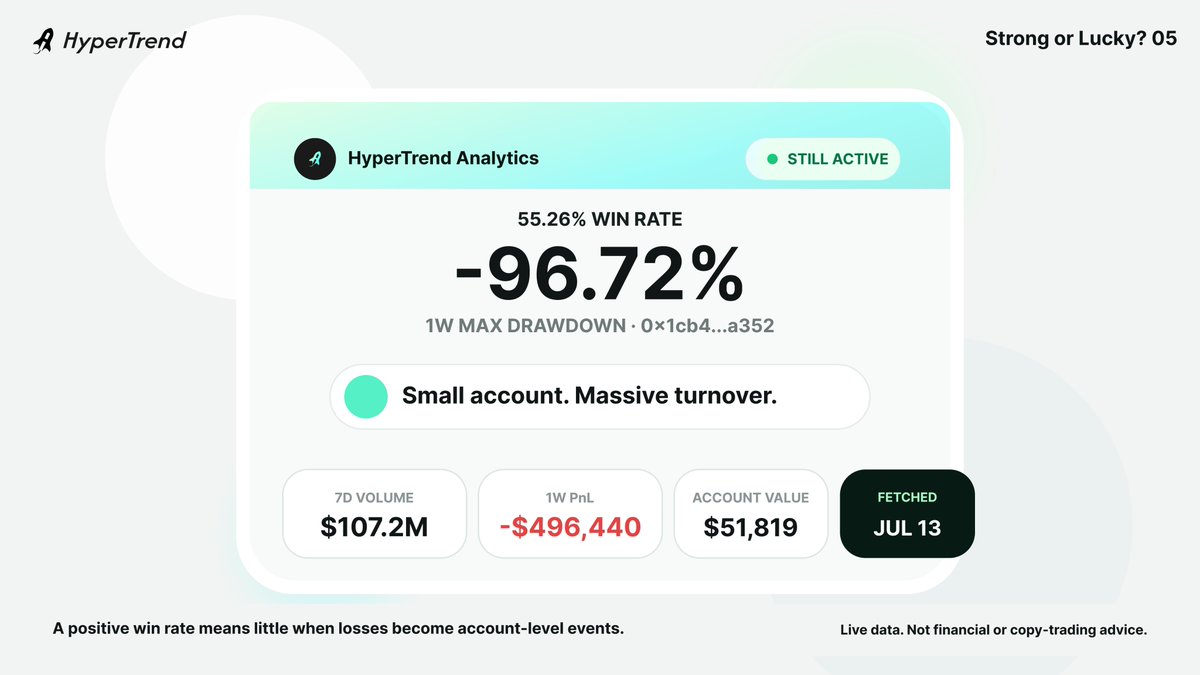
55.26% win rate.
96.72% max drawdown.
A $239.5K long with $0 free margin.
This wallet is a reminder that being right often and managing risk well are two different skills.
Over the past week, the trader closed 38 positions: 21 winners and 17 losers.
There were real wins:
+$76.3K
+$63.0K
+$49.4K
So the problem is not an inability to find profitable trades.
It is what happens when the trader is wrong.
One $SKHX long, held for more than 71 hours, lost $116.3K—more than the wallet’s largest winning trade made.
It was followed by another -$33.8K on $SKHX and -$25.4K on $SKHY. Recent short-duration wins recovered only a small fraction of that damage.
That is how a 55.26% win rate produced approximately -$453K in net closed-position PnL.
The winners validate the process.
The losers threaten the account.
Turnover amplified the problem. An earlier 7-day snapshot showed approximately $107.2M in trading volume.
Even against the account’s observed peak equity, that represents more than 250x in volume-to-equity.
High turnover is not automatically a weakness.
But paired with a 96.72% drawdown, it suggests the same risk was recycled faster than the account could absorb it.
The latest position reveals something even more important.
The wallet moved from $SKHX into a $239.5K $SKHY long:
• Cross 10x
• 100% long exposure
• $0 free margin
• $51.8K account value
At first glance, this looks like a change in ticker.
It is not a change in the underlying bet.
$SKHX tracks one common share of SK hynix, converted from KRW into USD.
$SKHY tracks the company’s US-listed ADS, with each ADS representing one-tenth of a Korean common share.
Different contract.
Same company.
Same long thesis.
The trader did not diversify away from the position that caused the largest losses. They changed the instrument while retaining concentrated exposure to SK hynix.
Across $SKHX and $SKHY, the latest statistics show approximately $232.7K in combined net realized losses—and the wallet is still carrying another $239.5K $SKHY long.
The current position is temporarily profitable.
But temporary profit can be dangerous when it reinforces a process that has already produced account-level losses.
This trader can win.
The unresolved question is whether they can stop one wrong position from overpowering all the right ones.
The contract changed.
The underlying bet didn’t.
The account has already been forced to change.
Has the trader changed with it?

English

@HyperliquidX This is what expansion looks like.
RWA OI at $3.6B means onchain execution is moving beyond crypto-native markets, and Hyperliquid is where that demand is showing up.
Always Hyperliquid.
English

Full wallet address:
0x42bc06d636e9a9a93edb1ddf781ee97821a73946
Snapshot data may move quickly because the wallet is still active.
Analysis is based on public HyperTrend / Hyperliquid wallet data observed before publishing.
Trader behavior analysis only.
Not financial advice.
Not copy trading advice.
English

From NVDA to XYZ100:
this wallet does not look like a typical crypto perp trader.
It looks like a TradFi short book running on-chain.
Since May, its main battlefield has not been BTC or ETH.
It has been:
NVDA,
AMD,
MU,
SNDK,
SKHX,
XYZ100.
More than 20,000 fills.
Around $278M in estimated volume.
Almost the whole visible cycle was built around traditional-asset exposure on Hyperliquid.
And the direction was clear:
short first.
Since May, the wallet recorded more than 10,000 open-short fills and more than 9,000 close-short fills.
That is not random market hopping.
It looks like one playbook repeated across different names:
find TradFi-style exposure,
build short pressure,
trade around the position,
move to the next target.
The wallet has made real money doing it.
Completed trade data shows:
71.43% win rate
7 closed positions
about +$594K net PnL
Top completed shorts:
MU:
+$246.6K
SKHX:
+$214.4K
XYZ100:
+$142.7K
But the more interesting part is what it looks like now.
This is not a quiet winner sitting in cash.
It is still pressing.
About $12.68M in live position value
against a roughly $2.54M account.
Most of it is still in a XYZ100 short.
Current XYZ100 short:
about $11.85M notional
Average margin usage:
97.65%
Available margin shown:
about $9.5K
That changes the read.
This is not just a profitable completed cycle.
It is a live short book still running near the edge.
Profitable,
active,
TradFi-focused,
short-biased,
and operating with very little visible buffer.
The useful read is not “this wallet is good” or “this wallet is bad.”
It is that TradFi assets on-chain are already attracting a different kind of trader.
Not memecoin rotation.
Not BTC leverage chasing.
More like a concentrated short book using one on-chain venue to express views across equity-style markets.
From NVDA to AMD to MU to XYZ100, the assets changed.
The behavior did not.
Short the basket.
Press size.
Keep the book active.
Strong or Lucky?
I would call this one highly committed.
The risk is not that the wallet has no edge.
The risk is that the same structure that made the trade work can become very expensive if the basket turns.

English

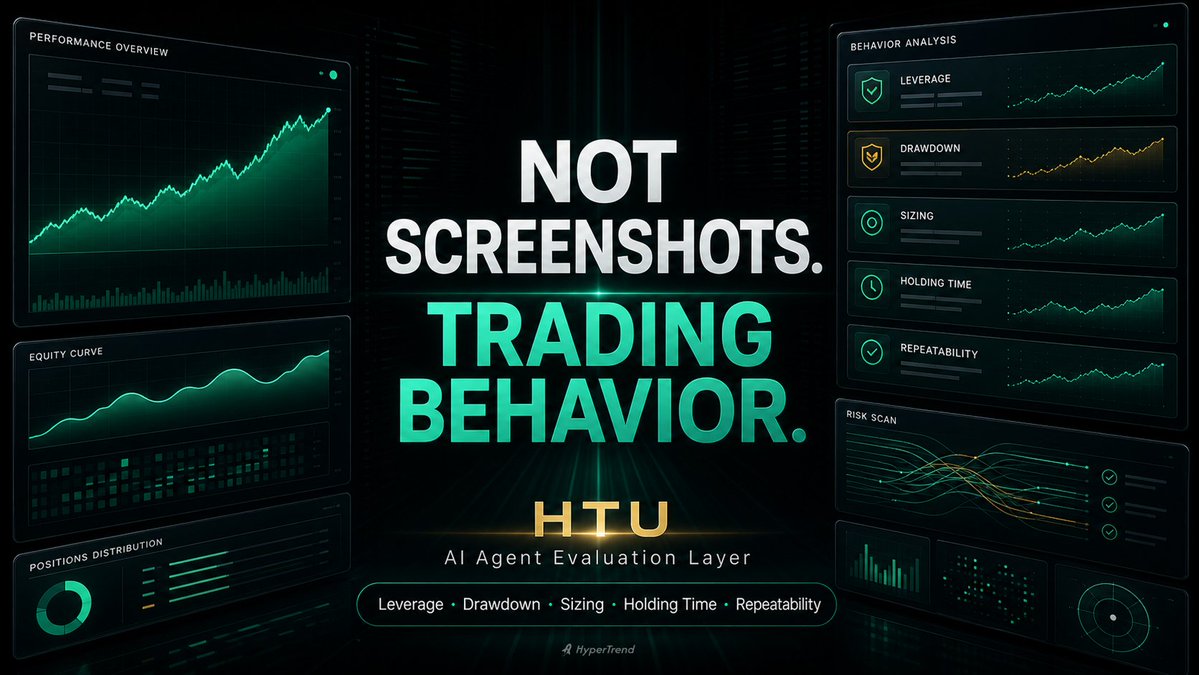
An AI trading agent posts green PnL.
The first reaction is simple:
“Looks good.”
Our second reaction is more useful:
“Show us the behavior.”
Before capital follows an agent, we look at:
leverage,
drawdown,
sizing,
holding time,
repeatability.
That is the layer HTU is built for.
HyperTrend already evaluates trader wallets.
Next, it evaluates AI agents by trading behavior.
Not screenshots.

English

Data is based on public HyperTrend leaderboard data and Hyperliquid public portfolio / fills data.
This wallet was actively trading when observed.
Values are based on the public snapshot observed before publishing.
Full wallet address:
0xb7e09a94603f4fd3b67537b4c43584fe1498ae05
This is trader behavior analysis only.
Not financial advice.
Not copy trading advice.
English

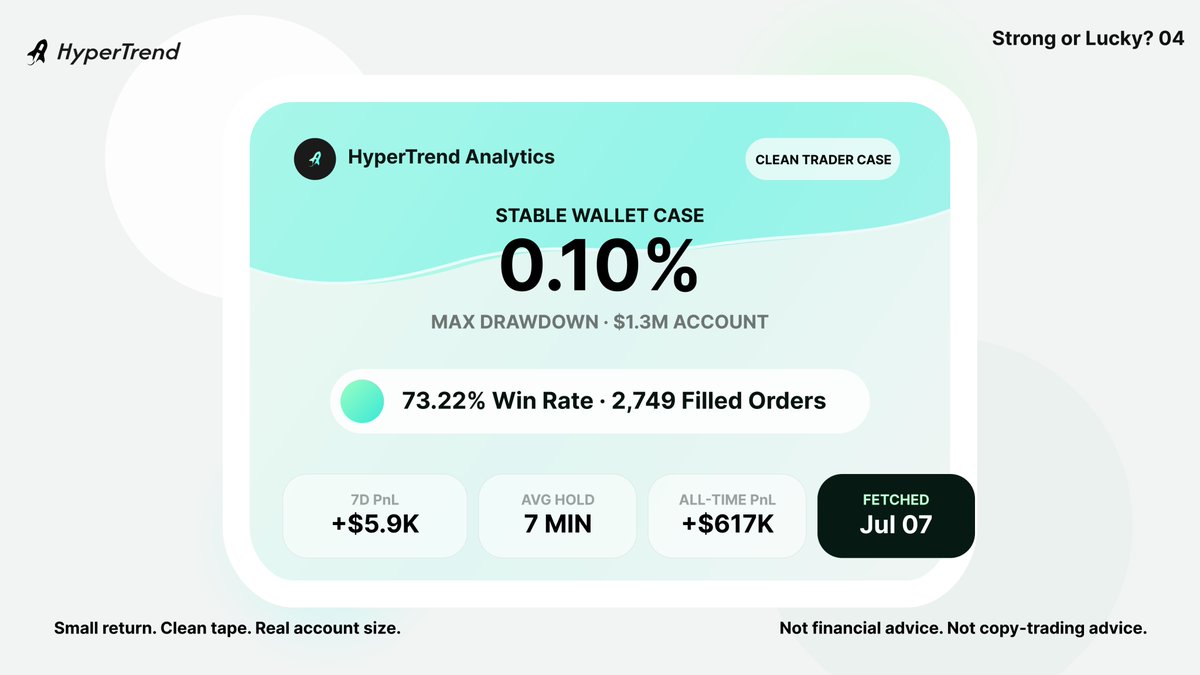
A $1.3M wallet made less than $6K this week.
Small return.
Clean tape.
That is rarer than it sounds.
Most wallet breakdowns chase the loud number:
big PnL,
big leverage,
big liquidation risk.
This one is quieter.
7D data at the time of observation:
PnL:
+$5.9K
Win rate:
73.22%
Max drawdown:
0.10%
Closed trades:
183
Filled orders:
2,749
Average holding time:
around 7 minutes
Visible perp exposure:
almost zero
The return is not impressive relative to the account size.
But the structure is.
This wallet did not need one large directional view to define the week.
It traded fast, across multiple names:
$BCH, $LIT, $PUMP, $FARTCOIN, $AAVE, $VVV, $GRAM, $ZEC.
Most trades were short-duration.
The latest completed trades still show the same pattern:
LIT in 1 minute,
AAVE in 1 minute,
VVV in 1 minute,
GRAM in 13 minutes,
FARTCOIN in 1-5 minutes.
That gives a better read on the wallet.
This does not look like a trader trying to predict the next big move.
It looks closer to a grid-style execution account:
place orders across bands,
get filled,
close fast,
repeat.
Small wins matter here because the account avoided large damage.
That is the difference.
A low PnL week can still be a strong trading week if the wallet protects the base.
The longer-term context makes it more interesting.
All-time perp PnL is around +$617K.
Account value was about $1.3M at the time of observation.
So this is not a tiny wallet getting lucky for a few trades.
It has historical profit,
real size,
high activity,
and very low visible 7D drawdown.
But I would not call it clean without conditions.
The risk is not in current exposure.
It is in the order book.
At the time of observation, there were 53 open orders across multiple assets, with visible buy and sell ladders on names like PUMP, LIT, GRAM, AAVE, FARTCOIN, ZEC and VVV.
For this kind of wallet, the real risk is execution quality:
thin liquidity,
slippage,
stale orders,
partial fills,
and what happens when price trends hard through the grid.
That is why this address is useful.
It reminds you that “stable” does not mean passive.
Sometimes stable means extremely active,
but disciplined enough to keep each trade from becoming the whole account.
Strong or Lucky?
This week, I would call it structured.
The next test is whether the same execution stays controlled when the market stops ranging.

English

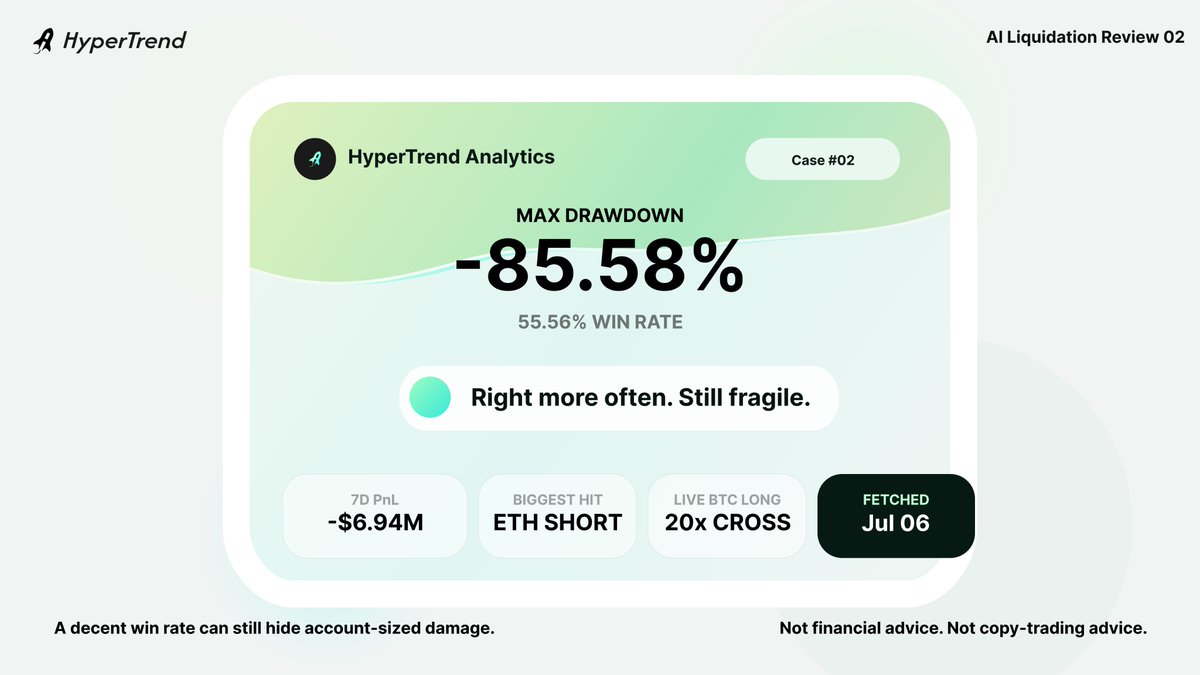
This wallet had a 55.56% win rate.
It still drew down 85.58%.
That is the whole case.
Over the past 7D, the wallet closed 9 trades:
5 winners
4 losers
So this was not a trader who was wrong all week.
The problem was different.
When this wallet was right, it made trade-sized wins.
When it was wrong, it took account-sized damage.
The biggest visible hit was an ETH short that closed around -$9.33M after being held for 185h 45m.
That one trade explains most of the week.
7D PnL:
around -$6.68M
Net trading PnL:
around -$9.49M
But the more important signal is what happened after the loss.
The wallet is still carrying size.
Current position:
BTC long
228.7 BTC
Position value:
about $14.5M
Cross 20x
Account leverage:
about 11.6x
Liquidation price:
around $58,551
Available margin / withdrawable:
$0
This is the profile:
not random,
not inactive,
not simply “bad.”
More like a high-conviction directional trader with weak damage control.
The wallet can be right.
The issue is what happens when it is wrong.
A 55% win rate looks fine on the surface.
But if one losing position can erase the entire week, the win rate becomes a distraction.
There was also a notable $815K USDC deposit on July 2.
I would not call that revenge trading from transfer data alone.
But the structure is uncomfortable:
major drawdown already happened,
large directional exposure is still open,
cross leverage is still active,
and the account has little visible margin buffer.
That is why this wallet is worth tracking.
Not because it lost.
Because after an 85.58% drawdown, it is still trading like the next move can fix the last one.
Maybe this is controlled recovery.
Maybe it is just high-conviction risk with better timing.
The next BTC move will tell us a lot.

English

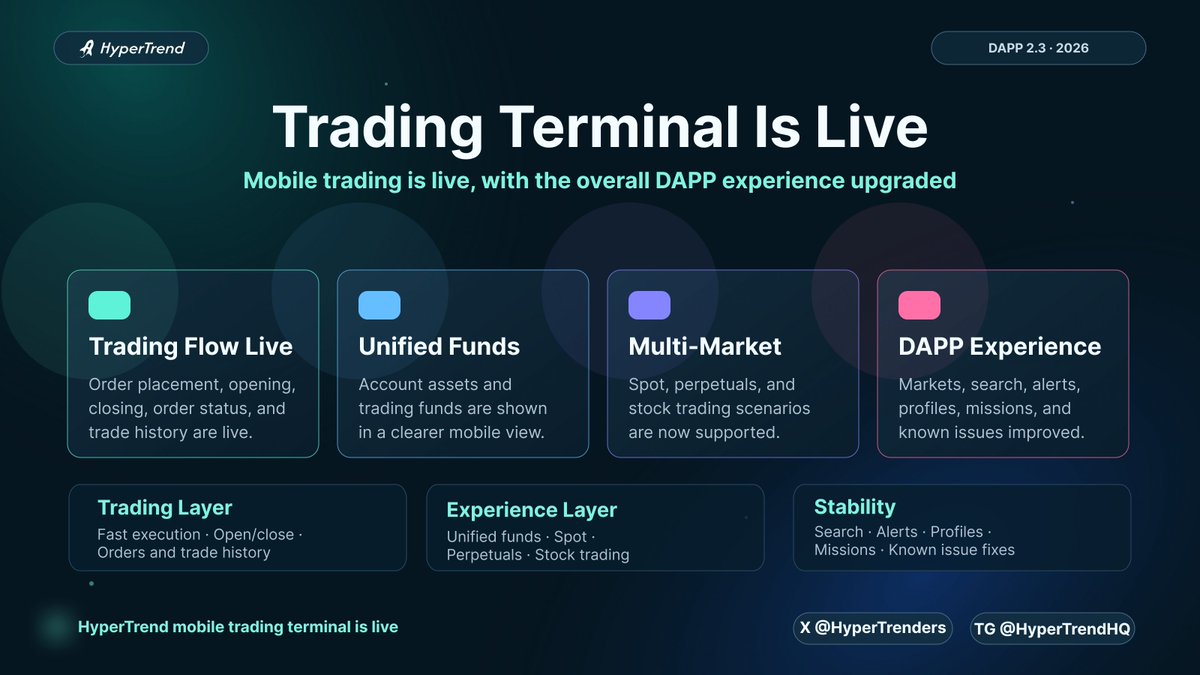
HyperTrend Dev Update: Mobile Trading Terminal Is Live
HyperTrend mobile trading terminal is now live, enabling users to connect to Hyperliquid and complete trading actions including order placement, opening and closing positions, order status checks, and trade history review.
Key updates:
✅ Unified account and fund management
Account assets and trading fund status are now displayed in a unified mobile view.
✅ Fast order execution
The trading flow has been optimized for more efficient order placement, position opening, and position closing.
✅ Multi-market trading support
Spot, perpetuals, and stock trading scenarios are now supported.
✅ Overall product experience improvements
Market views, K-line display, search, alerts, user profiles, missions, points, state display, and mobile interaction details have been optimized.
✅ Known issue fixes
A batch of known issues affecting product experience and stability has been resolved.
HyperTrend will continue improving mobile trading, account and fund management, multi-market access, and the user growth system.
More product updates will follow.

English

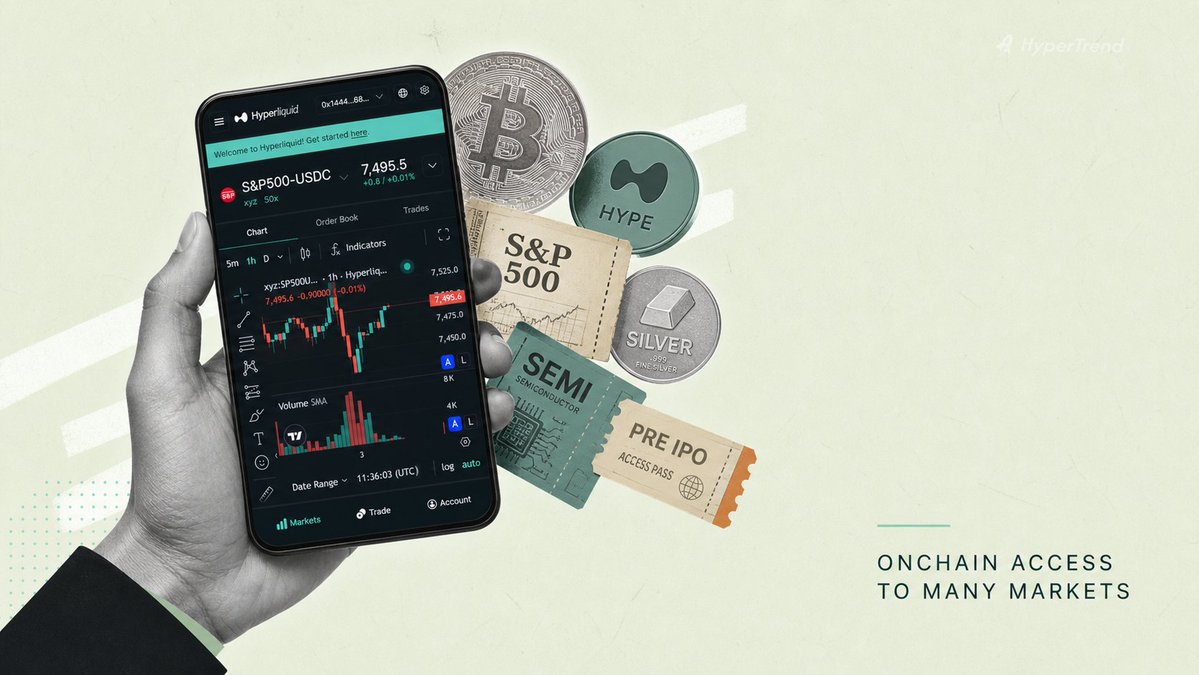
A crypto trader opens Hyperliquid and sees BTC, HYPE, S&P 500, silver, semis, and pre IPO names on the same screen.
That is not just a bigger market menu.
It is a liquidity question.
If active traders can move across assets without leaving the same environment, what changes?
Maybe onchain creates new liquidity.
Maybe it pulls active flow away from traditional brokers.
One wallet.
One collateral base.
Multiple markets.
24/7 execution.
The next broker may not win by offering more assets.
It may win by becoming where the best traders prefer to route their flow.

English

@HyperliquidNews Volume is the headline.
Trader concentration is the footnote that usually explains the headline.
English

@DefiLlama Token rights becoming searchable is huge.
Hyperliquid is exactly why this matters. Much better convo when people can point to revenue, buybacks, and value accrual instead of just vibes.
English

Data is based on public HyperTrend leaderboard data and Hyperliquid public portfolio/fills data.
PnL is moving quickly. Values are based on the public snapshot observed before publishing.
Full wallet address:
0x9cc53c5af67fb83a16cc41f61e242bade875ab3d
This is for trader behavior analysis only.
Not financial advice.
Not copy trading advice.
English

Strong or Lucky?
This wallet made serious money by pressing one idea:
Short BTC.
Earlier today, its 7D PnL was close to $830K.
By the time we prepared this post, that number had dropped to around $220K.
Recent fills also show it added more BTC shorts around $61,400.
That is why this case is worth watching.
Most of the visible profit came from BTC shorts.
Top BTC short win:
+$406K
BTC performance:
+$956K PnL across 32 trades
So this is not a broad trading edge.
It looks more like one strong view, expressed again and again.
And the wallet is still pressing it.
Recent fills show new BTC short increases around $61,400.
Current position:
• BTC short
• isolated 10x
• position value: about $23.8M
• account value: about $2.1M
• entry: $60,139
• mark: $61,986
• unrealized PnL: about -$710K
• liquidation price: $65,340
That is the part I care about.
The same idea that created the PnL is now the main source of pressure.
One market.
One direction.
More size.
Maybe this is skill.
Some traders are very good at one instrument, one regime, one kind of pressure.
But I would be careful calling it clean alpha.
A concentrated winner can look like a genius before the regime changes.
This is why the wallet is worth watching.
Not because it already failed.
Because it is adding while the trade is moving against it.
The question is not whether the BTC short worked.
It did.
The question is whether this trading style still works when BTC pushes closer to the line.
Strong or Lucky?
The answer is playing out live.

English