Simon Elmer@SimonElmer2022
In his speech to the Conservative Party in April 1968, Enoch Powell, the MP for Wolverhampton South West and Shadow Secretary of State for Defence, made this prediction about the effects on the British working class of allowing 50,000 immigrants, largely from the Commonweath, to settle every year in Britain:
‘For reasons which they could not comprehend, and in pursuance of a decision by default on which they were never consulted, they found themselves made strangers in their own country. They found their wives unable to obtain hospital beds in childbirth, their children unable to obtain school places, their homes and neighbourhoods changed beyond recognition, their plans and prospects for the future defeated; at work they found that employers hesitated to apply to the immigrant worker the standards of discipline and competence required of the native-born worker; they began to hear, as time went by, more and more voices which told them that they were now the unwanted.’
Powell delivered his speech as part of his argument against Parliament passing the Race Relations Act 1968, which made it illegal to refuse housing, employment or public services to someone on the grounds of their race, ethnicity or national origins.
Today, such discrimination has become legalised practice in the UK on condition that that ‘someone’ is White and British, and therefore not protected under the Equality Act 2010. Muslim landlords and employers openly and with impunity advertise accommodation and jobs exclusively to Muslim candidates; and under the justification of meeting DEI quotas that have never been written into UK legislation, White British candidates are openly banned from applying for jobs in both the public and private sectors.
Subsequently televised and published in the UK press, Powell’s assessment was agreed with by 75% of the British public in an opinion poll conducted later that month. Despite this, Powell was sacked as Shadow Secretary for Defence for a speech that, in the words of Edward Heath, the then Leader of the Conservative Party, was ‘inflammatory and liable to damage race relations’, and subsequently ostracised from UK politics.
This is the exactly the same reason the police forces and councils of Rotherham, Rochdale, Telford, Oldham, Bradford, Oxford and the scores of other English towns, boroughs and cities gave for covering up the grooming, rape, torture and trafficking of upwards of a hundred thousand English girls by Muslim rape gangs that we know now had already started in Powell’s time. It is the same reason police continue to give for refusing to identify the race, religion or nationality of a rapist or other criminal in the UK when he is not White, Christian and British.
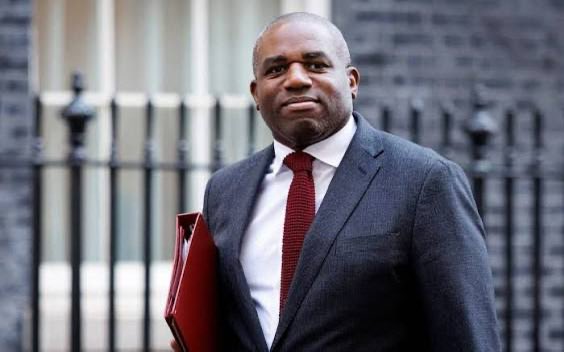
But it’s an indication of how far back the policy of replacement immigration goes that, in 2016, the Chairman of the Equality and Human Rights Commission, Trevor Phillips, himself the children of Guyanese immigrants but — unlike the UK’s current DEI Foreign Secretary and his fellow Guyanese, David Lammy — not someone who built his career on anti-White racism, wrote of Powell’s fate in the Telegraph:
‘Everyone in British public life learnt the lesson: adopt any strategy possible to avoid saying anything about race, ethnicity (and latterly religion and belief) that is not anodyne and platitudinous.’
I would guess that, even after the ensuing half a century of indoctrination and censorship, not 75% of the British public anymore but at least that percentage of the White working class would recognise themselves today in Powell’s description of the British as ‘strangers in their own country’. And they are right.
Powell was worried about 50,000 immigrants coming to Britain every year. Following the signing of the Maastricht Treaty in 1992, which granted all EU citizens the right to live and work in the UK, net migration to Britain was 51,000 immigrants per year, mostly from the European Union.
However, after the election of the New Labour Government of Tony Blair in 1997, net immigration to Britain more than trebled to an average of 166,000 per year. Then, after the expansion of the European Union to Eastern Europe in 2004, net immigration to Britain increased again to an average of 255,000 per year.
Following the election of the Conservative/Liberal Democrat coalition government in 2010, net migration to Britain dropped marginally to 206,000 per year, still four times what Powell was concerned about; but by 2014 it had risen again to over 300,000, and until 2019 averaged 275,000 immigrants per year.
After initially dropping in 2020 under lockdown restrictions on travel to Britain, net immigration since 2021 rose in the four years to 2025 to an average of 662,000 per year, considerably more than double the most it has ever been previously.
Just as importantly as these vast numbers, as Brexit came into effect in 2020 and European workers began to emigrate, the immigrants were now overwhelmingly from South Asia and sub-Saharan Africa.
Between 2015 and 2024, 9.081 million immigrants entered Britain. 5.317 million of these came from outside the European Union, 3.887 million since Brexit. Over this decade, net migration to Britain from non-European countries was 3.747 million.
In June 2021, just 6 months into this period of increased immigration, 9.6 million foreign-born nationals were living in Britain. That’s more than the population of London and 14.5% of the total population of the United Kingdom. Of these 9.6 million, 896,000 were Indian, 456,000 Pakistanis, 312,000 Nigerians, 223,000 Bangladeshis, 131,000 Sri Lankans, 130,000 Ghanaians and 122,000 Zimbabweans. That’s a total of 2.27 million immigrants from these 7 countries living in Britain in June 2021.
But that was just the start. Between January 2021 and December 2024, a further 826,000 Indians, 362,000 Nigerians, 242,000 Pakistanis, 86,000 Bangladeshis, 80,000 Zimbabweans, 71,000 Ghanaians, and over 40,000 Sri Lankans entered Britain as immigrants. That’s over 1.7 million immigrants from these seven countries, or two-thirds the population of Birmingham, Britain’s second-largest city, in just four years.
In 2026, as a result of these disastrous immigration policies, there are nearly 13 million foreign-born nationals living in Britain, larger than the population of Belgium, making up 19% of the population of the UK, and overwhelmingly composed of immigrants from outside Europe.
In addition, there are millions of more second generation immigrants who, as we are seeing demonstrated every day, in every rape, every mugging, every theft, every murder, every demonstration, every council election, have no allegiance to Britain, who hate the British people, and are intent on turning our homeland into a mirror of the third-world slums from which they came.
These figures show that Enoch Powell was, without a shadow of doubt, correct in his fears, which is why the political establishment destroyed his career and, to this day, his name is a byword among liberals and the Left for racism. As history has proven, however, he was a prophet of the times in which we live, and which he warned us were coming 58 years ago. Today, the rivers of blood are flowing, but it is our blood, that of the British people, that is being spilled by the lusts and greed and violence of foreign invaders. It is time — it is 58 years past the time — that we start fighting back.