Graham K

45.5K posts

Graham K banner
Graham K

Graham K

@GrahamLKeegan

Interested in truth, reason and trying to lead a half decent life.

England, United Kingdom Katılım Mart 2016
5.8K Takip Edilen7.1K Takipçiler
Sabitlenmiş Tweet
Graham K
Graham K@GrahamLKeegan·
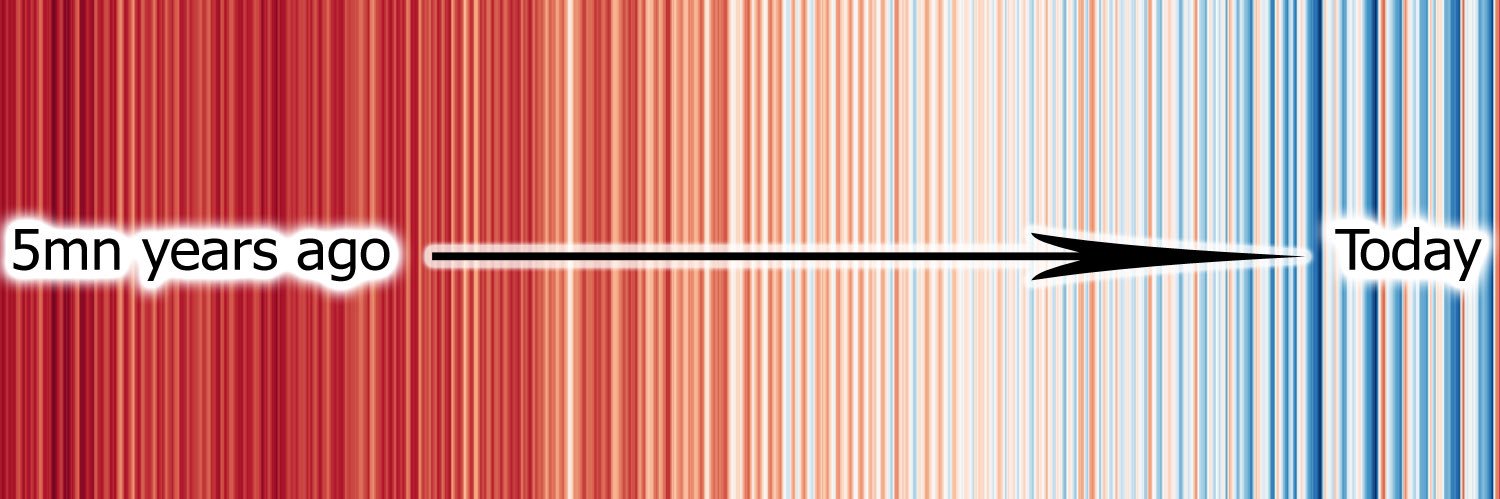
Climate… It has warmed since the end of the Little Ice Age, thank goodness. This warming will have been caused in part naturally and in part by man. How much has it warmed and what is man’s contribution isn’t known with any degree of accuracy. Burning hydrocarbons generates CO2 and this causes warming. That’s what the physics shows. All agree that doubling CO2 causes a temperature increase of ~1C. But here is the disagreement… some climate scientists hypothesise that there is an additional climate sensitivity factor caused by the extra CO2. This sensitivity factor isn’t agreed upon and hasn’t been observed. Is warming harmful? Some will argue that it is, others argue that civilisation and life thrives in the warmth. Certainly, the planet is unusually cold today, compared to the average across the Phanerozoic. The Nobel Prize winning climate economist, William Nordhaus, forecasts that the world will be some 430% more wealthy by 2100 despite climate change impacts - civilisation is thriving. So, we have a poor understanding of climate with little data. And this field of study has been dreadfully distorted by money and politics, making it difficult to get to the facts. Consequently, I think it profoundly wrong to upend our industrial civilisation in pursuit of net zero.

Graham K tweet media
English
9
8
26
1.6K
Graham K
Graham K@GrahamLKeegan·
@RonLyleWilliams Yes. I’m sure that is right. And, there is little mention in the media about the 0.5C drop in temperature over the last 12 months or so (UAH data). If it was an increase the alarmists would be screaming about it.
English
0
0
1
5
Ron Williams
Ron Williams@RonLyleWilliams·
@GrahamLKeegan That ~1 C rise since 1850 is mostly accounted for with warmer temps in the northern hemisphere, in winter & at night. Not to mention UHIE bias in historical temp measurement. So on balance, it is a little less cold in the NH, with natural warming since LIA driving the average up.
English
1
0
1
9
Graham K
Graham K@GrahamLKeegan·
Increase of approximately 1C in 175 years. So what! It increases by more than that every day between breakfast and lunch.
Arjan de Groot@adegraat

@GrahamLKeegan There are more factors that influence temperature. Fact is that temperature rizes in unnatural tempo, against natural determants (like solar power), conform our Co2 usage. Logic if we Pump back the Co2 in 200yrs that nature got out in millions of years.

English
2
6
15
409
Graham K
Graham K@GrahamLKeegan·
@SmartGrowthUK I’m not your researcher. Please go and do your own study.
English
0
0
0
10
Graham K
Graham K@GrahamLKeegan·
The Sun and planet cycles drive the temperature. CO2 is an effect not a cause. It lags temperature change by around 800 years. We have 800,000 years of ice core data that proves this.
Massimo@Rainmaker1973

Scientists confirm Earth is slowly heading toward Its next Ice Age. A new study from Cardiff University has unraveled the mystery behind Earth’s 100,000-year glaciation cycles by examining deep-sea fossil records. The research reveals that the onset of an ice age is primarily triggered by changes in the planet’s axial tilt (obliquity). While the end of a glacial period requires a precise combination of this tilt and Earth’s orbital wobble (precession), the shift into a new cooling phase follows a remarkably predictable natural rhythm. According to the findings, Earth is already on a gradual trajectory toward its next major ice age, which is expected to begin in roughly 11,000 years — if left undisturbed by human influence. However, this ancient orbital clock now faces an unprecedented disruption: anthropogenic climate change. Greenhouse gas emissions have driven global temperatures far beyond historical norms, potentially overriding or delaying the natural cooling signal for thousands of years, or even longer. The study highlights the delicate interplay between long-term orbital mechanics and modern human activity. Understanding these deep-time climate rhythms is essential for better predicting future climate patterns and appreciating the profound scale at which human emissions are reshaping Earth’s geological destiny. [Barker, S., et al. (2025). Distinct roles for precession, obliquity, and eccentricity in Pleistocene 100-kyr glacial cycles. Science, 387(eadp3491). DOI: 10.1126/science.adp3491]

English
13
44
93
2K
Graham K
Graham K@GrahamLKeegan·
This lot have been captured by the Islamists. A nasty mix of Jew hate and Marxism.
Graham K tweet media
English
1
1
5
40
Graham K
Graham K@GrahamLKeegan·
CO2 does cause warming but it declines rapidly with increased concentration. Please study the Schwarzschild Equation.
Geoffrey Kitching@geoff19542

@GrahamLKeegan If higher global temperatures cause more CO2, why does that exclude the fact that more CO2 causes higher temperatures? The two are not mutually exclusive. It's called positive feedback.

English
1
0
1
96
Graham K
Graham K@GrahamLKeegan·
@SmartGrowthUK Have a look at the NASA CERES data which shows albedo decline that explains all the warming since 1980.
English
1
0
0
20
SmartGrowthUK
SmartGrowthUK@SmartGrowthUK·
@GrahamLKeegan Odd then that, despite a very slight decline in solar energy in recent decades, global temperatures are shooting up. CO2 has measurably been a cause of temperature for hundreds of millions of years. Please stop grasping at straws and face reality.
English
2
0
1
20
Graham K
Graham K@GrahamLKeegan·
If the 4.5 billion years of the Earth’s existence was converted into a 24 hr day, the Eemian was approx 2 seconds ago. The U.K. had a tropical savanna climate with Hippopotamus in the Thames.
Charles Duncan@Charles71704451

@GrahamLKeegan And here's a graph that shows it.

English
0
0
4
101