
Sabitlenmiş Tweet
💜Greenley
19K posts

💜Greenley
@GreenleyMaskVax
Covid Aware Doomer. Mom. Nurse. Teen wrangler. Community and cooperation for end of fucking days. SARS2 & Many Resp🦠AIRBORNE 327ppm greenleymaskvax@🦋
Tampa, FL Katılım Temmuz 2021
499 Takip Edilen1.2K Takipçiler


NOW - Trump says it's good to have 500,000 foreign Chinese students in the U.S. and for China to purchase U.S. farmland; otherwise, colleges and farm prices would collapse: "I frankly think that it's good that people come from other countries and they learn our culture."
English
💜Greenley retweetledi

@adamscochran - I'm your huckleberry ;) .
Your statements are incorrect for more than 2 reasons - my apologies.
@RVAwonk - I do aerosols, masking, and clean air advocacy, so just going to slide in, if that's ok.
🧵 of clarification . as always with sources.
GIF
Adam Cochran (adamscochran.eth)@adamscochran
This is the correct protocol for 2 reasons: 1) N95’s are optimized to filter *incoming* air. Surgical masks are optimized to prevent contaminating the environment when exhaling. 2) The hantavirus 80–120 nm in body diameter. By comparison, COVID was 60-80 nm in body diameter (excluding spike proteins) While that may not seem dramatic it means a very large difference in actual mass of the pathogen. The larger and heavier pathogen size means it needs droplet vapor to carry, not just air. So the person you think is infected, wearing a surgical mask is effective as it traps droplets on exhalation. The staff wear n95s. The patients don’t. If someone is already infected there would be no statistical difference between them wearing an n95 and a surgical mask, so you do not need to waste the better equipment. In a quarantine facility the staff change over PPE and sterilize equipment between patient rooms, so there is zero risk of cross patient exposure. So only the staff need an n95.
English
💜Greenley retweetledi

What is this headline, @DailyMail?? For one, her mask is right there in her hand. Secondly, why do you care?
Trash “stories” like this just serve to further ostracize those of us who are trying to protect our health. Do better.

English
💜Greenley retweetledi
@WittyVitale This is exactly it! We cannot safely process trauma when the source is literally all around us. Another thing I've noticed is even people who have done a lot of trauma work and worked through past traumas are still knocked flat by this one. The uncertainty, the years. 😢
English
💜Greenley retweetledi

as opposed to neverending trauma. I've learned how to adapt and be innovative with my techniques since I've been doing this exclusively for 3 years, but man I wish there were more resources. 2/2
English
💜Greenley retweetledi
I think one of the hardest things about being a Covid-Conscious therapist is the fact that all Covid-Conscious people are actively being traumatized. There's no post- anything, this is happening now. So many modalities I've studied throughout my life focus on past trauma 1/2
English
💜Greenley retweetledi

@WittyVitale @retweetingMarie You've described the precise reason why I've not asked for therapy in this situation. I know what is wrong. The problem is the therapy can't stop this reality so it can't resolve anything. Fundamentally stuck in this purgatory which is a form of isolation torture.
English
💜Greenley retweetledi

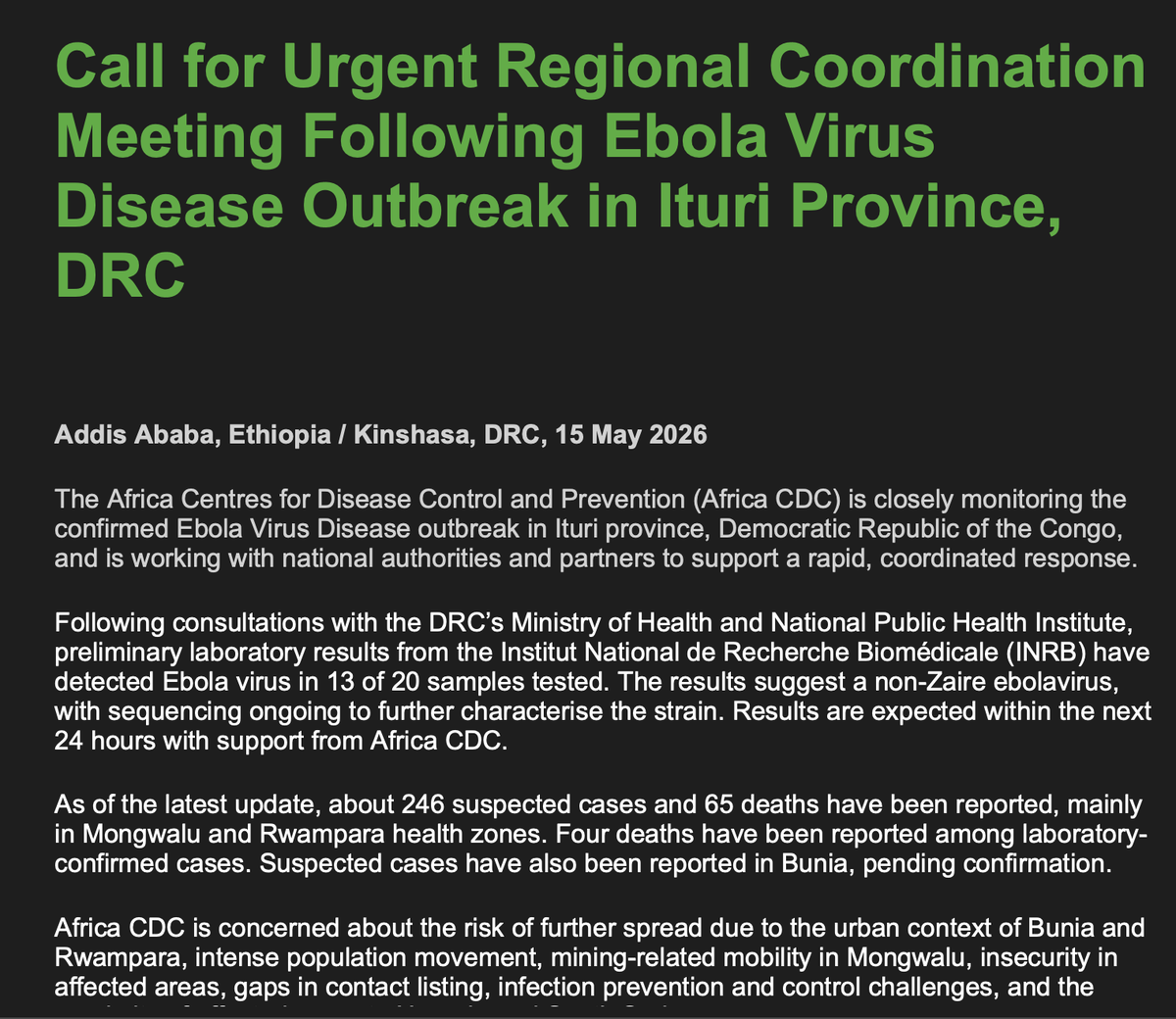
🚨 The @AfricaCDC statement on the new #Ebola outbreak in #DRC is deeply concerning.
🔬 This is a non-Zaire ebolavirus outbreak
🧪 13 of 20 samples tested positive
⚠️ 246 suspected cases reported
🕊️ 65 deaths, including 4 laboratory workers
This highlights the urgent need for enhanced surveillance, rapid diagnostics, infection prevention and control, and protection of frontline healthcare and laboratory personnel.
English
💜Greenley retweetledi

This is an excellent article by Dr. @PathogenScribe 🔥
It's 20-min read, so it may feel long. However, I assure you will appreciate the precision and care in wording THAAAAATTT MUCH‼️. #Hantavirüs
infectiousdose.com/post/hantaviru…
English
@tryna_do_rite @IanCopeland5 I’ve had a hysterectomy so I may no longer be hysterical.
English
@IanCopeland5 We are still in the current ongoing AIRBORNE SARS2 pandemic because leadership decided human lives weren't as important as the economy. Don't pretend that Hantavirus isn't a danger.
English

Are we over the mass Hantavirus hysteria yet?
When are we moving to the next conspiracy fueled by ignorance and rethoric?
English

@IanCopeland5 I’m not over it yet. I’m going to wait a few more weeks.
English
@ghhughes @IanCopeland5 We are still in the midst of the Covid pandemic, so trying to prevent yet another deadly pathogen from spreading doesn't seem hysterical to me.
English
💜Greenley retweetledi

People need to stop using the Waymo serve and let that company go bankrupt. Those cars are death traps and are being used for surveillance no different from Flock cameras.
philip lewis@Phil_Lewis_
Dozens of empty Waymos invaded an Atlanta neighborhood and circled a cul-de-sac for hours with no passengers wsbtv.com/news/local/atl…
English

On top of getting to talk to really lovely people at my part time job, I get to interact with people’s fur babies! And my cousin stopped to chat with me!! It was a pretty great day & not once did I feel as if wearing a mask hindered my ability to connect with other beings if they

English

Everyone who has ever had Covid is permanently damaged.
‘Long ‘COVID’ affects us all.

Harry Spoelstra@HarrySpoelstra
Endothelial dysfunction and metabolic biomarkers in post-COVID-19 syndrome 🚨A nightmare study for many! FOR EVERYBODY: 9 months after your COVID-19, your blood vessels are STILL damaged, with probably biomarkers to prove it! 1. Study design: German prospective cohort (n=262 adults) compared blood biomarkers ~37 weeks post-SARS-CoV-2 infection (PCS patients + recovered) versus uninfected controls. 2. Endothelial dysfunction: - Soluble thrombomodulin (sTM) and lactate dehydrogenase (LDH), two established markers of endothelial (blood-vessel) damage, were significantly elevated in the combined infected group (UOC PCS + LIFE Cov+) versus never-infected controls. - So, previously infected individuals had significantly higher soluble thrombomodulin (TM) and lactate dehydrogenase (LDH), independent of PCS diagnosis or fatigue severity. - Critically, there were no significant differences between the PCS group and the LIFE Cov+ group for these markers. 3. Metabolic disruption: - Clear alterations in arginine biosynthesis and taurine/hypotaurine pathways, indicating impaired nitric-oxide (NO) metabolism with reduced L-arginine and taurine levels. →In plain terms: the vascular damage signal was just as strong in the symptom-free recovered people as in those still suffering from fatigue and other PCS complaints. The same held for the metabolic disruptions (impaired arginine biosynthesis and taurine/hypotaurine pathways linked to nitric-oxide production). 4. Fatigue-specific signal: - High-fatigue PCS patients (top MFI-20 quartile) showed elevated linoleic acid (LA) plus monounsaturated fatty acids oleic (OA) and palmitoleic (PA). →The fatty-acid signature specific to high-fatigue PCS adds a potential severity marker. 5. Notes: - Changes persisted already up to 9 months after infection. - PCS remains symptom-based, but these markers offer objective, measurable signals of underlying vascular and metabolic damage! -The discussion and results treat the observed endothelial and metabolic changes as consequences of a single infection and do not speculate on additive damage from subsequent exposures. - Limitations well noted. ‼️So, COVID-19 leaves detectable, objective blood-vessel and metabolic damage in the bloodstream nearly a year later, even if you feel completely fine and never had Long COVID symptoms. Specific fatty-acid spikes flag severe post-COVID fatigue. The “it’s all in your head” narrative for many post-covid people is directly contradicted by these biomarkers! These findings, solidly backed by prior 2021–2025 evidence, prove that COVID-19 inflicts measurable, persistent endothelial and nitric-oxide metabolic damage up to nearly a year later, even in fully symptom-free survivors, thereby supporting the implementation of routine biomarker screening, but even more importantly: #AvoidSars2 #AvoidReinfections. YOU ARE NOW A CV RISK PATIENT! nature.com/articles/s4159…
English
💜Greenley retweetledi
@StructSkeptic Thank you for the explanation of Thucydides Trap. It gives me shivers knowing we’re the dying empire.
English
💜Greenley retweetledi

#hantavirus
[Interesting timeline:]
➡️⚠️ Passenger says hantavirus outbreak on cruise ship 'could have been prevented'
- Ruhi Cenet, a Turkish national, was on board MV Hondius for 24 days from the start of April.
- The deceased man was travelling with his wife, who during that time, was being comforted - in close proximity - by other passengers.
- A few days further into the journey to St Helena, she then became symptomatic - of what we now know as Hantavirus - and later died from the disease too.
- “All of the other passengers were giving her hugs and everyone was talking to her.
- ➡️ “At every meal, someone else was sitting beside her and we had open buffets, we had group activities, lecture sessions, we had meetings in lounge area.
- “On a ship like Hondius, there isn't much to do other than socialising.”
- ⚠️ By that time, she too had started to show symptoms of Hantavirus.
- ⚠️“She was struggling to stand, ⚠️ she was looking really ill. “We thought that she was just having a very deep grief, but in fact she had the virus.“
- From St Helena, Ruhi and the rest of the group -including the infected Dutch woman - travelled together on a flight to Johannesburg, where the woman later died.
- ⚠️ “I saw her on a wheelchair and that was unusual because she did not have any problems walking.
- ➡️ From St Helena, Ruhi and the rest of the group -including the infected Dutch woman - travelled together on a flight to Johannesburg, where the woman later died. [a 5 hour flight]
- “I feel very unhappy with the ship management. I wish they would have thought about it being a potential contagious disease.”
uk.news.yahoo.com/passenger-says…
English