Gina Relic
14 posts



In China’s Gansu province, the village of Liqian has long puzzled historians. Locals with green eyes and fair hair are believed to be descendants of lost Roman soldiers from 2,000 years ago. DNA shows traces of European ancestry, keeping this East-meets-West mystery alive.
For decades, Liqian has occupied a strange crossroads between legend and scholarship. The theory traces back to the first century BCE, when Roman forces under Crassus were defeated by the Parthians at the Battle of Carrhae in 53 BCE. Ancient accounts suggest some captured Roman soldiers were relocated eastward as mercenaries or border guards. From there, a long and indirect journey toward Central Asia and eventually the fringes of Han China is not as impossible as it sounds.
The Han dynasty maintained extensive contact across the Silk Road, exchanging goods, envoys, and sometimes soldiers with western regions. Chinese historical texts describe encounters with foreign fighters who used unfamiliar shield formations resembling Roman testudo tactics. This detail, while debated, helped fuel the idea that a small group of Roman prisoners or descendants may have been absorbed into frontier settlements like Liqian.
Genetic studies conducted in the late twentieth and early twenty first centuries revealed traces of western Eurasian ancestry among some villagers, though not enough to conclusively prove Roman lineage. Still, Liqian stands as a reminder that the ancient world was far more interconnected than we often imagine. Empires did not exist in isolation. People moved, adapted, and blended across thousands of miles, sometimes leaving behind mysteries that history never fully resolves.
Liqian later embraced the legend so strongly that the town built Roman style statues and tourist sites, turning an unresolved historical hypothesis into a living piece of cultural identity.
© Reddit
#archaeohistories

English

The Tel Dan Stele, an archaeological find with the first mention of the House of David. It’s from 900 BCE. We go back another 1,100 years or so.
To the modern nation of Israel in 2026, another station on the route. We’ll still be here in another 4,000 years 😎
Time passes, empires fall, but Israel endures. Both youthful and mature at the same time.

English


@histories_arch Awwww who cares if people say CE or AD - sheesh we can all understand multiple terms!
English

A local hiker in Norway spotted an old sandal peeking out of the snow in August 2019. He snapped a few photographs of the find and shared its coordinates with Secrets of the Ice, a glacial archaeology program that has previously unearthed 1300 year-old wooden skis, a 1700 year-old tunic and thousands of other artifacts preserved in Norway’s glaciers and ice patches. The hiker’s message arrived just in time for the team to safely recover the sandal. Racing to beat a snowstorm scheduled to blanket the area, the researchers spent a full day excavating the shoe and other nearby objects, The very next day, a fresh coat of snow covered the site.
Radiocarbon dating placed the shoe’s creation around 300 CE. The size nine rawhide sandal is a variant of the Roman carbatina style, which was popular across Europe in the same general time period. To combat the cold, the sandal’s owner likely wore it with wool wrappings or socks made out of fabric or animal skin. And the traveler probably didn’t lose the shoe, instead, he may have thrown it away as rubbish after it became worn out.
Roman-inspired sandal is one of several centuries-old shoes found near the Lendbreen pass in Norway’s Jotunheim Mountains. Objects uncovered from the melting ice testify to the pass’ significance as a travel route between Roman Iron Age (around 300 CE) and the Middle Ages. Like its better-known neighbor, the Horse Ice Patch was a key passage for ancient travelers. Its trails linked inland Norway to the coast.
© Secrets of the Ice
#archaeohistories

English
In late 19th Century, the world was buzzing with new ideas about evolution, intelligence, and the nature of humanity. And for women, those ideas were often wielded as weapons. In 1871, Charles Darwin—brilliant, groundbreaking, and deeply influential—published a theory arguing that women were biologically destined to be intellectually inferior to men. He framed it as science, as fact, as the natural order. And for a moment, much of the world nodded along.
But four years later, a woman who had spent her entire life refusing to accept the limits imposed on her picked up her pen and dismantled Darwin’s claims with such clarity, such force, and such elegance that his argument never truly recovered.
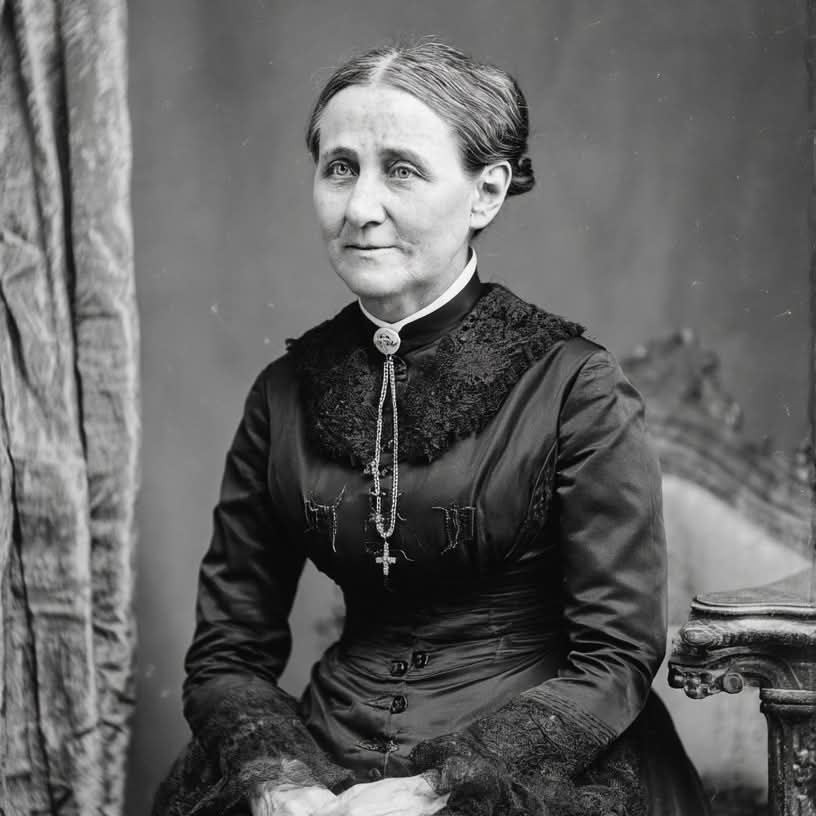
Antoinette Brown Blackwell was not new to impossible battles. By the time she confronted Darwin, she had already achieved what most considered unthinkable: in 1853, at only twenty-eight, she became the first woman ordained as a minister in the United States. She stood before a congregation in South Butler, New York, and did the one thing generations of men insisted she never could. She claimed her voice—loudly, publicly, unapologetically.
Her ordination wasn’t simply symbolic; it was revolutionary. Churches did not ordain women. Scripture was interpreted to exclude them. Theology was a fortress men had built for themselves, brick by brick, over centuries. But Antoinette walked straight through the front door. She had studied the same texts, mastered the same theological training, and refused to accept the argument that gender defined a person’s capacity to reason, teach, or lead.
So when Darwin presented his theory of female inferiority, Antoinette recognized it for what it was: another fortress built to keep women out. Another argument cloaked in science to justify inequality. And she didn’t hesitate to challenge him.
In 1875, she published The Sexes Throughout Nature, a work that took Darwin’s assumptions and methodically, gracefully dismantled them. Darwin argued that men evolved superior intellect because competition shaped them into better thinkers. Women, he claimed, evolved only to nurture and please. Antoinette countered with a broader, more expansive understanding of evolution—one rooted not in hierarchy, but in balance. She showed how both sexes developed complementary strengths essential to humanity’s survival. She demonstrated that Darwin’s conclusions were shaped more by Victorian social norms than by biological evidence.
But what made her critique devastating wasn’t its anger—it was its precision. She understood Darwin’s theories as well as, if not better than, many of his male contemporaries. She spoke his scientific language fluently, confidently, and without apology. And in doing so, she exposed a truth still relevant today: when society labels something as “science,” people often stop questioning it, even when it reinforces harmful assumptions.
Antoinette questioned everything.
Her work forced scholars of her time to confront what they had taken for granted. And while Darwin himself never publicly conceded defeat, historians agree that her critique struck a blow he never successfully rebutted. More importantly, she expanded the conversation. She proved women were not only capable of participating in scientific debate—they were capable of reshaping it.
And perhaps the most remarkable part? She did all of this in a world determined to keep her silent. She carved intellectual space where none existed, then held it open for the women who would follow.
Today, her name isn’t as famous as Darwin’s, but her impact is every bit as radical. She reminds us that progress often comes from the voices that refuse to accept “because it’s always been this way” as an answer. She reminds us that intelligence has never been bound by gender, only by the limits others try to impose.
© Women In World History
#archaeohistories
English