Minghao Guo

83 posts

Minghao Guo

Minghao Guo

@GuoMh14

PhD Student @MIT_CSAIL | Building design-ready world simulators for scientific systems

Katılım Nisan 2018
1.3K Takip Edilen743 Takipçiler
Sabitlenmiş Tweet
Minghao Guo
Minghao Guo@GuoMh14·
Excited to share GeoPT: Scaling Physics Simulation via Lifted Geometric Pre-Training, which received the Best Paper Award at the ICLR 2026 Workshop on Foundation Models for Science. Can we scale neural physics simulation without scaling expensive solver-generated labels? (1/6) (The below results are all predicted by GeoPT.)
English
3
46
340
34.4K
Minghao Guo
Minghao Guo@GuoMh14·
“Generalist beats specialist” has become a major theme in vision and language. Maybe we are now starting to see a similar pattern in scientific ML and physics simulation. The era of physics representation learning is coming. More to come.
English
0
0
0
165
Minghao Guo
Minghao Guo@GuoMh14·
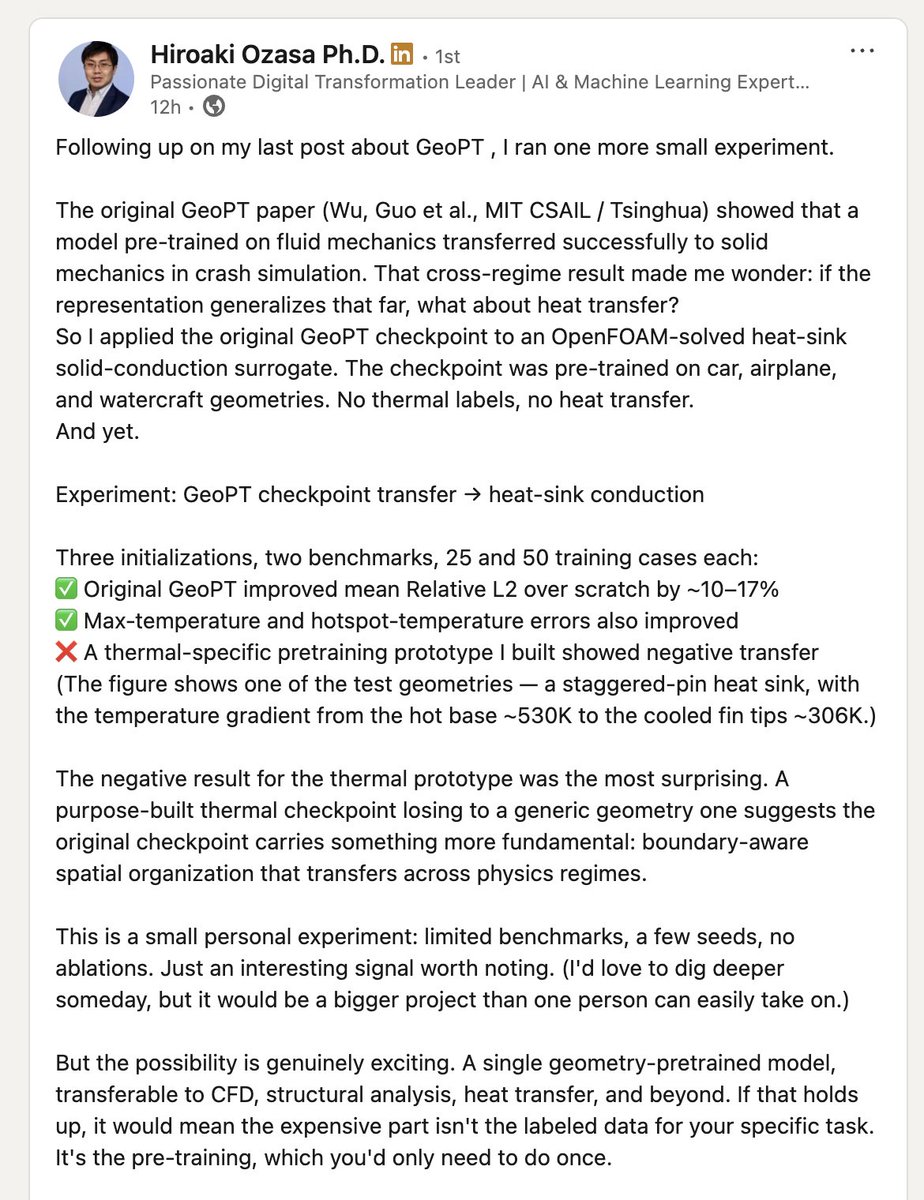
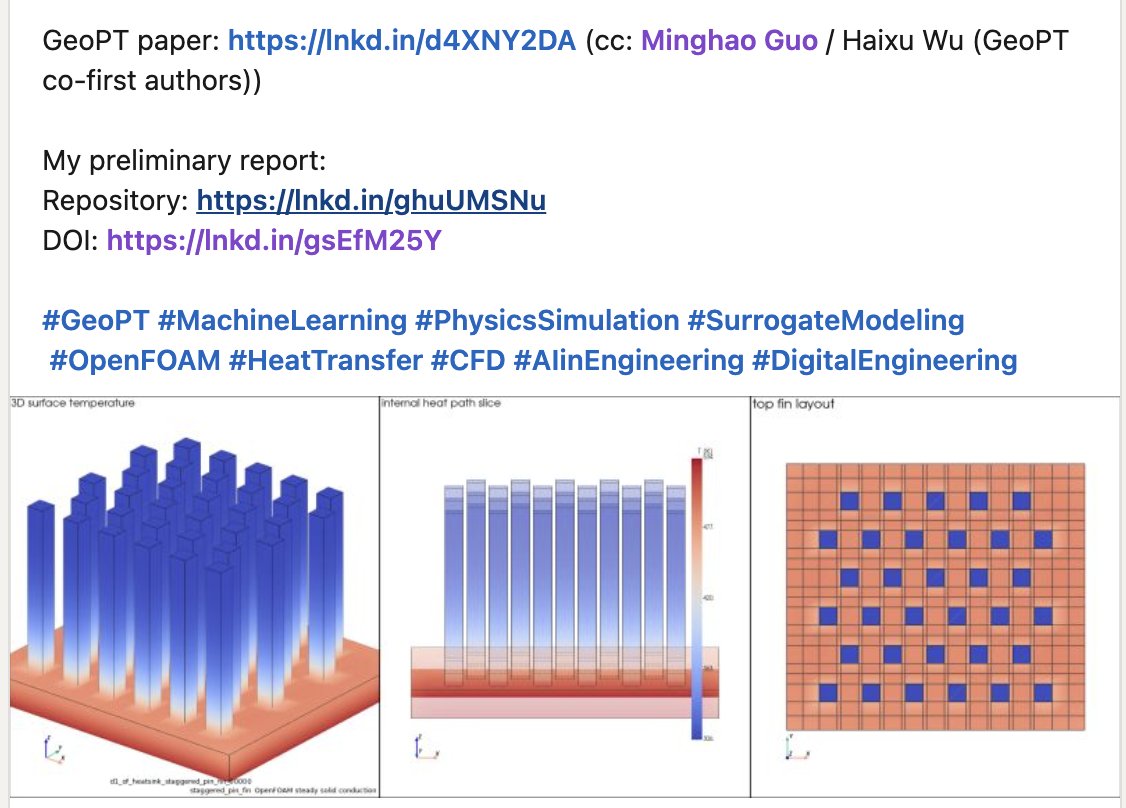
In his preliminary experiment, GeoPT improved mean Relative L2 over scratch by ~10–17%, improved max-temperature and hotspot-temperature errors, and even outperformed a thermal-specific pretraining prototype. The signal is very exciting: GeoPT may be learning something more fundamental than task-specific physics: a geometry-aware, boundary-aware representation that transfers across regimes. x.com/GuoMh14/status…
English
1
0
0
209
Minghao Guo
Minghao Guo@GuoMh14·
I was very excited to saw a really interesting independent GeoPT experiment from Hiroaki Ozasa. He tested the original GeoPT checkpoint on a completely new OOD physics setting: heat-sink solid conduction / heat transfer. This was not a benchmark from our paper. The GeoPT checkpoint was pretrained on car, airplane, and watercraft geometries. No thermal labels. No heat-transfer supervision. No task-specific thermal pretraining. And yet, it transferred. Link to the post: linkedin.com/feed/update/ur…
Minghao Guo tweet mediaMinghao Guo tweet media
English
1
4
13
1.3K
Minghao Guo retweetledi
Jitendra MALIK
Jitendra MALIK@JitendraMalikCV·
We have seen some impressive robot manipulation policies recently. This is great, but for these results to be convincing (and practical) we should insist on generalization across 1. Object location (within some range) 2. Different instances of an object category 3. Background clutter. Authors should present experiments which demonstrate the range of variation which can be handled. Far too often the policy doesn't even generalize across all instances of an object category! Legged locomotion policies were convincing only when they worked across different terrain as in ashish-kmr.github.io/rma-legged-rob… We need to do the same for manipulanda.
English
10
26
281
22.1K
Minghao Guo
Minghao Guo@GuoMh14·
The broader message is that scientific foundation models may need the right **pre-training space**, not just more data. By lifting geometry into a space that reflects downstream physical structure, GeoPT offers a scalable path toward physics-aware world models. Huge thanks to co-authors Haixu Wu @Haixu_Wu_1998, Zongyi Li @zongyili_nyu, Zhiyang Dou @frankzydou, Mingsheng Long, Kaiming He, and Wojciech Matusik @wojmatusik. (6/6) Paper: arxiv.org/abs/2602.20399 Workshop: fm-science.github.io #GeoPT #NeuralSimulation #PhysicsSimulation #ScientificML #FoundationModels #AI4Science #Pretraining #SelfSupervisedLearning #NeuralOperators #CFD #DigitalTwins
Minghao Guo tweet media
English
1
2
14
882
Minghao Guo
Minghao Guo@GuoMh14·
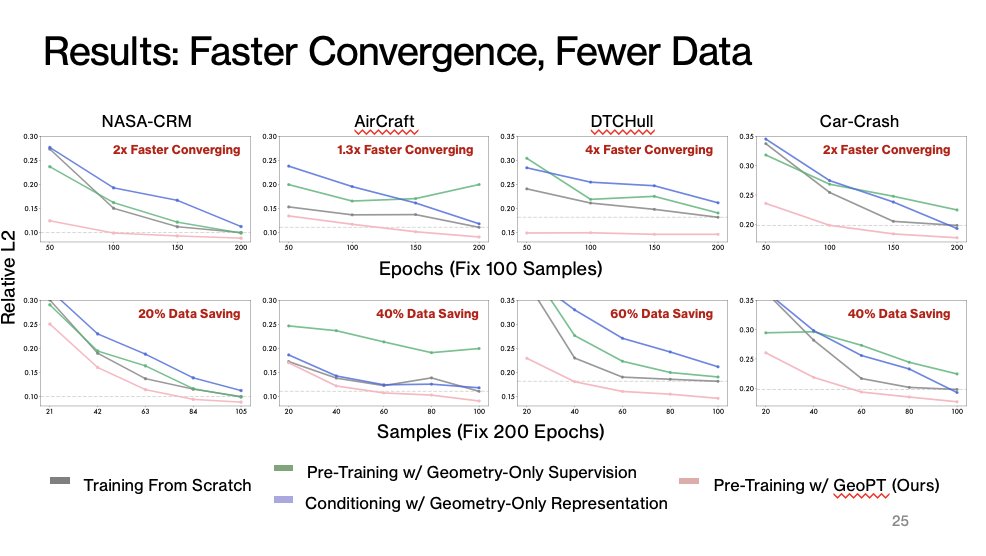
We pre-train GeoPT on over 1M geometry-dynamics samples and fine-tune it on industrial-fidelity benchmarks, including car/aircraft aerodynamics, ship hydrodynamics, and car crash simulation. GeoPT reduces labeled physics data requirements by 20–60% and speeds up convergence by up to 2×. (5/6)
Minghao Guo tweet media
English
1
0
7
894
Minghao Guo
Minghao Guo@GuoMh14·
Excited to share GeoPT: Scaling Physics Simulation via Lifted Geometric Pre-Training, which received the Best Paper Award at the ICLR 2026 Workshop on Foundation Models for Science. Can we scale neural physics simulation without scaling expensive solver-generated labels? (1/6) (The below results are all predicted by GeoPT.)
English
3
46
340
34.4K
Minghao Guo retweetledi
Peter Yichen Chen
Peter Yichen Chen@peterchencyc·
What happens when differentiable simulation meets diffusion models? You get a foundation model that is both 𝗲𝘅𝗽𝗿𝗲𝘀𝘀𝗶𝘃𝗲 AND 𝗴𝘂𝗮𝗿𝗮𝗻𝘁𝗲𝗲𝗱 𝘁𝗼 𝗼𝗯𝗲𝘆 𝗽𝗵𝘆𝘀𝗶𝗰𝗮𝗹 𝗰𝗼𝗻𝘀𝘁𝗿𝗮𝗶𝗻𝘁𝘀. 📢 Excited to share our latest work accepted to #ICLR2026: "Physically Valid Biomolecular Interaction Modeling with Gauss-Seidel Projection." 🧬 Foundation models like AlphaFold3 and Boltz have transformed biomolecular structure prediction — yet they still hallucinate physically invalid structures: steric clashes, distorted covalent geometry, broken stereochemistry. The root cause? Current predictors are trained to match empirical distributions — they never enforce physical validity as a 𝗵𝗮𝗿𝗱 𝗰𝗼𝗻𝘀𝘁𝗿𝗮𝗶𝗻𝘁. The secret sauce? A 𝗱𝗶𝗳𝗳𝗲𝗿𝗲𝗻𝘁𝗶𝗮𝗯𝗹𝗲 𝗚𝗮𝘂𝘀𝘀-𝗦𝗲𝗶𝗱𝗲𝗹 𝗽𝗿𝗼𝗷𝗲𝗰𝘁𝗶𝗼𝗻 𝗺𝗼𝗱𝘂𝗹𝗲 that takes provisional atom coordinates from the diffusion model and projects them onto the nearest physically valid configuration. By exploiting the locality and sparsity of atomic constraints, it converges stably and fast at scale. The module plugs into existing frameworks end-to-end via implicit differentiation — treating physical validity as a first-class citizen during 𝗯𝗼𝘁𝗵 𝘁𝗿𝗮𝗶𝗻𝗶𝗻𝗴 𝗮𝗻𝗱 𝗶𝗻𝗳𝗲𝗿𝗲𝗻𝗰𝗲. With our projection module in place, just 𝟮 𝗱𝗲𝗻𝗼𝗶𝘀𝗶𝗻𝗴 𝘀𝘁𝗲𝗽𝘀 suffice to match the structural accuracy of 200-step diffusion baselines — delivering a ~𝟭𝟬× 𝘄𝗮𝗹𝗹-𝗰𝗹𝗼𝗰𝗸 𝘀𝗽𝗲𝗲𝗱𝘂𝗽 while guaranteeing physical validity. Across six benchmarks (CASP15, PoseBusters, AF3-AB, dsDNA, RNA-Protein, and more), our model closes the gap between guaranteed physical validity and state-of-the-art structural accuracy. Joint work across UBC, MIT, NVIDIA, PKU, U of Utah, and Foundry Biosciences. 📄 Project: chensiyuan030105.github.io/ProteinGS/ 💻 Code: github.com/chensiyuan0301…
GIF
Peter Yichen Chen tweet media
English
0
4
9
624
Minghao Guo
Minghao Guo@GuoMh14·
Huge thanks to the amazing authors who made this work possible: Siyuan Chen @syunchn3, Caoliwen Wang @wclw1021, Anka He Chen @AnkaHeChen, Yikun Zhang, Jingjing Chai @chai_jingj23466, Yin Yang @YinYang24414350, Wojciech Matusik @wojmatusik, and Peter Yichen Chen @peterchencyc. A special shoutout to Siyuan @syunchn3, a first-year PhD student and co-first author, whose hard work, talent, and dedication were instrumental in making this happen. (6/6) Paper link: arxiv.org/abs/2510.08946.
Filipino
0
3
7
791
Minghao Guo
Minghao Guo@GuoMh14·
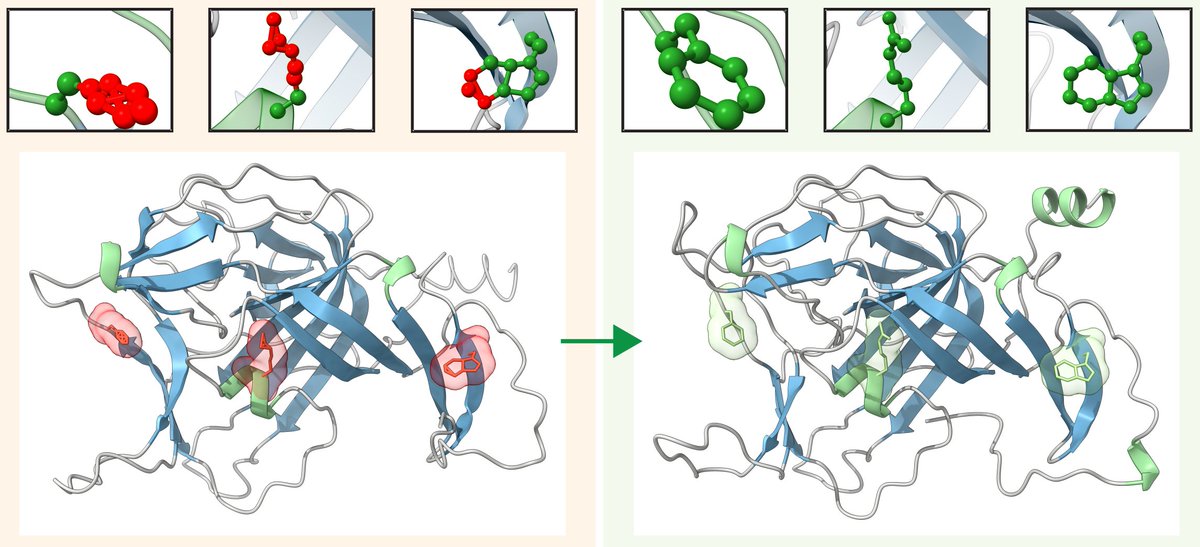
At the same time, our 2-step model guarantees physical validity and delivers ~10x wall-clock speedups. If biomolecular generative models are going to be useful for downstream science and drug discovery, physical validity cannot be an afterthought. It has to be built into the pipeline. (5/6)
English
1
0
0
198
Minghao Guo
Minghao Guo@GuoMh14·
Modern all-atom biomolecular foundation models can be impressively accurate, but they still often generate steric clashes and other physically invalid structures. In our ICLR 2026 paper, we ask: can physical validity be enforced as a hard constraint, instead of a soft preference? Many existing approaches use physics mainly as inference-time guidance. That can reduce violations, but with finite guidance strength and finite denoising steps, invalid structures can still slip through. We wanted guarantees. (1/6)
Minghao Guo tweet media
English
1
6
32
38.7K