Yask gupta

20 posts

Yask gupta

Yask gupta

@GuptaYask

Dr. Yask Gupta Statistical genetics and Bioinformatics LIED, Department of Dermatology, Germany

Lubeck, Germany Katılım Kasım 2016
79 Takip Edilen16 Takipçiler
Yask gupta
Yask gupta@GuptaYask·
Genome-wide meta-analysis and integrative fine-mapping identify novel susceptibility loci and effector genes in psoriatic arthritis medrxiv.org/content/10.110…
English
0
0
0
10
Yask gupta retweetledi
SSC_Lab 🧬
SSC_Lab 🧬@SannaCherchiLab·
The news is spreading!
Veera Rajagopal @doctorveera

A new preprint by Gupta et al. reports a missense variant that cancels out the pathogenic effects of APOL1 risk variants for kidney disease in African Americans. This is one of the most impressive disease modifier variants I’ve seen so far. Let’s dive deep (medrxiv.org/content/10.110…) APOL1 and kidney disease For background on APOL1 kidney disease in Africans and African Americans, refer to my past thread (x.com/doctorveera/st…). Long story short, two coding common variants in APOL1—G1 (comprising of two missense variants in perfect LD) and G2 (a 6 bp deletion)—confer the highest genetic risk known to date (under a recessive model) for kidney disease in Africans and African Americans. These variants have been under intense positive selection in African ancestries as they offer protection from sleeping sickness by strengthening the APOL1-mediated immune defence against parasitic invasion. Unfortunately, as always, the beneficial effect came at a cost: the overactive APOL1 cause collateral damage to the host kidney tissue resulting in chronic renal failure. APOL1 is an important drug target today; there are probably a dozen drug programs from various companies under various stages of clinical development. Recent examples of disease modifier mutations The current preprint falls right under my favourite, recurring theme of my Twitter posts: drug designs inspired by evolution. Some of the best insights on treating human diseases can be found in nature. And that is why scientists have been always in search of disease modifier variants. A naturally occurring genetic variant neutralizing a disease risk variant. We have seen a few examples of both cis and trans genetic modifiers in the Alzheimer’s field (though not as compelling as the present one). * A Columbian woman in whom two copies of APOE3 Christchurch mutation was believed to have nullified the PSEN1 mutation that causes early-onset autosomal dominant Alzheimer’s disease (ADAD), hinting that APOE therapeutic targeting might prove beneficial in ADAD patients (trans genetic modifier) (nature.com/articles/s4159…) * A recent report on a handful of individuals with E4 genotypes who lived a full healthy life probably due to co-inheriting loss of function mutations that butchered the E4 missense bearing copies of the APO-E protein, hinting that allele-specific elimination of APO-E transcripts might be an effective approach to prevent Alzheimer’s in E4 carriers (cis genetic modifier) (medrxiv.org/content/10.110…). Fascinatingly, the converse is also true. That is, sometimes a mutation can cancel out the beneficial effect an another. A rare case of a family where mother and daughter were cursed with a hypercholesterolemia-causing mutation (in LDLR) and blessed with a hypercholesterolemia-protecting mutation (in PCSK9) at the same time. Sadly, the blessing worked in the daughter but not in the mother. The mother, unlike the daughter, was homozygous for the LDLR mutation and did not have any residual LDLR activity to benefit from the loss of PCKS9 (this is one striking example of how naturally occurring mutations can inform when a drug will and will not work). (journals.lww.com/md-journal/ful…). Okay now back to the main topic. Discovery of the N264K missense variant In 2013, doctors at the Ghana Ports and Harbours Authority Hospital in Ghana encountered a case of 54 yrs old male with complaints of fever, nausea and gastroenteritis. On diagnostic workup, the patient was found to have trypanosomiasis. The doctors were surprised as it was the first time in nearly a decade for someone to show up at the clinic with this parasitic infection. So, they ensured that they collected an additional sample of blood for future analysis, before treating the patient and sending him home. After clearing the institutional review, the blood sample of the patient blotted on a filter paper was flown to the University of Antwerp, Belgium, for DNA sequencing. The patient was found to be homozygous for the APOL1 G2 allele which should have actually made the patient’s blood uninhabitable for the parasites. But apparently, it didn’t. The scientists searched for other genetic mutations APOL1 that might solve the riddle. There were a handful of missense variants. Based on prior knowledge, the scientists eliminated most variants as they didn’t appear to interfere with APOL1’s trypanolytic activity. Except for one: N264K missense variant. Experimentally introducing the variant into APOL1 G1 and G2 haplotypes and testing for APOL1 activity showed that in the presence of N264K, the APOL1 G1 and G2 gain of function variants didn’t matter, as the N264K variant abolished the APOL1 trypanolytic activity. N264K turned out to be a loss of function variant. And the complete APOL1 deficiency is what should have made the patient susceptible to infection, they concluded (ncbi.nlm.nih.gov/pmc/articles/P…). If the N264K missense variant has the power to abolish the G1/G2 protective effect on trypanosomiasis, then it should also abolish the G1/G2’s risk effect on kidney disease. The current preprint addresses exactly that. N264K missense variant and protection against kidney disease Looking at the N264K variant in the genetic databases, the authors found that it is present both in the G0 wild-type haplotype (that is mainly seen in Europeans) and the G2 risk haplotype (that is mainly seen in Africans). So it appears that two mutational events birthed N264K variants in each of the haplotypes. There is no use in studying the G0 haplotypes as they are rare in African ancestries. So, the authors focussed only on carriers of G1 and G2 haplotypes and asked the question if those with G2/G2 or G1/G2 risk alleles with N264K are protected from kidney disease compared to the ones with the same risk alleles but without N264K missense variant. It turned out they are. The N264K carriers are strongly protected from developing kidney disease, especially those who are homozygous for G2 alleles where zero individuals had kidney disease, suggesting complete protection. The authors further replicate the protective effects in an independent sample. Implications The first and major implication here is that this is compelling evidence that therapeutically knocking down the APOL1 is an effective way to treat (or prevent) APOL1 kidney disease. Such drug designs have been already in the making. The second implication, as the authors discuss, is this variant will likely expand the kidney donor pool by shifting a subset of G2 risk allele carriers (those with the N264K variant) from the high-risk category to the low-risk category. A hearty congrats to all the authors for this amazing and truly transformative work 👏👏 Read the preprint: medrxiv.org/content/10.110…

English
0
1
7
201
Yask gupta
Yask gupta@GuptaYask·
@doctorveera Thank you Dr. Veera for such a beautiful commentary on our research work.
English
0
0
5
240
Yask gupta retweetledi
Veera Rajagopal 
Veera Rajagopal @doctorveera·
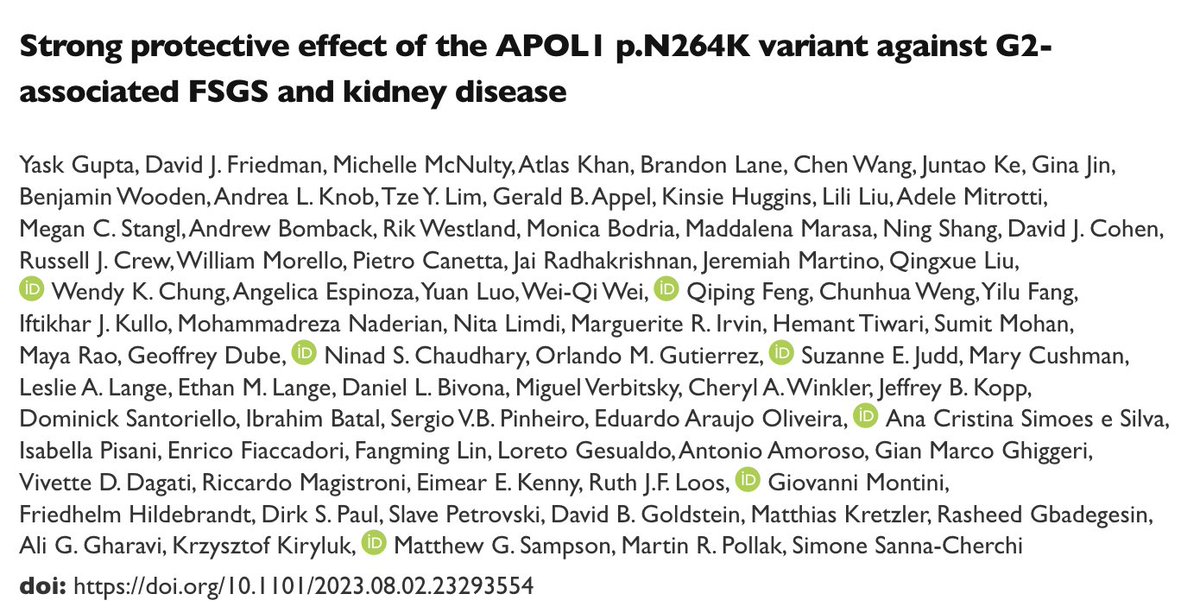
A new preprint by Gupta et al. reports a missense variant that cancels out the pathogenic effects of APOL1 risk variants for kidney disease in African Americans. This is one of the most impressive disease modifier variants I’ve seen so far. Let’s dive deep (medrxiv.org/content/10.110…) APOL1 and kidney disease For background on APOL1 kidney disease in Africans and African Americans, refer to my past thread (x.com/doctorveera/st…). Long story short, two coding common variants in APOL1—G1 (comprising of two missense variants in perfect LD) and G2 (a 6 bp deletion)—confer the highest genetic risk known to date (under a recessive model) for kidney disease in Africans and African Americans. These variants have been under intense positive selection in African ancestries as they offer protection from sleeping sickness by strengthening the APOL1-mediated immune defence against parasitic invasion. Unfortunately, as always, the beneficial effect came at a cost: the overactive APOL1 cause collateral damage to the host kidney tissue resulting in chronic renal failure. APOL1 is an important drug target today; there are probably a dozen drug programs from various companies under various stages of clinical development. Recent examples of disease modifier mutations The current preprint falls right under my favourite, recurring theme of my Twitter posts: drug designs inspired by evolution. Some of the best insights on treating human diseases can be found in nature. And that is why scientists have been always in search of disease modifier variants. A naturally occurring genetic variant neutralizing a disease risk variant. We have seen a few examples of both cis and trans genetic modifiers in the Alzheimer’s field (though not as compelling as the present one). * A Columbian woman in whom two copies of APOE3 Christchurch mutation was believed to have nullified the PSEN1 mutation that causes early-onset autosomal dominant Alzheimer’s disease (ADAD), hinting that APOE therapeutic targeting might prove beneficial in ADAD patients (trans genetic modifier) (nature.com/articles/s4159…) * A recent report on a handful of individuals with E4 genotypes who lived a full healthy life probably due to co-inheriting loss of function mutations that butchered the E4 missense bearing copies of the APO-E protein, hinting that allele-specific elimination of APO-E transcripts might be an effective approach to prevent Alzheimer’s in E4 carriers (cis genetic modifier) (medrxiv.org/content/10.110…). Fascinatingly, the converse is also true. That is, sometimes a mutation can cancel out the beneficial effect an another. A rare case of a family where mother and daughter were cursed with a hypercholesterolemia-causing mutation (in LDLR) and blessed with a hypercholesterolemia-protecting mutation (in PCSK9) at the same time. Sadly, the blessing worked in the daughter but not in the mother. The mother, unlike the daughter, was homozygous for the LDLR mutation and did not have any residual LDLR activity to benefit from the loss of PCKS9 (this is one striking example of how naturally occurring mutations can inform when a drug will and will not work). (journals.lww.com/md-journal/ful…). Okay now back to the main topic. Discovery of the N264K missense variant In 2013, doctors at the Ghana Ports and Harbours Authority Hospital in Ghana encountered a case of 54 yrs old male with complaints of fever, nausea and gastroenteritis. On diagnostic workup, the patient was found to have trypanosomiasis. The doctors were surprised as it was the first time in nearly a decade for someone to show up at the clinic with this parasitic infection. So, they ensured that they collected an additional sample of blood for future analysis, before treating the patient and sending him home. After clearing the institutional review, the blood sample of the patient blotted on a filter paper was flown to the University of Antwerp, Belgium, for DNA sequencing. The patient was found to be homozygous for the APOL1 G2 allele which should have actually made the patient’s blood uninhabitable for the parasites. But apparently, it didn’t. The scientists searched for other genetic mutations APOL1 that might solve the riddle. There were a handful of missense variants. Based on prior knowledge, the scientists eliminated most variants as they didn’t appear to interfere with APOL1’s trypanolytic activity. Except for one: N264K missense variant. Experimentally introducing the variant into APOL1 G1 and G2 haplotypes and testing for APOL1 activity showed that in the presence of N264K, the APOL1 G1 and G2 gain of function variants didn’t matter, as the N264K variant abolished the APOL1 trypanolytic activity. N264K turned out to be a loss of function variant. And the complete APOL1 deficiency is what should have made the patient susceptible to infection, they concluded (ncbi.nlm.nih.gov/pmc/articles/P…). If the N264K missense variant has the power to abolish the G1/G2 protective effect on trypanosomiasis, then it should also abolish the G1/G2’s risk effect on kidney disease. The current preprint addresses exactly that. N264K missense variant and protection against kidney disease Looking at the N264K variant in the genetic databases, the authors found that it is present both in the G0 wild-type haplotype (that is mainly seen in Europeans) and the G2 risk haplotype (that is mainly seen in Africans). So it appears that two mutational events birthed N264K variants in each of the haplotypes. There is no use in studying the G0 haplotypes as they are rare in African ancestries. So, the authors focussed only on carriers of G1 and G2 haplotypes and asked the question if those with G2/G2 or G1/G2 risk alleles with N264K are protected from kidney disease compared to the ones with the same risk alleles but without N264K missense variant. It turned out they are. The N264K carriers are strongly protected from developing kidney disease, especially those who are homozygous for G2 alleles where zero individuals had kidney disease, suggesting complete protection. The authors further replicate the protective effects in an independent sample. Implications The first and major implication here is that this is compelling evidence that therapeutically knocking down the APOL1 is an effective way to treat (or prevent) APOL1 kidney disease. Such drug designs have been already in the making. The second implication, as the authors discuss, is this variant will likely expand the kidney donor pool by shifting a subset of G2 risk allele carriers (those with the N264K variant) from the high-risk category to the low-risk category. A hearty congrats to all the authors for this amazing and truly transformative work 👏👏 Read the preprint: medrxiv.org/content/10.110…
Veera Rajagopal  tweet mediaVeera Rajagopal  tweet media
English
7
43
158
41.7K
Yask gupta retweetledi
Siddharth Tripathi / SidTree
भोजन के प्रभावों से जुड़े इस रिसर्च से शानदार बातें निकली हैं, भारत के @GuptaYask दाल चावल सहित भारत के सादे भोजन को सर्वोच्च बताने वाली रिसर्च टीम का हिस्सा हैं। उनसे बातचीत में कुछ रोचक बातें पता चलीं। ये पूरी टीम बधाई की पात्र है। 🙏 🇮🇳 @aajtak
AajTak@aajtak

इस स्टडी रिपोर्ट में दाल-चावल को माना गया सबसे उत्तम और रोगों से मुक्ति दिलाने वाला खाना. अगर आपको भी पसंद है दाल-चावल तो इस वीडियो को रीट्वीट करें #Khabardar (@SwetaSinghAT) लाइव: bit.ly/at_liveTV

हिन्दी
0
3
17
0
Yask gupta retweetledi
निखिल कुमार दुबे
दाल भात खाएंगे ज़िन्दगी बिताएंगे हल्दी लगाएंगे ठीक है.... #indianknowledgesystem #newnormal #posttruth ( जो लोग दाल भात रोटी को देहाती गंवार कह के बहुत शहर वाले बनते थे उनके लिए झटका😄?
निखिल कुमार दुबे tweet media
हिन्दी
19
85
446
0
Yask gupta retweetledi
AajTak
AajTak@aajtak·
इस स्टडी रिपोर्ट में दाल-चावल को माना गया सबसे उत्तम और रोगों से मुक्ति दिलाने वाला खाना. अगर आपको भी पसंद है दाल-चावल तो इस वीडियो को रीट्वीट करें #Khabardar (@SwetaSinghAT) लाइव: bit.ly/at_liveTV
हिन्दी
108
1K
2.2K
0
Yask gupta
Yask gupta@GuptaYask·
Gene-diet interactions associated with complex trait variation in an advanced intercross outbred mouse line disq.us/t/3i5f8e0
English
0
1
1
0
Yask gupta retweetledi
Frontiers - Immunology
Frontiers - Immunology@FrontImmunol·
Gene Expression Analysis Reveals Novel Shared Gene Signatures and Candidate Molecular Mechanisms between Pemphigus and Systemic Lupus Erythematosus in CD4+ T Cells: Tanya Sezin, Artem Vorobyev, Christian D. Sadik, Detlef Zillikens, Yask Gupta, Ralf J.… goo.gl/14eo9B
English
0
2
7
0