The HealthCare IT Experts Blog

66.5K posts

The HealthCare IT Experts Blog banner
The HealthCare IT Experts Blog

The HealthCare IT Experts Blog

@HCITExpert

Latest #DigitalHealth, #HealthIT news. #HIMSS #HITsmIND | Newsletter https://t.co/3RUysshmiR | Editor @msharmas | Support Us - https://t.co/zPE7p547Ht

India Katılım Temmuz 2012
14.2K Takip Edilen15.6K Takipçiler
The HealthCare IT Experts Blog retweetledi
CaladriusHealth.AI
CaladriusHealth.AI@CaladriusHealth·
India's NHCX: 83 payers, 42,687 providers, 23 million claims processed. The IRDAI sub-committee is now formally in place, tasked with recommending reforms around NHCX adoption, medical inflation analysis, and a joint code of conduct for insurers and providers.
English
1
3
4
44
The HealthCare IT Experts Blog retweetledi
CaladriusHealth.AI
CaladriusHealth.AI@CaladriusHealth·
One pattern is consistent across all four. Technical standards were necessary but never sufficient. Governance clarity and mid-market provider support were equally decisive.
English
1
3
4
38
The HealthCare IT Experts Blog retweetledi
CaladriusHealth.AI
CaladriusHealth.AI@CaladriusHealth·
We examined four reference systems: → US: clearinghouse model, federal standards → Australia: real-time point-of-care claims via HICAPS → Singapore: centralized trust architecture → Germany: statutory mandate with financial penalties
English
1
3
4
50
The HealthCare IT Experts Blog retweetledi
CaladriusHealth.AI
CaladriusHealth.AI@CaladriusHealth·
Every country that built a national health claims exchange found adoption took longer than anticipated. What separated the systems that scaled is worth understanding. 🧵 #NHCX #CaladriusHealthAI
English
1
4
4
64
The HealthCare IT Experts Blog retweetledi
Evan Luthra
Evan Luthra@EvanLuthra·
The Head of Claude Code at Anthropic said he hasn’t written code by hand in months. In 2 days he shipped 49 full features. All written 100% by AI. He just dropped a 30 min talk on exactly how he does it. Worth more than any $500 vibe coding course. Bookmark it:
English
178
784
9.2K
1.6M
The HealthCare IT Experts Blog retweetledi
Reid Wiseman
Reid Wiseman@astro_reid·
Only one chance in this lifetime… Like watching sunset at the beach from the most foreign seat in the cosmos, I couldn’t resist a cell phone video of Earthset. You can hear the shutter on the Nikon as @Astro_Christina is hammering away on 3-shot brackets and capturing those exceptional Earthset photos through the 400mm lens. @AstroVicGlover was in window 3 watching with @Astro_Jeremy next to him. I could barely see the Moon through the docking hatch window but the iPhone was the perfect size to catch the view…this is uncropped, uncut with 8x zoom which is quite comparable to the view of the human eye. Enjoy.
English
4.1K
45.6K
265.4K
18.8M
The HealthCare IT Experts Blog retweetledi
Google India
Google India@GoogleIndia·
Full length, no cost NEET UG practice tests are now in @GeminiApp, isn’t that neat? 😄 Say “I want to take a NEET mock test” and begin ✍️ Read here: goo.gle/NEERPrep
English
44
128
979
300.5K
The HealthCare IT Experts Blog retweetledi
Aakash Gupta
Aakash Gupta@aakashgupta·
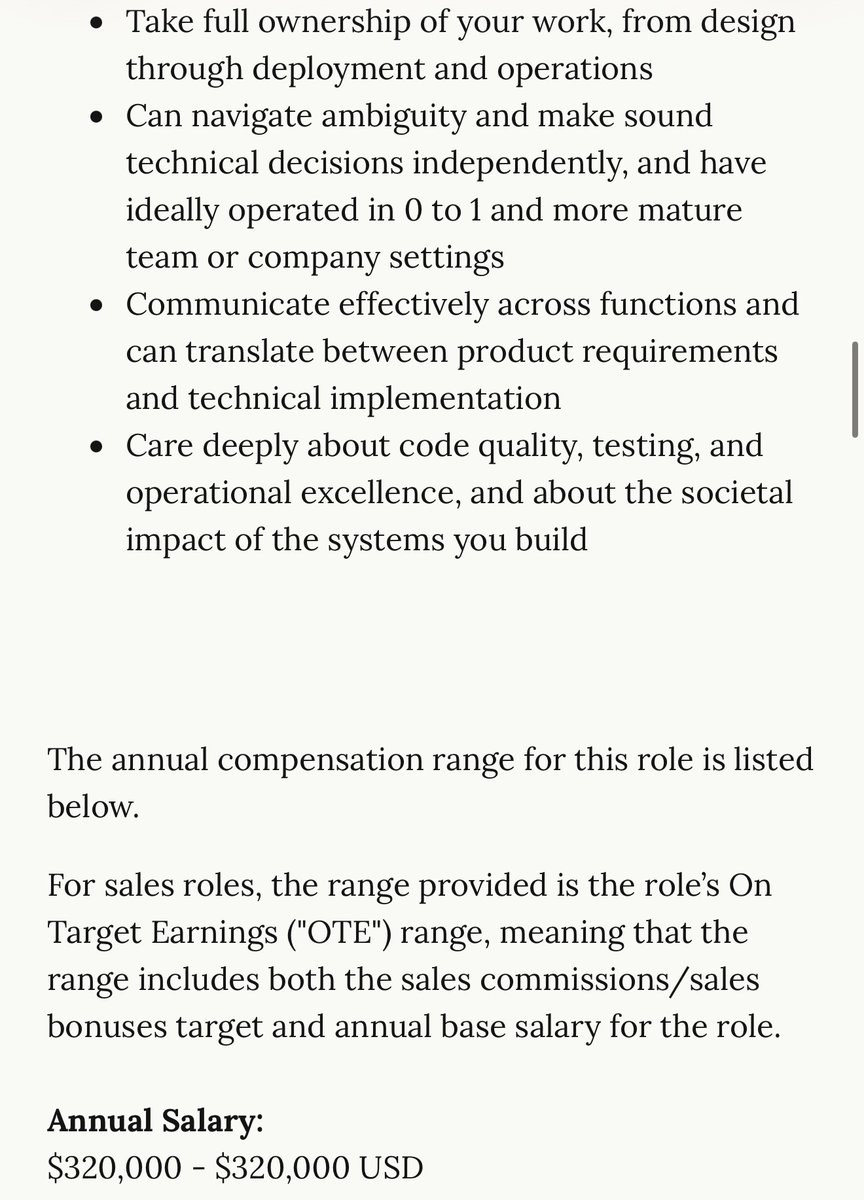
Anthropic has 454 open roles. The company is hiring software engineers at $320K-$405K. Their CEO, Dario, said three months ago that coding is "going away first, then all of software engineering." The paradox resolves instantly. Dario's engineers told him they don't write code anymore. They let Claude write it. They edit. They review. They architect. They didn't lose their jobs. They got faster. Anthropic grew from a small research lab to 1,500 employees in four years, adding engineers the entire time. This has played out five times in computing history. Compilers replaced assembly. Frameworks replaced boilerplate. Cloud replaced server management. Every prediction was the same: most programmers won't be needed. Every result was the same: the number of engineers grew. The global software engineer pool went from roughly 5 million in 2010 to 28.7 million today. BLS projects 17% growth in US software developer roles through 2033, adding 304,000 positions. The pool is projected to hit 45 million by 2030. When building software gets cheaper, more problems become worth solving with software. A startup that needed 10 engineers now needs 3. But 50 companies that couldn't afford to build at all now can. The denominator shrinks. The numerator explodes. Meta's engineering headcount is up 19% from January 2022. Google's is up 16%. Apple, 13%. These companies adopted AI coding tools years ago. They're using Copilot and Claude Code daily. They're hiring more engineers than before those tools existed. Every generation of "coding is dead" content creates two cohorts: engineers who freeze up, and engineers who build 10x more with the new tools. The second group has won every single time.
Aakash Gupta tweet mediaAakash Gupta tweet media
English
199
471
3.7K
1.8M
The HealthCare IT Experts Blog retweetledi
Ajit kumar
Ajit kumar@ajitcodes·
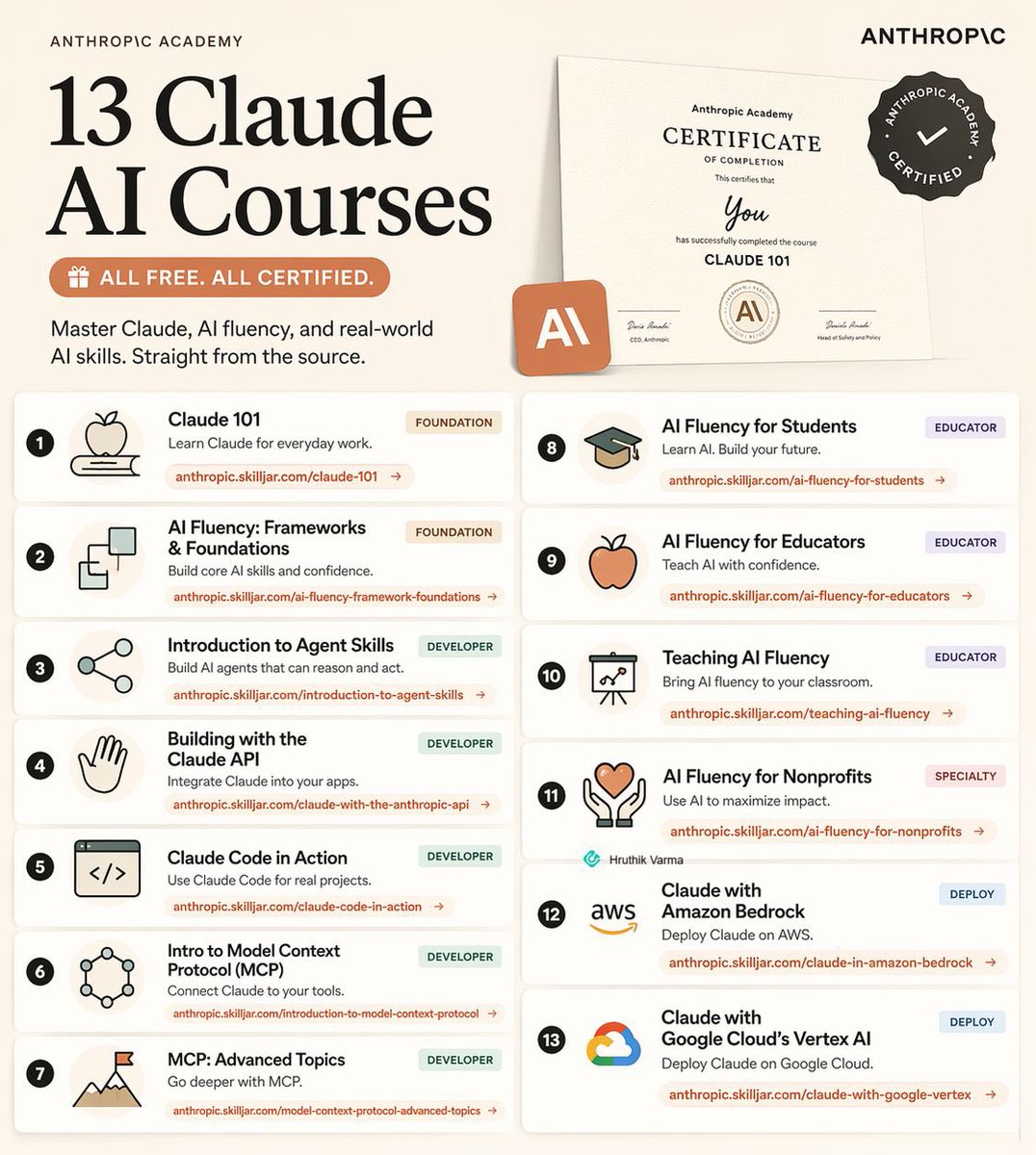
Claude just dropped 13 FREE AI courses (with certificates). No $500 course needed. No “guru” required. Just real skills — straight from Anthropic. Here’s the full list: 👇 1. Claude 101   lnkd.in/gCPUQsRg 2. AI Fluency: Frameworks & Foundations   lnkd.in/gS6ceZ_M 3. Introduction to Agent Skills   lnkd.in/g_wWNiEb 4. Building with the Claude API   lnkd.in/gDr5K_B4 5. Claude Code in Action   lnkd.in/g9wWZbK9 6. Introduction to Model Context Protocol   lnkd.in/gAj5HqMY 7. MCP: Advanced Topics   lnkd.in/g3eDwBFY 8. AI Fluency for Students   lnkd.in/gKKujHGG 9. AI Fluency for Educators   lnkd.in/gVcKnuhA 10. Teaching AI Fluency   lnkd.in/g9P4gJFM 11. AI Fluency for Nonprofits   lnkd.in/gpsm_BVf 12. Claude with Amazon Bedrock   lnkd.in/gbfPjSFt 13. Claude with Google Vertex AI   lnkd.in/gvVgB4Ub — If you go through even HALF of these… You’ll be ahead of 95% of people using AI. Most people won’t. Because they’re still: • Watching random YouTube videos • Buying overpriced courses • “Learning AI” without actually building Don’t be that person. Do this instead: 1. Save this post (you’ll come back to it) 2. Pick 1 course → start today 3. Share it with someone who needs this Free. Practical. No excuses.
Ajit kumar tweet media
English
31
540
2.2K
222.4K
The HealthCare IT Experts Blog retweetledi
Luiza Jarovsky, PhD
Luiza Jarovsky, PhD@LuizaJarovsky·
🚨 BREAKING: Stanford's 423-page AI Index Report 2026 is out! [Bookmark it below]. These are its key takeaways: 1. AI capability is not plateauing. It is accelerating and reaching more people than ever. 2. The U.S.-China AI model performance gap has effectively closed. 3. The U.S. hosts the most AI data centers, with the majority of its chips fabricated by one Taiwanese foundry. 4. AI models can win a gold medal at the International Mathematical Olympiad but cannot reliably tell time, an example of what researchers call the jagged frontier of AI. 5. Robots still fail at most household tasks, even as they excel in controlled environments. 6. Responsible AI is not keeping pace with AI capability, with safety benchmarks lagging and incidents rising sharply. 7. The U.S. leads in AI investment, but its ability to attract global talent is declining. 8. AI adoption is spreading at historic speed, and consumers are deriving substantial value from tools they often access for free. 9. Productivity gains from AI are appearing in many of the same fields where entry-level employment is starting to decline. 10. AI’s environmental footprint is expanding alongside its capabilities. 11. AI models for science can outperform human scientists, though bigger models do not always perform better. 12. AI is transforming clinical care, but rigorous evidence remains limited. 13. Formal education is lagging behind AI, but people are learning AI skills at every stage of life. 14. AI sovereignty is becoming a defining feature of national policy, but capabilities remain uneven, even as open-source development helps to redistribute who participates. 15. AI experts and the public have very different perspectives on the technology’s future, and global trust in institutions to manage AI is fragmented. - 👉 Download the full document below. 👉 To learn more about AI's legal and ethical challenges, join my newsletter's 93,500+ subscribers (link below).
Luiza Jarovsky, PhD tweet media
English
27
230
584
48K
The HealthCare IT Experts Blog retweetledi
Reid Wiseman
Reid Wiseman@astro_reid·
There are no words.
Reid Wiseman tweet media
English
7.9K
86.7K
650.8K
38.8M
The HealthCare IT Experts Blog retweetledi
Wall Street Mav
Wall Street Mav@WallStreetMav·
SpaceX now has over 10,000 Starlink satellites in orbit (and growing), providing internet data service to every corner of the earth. Even ships at sea or aircraft in the sky can receive high speed internet service. Over 2/3 of the active satellites in orbit are Starlink now. And it won't create any long term trash in orbit. The orbits are so low (480 km to 550 km) that even if SpaceX were to lose control of one, the small satellites will run out of fuel within 5 years. Then they get dragged back into the atmosphere and burn up. Every satellite is in a lane to avoid other Starlink satellites. They all are connected to a collusion avoidance system and can make small course adjustments if needed. Starlink can provide high speed internet anywhere on the planet without having to bury expensive fiber cables underground or undersea. All you need is a small dish which scans the sky for the closest satellite to provide internet connectivity.
English
385
935
3.4K
812K
The HealthCare IT Experts Blog retweetledi
Mr. Jason💡
Mr. Jason💡@jason_coder0·
🚨 𝗕𝗥𝗘𝗔𝗞𝗜𝗡𝗚: Claude can now build your entire mobile app from a screenshot like a $350K senior developer at Apple. (for free) Here are 8 insane Claude prompts replacing your entire mobile development team before they finish estimating the project cost:👇 (Save this 🔖 thread before it blows up.)
Mr. Jason💡 tweet media
English
53
76
351
52.3K
The HealthCare IT Experts Blog retweetledi
Dr. Sangita Reddy
Dr. Sangita Reddy@drsangitareddy·
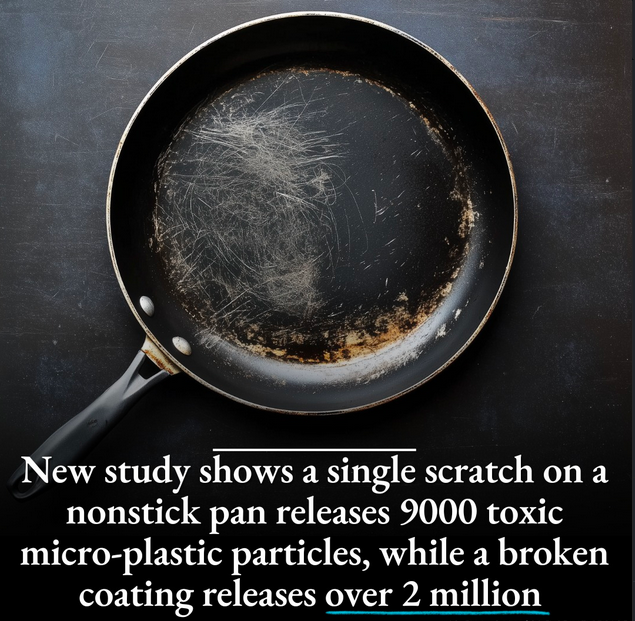
You would never knowingly serve plastic to your family. And yet, a simple scratch on a non-stick pan may be doing exactly that releasing thousands, even millions, of invisible particles into the food we cook every day. This isn’t a distant environmental issue. It’s in our kitchens. In our daily lives. These particles often carry PFAS “forever chemicals” that don’t break down in the body and are increasingly linked to cancer, hormonal imbalance, infertility, and immune disorders. What’s more concerning? Most of us are already exposed. Studies show these chemicals are present in the bloodstream of nearly everyone globally. This is not about fear. It’s about awareness. Because health isn’t built in hospitals alone it is shaped every day at home, through the choices we make. Maybe it is time to rethink what we cook with. A simple shift to safer materials like stainless steel or cast iron could be one of the most powerful preventive health decisions we make. The question isn’t whether this affects us. The question is what will we choose to change? #PreventiveHealth #HealthyLiving #AwarenessMatters #KitchenChoices #PublicHealth #Wellbeing #SustainableLiving
Dr. Sangita Reddy tweet media
English
29
180
449
122.9K
The HealthCare IT Experts Blog retweetledi
Bo Wang
Bo Wang@BoWang87·
This week, the "AI replacing doctors" debate is back. The CEO of America's largest public hospital system says he's ready to replace radiologists with AI. The Stanford-Harvard NOHARM study shows top models outperforming generalists. The discourse is moving fast. I run AI at @UHN, the largest hospital in Canada. Here's what I actually see. We've developed AI models across imaging, pathology, and clinical decision support. In controlled conditions, the accuracy numbers are real. In some narrow tasks, models genuinely outperform. That's not hype. But the operational reality of running these systems inside a large hospital teaches you things benchmarks never will. The errors that hurt patients aren't the confident wrong answers. They're the quiet omissions, i.e., the thing the model didn't flag because it wasn't in the training distribution. NOHARM found 76.6% of AI errors were omissions. We see this too. And in a hospital, a missed finding doesn't just affect one case. It propagates: the downstream physician trusts the AI read, the patient waits, the window closes. The accountability structure also doesn't exist yet. When an AI-assisted diagnosis leads to harm, who is responsible: the physician, the hospital, the vendor? In Canada, we don't have a clear answer. No hospital system deploying AI at scale does. That's not a regulatory delay. That's a fundamental gap in the infrastructure for AI-in-medicine. What I'm genuinely optimistic about: AI is already changing how our radiologists work. Not replacing them, but changing the shape of the job. Routine reads get faster. Their time shifts toward complex cases, clinical correlation, cases where the AI flags uncertainty. That's the right direction. But "ready to replace radiologists" skips 10 hard years of work on deployment infrastructure, liability frameworks, clinician training, and failure mode monitoring that nobody wants to talk about because it's less exciting than accuracy benchmarks. The capability question is nearly answered. The deployment question has barely been asked. CEO story: beckershospitalreview.com/radiology/nyc-… NOHARM paper: arxiv.org/abs/2512.01241
English
35
92
355
63.7K