Huw Llewelyn

1.3K posts

Huw Llewelyn banner
Huw Llewelyn

Huw Llewelyn

@HL327

Very long time a diagnostician; longer a mathematician! Originator & lead author of the Oxford Handbook of Clinical Diagnosis

Wales Katılım Mart 2011
260 Takip Edilen266 Takipçiler
Sabitlenmiş Tweet
Huw Llewelyn
Huw Llewelyn@HL327·
When will Covid-19 make our research community appreciate its limited understanding of how diagnostic tests are really used (& not focus only on sensitivity & specificity)? @mgtmccartney @JeremyFarrar @deeksj @pash22 @VPrasadMDMPH @deb_cohen @TomChivers @d_spiegel @Deborah_Ashby
Huw Llewelyn@HL327

@arxivabs @mgtmccartney I fear that no one really cares how well PCRs compare to LFDs in selecting people for targeted isolation so as to reduce spread of SARS-Cov-in the population (arxiv.org/abs/1808.09169) Instead they chatter about irrelevant false positives when LFDs try to predict PCR results.

English

1
2
4
0
Tatler
Tatler@Tatlermagazine·
The unsettling history of Wood Farm, where a ‘lost prince’ was once hidden away to die, as it becomes Andrew Mountbatten-Windsor's latest home tatlermagazine.visitlink.me/YnX9qz
Tatler tweet media
English
11
10
26
5.3K
Huw Llewelyn
Huw Llewelyn@HL327·
@pash22 Dichotomising numerical test results wastes information. They indicate degrees of disease severity and the extent to which homeostatic and reparative feedback mechanisms are coping or failing and the extent to which treatment helps, including for cancer: discourse.datamethods.org/t/dichotomizat…
English
0
1
0
244
Ash Paul
Ash Paul@pash22·
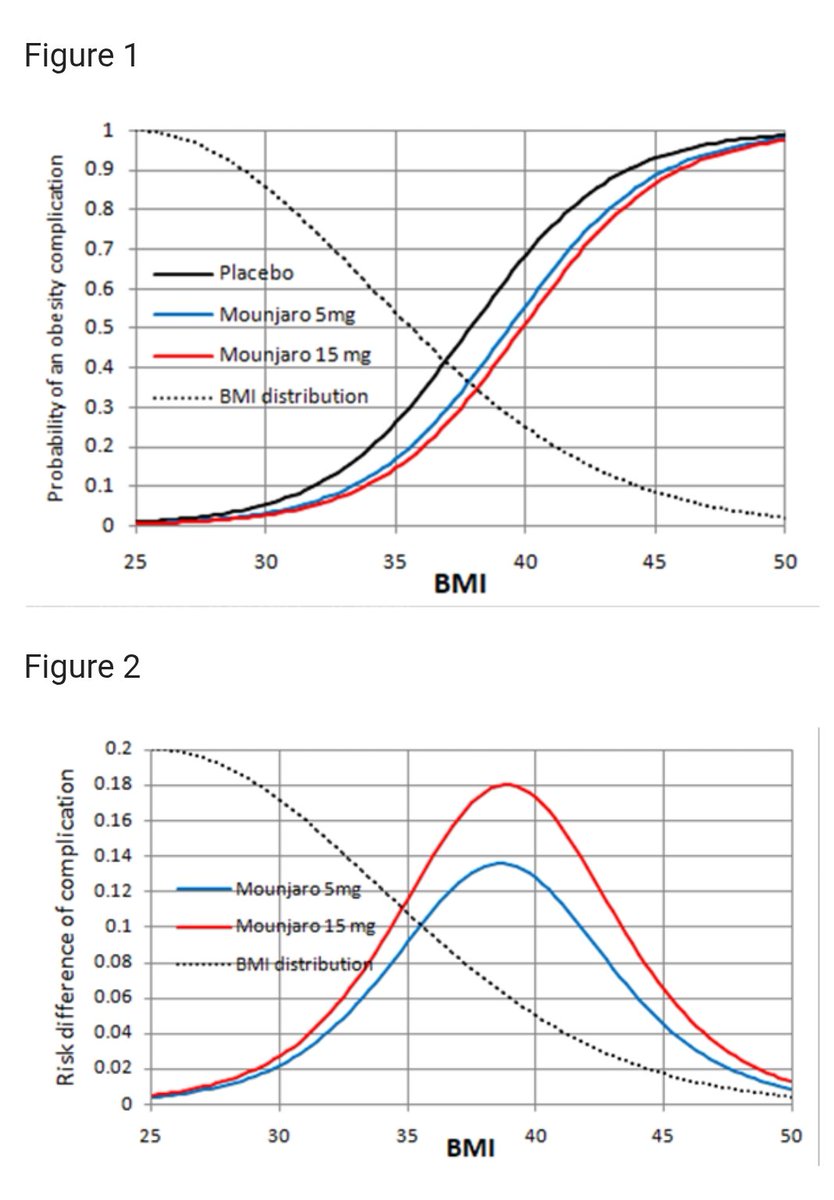
Curves such as those in Figures 1 and 2 would have to be developed for each complication of obesity. If a decision to take Mounjaro is shared using a formal decision analysis, the probability of each complication conditional on the individual patients BMI and its utility has to be considered as well as the demands of weekly injections possibly for life. discourse.datamethods.org/t/some-thought… via @HL327
Ash Paul tweet media
English
1
0
4
807
Huw Llewelyn
Huw Llewelyn@HL327·
PS. My ‘subjective’ prior distribution of possible true mean values of a study would be conditional on my expected mean of the paired differences (e.g. 1.96) and the expected standard deviation (e.g. 10) in an imagined study based on prior knowledge etc, and the ‘conventional’ sample size required (e.g. 204.3=>205) for a power of 80% of getting P≤ 0.05 t/s. The sample size required for P≤ 0.05 in a proposed study would be 408.6 =>409 and also to get P≤ 0.05 in a second replicating study would be 612.9=>613. How does this compare to assurance calculations?
English
0
0
0
26
Huw Llewelyn
Huw Llewelyn@HL327·
Thank you. My approach is different. My calculation of sample size for a power of x that a proposed study should provide a P value ≤ y is based on doubling the variance of the subjective prior distribution of possible true values of the study. The sample size required that a subsequent (replicating) study gives a P value ≤ y too, is based on tripling the variance.
English
1
0
0
73
Huw Llewelyn
Huw Llewelyn@HL327·
I agree of course that we estimate the minimum number of observations but this 80% power is a likelihood. To calculate the number needed to get probability of 0.8 of a P value <=0.05, we need to use the Gaussian prior probability distribution conditional on the data (on which the likelihood distribution is based by assuming it to be identical). This means doubling the estimated variance, which means you need twice as many observations as for a ‘conventional’ power calculation to estimate the minimum posterior probability of getting a P value of <=0.05 (see arxiv.org/pdf/2403.16906).
English
0
0
0
93
Stephen John Senn
Stephen John Senn@stephensenn·
@baym This is a common claim but IMO, it's wrong. When you design a new telescope you don't know the magnitude of the stars you will find but you can still say something about the lowest magnitude star you can detect. errorstatistics.com/2014/03/17/ste…
English
3
1
15
760
Michael Baym
Michael Baym@baym·
Prospective power analysis is hilarious because your replace an arbitrary guess of sample size with an arbitrary guess of the effect size you’ve yet to measure, do a touch of arithmetic, and suddenly it’s considered rigorous
English
26
51
504
153.7K
Huw Llewelyn
Huw Llewelyn@HL327·
If there is an estimated Gaussian distribution based on 100 observations with a mean of 0 and a SD of 10, then 58% of the distribution will fall within 0.202 SDs of the mean. As the SEM is 10/√100 = 1, the 95% CLs of 58% will be based 0.202+/-0.196 and will be 0.655 and 0.502. However the binomial 95% CLs for 58/100 are wider at 0.677 and 0.483 and less precise. Does this illustrate your point about dichotomisation reducing precision or is there another explanation?
English
0
0
1
167
Stephen John Senn
Stephen John Senn@stephensenn·
Over the past 30 years many, including me, have drawn attention to the loss of precision in the awful habit of dichotomising continuous data. I suspect that the criticism is much older. I would be grateful for early references. #historyofstatistics
English
6
9
57
7.6K
Huw Llewelyn
Huw Llewelyn@HL327·
The same problem affects diagnostic test assessment. Sensitivity and specificity require dichotomisation of numerical values that experienced diagnosticians interpret as numbers. Instead of criticising the dichotomisation they think that they can’t understand statistics. P values also convert an observed mean into a range (what was actually observed or something more extreme). Has anyone else raised these issues too?
English
0
0
0
188
Huw Llewelyn
Huw Llewelyn@HL327·
@stephensenn Do you think that the risk ratio estimated on that non random sample is transportable to population defined by the inclusion criteria?
English
0
0
0
89
Stephen John Senn
Stephen John Senn@stephensenn·
I’m baffled & exasperated by the numbers doing statistical analysis who imagine that the patients in a clinical trial can be regarded as a random sample from the population defined by the inclusion criteria. Some heinous crime was committed in educating them.
English
14
21
114
31.6K
Huw Llewelyn
Huw Llewelyn@HL327·
For example, we apply the risk ratio R from an RCT on statins to individuals with a total risk of a CV event over 10% based on summing the risks from individual risk factors. We then apply R to the 10%. But if that individual had a very low risk lipid profile already and a very high risk BP, would the estimated risk reduction be sensible? The RCT was designed with the hypothesis that statins reduce CV risk via lipid profile, which was already low risk in this individual and there is no evidence that statins lower the BP. These considerations apply to all applications of RCTs to individuals.
English
0
0
0
74
Huw Llewelyn
Huw Llewelyn@HL327·
Agreed. It is undefined. However we seem to assume that a new individual to whom the measure of efficacy is to be applied is from the same population. That individual’s RELEVANT baseline risk has to be estimated conditional the known features used to recruit into the trial. The unknown features will contribute variance of this risk.
English
1
0
1
169
Stephen John Senn
Stephen John Senn@stephensenn·
To be clear, not only do inclusion and exclusion criteria not define a probabilistic rule for sampling from a sampling frame they don’t even define a relevant frame.
English
3
8
25
4.8K
Huw Llewelyn
Huw Llewelyn@HL327·
@stephensenn 3/3. The foregoing posts make all sorts of assumptions of course especially about the‘ transportability’ of risk ratios, differences etc. How should we test these assumptions?
English
0
0
1
79
Huw Llewelyn
Huw Llewelyn@HL327·
2/2. The exchangeable sets allow us to estimate the efficacy of treatment in the form of average risk ratios, odds ratios, risk differences based on individuals in those sets. The question is: How are the latter applied to other individuals in the population from which they were recruited? How do we estimate the untreated risk for such individuals?
English
2
0
1
196