

Luke Glowacki
1.9K posts
Luke Glowacki
@HSB_Lab
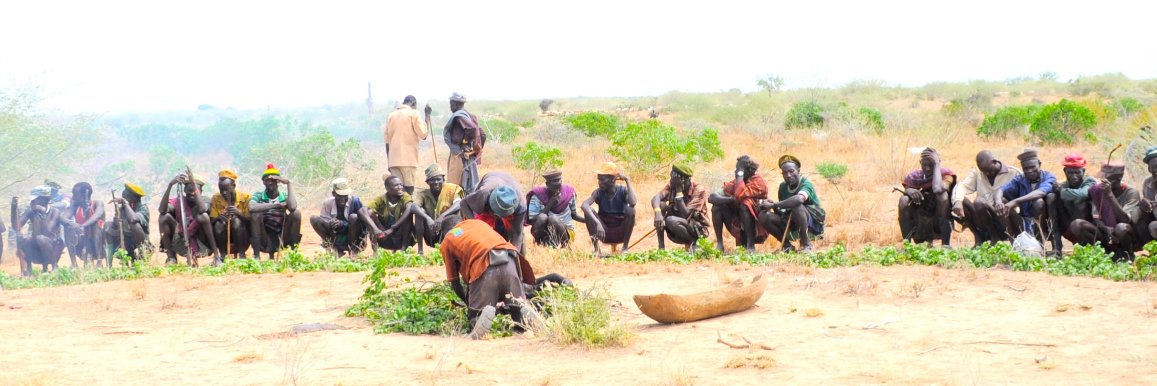
Anthropologist. PI Human Systems and Behavior Lab. Co-Director of the Omo Valley Research Project @theOVRP
Nyangatom, Ethiopia Katılım Ağustos 2018
661 Takip Edilen4.1K Takipçiler
Luke Glowacki retweetledi

Underrated Ideas in Biotech (Part I)
My list of writing ideas is growing far faster than I can possibly publish. So here are some "half-baked" ideas in biology that I hope others will pick up and run with.
In this first blog, I share three ideas:
1. Hyperspectral Biology — It is possible to see microbes from outer space. (That sentence sounds ridiculous, but it's true.) We can now build planetary-scale networks that would enable us to engineer microbes that sense pathogens, or act as early warning systems for other threats, and monitor using satellites.
2. Biology for Beauty — Nature is often described as the most beautiful thing on Earth, far exceeding artistic works from Monet and Picasso. Yosemite and the Grand Canyon feel as if they were sculpted by the hands of God; all other art is unmistakably the work of humans. Why aren't there entire companies that (like Tiffany or Cartier) aim to make eternal art using biology?
3. Mapping the Air — Microbes can travel thousands of miles, traversing continents by riding on dust motes carried by atmospheric winds. Sand from the Sahara desert travels all the way to New York City, carrying pathogens with it. We have barely begun to study the microbes hitching rides on these atmospheric winds.
On a related note: There is a growing field of AirDNA. Every time you breathe, saliva droplets are released into the air. These droplets contain DNA, which can be captured and sequenced. After the DNA settles onto the ground after about 24 hours, it gets wrapped into dust, and sits there for years.
It is feasible to take the dust from a room and build a genomic record of everyone who has ever entered it. In 2023, researchers at MIT also engineered living cells to take up and permanently record DNA from their surroundings. The bacteria were sensitive enough to distinguish between two sequences differing by a single nucleotide at exceptionally low concentrations — about 4.6 femtomolar.
These “sentinel” cells can be used to figure out what a person looks like, solely by storing the trace amounts of DNA they leave behind in a room.
Many facial features are influenced by single-nucleotide polymorphisms (SNPs), or single-letter variants in the genome that correlate with things like nose width and eye spacing. The MIT team engineered cells to detect five facial SNPs and showed each could be detected independently. Sprayed onto a surface, these cells would capture SNPs and, once sequenced later, reveal who passed through.
This is not science fiction. The authors say it directly in the paper: “we demonstrated sentinel cells on a set of five human SNPs associated with human facial features. One could record this information in a single cell or consortium, recover the DNA, and use artificial intelligence to rebuild the predicted face.”
Much more: nikomc.com/essays/underra…


English
English

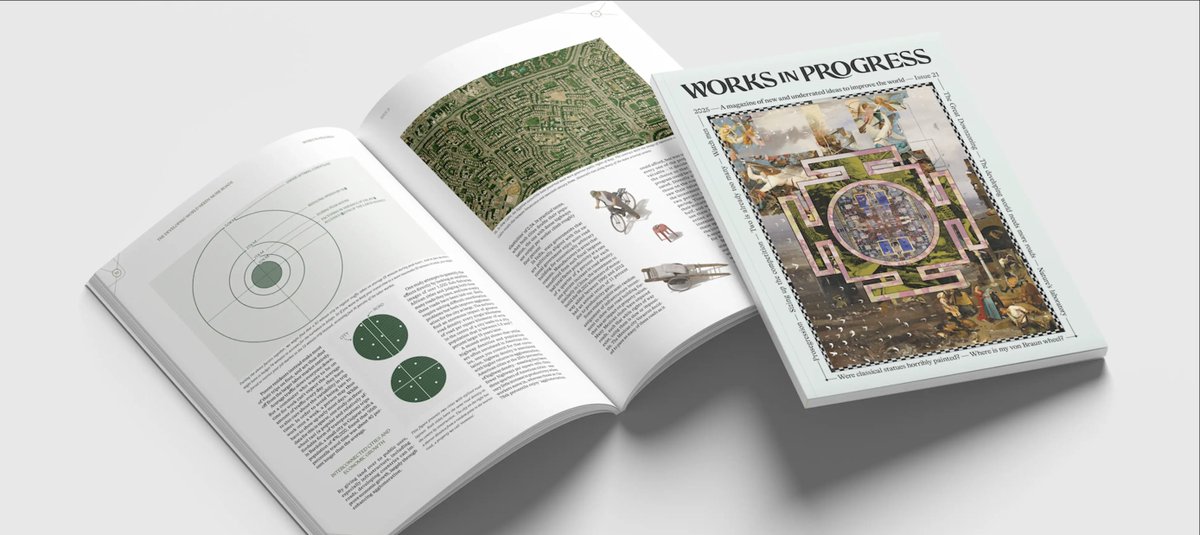
Thrilled to announce I'm joining @WorksInProgMag and @stripe to continue my research and writing on clinical trials & biotech innovation, with many more articles to come. (If you haven't already, subscribe to the magazine. It's great in terms of content and very beautiful.)
My work is driven by a core conviction: in the years and decades ahead, we will be far more constrained by the quality of our culture and institutions than by technology itself. In biology, a remarkable convergence is underway. AI, alongside a wave of other emerging tools, is fundamentally expanding what science can do.
But beneath this sizzling potential, something is going wrong in Western biotechnology. China is pulling ahead and companies are increasingly moving clinical trials there, drawn by faster clinical trial timelines and a more dynamic ecosystem. Promising therapies sit in limbo for years. Despite the science being here, personalized cancer therapies are not viable to anyone but a few who can afford to navigate the labyrinthine regulatory apparatus. And pharmaceutical R&D productivity has remained stubbornly flat in the last 10 years, after decades of decline.
And I can't imagine a better home for my research and writing on what can be done to accelerate biomedical progress than Works in Progress. This is a magazine that has published some of the most important writing on why the physical world has stopped working, including "The Housing Theory of Everything," which became one of those rare pieces that actually changed how people think about a problem.
But this is not just about my desire to study biotech innovation.
Biotech is not an anomaly. The same pattern: technology outrunning the institutions meant to govern it, is playing out across society. And now AI is compressing the timeline, accelerating pressures that were already straining the system.
When people ask what I worry about when it comes to AI, I tell them it’s not the usual things. I'm not losing sleep as much over AI taking my job. I am more worried that we will lose our appetite for depth and that long-form thought, serious reading, sustained attention, the very things that make culture worth having, will erode faster than we notice. That our collective intelligence will hollow out, gradually. And the very problems we have now will only accelerate.
@WorksInProgMag is a resistance movement against that, condensed in the form of magazine. It stands for long-form, in-depth writing. It stands for beauty. It is fundamentally anti-slop.
In that sense, it's a natural fit with @stripe. A payments company publishing a magazine might seem like an odd pairing. That is, until you understand what kind of payments company @stripe actually is. It has always been driven by a genuine passion for craft and for getting small things exactly right.
I am really proud to be part of something that embodies my own values in such a deep way, especially at a turning point in history.
English
Luke Glowacki retweetledi

Write for us!
We're commissioning many more pieces at Works in Progress, and broadening formats too. worksinprogress.news/p/more-article…
I'll be commissioning & editing much more on science and global health. Here's a thread of some pieces I'm excited about –
English
Luke Glowacki retweetledi

Even societies that are sometimes called matriarchal often had strong and oppressive patriarchal structures.
Alice Evans@_alice_evans
Academics use the Standard Cross Cultural Sample to study the variation of small scale societies But looking at the indicator for “female power”, I realised that many societies given the max score were actually violent & coercive Including “ceremonial rape”
English

Academics use the Standard Cross Cultural Sample to study the variation of small scale societies
But looking at the indicator for “female power”, I realised that many societies given the max score were actually violent & coercive
Including “ceremonial rape”

English
Luke Glowacki retweetledi

Want to learn more about psilocybin use in Lesotho? Looking for something more complete than a Twitter thread but more fun than a paper? This Substack post is for you! Link in 🧵

English
@ashleytrubin I agree, but i'm also not sure tenure as it's designed makes a lot of sense in 21st century universities (said as someone who is up for tenure). I also wonder what it's for when so many tenured colleagues don't use the security it gives them.
English

I don't think we (academics) realize how vulnerable we are. I'm not sure how much longer tenure will last in an era when a) we've lost the public trust (for a lot of reasons, b) college/academia is a partisan political issue, and c) college-educated white-collar workers are losing their jobs to AI. We are in an incredibly privileged position relative to others, but that privilege also makes us far more precarious than most academics realize bc it makes us a target--and the threat is not just conservative politicians gunning for us but the much larger group of regular people who don't mind if we get put in our place or start losing our jobs like similar others or being asked to do tasks we don't want to do.
English
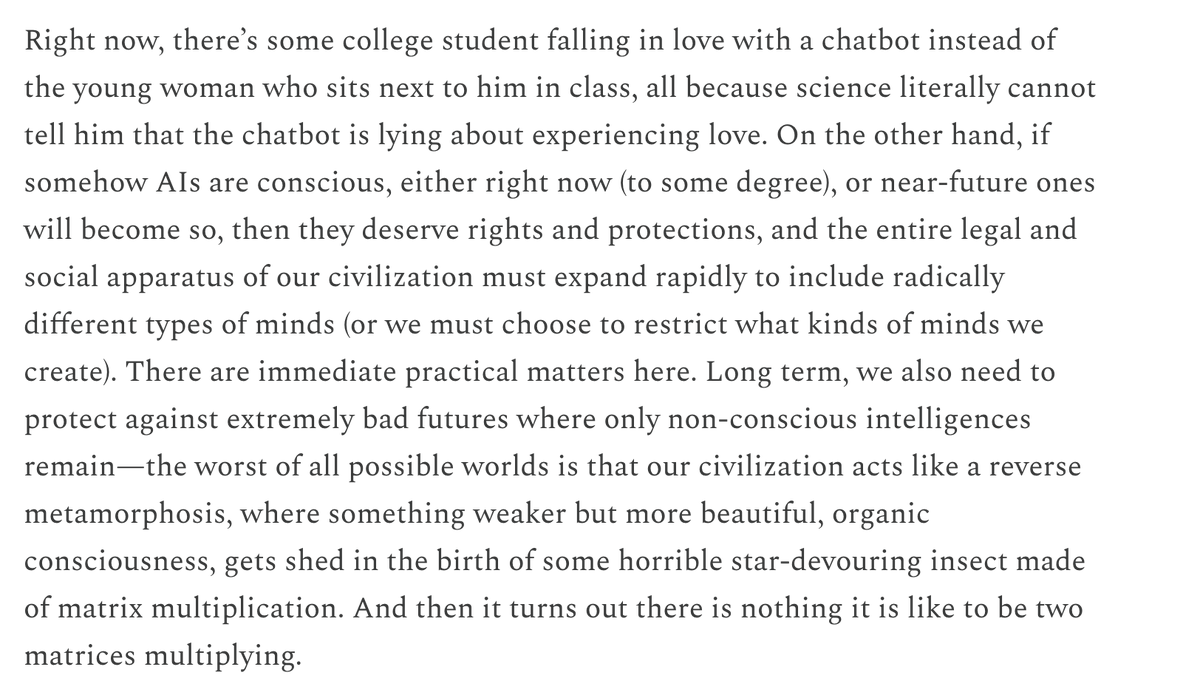
"We Consciousness Researchers Have Failed You" This passage says it all.
Excellent piece by @erikphoel Link in rt
English
I've started writing my book: "Biology is a Burrito & Other Essays." It is an interactive and highly visual look into the beauty, speed, and complexity of a living cell.
I'm planning to print hardcover books while serializing the essays online. The first essay is now available at burrito.bio.
This was inspired by Stewart Brand's latest book, "Maintenance of Everything," which he developed in serialized form with @WorksInProgMag. One cool thing about that book was that he improved each chapter with reader comments before printing the physical copies!
I'll be doing the same with this book. If you send me feedback that improves the text, I'll credit you online and in the final print version. You can also sign up to get email updates when a new essay launches. Hope you enjoy!
English
This is the most exciting period for science writing in my lifetime.
Niko McCarty.@NikoMcCarty
I've started writing my book: "Biology is a Burrito & Other Essays." It is an interactive and highly visual look into the beauty, speed, and complexity of a living cell. I'm planning to print hardcover books while serializing the essays online. The first essay is now available at burrito.bio. This was inspired by Stewart Brand's latest book, "Maintenance of Everything," which he developed in serialized form with @WorksInProgMag. One cool thing about that book was that he improved each chapter with reader comments before printing the physical copies! I'll be doing the same with this book. If you send me feedback that improves the text, I'll credit you online and in the final print version. You can also sign up to get email updates when a new essay launches. Hope you enjoy!
English
I still can't get over how insane and self-defeating this is.
John Hawks@johnhawks
New in @nytimes on how some research on human origins and genetics are being cut from federal science programs. @carlzimmer interviews Brenna Henn, who has done much to illuminate the genetic variation and history of southern African peoples. nytimes.com/2026/01/02/sci…
English
Luke Glowacki retweetledi
People claim that psychedelics have been used by Indigenous groups around the world for millennia. But clear evidence of serotonergic psychedelic use – even psilocybin – has long been confined to the Americas.
Until now. In a new preprint summarizing months of fieldwork, my collaborators and I systematically show that people in Lesotho use native psilocybin mushrooms for many different purposes, and have potentially been doing so for a very long time. 🧵
osf.io/preprints/soca…
English
26 hilly miles in two hours and one minute. Evolution at its finest. We are as finely adapted as any animal.
ESPN@espn
With a time of 2:01:52, John Korir is a back-to-back men's Boston Marathon champion 🏆
English
@ChrisStringer65 Nice overview, but not a brand new idea. Here's our empirical article in the same issue that implicitly views social structure as a form of collective intelligence. royalsocietypublishing.org/rstb/article/3…
English
Social structure as a form of collective intelligence: a new framework royalsocietypublishing.org/rstb/article/3…
English
IRB reform is drastically needed. Great suggestions here but I would add shifting to a license model. Researchers can do projects that conform to guidelines without prior review.
Ruxandra Teslo 🧬@RuxandraTeslo
Reminder that often IRBs delay important research. My proposal with @matthewesche on how to get rid of this issue.
English