Hasan T. Alhasan حسن الحسن
15.7K posts

Hasan T. Alhasan حسن الحسن
@HTAlhasan
Senior Fellow for Middle East Policy @IISS_org | Foreign policy & economic statecraft | Gulf & S Asia | PhD @KingsIndiaInst | Formerly @BahrainPMO


NEW: The Department of Commerce just removed all export controls on AI chips on the UAE government and its AI national champion, G42. This is a HUGE deal, poses massive national security risks, will slow the US AI buildout, and will cause the largest data centers in the world to be built in the UAE instead of the US. These license requirements were in place because of significant national security concerns related to the UAE government and G42 in particular, which are well documented in public reporting. The UAE government and G42 can now buy as many AI chips as they want. Here's what will likely happen as a result of AI chips being uncapped to the UAE: (1) The UAE/G42 will buy millions of Blackwell chips (~6 million Blackwells are being made this year, so this would be a big chunk of global capacity); (2) UAE-owned G42 will build AI data centers globally, and be the first global competitor to U.S. hyperscalers, which currently dominate that market; (3) The UAE will build the largest data centers in the world, will become the world's second largest hub for AI compute, and leading AI models will be hosted in the UAE. This will pose enormous national security risks, as the UAE will become one of the most important AI compute hubs in the world, just as it now is for oil, but also a backdoor for China. It will create a massive foreign-owned competitor to the most important US companies. It will provide one of the few countries in the world with the money and interest to build AI models that rival the United States, with the tools to do it. And most importantly, it will exacerbate the already extreme supply shortage for AI chips in the United States, slowing the U.S. AI buildout. How does the United States benefit from this? How is this America First? This policy just seems like it's Steve Witkoff first, given G42 purchased 49% of World Liberty Financial in 2025 in an effort to convince the administration to let them buy large numbers of AI chips. That seems to have worked. It is hard to overstate how far-reaching the implications of this decision could be for the global AI infrastructure buildout, which was previously dominated by the US--but now has legitimate non-US competitors that have extensive ties to China. And the AI chip supply crunch for US firms will get tighter, making it even harder to build data centers in the US. Why are we doing this? Who benefits?


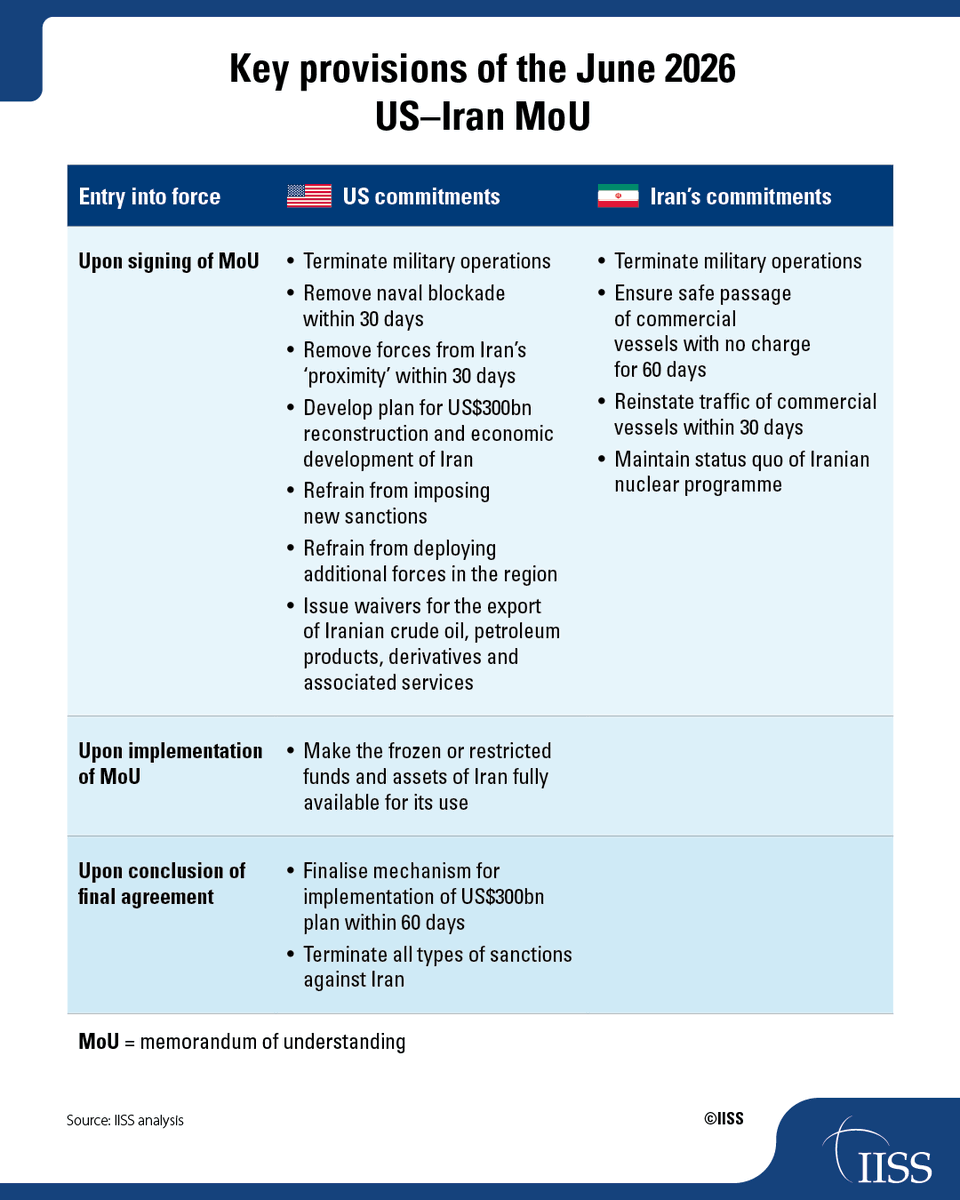
The Arab Gulf states are publicly supporting the US–Iran MoU to avoid further hostilities. However, the associated concessions from the US in the MoU come with numerous security concerns for the region. Read the latest analysis by Dr Hasan Alhasan (@HTAlhasan): go.iiss.org/4xQ2aGt


📢 UPCOMING WEBINAR | Is the Middle East splitting into rival blocs? Speakers discuss how the Iran war is reshaping rivalries across the Middle East. ▪️@HTAlhasan ▪️@DEsfandiary ▪️@YasFarouk ▪️@FirasMaksad ▪️@SanamVakil 📅 10/6 🕐 2pm BST Register ⤵️ chathamhouse.org/events/all/sta…


Recent events need not jeopardise plans by Gulf states to acquire nuclear power plants. Yet precedents, doctrinal realities and the fragile regional-security landscape require nuclear newcomers in the Gulf to consider the risks of attacks against civilian nuclear facilities and potential mitigation measures. Explore the latest #ChartingMiddleEast analysis by Tomisha Bino: bit.ly/4dlRPdo


The British military said a ship caught fire after being hit by an unknown projectile off the coast of Qatar. There were no reported casualties, it said. apnews.com/article/iran-u…


Watch today's webcast featuring @HTAlhasan, @NicoleGrajewski, and Matthew Tavares. #TWIPolicyForum washingtoninstitute.org/policy-analysi…