
Halldór Armand

1.2K posts

Halldór Armand banner
Halldór Armand

Halldór Armand

@HalldorArmand

Rithöfundur / Writer.

Berlin, Germany Katılım Kasım 2014
312 Takip Edilen2K Takipçiler
Sabitlenmiş Tweet
Halldór Armand
Halldór Armand@HalldorArmand·
Einu sinni reyndi ég að kenna kærasta vinkonu minnar grunnatriðin í að skrifa söngleiki. Ég vissi ekki að hann væri Tony-verðlaunahafi og að skrifa besta söngleik allra tíma. Sambærilegt við að hitta Michael Jordan og kenna honum að drippla gegnum klofið. ruv.is/frett/2020/11/…
IS

15
4
457
0
Halldór Armand
Halldór Armand@HalldorArmand·
@blaaondin Gaman að heyra. Ég fékk líka póst um að íslenskur domtulkur, Sara Bartels Bailey, hefði unnið þar nov 45 til nov 46
IS
0
0
2
76
Bláa öndin 𝕏
Bláa öndin 𝕏@blaaondin·
@HalldorArmand Ég er ekki með heimildir við höndina og ekki viss, en mig rámar í að Kristján Albertson hafi verið viðstaddur a.m.k. hluta þinghaldsins.
IS
1
0
3
186
Halldór Armand
Halldór Armand@HalldorArmand·
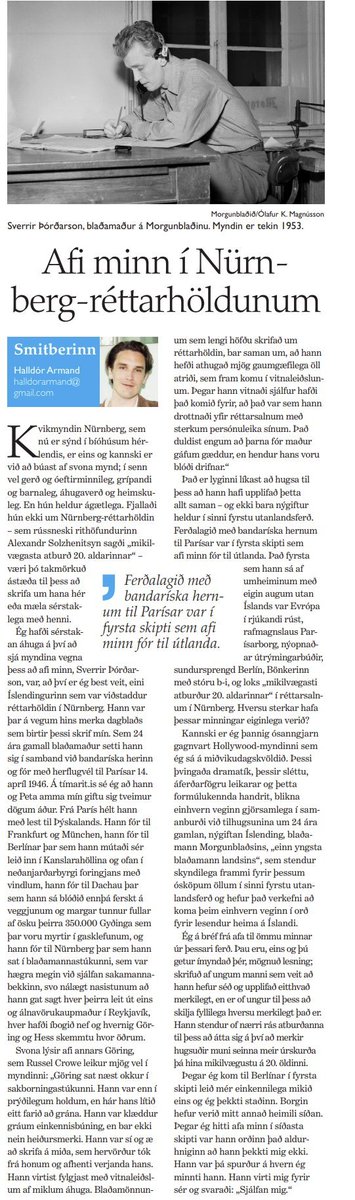
Pistill um kvikmyndina Nurnberg og þá staðreynd að afi minn var á staðnum. / A column on the movie Nuremberg and the fact that my grandfather was present. English below. My Grandfather at the Nuremberg Trials The film Nuremberg, now playing in cinemas in Iceland, is perhaps exactly what one might expect from a film of this kind: at once well made and forgettable, gripping and childish, interesting and dumb. Still, it holds together reasonably well. Were it not about the Nuremberg Trials—which the Russian writer Aleksandr Solzhenitsyn once called “the most important event of the twentieth century”—there would probably be little reason to write about it here or to recommend it in particular. I was especially curious to see the film because my grandfather, Sverrir Þórðarson, was, as far as I know, the only Icelander present at the trials in Nuremberg. He was there on behalf of the distinguished newspaper that publishes these words of mine. At the age of twenty-four, a young reporter, he contacted the American army and flew with a military aircraft to Paris on April 14, 1946. On timarit.is I can see that he and my grandmother Peta had married two days earlier. From Paris he continued by train into Germany. He went to Frankfurt and Munich; he went to Berlin, where he bribed his way into the Reich Chancellery and down into the Führer’s underground bunker with cigars; he went to Dachau, where he saw the blood still fresh on the walls and barrels filled with the ashes of the 350,000 Jews murdered there in the gas chambers; and he went to Nuremberg, where he sat in the press gallery, to the right of the defendants’ dock, so close to the Nazis that he could remark which of them resembled a cloth merchant in Reykjavík, which had a hooked nose, and how Göring and Hess amused one another. This is how my grandfather described Göring, whom Russell Crowe portrays very well in the film: “Göring sat closest to us in the defendants’ enclosure. He was still of heavy build, though his hair had begun to turn slightly grey. He wore a grey uniform but no decorations. He was constantly writing notes, which a guard would take from him and pass to his defence counsel. He appeared to follow the testimony with great interest. Journalists who had long been covering the trial agreed that he examined every detail of the testimony with great care. When he himself testified it sometimes seemed as though he dominated the courtroom with the force of his personality. It was clear to everyone that this was a man of considerable intelligence—but his hands were stained with blood.” It seems almost unbelievable to think that he experienced all this—and not only as a newly married man but on his very first trip abroad. The journey with the American army to Paris was the first time my grandfather had ever left Iceland. The first glimpse he had of the wider world with his own eyes was Europe in smoking ruins: a Paris without electricity, newly opened extermination camps, a shattered Berlin, the Bunker—with a capital B—and finally “the most important event of the twentieth century” unfolding in the courtroom at Nuremberg. How powerful must those memories have been? Perhaps, then, I am being unfair to the Hollywood film I watched on Wednesday evening. Its forced drama, its smooth and handsome actors, and its formulaic screenplay somehow pale in comparison with the thought of a twenty-four-year-old, newly married Icelander—a reporter for Morgunblaðið, “one of the youngest journalists in the country”—suddenly confronted with all these horrors on his first journey abroad, tasked with finding words for them for readers back home in Iceland. I have letters my grandfather wrote to my grandmother during this trip. They are, as you might imagine, extraordinary reading: written by a young man who knows he has seen and experienced something remarkable, yet is still too young to grasp fully how remarkable it is. He stands too close to the flow of events to realize that later generations of thinkers will declare them the most consequential of the twentieth century. When I first arrived in Berlin, I felt strangely as though I already knew the place. The city has been my second home ever since. The last time I saw my grandfather he had grown so old that he no longer recognized me. Someone asked him whom I reminded him of. He looked at me for a moment and answered: “Myself.”
Halldór Armand tweet media
IS
2
0
14
995
Halldór Armand
Halldór Armand@HalldorArmand·
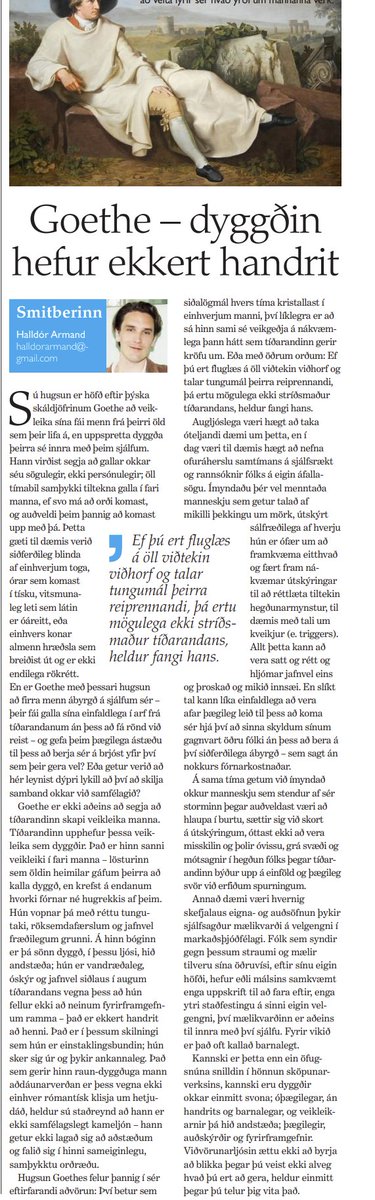
Pistill frá því í janúar um þá speki sem höfð er eftir Goethe að menn fái veikleika sína frá þeirri öld sem þeir lifa á. / A column on Goethe's insight on virtues and weaknesses. English below: Goethe: Virtue Has No Script A thought attributed to the German literary giant Goethe holds that people inherit their weaknesses from the age in which they live, while the source of their virtues lies within themselves. His point seems to be that our faults are historical rather than purely personal. Every era, so to speak, tolerates certain flaws in human character and thereby makes it easier for people to get away with them. These might take the form of a particular kind of moral blindness, fashionable delusions, intellectual laziness that goes unchallenged, or some generalized fear that spreads through society without necessarily being rational. But does Goethe, in saying this, absolve individuals of responsibility for themselves—suggesting that they simply inherit their defects from the spirit of the age without any say in the matter—while giving them a comfortable excuse to boast about whatever they happen to do well? Or is there, perhaps, a deeper key here to understanding the relationship between the individual and society? Goethe is not merely saying that the spirit of the age produces human weaknesses. The spirit of the age elevates those weaknesses into virtues. That is the true weakness of character: the vice that an era allows people’s intellect to call virtue, while ultimately demanding neither sacrifice nor courage of them. The age arms them with the proper language, the right arguments, and even an academic framework. True virtue, seen in this light, is the opposite. It is awkward, unclear, and may even appear immoral in the eyes of the age precisely because it does not fit into any predetermined framework—there is no script for it. In that sense it is individual: it stands out and seems strange. What makes a truly virtuous person admirable is therefore not some romantic cliché about heroism, but the fact that he is not a social chameleon. He cannot adapt himself to circumstances and disappear into the shared and sanctioned language of the time. Goethe’s idea thus contains a warning: the more perfectly a person embodies the moral code of his own age, the more likely it is that he is weak in precisely the way that age demands. Or put differently: if you are perfectly fluent in all the accepted attitudes and speak their language effortlessly, you may not be a warrior of the spirit of the age, but its prisoner. There are countless examples of this. One contemporary instance might be the intense cultural emphasis on self-development and on exploring one’s personal history of trauma. Imagine a well-educated person who can speak knowledgeably about boundaries, explain in psychological terms why they are unable to carry out certain actions, and offer precise explanations for particular patterns of behavior—for example by invoking “triggers.” All of this may be true and valid, and it may even sound like maturity and deep self-insight. Yet such language can also function as an extremely convenient way to avoid one’s obligations to others without bearing any moral responsibility for doing so—in other words, without paying any real price. At the same time, we can imagine a person who weathers the storm when the easiest option would be to run away; who accepts the absence of clear explanations, is not afraid of being misunderstood, and tolerates uncertainty, grey areas, and contradictions in human behavior—at a time when the spirit of the age offers simple and comfortable answers to difficult questions. Another example might be the way unrestrained accumulation of property and wealth is treated as the obvious measure of success in a market society. Those who swim against that current and measure their lives differently, according to their own judgment, naturally have no formula to follow and no external confirmation of their success, since the standard exists only within themselves. As a result, they are often dismissed as naïve. Perhaps this is yet another of the inverted strokes of genius in the design of creation. Perhaps our virtues really are like this: uncomfortable, unscripted, and a little naïve—while our weaknesses are the opposite: comfortable, easily explained, and pre-packaged. The warning lights should not begin flashing when you are unsure what you are doing, but precisely when you believe you know.
Halldór Armand tweet media
IS
1
0
10
692
Ishmael
Ishmael@hodl_ishmael·
Gefum okkur að Bitcoin sé peningakerfi sem valdeflir einstaklinga með því að gefa þeim kost á að geyma og senda fullkomlega sjaldgæfan pening á milli án aðkomu þriðja aðila, er þá rétt að segja að það sé verðlaust? Er furða að fólk sé hætt að taka mark á meginstraumsmiðlum?
Financial Times@FT

Bitcoin is still about $69,000 too high ft.trib.al/s4Nwhwi | opinion

IS
2
0
5
977
Halldór Armand
Halldór Armand@HalldorArmand·
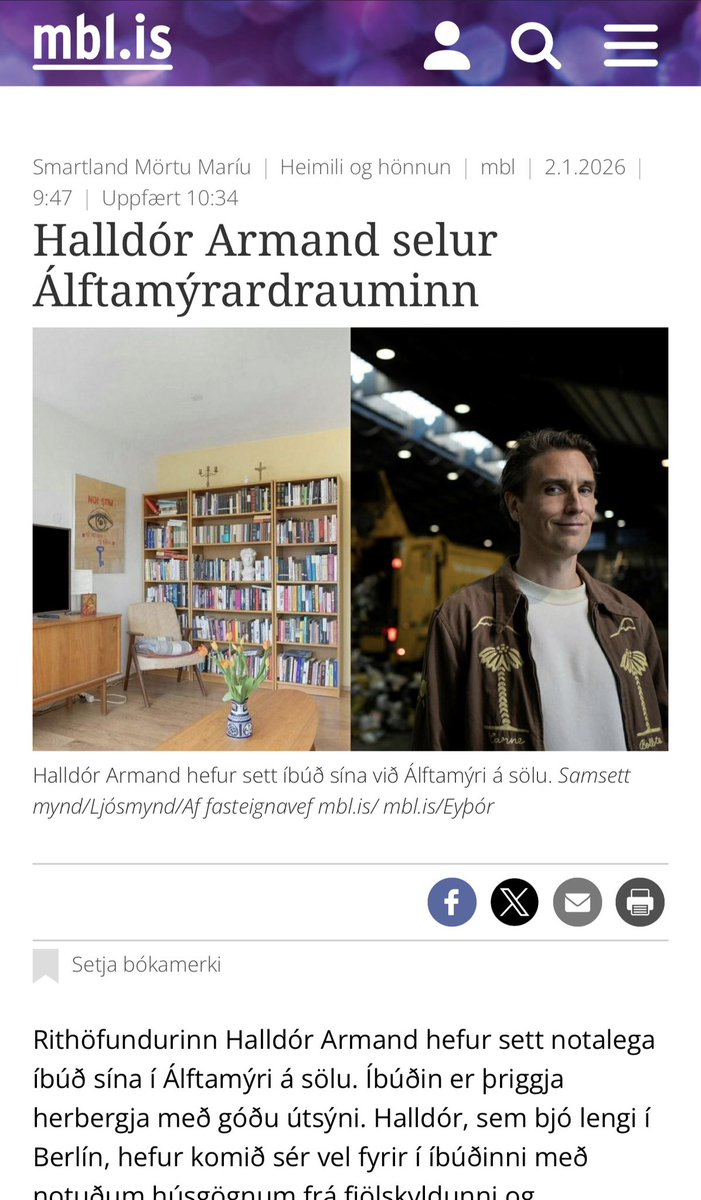
Yndislega íbúðin mín er komin á sölu. 80 fm, þriggja herbergja íbúð á annarri hæð í húsi sem hefur fengið mjög gott viðhald. Sól og skjól allan daginn á suðursvölunum. Stór garður, sem snýr í suður, með trjám og viðarbekkjum. Rólegt og gott hverfi, mjög góðir grannar, og allt sem hugurinn girnist í göngufæri. Opið hús mánudaginn 5. janúar frá 16:30–17:15. Endilega deilið með þeim sem eru að leita sér að góðri og huggulegri íbúð.
Halldór Armand tweet media
IS
1
0
6
1.8K
Halldór Armand
Halldór Armand@HalldorArmand·
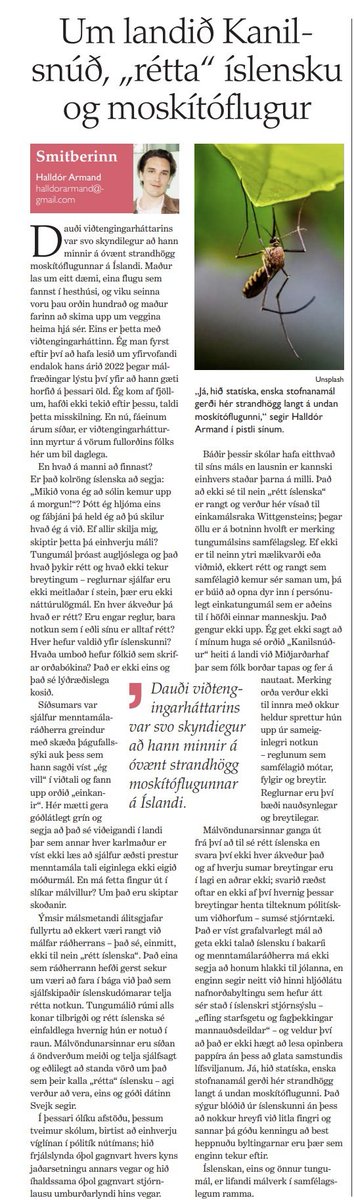
Pistill um dauða viðtengingarháttarins, landið Kanilsnúð, rétta íslensku og moskítóflugur. English: On the Land of Cinnamon Buns, “Correct” Icelandic, and Mosquitoes The death of the subjunctive was so sudden that it recalls the unexpected raid of mosquitoes on Iceland. You read about a single case — one mosquito found in a stable — and a week later there are a hundred of them, and you find yourself scanning the walls at home. The same is true of the subjunctive. I first remember reading about its impending demise in 2022, when linguists declared that it might disappear within this century. I was taken aback; I hadn’t noticed anything of the sort and assumed it must be a misunderstanding. But now, just a few years later, the subjunctive is being murdered on the lips of grown adults almost daily. So how should one feel about this? Is it outright wrong Icelandic to say, “Mikið vona ég að sólin kemur upp á morgun”? If everyone understands me, does it actually matter? Languages obviously evolve, and what counts as correct or incorrect changes over time — the rules themselves are not carved in stone; they are not laws of nature. But who, then, decides what is correct? Are there no rules at all, only usage that is always right by definition? Who holds power over Icelandic? What mandate do the people who compile the dictionary actually have? It is not as if they are democratically elected. Late last summer, the Minister of Education himself was diagnosed with a severe case of dative sickness, in addition to allegedly saying “Ég vill” in an interview and inventing the word "einkanir". One could make a friendly joke and say that this is only fitting in a country where, supposedly, every other man is illiterate, that the high priest of education barely speaks his own mother tongue. But is it fair to pick at such linguistic errors? Opinions differ. Various respected commentators asserted that there was nothing wrong with the minister’s language at all — that, precisely, there is no such thing as “correct Icelandic.” The only thing the minister was guilty of, they claimed, was violating what self-appointed language judges consider correct usage. The language accommodates all kinds of variation, and correct Icelandic is simply how it is actually used. Language purists, on the other hand, take the opposite view and consider it both natural and necessary to defend what they call “correct” Icelandic — discipline must be maintained, as the good soldier Švejk puts it. In these opposing attitudes, these two schools of thought, we glimpse something like the fault line of contemporary politics: liberal intolerance of any form of marginalisation on the one hand, and conservative intolerance of uncontrolled permissiveness on the other. Both camps have something to say for themselves, but the solution probably lies somewhere in between. The claim that there is no such thing as “correct Icelandic” is false, and here Wittgenstein’s private-language argument is relevant: at bottom, the meaning of language is social. If there is no external yardstick, no shared criterion — no right and wrong that a community agrees upon — then the door is opened to a kind of private language that exists only in the mind of a single individual. That does not work. I cannot decide that, in my own head, the word “cinnamon bun” refers to a country on the Mediterranean where people eat tapas and attend bullfights. The meaning of words does not arise within us; it emerges from shared use — from the rules a society forms, follows, and revises. The rules are therefore both necessary and mutable. Language purists assume that correct Icelandic exists, but they rarely explain who determines it, or why certain changes are acceptable while others are not; more often than not, the answer depends on how those changes align with particular political attitudes — in other words, language as a tool of power. It is apparently a grave matter not to be able to speak Icelandic in a bakery, and the Minister of Education must not say that he is looking forward to Christmas, yet no one objects to the silent nominal revolution that has taken place in Icelandic public administration — “the enhancement of workforce capability and professional expertise within the human-resources division” — which makes it impossible to read official documents without immediately losing the will to live. Yes, stiff, English-derived bureaucratic language made landfall here long before the mosquito. It drains the blood from Icelandic without anyone lifting a finger, and thus confirms the sound theory that the most successful revolutions are the ones no one notices.
Halldór Armand tweet media
IS
0
0
5
331
Halldór Armand
Halldór Armand@HalldorArmand·
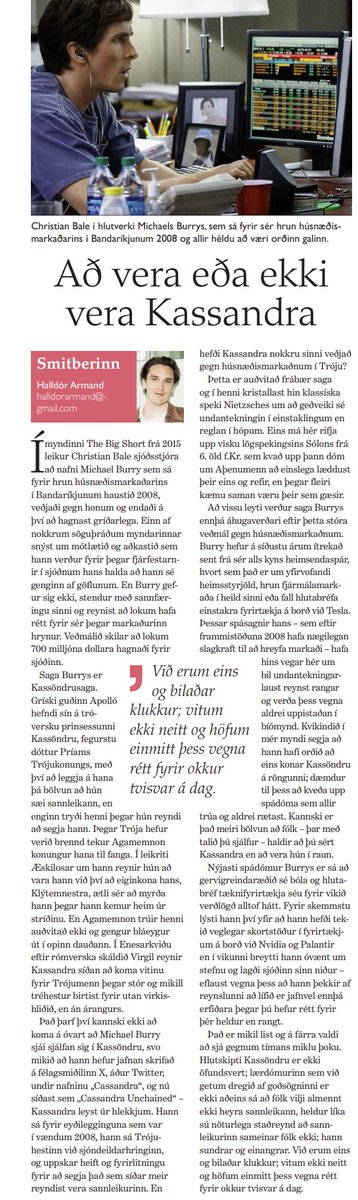
Að vera eða ekki vera Kassandra - pistill úr Sunnudagsmogga um goðsögnina um Kassöndru dóttur Príams, skortstöðukónginn Michael Burry úr Big Short og þá erfiðu list að sjá gegnum þoku tímans.
Halldór Armand tweet media
IS
0
0
7
805
Halldór Armand
Halldór Armand@HalldorArmand·
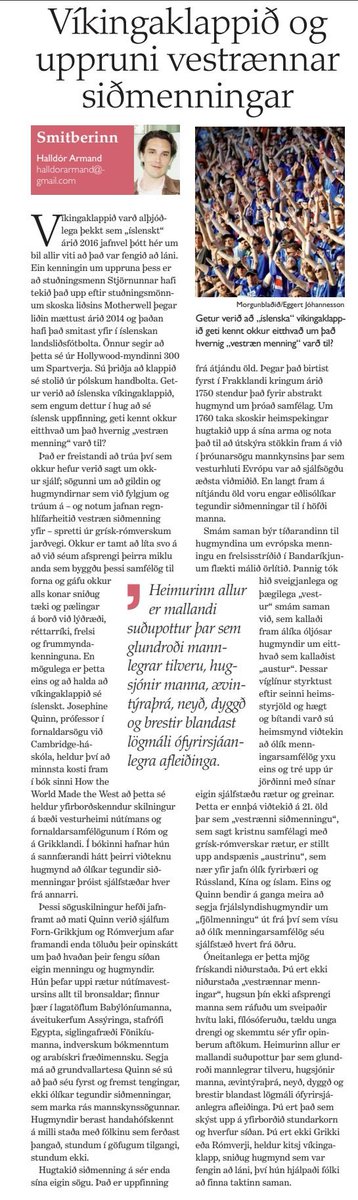
Pistill úr sunnudagsblaði um hvað Víkingaklappið getur kennt okkur um uppruna vestrænnar siðmenningar. English translation The Viking Clap and the Origins of Western Civilization The Viking clap became internationally known as “Icelandic” in 2016, even though just about everyone knows it was borrowed. One theory traces its origin to supporters of the Icelandic club Stjarnan, who picked it up from fans of the Scottish team Motherwell when the two teams met in 2014, from where it spread into Icelandic national football. Another says it comes from the Hollywood film 300, about the Spartans. A third claims it was stolen from Polish handball. Could it be that the Icelandic Viking clap—something no one seriously believes to be an Icelandic invention—has something to teach us about how “Western civilization” itself came to be? It is tempting to believe the story we’ve been told about ourselves: that the values and ideas we follow and believe in—summed up conveniently under the umbrella term Western civilization—spring from Greco-Roman soil. We like to think of ourselves as the offspring of those great minds who built those ancient societies and gave us all kinds of clever tools and concepts, such as democracy, the rule of law, liberty, and the theory of forms. But perhaps this is rather like believing that the Viking clap is Icelandic. Josephine Quinn, professor of ancient history at the University of Cambridge, argues in her book How the World Made the West that this is a shallow understanding of both the modern Western world and the ancient societies of Rome and Greece. In the book, she convincingly rejects the common idea that distinct civilizations evolved independently from one another. According to Quinn, this historical understanding would have been utterly foreign to the ancient Greeks and Romans themselves, who spoke openly about where they had acquired their own culture and ideas. She traces the roots of the modern West all the way back to the Bronze Age: to the Babylonian law tablets, the Assyrian irrigation systems, the Egyptian alphabet, the Phoenician mastery of navigation, Indian literature, and Arabic scholarship. One might say that Quinn’s central thesis is that connections—not distinct, self-contained civilizations—are what shape the course of human history. Ideas travel haphazardly from place to place with the people who move between them, sometimes with noble intentions, sometimes not. The very concept of “civilization” has its own history—it is an invention of the eighteenth century. When it first appeared in France around 1750, it referred to an abstract notion of a “developed society.” Around 1760, Scottish philosophers adopted the term and used it to explain the leaps forward in human development, with Western Europe, naturally, as the highest standard. But well into the nineteenth century, no one imagined that there were fundamentally distinct kinds of civilization. Gradually, the spirit of the age created the idea of a specifically European culture—but the American War of Independence complicated matters slightly. The flexible and convenient term the West slowly took over, which in turn called forth equally vague notions of something called the East. These fault lines hardened after the Second World War, and little by little a worldview took hold in which separate cultural societies were imagined to grow like trees from the ground, each with its own roots and branches. This remains the prevailing view in the twenty-first century, where “Western civilization”—meaning a Christian society with Greco-Roman roots—is set against “the East,” a category that somehow includes such disparate entities as Russia, China, and Islam. As Quinn points out, even liberal ideas of “multiculturalism” rest on the assumption that different cultures exist as self-contained and independent entities. This conclusion is undeniably refreshing. You are not the product of “Western civilization”; your thought is not descended from men who wandered about draped in white sheets, philosophized, seduced young boys, and enjoyed public executions. The world is a simmering stew, a cauldron of human existence in which ideals, yearning, necessity, virtue, and frailty mix under the law of unforeseen consequences. You are what bubbles briefly to the surface and then disappears again. You are not a Greek or a Roman—you are the kitsch Viking clap, a clever idea borrowed because it helped people find their rhythm together.
Halldór Armand tweet media
IS
3
0
4
1.5K
Halldór Armand
Halldór Armand@HalldorArmand·
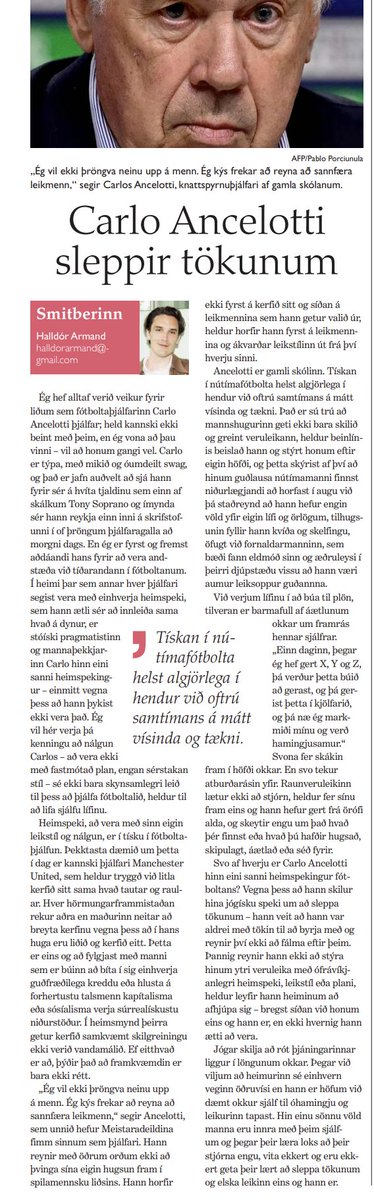
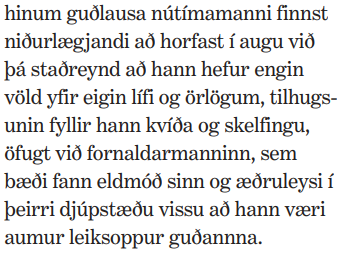
Pistill úr Sunnudagsmogga um Carlo Ancelotti og hvernig við verjum lífinu í að búa til plön og áætlanir -- erum með einhverja svakalega pælingu um það hvernig hlutirnir eiga að vera -- í heimi sem hlustar ekki á okkur. ENGLISH BELOW Carlo Ancelotti Lets Go I’ve always had a soft spot for the teams coached by Carlo Ancelotti. I might not exactly support them, but I hope they win—I want things to go well for him. Carlo is a character, with undeniable swag, and it’s as easy to picture him on the big screen as one of Tony Soprano’s lieutenants as it is to imagine him smoking alone in his office, wearing a tracksuit that’s too tight, early in the morning. But above all, I admire him for being the opposite of football’s current zeitgeist. In a world where every other coach claims to have a philosophy, which he insists on imposing no matter the circumstances, the stoic pragmatist and master of men, Carlo, is the only true philosopher—precisely because he doesn’t pretend to be one. I want to defend here the theory that Carlo’s approach—not having a fixed plan, no special style—is not only a wiser way to coach football, but a wiser way to live life itself. Philosophy, having one’s own style and approach, is fashionable in coaching. The best-known example today is perhaps Manchester United’s manager, who clings stubbornly to his little system no matter how disastrous the performances. One calamity follows another, but the man refuses to change because, in his mind, the team and the system are one. It’s like watching someone who has swallowed a theological dogma whole, or like listening to the most hardened defenders of capitalism or socialism justifying the most surreal outcomes. In their worldview, by definition, the system cannot be the problem. If something goes wrong, it only means the execution isn’t right. “I don’t want to impose anything on people. I prefer to try to convince the players,” says Ancelotti, who has won the Champions League five times as a coach. In other words, he doesn’t try to force his own ideas into his team’s style of play. He doesn’t begin with a system and then look at which players he can fit into it; he looks at the players first and decides on a style of play from there. Ancelotti is old school. The fashion in modern football goes hand in hand with the age’s blind faith in science and technology. It’s the belief that the human mind can not only understand and analyze reality, but actually harness and direct it according to its own will. This is because the godless modern man finds it humiliating to face the fact that he has no control over his own life or fate; the very thought fills him with anxiety and dread. This is the opposite of the ancient man, who found both his fire and his serenity in the deep knowledge that he was nothing more than a pitiful plaything of the gods. We spend our lives making plans; existence is overflowing with our projections of its future course. “One day, once I’ve done X, Y, and Z, then this will happen, and then that will follow, and then I’ll reach my goal and be happy.” That’s the chess game that plays out in our heads. But then events take over. Reality won’t be managed—it moves along on its own, as it has since the beginning of time, indifferent to what you think or what you had imagined, planned, or foreseen. So why is Carlo Ancelotti football’s only true philosopher? Because he understands the yogic wisdom of letting go—he knows he never had control to begin with, so he doesn’t grope for it. He doesn’t try to direct the outer world with an unbending philosophy, style, or plan; he allows the world to reveal itself, and then he responds to it as it is, not as it ought to be. Yogis understand that the root of suffering lies in our desires. When we want the world to be somehow different from what it is, we have already condemned ourselves to unhappiness, and the game is lost. The only true power humans have is within themselves, and when they finally learn that they control nothing, know nothing, and are nothing, they can finally learn to let go—and love the game as it is.
Halldór Armand tweet media
IS
2
1
38
2.6K
Halldór Armand
Halldór Armand@HalldorArmand·
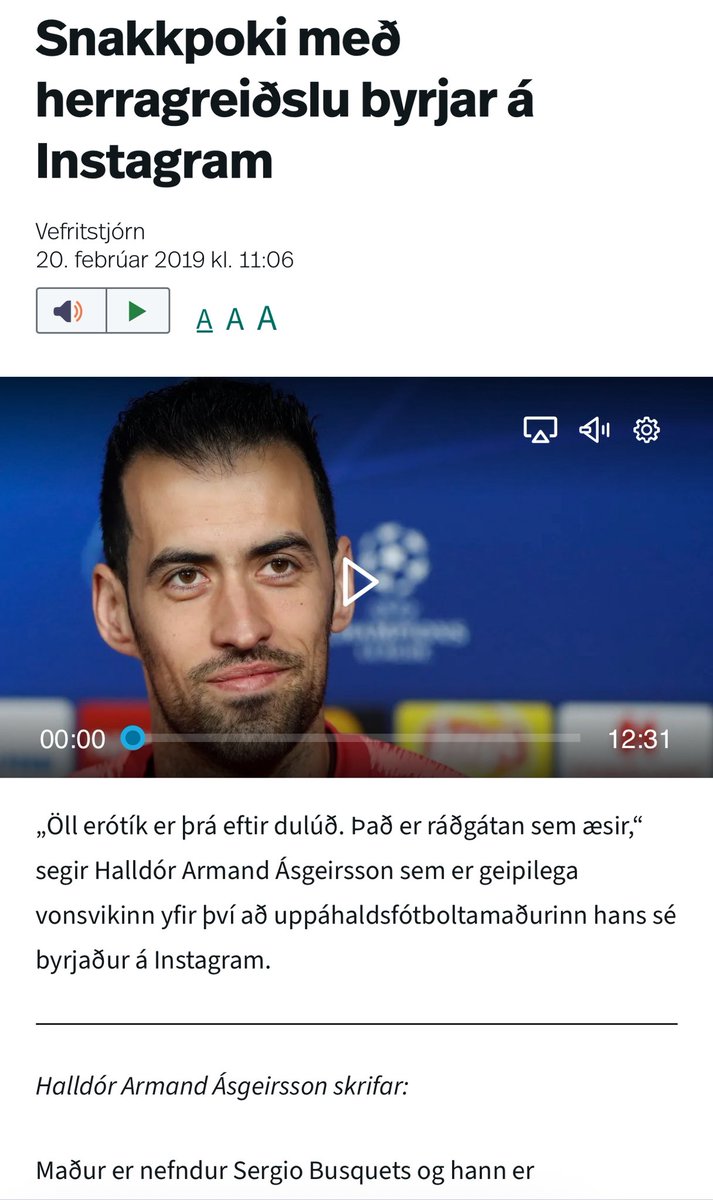
Busquets, uppáhaldsleikmaðurinn minn, að leggja skóna á hilluna. Tók það svo nærri mér þegar hann byrjaði á Instagram 2019 að ég skrifaði pistil um það. Fann meira að segja guðfræðilegan vinkil á málinu. "Lífið er leit að svari sem við viljum ekki heyra og þess vegna er ákvörðun Guðs að hylja sig alltaf það virðingarverðasta við hann." Hlekkur í reply. 👇
Halldór Armand tweet media
IS
1
0
1
404
Halldór Armand
Halldór Armand@HalldorArmand·
Nú snýst Wittgenstein eins og Tony Hawk í gröfinni🛹
Halldór Armand tweet mediaHalldór Armand tweet media
IS
0
3
26
1.6K
Halldór Armand
Halldór Armand@HalldorArmand·
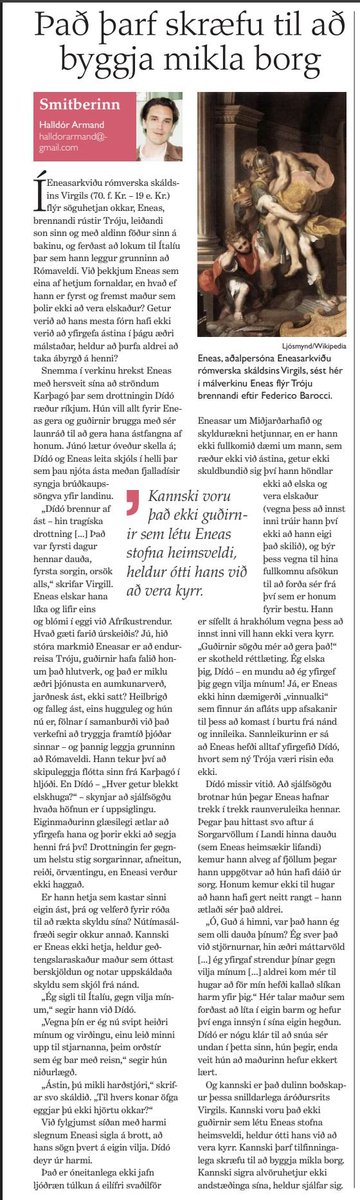
ENGLISH BELOW Pistill úr Sunnudagsmogganum um Enesarkviðu og hvernig greina má söguhetjuna með geðtengslaröskun. Á næstu opnu á undan í blaðinu er síðan grein um Charles Lindbergh, sem kallast óvænt á við skrifin um Eneas. Eneas fórnar öllu vegna þess að guðirnir hafa falið honum að nema land á Ítalíu. Eflaust hafa sömu guðir hvíslað því að Lindbergh að hann ætti að fljúga yfir Atlantshafið. Fyrst og fremst voru þetta menn á flótta undan sjálfum sér og óttuðust að sitja kyrrir. / A column from the Sunday edition of Morgunblaðið about the Aeneid and how its hero can be interpreted through the lens of attachment disorder. On the preceding spread of the paper, there happens to be an article about Charles Lindbergh, which unexpectedly resonates with the piece on Aeneas. Aeneas sacrifices everything because the gods have tasked him with settling in Italy. No doubt the same gods whispered to Lindbergh that he should fly across the Atlantic. Above all, these were men on the run from themselves, afraid of standing still. IT TAKES A COWARD TO BUILD A GREAT CITY In the Aeneid by the Roman poet Virgil (70 BCE – 19 BCE), our hero Aeneas flees the burning ruins of Troy, carrying his aged father on his back and leading his young son by the hand. He eventually makes his way to Italy, where he lays the foundations of the Roman Empire. We think of Aeneas as one of antiquity’s great heroes – but what if he wasn’t a hero at all? What if he was, above all, a man who couldn’t bear to be loved? What if his greatest sacrifice wasn’t giving up love for a higher cause, but never having to take responsibility for it in the first place? Early in the story, Aeneas and his men are driven by storm to the shores of Carthage, where Queen Dido rules. She wants nothing more than to help him, and the gods conspire to make her fall in love. Juno sends a storm; Dido and Aeneas take shelter in a cave, where they make love while mountain nymphs sing wedding songs over the land. “Dido burns with love—the tragic queen,” writes Virgil. “This was the first day of her death, the first of grief, the cause of it all.” Aeneas loves her too. He lives like a flower in bloom on the African coast. What could possibly go wrong? Well, Aeneas has a higher purpose: to rebuild Troy. The gods have entrusted him with this mission, and it demands more than the pitiful, earthly thing we call love—doesn’t it? A noble, tender love, as comforting as it may be, pales in comparison to the task of securing a nation’s future and founding an empire. So he quietly begins planning his escape from Carthage. But Dido—“Who can delude a lover?”—of course senses what’s coming. Her magnificent lover is preparing to abandon her, and he doesn’t have the courage to say it aloud. She cycles through the stages of grief—denial, anger, despair—but Aeneas won’t be moved. Is he truly a hero, casting aside love, longing, and comfort to fulfill his sacred duty? Modern psychology might say otherwise. Perhaps Aeneas isn’t a hero at all, but a man with an avoidant attachment style—terrified of vulnerability, hiding behind a grandiose sense of purpose to avoid intimacy. “I set sail for Italy – all against my will,” he tells Dido. “Thanks to you, my sense of honor is gone,” she replies. “My one and only pathway to the stars, the renown I once held dear.” “Love, you tyrant,” writes the poet. “To what extremes won’t you compel our hearts?” We then watch a sorrow-stricken Aeneas sail away—supposedly against his will. Dido dies of grief. It’s not as poetic a reading as the noble hero’s epic voyage across the Mediterranean. But isn’t Aeneas the perfect example of a man who can’t handle love, who can’t commit, who deep down believes he doesn’t deserve to be loved—and so finds the perfect excuse to flee what would actually be good for him? He’s always adrift because, at heart, he doesn’t want to stay. The gods told me to do it! is the ultimate justification. I love you, Dido—but remember, I’m leaving you against my will! Isn’t Aeneas the archetypal workaholic, always inventing new reasons to escape the people who love him? The truth is, Aeneas would have left Dido whether or not a new Troy ever rose from the ashes. Dido loses her mind. Of course she breaks, after Aeneas repeatedly denies her reality. When they meet again in the Fields of Mourning in the Land of the Dead (which Aeneas visits while still alive), he’s stunned to learn that she died from sorrow. It never occurs to him that he might have done something wrong—because he never meant to. “Oh, dear god, was it I who caused your death? I swear by the stars, by the powers on high… I left your shores, my queen, against my will… Nor did I ever dream my leaving could have brought you so much grief.” Here speaks a man who cannot bear to look inward—who has no insight into his own actions. Dido is wise enough to turn away this time. She says nothing. She knows he’s learned nothing. And maybe that’s the hidden message of Virgil’s brilliant propaganda piece: Maybe it takes emotional cowardice to build a great city. Maybe it wasn’t the gods who made him found an empire—but his fear of standing still. Maybe heroes don’t conquer their enemies. Maybe they conquer themselves.
Halldór Armand tweet media
IS
0
0
1
505
Halldór Armand
Halldór Armand@HalldorArmand·
Skrifaði pistil um Hlyn Bæringsson, Iljónskviðu, af hverju hetjur fornaldar litu ekki á sig sem sigurvegara, og hvernig mesta frelsið er kannski einfaldlega að gera skyldu sína og tæmast af sjálfum sér í þágu æðri málstaðar. @HlynurB
Halldór Armand tweet media
IS
2
5
78
5.2K
Stefán Þór Ólafsson
Stefán Þór Ólafsson@stefanthor81·
@HalldorArmand Þessi pistill er í miklu uppáhaldi hjá mér. Fáir pistlar sem mér verður eins oft hugsað til og þessi pistill. Kannski einna helst pistillinn hans Árna Helgasonar um ýmsar óskrifaðar reglur hér um árið ;)
IS
1
0
2
182
Halldór Armand
Halldór Armand@HalldorArmand·
Sá þetta niðri í Laugardal. Minnti mig á pistil sem ég skrifaði einu sinni um máttlausar tilraunir okkar til þess að hafa gaman. Fylgir hér í reply👇
Halldór Armand tweet media
IS
7
2
136
11.5K