@AshCrypto Altseason was a giant exit liquidity rug promoted by loads of KOLs.
English
PnutHarambe
2.5K posts








@CompellingDNA x.com/Phillip0516689… We also have the craniofacial and dental data of other Southern African sites like Klasies River Mouth, Border Cave, and these sites here. All roughly MIS 5 in age.




An ethnic nuristani man and his son in rural eastern Afghanistan... The Nuristani people are one of Afghanistan’s most culturally distinct and historically fascinating ethnic groups, living primarily in the rugged, mountainous region of eastern Afghanistan near the Pakistan border. For centuries, their remote valleys helped preserve unique traditions, languages, and physical features that set them apart from neighboring groups. Until the late 19th century, the region was known as Kafiristan, meaning “Land of the Unbelievers,” because the Nuristanis practiced an ancient polytheistic religion unlike the surrounding Muslim populations. In 1896, Afghan ruler Abdur Rahman Khan conquered the region, leading to its conversion to Islam and renaming it Nuristan, meaning “Land of Light.” Nuristani communities remain deeply tied to agriculture, livestock, and strong clan and family structures. Many still wear traditional clothing, with men often wearing distinctive caps and layered garments suited for the harsh mountain climate. Their languages belong to a rare Indo-Iranian branch spoken by relatively small populations, making them linguistically significant to historians and anthropologists. Nuristan is one of the most linguistically diverse regions in Afghanistan, with at least six distinct Nuristani languages, many of which are not mutually understood even between neighboring valleys. #archaeohistories


A year and a half ago I was brimming with optimism about the future. Now I just think about how my friends and family may have to a build a walled town in the mountains in order to escape the third world hellscape that’s coming.


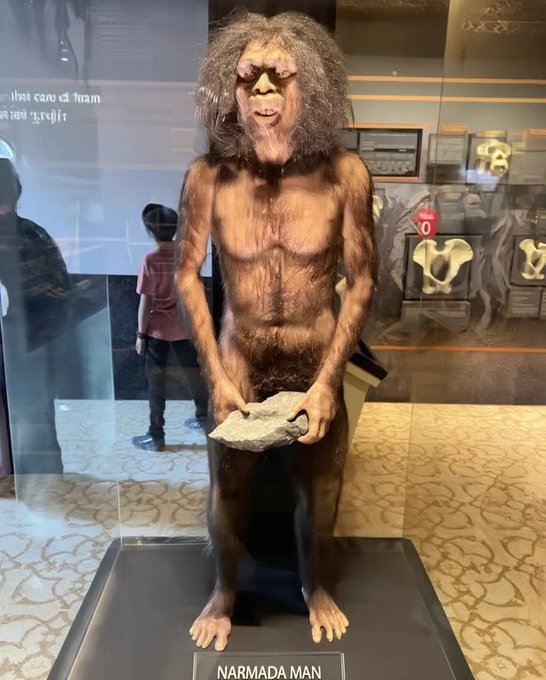
Have you ever wondered who might have been living on the Indian subcontinent hundreds of thousands of years before modern humans appeared? Narmada Man is one of the most important prehistoric human fossils ever discovered in South Asia. The fossil was found in the *Narmada Valley in Madhya Pradesh, India*, and is estimated to be around *250,000 to 300,000 years old*. This discovery has played a major role in helping scientists understand the ancient human populations that once lived on the Indian subcontinent. The remains of Narmada Man were discovered in 1982 by geologist Arun Sonakia while exploring the banks of the Narmada River. The fossil consists mainly of a partial skull, but even this fragment has provided valuable clues about early human evolution in the region. The skull shows a mixture of features that resemble both archaic humans and later human species, making it difficult for scientists to classify it with certainty. Some researchers believe Narmada Man may belong to a population related to Homo heidelbergensis, while others suggest it could represent an early form of Homo sapiens or even a unique regional group of ancient humans. This uncertainty makes the fossil especially fascinating because it highlights how complex and diverse human evolution was across different parts of the world. The discovery also suggests that the Indian subcontinent may have been an important corridor for early human migration between Africa, Europe, and East Asia. Ancient populations living in this region would have adapted to changing climates, shifting landscapes, and evolving ecosystems over hundreds of thousands of years. Today, Narmada Man remains one of the most significant pieces of evidence for early human presence in South Asia. Even though only a partial skull has been found, it continues to spark scientific debate and curiosity, reminding us that many chapters of human history are still hidden beneath the earth, waiting to be uncovered. #drthehistories