
Sabitlenmiş Tweet
Heartflow
3.1K posts


Heartflow
@Heartflow
Heartflow’s non-invasive AI-driven personalized 3D heart models empower clinicians to detect and manage coronary artery disease. #Heartflow #FFRct #Plaque #CCTA
San Francisco, CA Katılım Eylül 2016
843 Takip Edilen12.6K Takipçiler
Saturday morning at #SCCT2026: New Heartflow data sessions from 10:55 a.m., then Dr. Sarah Rinehart live at the Product Showcase Theater at 11:00 a.m.
Real data. Real cases. Exhibit Hall, Level 1. No registration required.
#YesCCT #AIinHealthcare

English
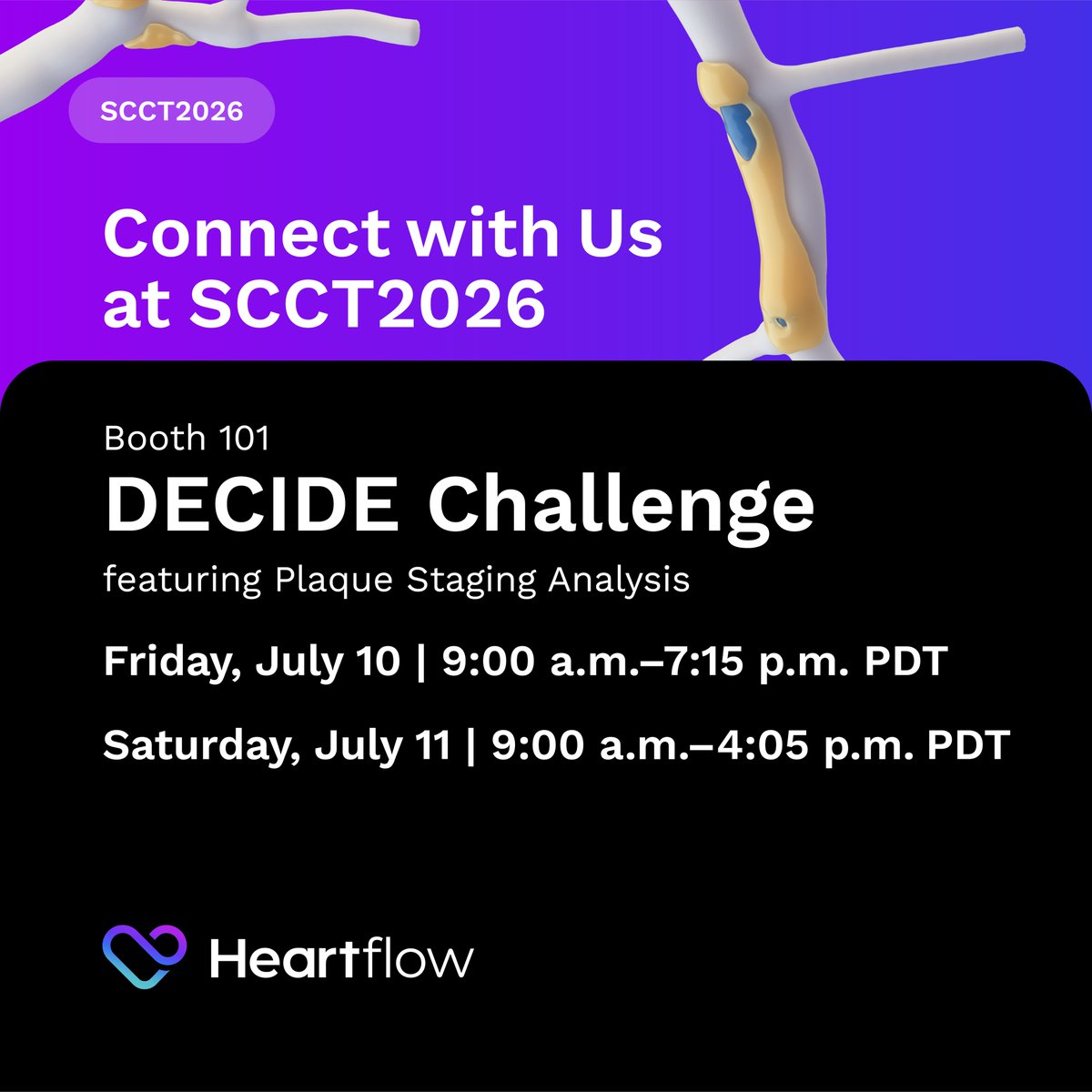
Day 2 at #SCCT2026. Stop by Booth 101 throughout the day to participate in the DECIDE challenge featuring Heartflow Plaque Staging and connect with our team.
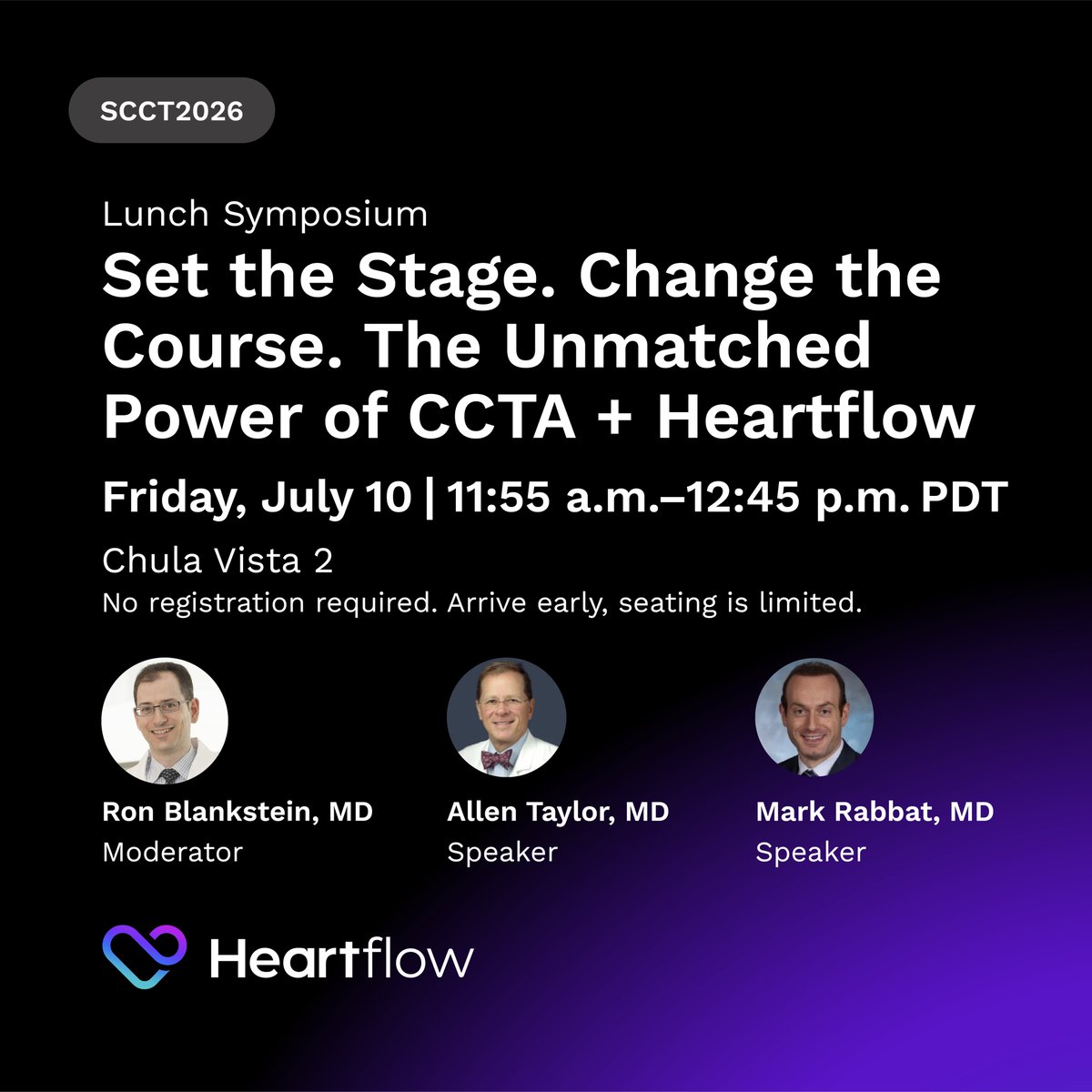
11:55 am-12:45 pm: Join Drs. @RonBlankstein, @TaylorMHVIcard and @MGRabbatMD for a lunch symposium, "Set the Stage. Change the Course. The Unmatched Power of CCTA + Heartflow" in Chula Vista 2.
5:10-6:25 pm: Hear from our Chief Medical Officer, Dr. Campbell Rogers, as he shares his perspective on the future of CCTA technology in the next five years in Chula Vista 4.
7:30-9:30 pm: Join us for “From the Heart”, a casual dinner reception featuring interactive chef stations and great networking opportunities. Register here: events.heartflow.com/en/E0aC836/scc…
#YesCCT #AIinHealthcare

English
Shaping the future of cardiovascular CT requires bold leadership, relentless curiosity, and diverse perspectives.
Join us at the Celebrate Women in CT reception at #SCCT2026 to connect with colleagues and recognize the women advancing cardiovascular CT. See you there! event.heartflow.com/scct
#WomenInCardiology #YesCCT

English
See Heartflow Plaque Analysis in action.
Join Dr. Sarah Rinehart as she walks through a real-world cardiovascular case and discusses how she incorporates plaque insights into her clinical practice.
Learn more: event.heartflow.com/scct
#SCCT2026 #YesCCT #AIinHealthcare

English
Day 1 at #SCCT2026. Here’s what we have in store:
12:30-5:30 pm: AI & Innovations Symposium. Join Chief Innovation Officer @timfonte for this hands-on workshop on AI in cardiac CT. Separate registration required.
1:00-3:00 pm: CPT Codes: Terminology & Code Formation session. Hear from Cara Santillo, SVP, Market Access and Reimbursement, on CPT code terminology, code formation, and current and future codes.
6:00-7:00 pm: Celebrate Women in CT reception on the Chula Vista Terrace (4th Floor).
And throughout the day, stop by Booth 101 to explore the DECIDE Challenge and connect with the Heartflow team. See our full slate of events here: event.heartflow.com/scct.
#YesCCT #AIinHealthcare

English
New clinical data at #SCCT2026 reinforce Heartflow Plaque Analysis as the standard for AI-powered CAD management.
Heartflow Plaque Staging, the only risk stratification tool based on Total Plaque Volume, is now included with every Heartflow Plaque Analysis. Learn more: ir.heartflow.com/news-releases/…
#AIinHealthcare #YesCCT

English
#SCCT2026 kicks off this week and we're looking forward to meeting the dedicated cardiovascular CT community driving the field forward.
We’ve rounded up the Heartflow events and sessions that you won’t want to miss. Learn more at event.heartflow.com/scct.
#YesCCT #AIinHealthcare


English
What happens between the CCTA read and the clinical decision? Too often: not enough.
Join us at our #SCCT2026 Lunch Symposium for a discussion with Drs. @RonBlankstein, @TaylorMHVIcard and @MGRabbatMD on getting more insights from CCTA. No registration required. Seating is limited.
#YesCCT #AIinHealthcare

English
Join us for “From the Heart,” our casual dinner reception at #SCCT2026.
Our Chief Medical Officer, Dr. Campbell Rogers, will kick off the evening with a 10-minute talk on what's next in cardiac imaging and AI, followed by opportunities to connect with leaders shaping the future of cardiovascular care.
Seats are limited. Reserve yours now: events.heartflow.com/en/E0aC836/scc…
#AIinHealthcare #YesCCT

English
Traditional risk evaluation tools can miss heart disease in women, prompting important conversations about how cardiovascular disease is evaluated and managed.
Watch Drs. @CMichaelGibson and @drmalissawood discuss the evolving role of CCTA in providing a more complete picture of CAD in women below.
#YesCCT #AIinHealthcare #HerHeartMatters
C. Michael Gibson MD@CMichaelGibson
Women don't always present with the "classic" signs of heart disease—and that can have serious consequences. Dr. Malissa Wood and I discuss the gaps in women's cardiovascular care and why CCTA is emerging as a powerful tool for earlier, more accurate diagnosis. S/b @Heartflow clinicaltrialresults.org/women-dont-alw…
English
CT-guided PCI is changing how clinicians think about procedural planning.
In this conversation, Drs. @CMichaelGibson and @ESHLOF discuss the role of CCTA in PCI planning and the ongoing research being conducted through the NAVIGATE-PCI Registry.
Watch their full conversation below.
#YesCCT #AIinHealthcare #PCI
C. Michael Gibson MD@CMichaelGibson
When we think of CT angio we usually think of risk stratification, prevention and diagnosis. But CT angio can also be used to plan your PCI procedures ! Dr. Evan Shlofmitz and I discuss how it can be used for stent sizing, stent length to assure you are stenting from normal to normal vessel walls (not lumens) and other advantages. s/b Heartflow clinicaltrialresults.org/when-we-think-…
English
How can we elevate the CCTA read to better serve the patient?
Join us at #SCCT2026 for our lunch symposium, “Set the Stage. Change the Course. The Unmatched Power of CCTA + Heartflow Plaque,” on July 10 at 11:55 a.m. in Chula Vista 2.
Drs. @RonBlankstein, @TaylorMHVIcard and @MGRabbatMD will discuss how to bridge the gap between the reading room and the clinic to better serve patients.
No registration is required, but seating is limited. See you there!
#YesCCT #PlaqueAnalysis

English
Heart disease is the leading cause of death in the U.S., but it is also one of the most manageable conditions in cardiovascular medicine.
The key is getting ahead of it. Heartflow gives cardiologists like Dr. Dharmesh Patel a clearer picture of plaque volume and composition in coronary vessels — enabling earlier, more targeted intervention. For patients with CAD, that insight can be life-changing.
Leaders like Richard Smith, COO International & CEO of Airline Operations at FedEx, know this well. Discover how Heartflow supports a more proactive approach to cardiovascular care: heartflow.com/patients-cad/p…
#AIinHealthcare #Cardiology #PlaqueAnalysis #HeartHealth
English
Join us at #SCCT2026 for our educational reception, “From the Heart,” on July 10 from 7:30-9:30 p.m. at Marzul Coastal Cuisine.
Hear from our Chief Medical Officer, Dr. Campbell Rogers, as he shares his perspective on the future of advanced imaging and what’s next for cardiovascular care, followed by an opportunity for questions and conversation.
Reserve your spot: events.heartflow.com/en/E0aC836/scc…
#PlaqueAnalysis #AIinHealthcare

English
Heading to San Diego for #SCCT2026?
Join us for an exciting lineup of educational sessions, expert discussions, and data presentations focused on the latest advances in diagnosing and managing CAD.
Be sure to stop by Booth 101 to see what’s new and participate in the DECIDE challenge featuring Heartflow Plaque Staging: event.heartflow.com/scct.
See you there!
#PlaqueAnalysis #yesCCT

English
After cardiovascular disease impacted his father, Richard Smith, COO International & CEO of Airline Operations at FedEx, wanted a deeper understanding of his own heart health.
A coronary CTA and Heartflow Plaque Analysis helped provide that understanding, revealing significant plaque burden despite otherwise reassuring cardiac test results.
Hear more from Dr. Dharmesh Patel as he explains how that level of insight can change the questions physicians ask, the conversations they have with patients, and the treatment decisions they make: heartflow.com/patients-cad/p…
Thank you to Stern Cardiovascular Center and East Memphis Imaging for helping us capture Richard’s story and supporting innovative patient care.
#AIinHealthcare #Cardiology #PlaqueAnalysis #HeartHealth
English
How is CCTA changing the way clinicians assess risk and guide cardiovascular care?
In a recent CardioNerds podcast episode, Dr. Michael Gallagher joined Drs. @JKassabMD, Mariana Garcia-Arango, and Christopher Mason to explore how CCTA has evolved to integrate physiology through FFRct and biology through AI-driven plaque quantification.
Their discussion highlighted landmark evidence from the SCOT-HEART and PROMISE trials, advances in CAD-RADS 2.0 reporting, and the growing role of AI in personalizing patient care.
Tune in to the full episode here: cardionerds.com/451-ccta-ct-ff…
#AIinHealthcare #YesCCT
English
Join us at 3:00 p.m. CDT on Thursday, June 11, in Sheraton Ballroom II for an exciting expert theater at #NLA2026.
We’ll explore how coronary CTA and Heartflow Plaque Analysis are advancing personalized cardiovascular prevention. Drs. Sarah Rinehart and Nihar Desai will examine the evolving role of plaque analysis in risk stratification—including how to identify patients who stand to benefit most, practical considerations for clinical integration, and what’s next for plaque-focused prevention strategies.
We hope to see you there.
#AIinHealthcare #PlaqueAnalysis #yesCCT

English
Heading to #NLA2026 in Chicago?
Stop by Booth 301 to connect with our team to see how we’re helping clinicians advance personalized cardiovascular prevention.
We’re looking forward to connecting!
#AIinHealthcare #PlaqueAnalysis #yesCCT

English
Attending @AHNtoday's 26th Annual Cardiovascular Disease Symposium in Bedford, PA?
Join us for a lunch symposium on Saturday, May 30, at 12:30 p.m. EDT in the Eisenhower Ballroom. Dr. @TaylorMHVIcard will discuss how CCTA and Heartflow Plaque Analysis can support risk stratification, identify the right patients, integrate into clinical workflows, and shape the future of plaque-focused prevention.
#PlaqueAnalysis #AIinHealthcare #yesCCT

English