HENRY HUANG

352 posts

HENRY HUANG banner
HENRY HUANG

HENRY HUANG

@HenryNestpoint

Managing Director at Nestpoint | Government Affairs · Finance · Trade

United States Katılım Aralık 2009
143 Takip Edilen108 Takipçiler
HENRY HUANG retweetledi
Winston
Winston@ChurchillWw·
US manufacturing capacity has shown solid growth for 16 consecutive quarters, indicating a consistent trend. This is the first sustained expansion of US manufacturing capacity in nearly two decades. What makes it more interesting is that many of the sectors leading the expansion are those that feed back into production itself: business equipment (+4.6% YoY), machinery, electrical equipment, fabricated metal, and computer and electronic products. federalreserve.gov/releases/g17/c…
Winston tweet media
English
61
643
3K
184.3K
HENRY HUANG
HENRY HUANG@HenryNestpoint·
Money supply growth at this stage reflects a system still adjusting to prior stimulus rather than a new phase of expansion. The key variable is whether liquidity is being absorbed into productive activity or remaining concentrated in financial assets, which determines its broader economic impact.
English
0
0
0
107
The Kobeissi Letter
The Kobeissi Letter@KobeissiLetter·
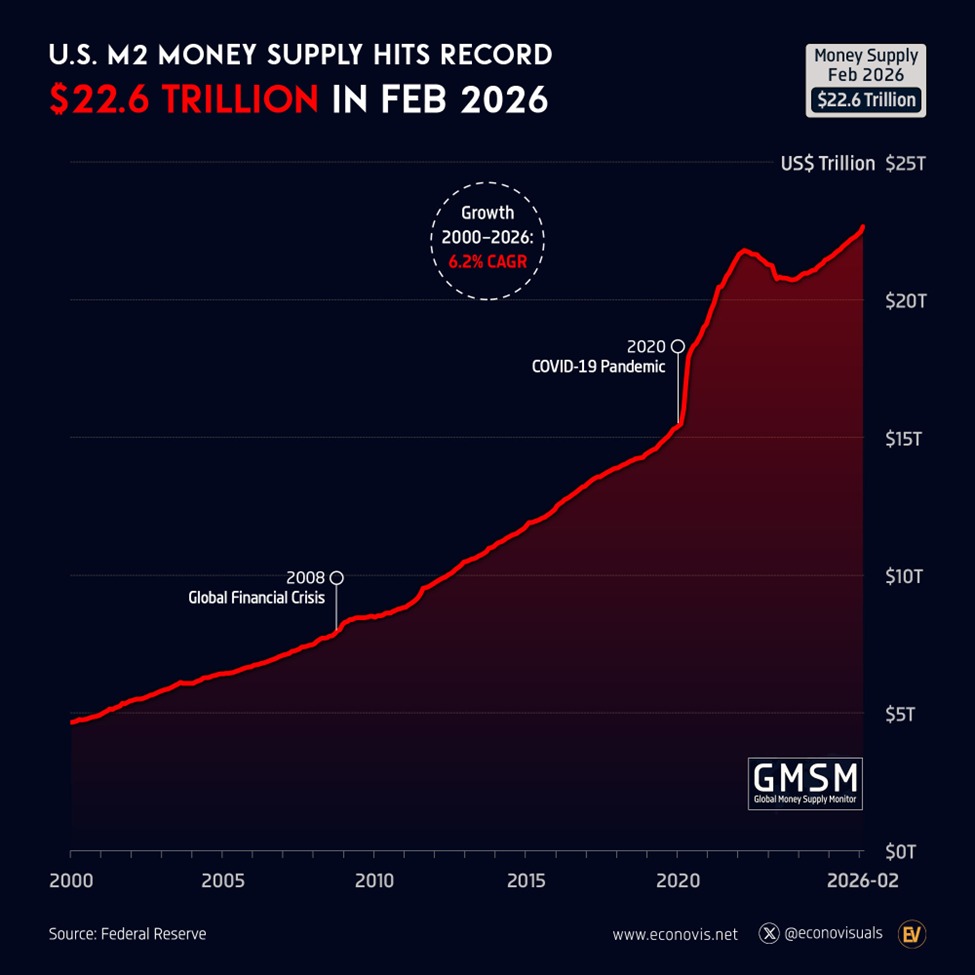
BREAKING: US M2 money supply jumped +4.8% YoY in February, to a record $22.6 trillion, marking the 24th consecutive monthly increase. Money supply is now ~$700 billion above the March 2022 peak. Since the 2020 pandemic, M2 has surged +$7.1 trillion, or roughly +$1.2 trillion per year. Since 2000, money in circulation has grown at an average annual rate of +6.2%. The US Dollar is losing purchasing power at a historic pace.
The Kobeissi Letter tweet media
English
234
1.1K
4.8K
571.6K
HENRY HUANG retweetledi
The Wall Street Journal
Iran’s chokehold on the Strait of Hormuz shows it isn’t just superpowers that can weaponize economic pinch-points on.wsj.com/41lQixd
English
78
154
596
49.2K
HENRY HUANG retweetledi
Ray Dalio
Ray Dalio@RayDalio·
Already both the U.S. and Iran are claiming to have won the war and are negotiating about the negotiations. As explained in my recent note, it all comes down to who controls the Strait of Hormuz, which will have big implications around the world. x.com/RayDalio/statu…
Ray Dalio@RayDalio

x.com/i/article/2033…

English
74
189
1.2K
228.5K
HENRY HUANG retweetledi
The Kobeissi Letter
The Kobeissi Letter@KobeissiLetter·
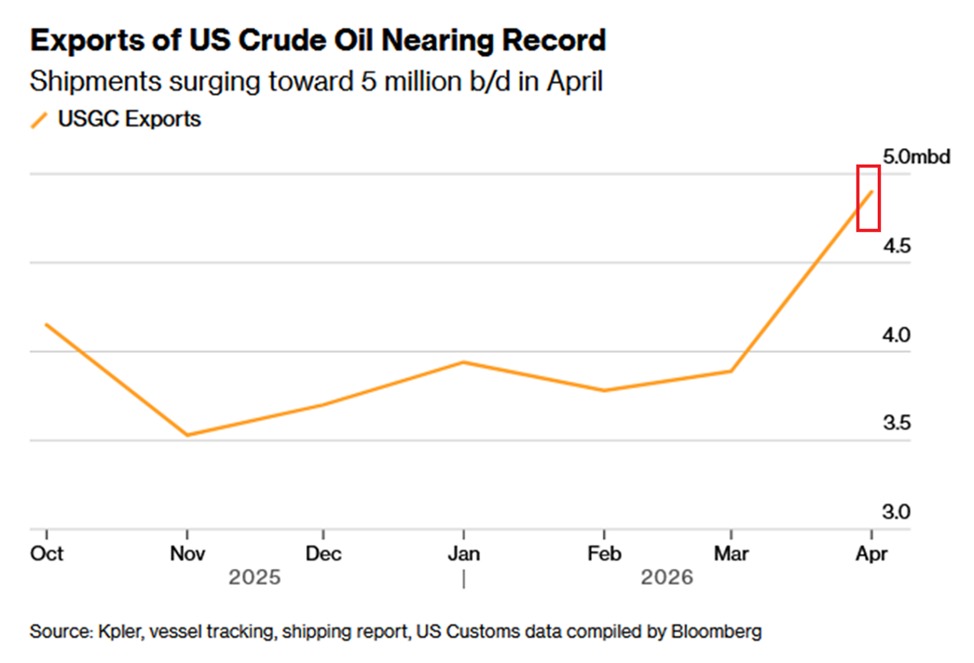
US crude oil exports are skyrocketing: US Gulf Coast crude exports are on track to average a record 4.90 million barrels a day in April based on current loadings. That would be up +23%, or +930,000 barrels per day since March, and up +30%, or +1.12 million barrels per day since February. At the current pace, May exports will exceed 5.0 million barrels a day for the first time in history. This comes as Asian buyers are securing US cargoes to offset the loss of Middle Eastern supply while flows from the Strait of Hormuz remain significantly limited. For May alone, 28 supertankers are already lined up to carry US crude, compared to 5 typically booked at this point in a month. Global demand for American oil has never been higher.
The Kobeissi Letter tweet media
English
246
1.1K
4.9K
578.2K
HENRY HUANG
HENRY HUANG@HenryNestpoint·
@GlobalMktObserv The system depends on continuous flow, not just available supply. Disruptions at this scale reprice risk immediately.
English
0
0
0
16
Global Markets Investor
Global Markets Investor@GlobalMktObserv·
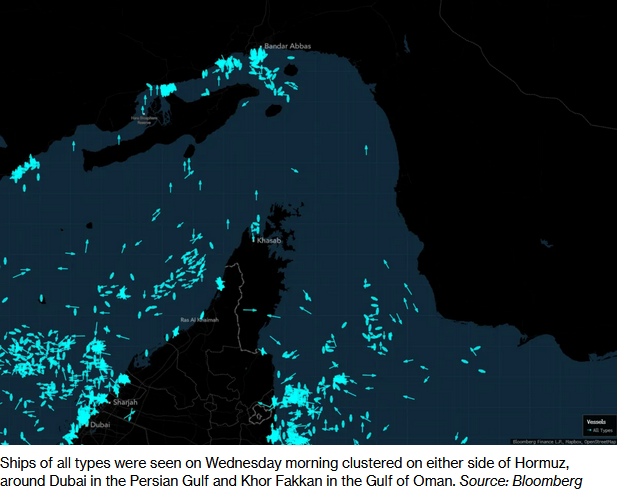
⚠️The Strait of Hormuz is still SHUT: Just 3 ships were observed leaving the Persian Gulf on Wednesday, compared to ~135 that transit daily in normal times, according to Bloomberg ship-tracking data. Over 800 vessels remain trapped inside the Gulf, including ~230 loaded with oil and ready to sail. Meanwhile, the head of Abu Dhabi National Oil, the UAE's largest producer, said "conditional passage is not passage" and demanded the Strait be opened fully and without restriction. Iran's armed forces are still requiring permission for all navigation through the Strait, while charging tolls of up to $2 million per transit. Moreover, Iran's Revolutionary Guard published a chart confirming sea mines were placed in the main shipping lanes, directing all vessels through two alternative routes closer to Iran's mainland near Larak Island. Goldman Sachs warns that if the Strait remains closed for another month, Brent crude is set to average over $100 a barrel through 2026, with an adverse scenario seeing $120 in Q3. The ceasefire is extremely fragile.
Global Markets Investor tweet media
English
4
27
102
10.9K
HENRY HUANG
HENRY HUANG@HenryNestpoint·
@KobeissiLetter Growth at this level complicates the policy path. Slower activity would normally support easing, but persistent inflation and fiscal dynamics limit how aggressively policy can adjust, creating a narrower and more uncertain path forward.
English
0
0
0
111
The Kobeissi Letter
The Kobeissi Letter@KobeissiLetter·
BREAKING: US GDP growth falls from 4.4% to 0.5% in Q4 2025, well below the initially expected +2.8% growth.
English
901
4K
19.2K
4.6M
HENRY HUANG retweetledi
Global Markets Investor
Global Markets Investor@GlobalMktObserv·
🔴Europe's diesel and jet fuel squeeze is exposing deep supply vulnerabilities: France and the UK run the largest diesel and kerosene deficits in Europe, with consumption outpacing domestic refinery output by over -400 thousand barrels per day each, according to BloombergNEF data. France's deficit is driven primarily by diesel, while the UK faces a more balanced gap across both fuels. Germany and Poland follow, with shortfalls of ~-150 and ~-75 thousand barrels per day, respectively. With the Strait of Hormuz closure limiting Middle Eastern crude flows, countries already running deep product deficits face the sharpest price spikes ahead. Europe's structural refining deficit is now the front line of the crisis.
Global Markets Investor tweet media
English
5
83
211
27.8K
HENRY HUANG retweetledi
The Kobeissi Letter
The Kobeissi Letter@KobeissiLetter·
We are now facing the biggest global energy crisis in history: Total oil product exports from the Middle East plunged -63% in March, or -4.8 million barrels per day, to ~2.8 million barrels per day. Of the remaining ~2.8 million barrels per day still being exported, ~1.1 million barrels per day, or 39%, is flowing through Saudi Arabia's Red Sea ports, bypassing the shut Strait of Hormuz. Jet fuel was hit the hardest, with exports plunging -85%, triggering flight cancellations and fuel shortages across Asia-Pacific. At the same time, LPG and naphtha exports dropped by -1.0 million barrels per day. Diesel, gasoline, and fuel oil exports also fell sharply, with declines ranging from -60% to -70%. The Strait of Hormuz crisis is in full-swing.
The Kobeissi Letter tweet media
English
195
897
3.2K
327.2K
HENRY HUANG
HENRY HUANG@HenryNestpoint·
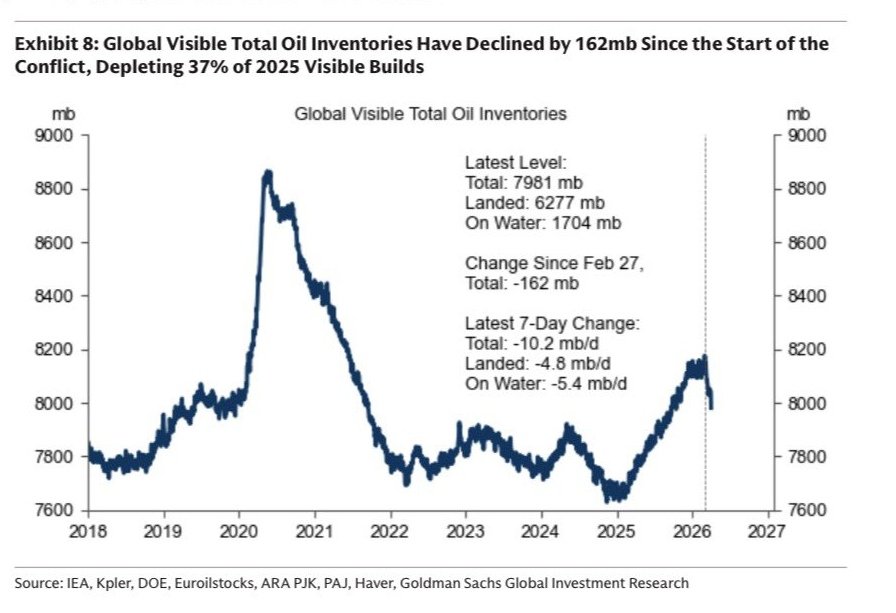
This isn’t about the world running out of oil, it’s about the system losing its buffer. Inventories are the shock absorbers of the energy market, and when they draw down this quickly, even small disruptions can have outsized price and volatility impacts. The issue shifts from supply levels to supply resilience, which is where geopolitical risk becomes embedded directly into pricing.
English
0
0
0
97
Global Markets Investor
Global Markets Investor@GlobalMktObserv·
⚠️Is the world running out of oil? Global visible oil inventories have fallen -162 million barrels since the start of the Iran war on February 27, erasing ~37% of the inventory built up in 2025. Total inventories are down to 7,981 million barrels, declining at a rate of -10.2 million barrels per day over the last 7 days. Floating storage from the Persian Gulf has collapsed by ~250 million barrels, as oil that would normally be in transit through Hormuz is no longer moving. Asia excluding China and India has been the hardest hit on the landed side, with inventories falling sharply since early March. Goldman Sachs has called this the largest oil supply shock on record, estimating cumulative losses could exceed 800 million barrels over a 6-week period if the Strait remains at current levels. The global oil buffer is disappearing fast.
Global Markets Investor tweet media
English
4
39
117
9.8K
HENRY HUANG
HENRY HUANG@HenryNestpoint·
@GlobalMktObserv Energy markets are becoming increasingly regional under stress, even as pricing remains globally linked.
English
0
0
2
246
Global Markets Investor
Global Markets Investor@GlobalMktObserv·
‼️The diesel shortage in Asia is so severe that traders are shipping fuel from the UK and the US to meet demand: The price spread between Asian and European diesel has exploded to $244 per ton, up from near zero before the Iran war. This spread measures how much more Asian buyers are paying for diesel compared to European buyers, and at these levels, it is profitable to ship fuel halfway around the world to meet Asian demand. As a result, tankers are now making journeys that would normally make no economic sense, including a 12,000-mile shipment of diesel from the UK to Australia and cargoes moving from the US West Coast to Singapore and Pakistan. Europe itself remains short of diesel, but the situation in Asia is so much more difficult that barrels are being pulled away from European markets. The IEA has already called this the biggest supply shock in HISTORY. The longer the Strait of Hormuz remains closed, the more intense the global competition for fuel will become.
Global Markets Investor tweet media
English
6
106
254
24.5K
HENRY HUANG retweetledi
The Economist
The Economist@TheEconomist·
The number of people facing acute hunger could reach record levels in 2026, if the conflict in Iran does not end soon. The Economist has analysed some of the emerging markets most at risk, examining their reliance on imported energy and the fragility of their economies. Explore the full list: econ.st/489se4d
English
50
490
1.1K
132.1K
HENRY HUANG
HENRY HUANG@HenryNestpoint·
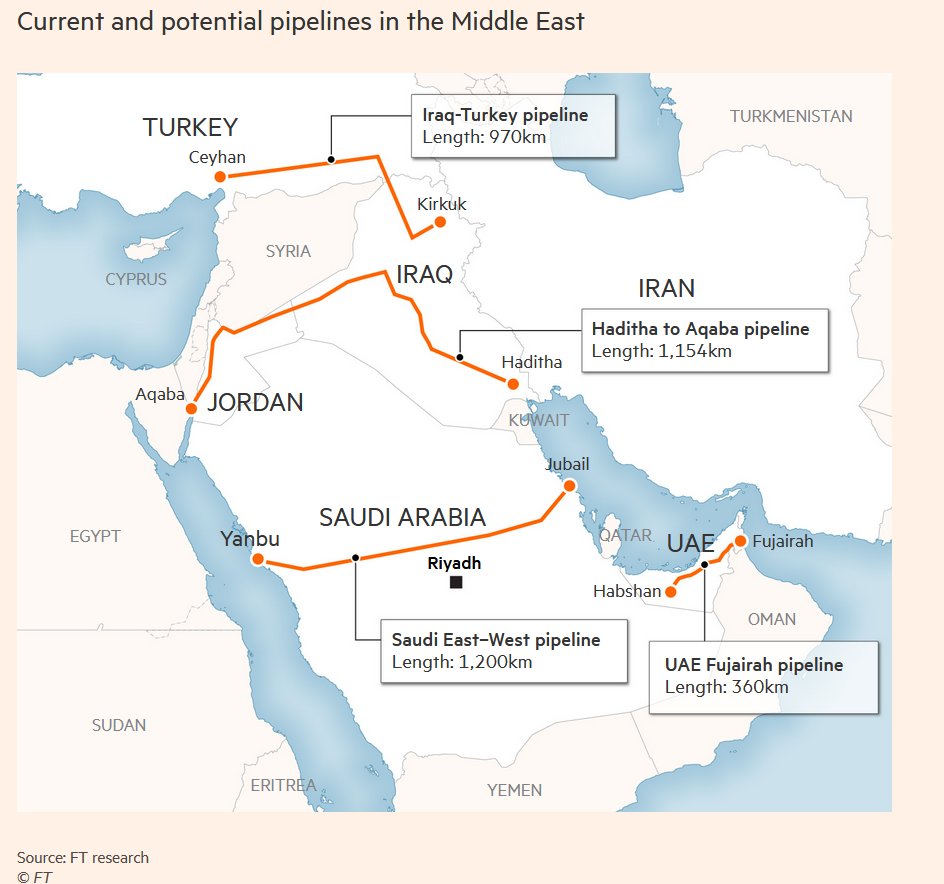
This is a clear shift from efficiency to resilience where the priority is no longer minimizing cost but reducing exposure to single points of failure. Pipeline expansion is effectively a form of geopolitical insurance, but it comes with long timelines, high capital intensity, and political friction across borders, which means the world remains structurally exposed even as countries attempt to rewire flows.
English
0
0
1
103
Global Markets Investor
Global Markets Investor@GlobalMktObserv·
⚠️Gulf states are planning a network of pipelines to reduce their dependence on the Strait of Hormuz: The Iran war has exposed how dependent Gulf oil exporters remain on a single chokepoint, pushing countries to revisit costly pipeline projects that have stalled for years. Saudi Arabia's 1,200km East-West pipeline, built in the 1980s during the Iran-Iraq war, is now the blueprint, delivering ~7 million barrels per day to the Red Sea port of Yanbu and bypassing Hormuz entirely. The kingdom is now exploring expanding the East-West pipeline further, while Iraq is looking to revive routes through Turkey (970km to Ceyhan) and Jordan (1,154km to Aqaba). At the same time, the UAE is considering expanding its 360km Fujairah pipeline. However, the cost of building new multi-country routes from Iraq through Jordan, Syria, or Turkey is estimated at $15 billion to $20 billion, with security risks and political complexity adding further obstacles. Even replicating the East-West pipeline today would cost at least $5 billion. The crisis has made one thing clear: relying on a single maritime chokepoint for ~20% of global oil supply is no longer acceptable.
Global Markets Investor tweet media
English
17
41
105
13.9K
HENRY HUANG
HENRY HUANG@HenryNestpoint·
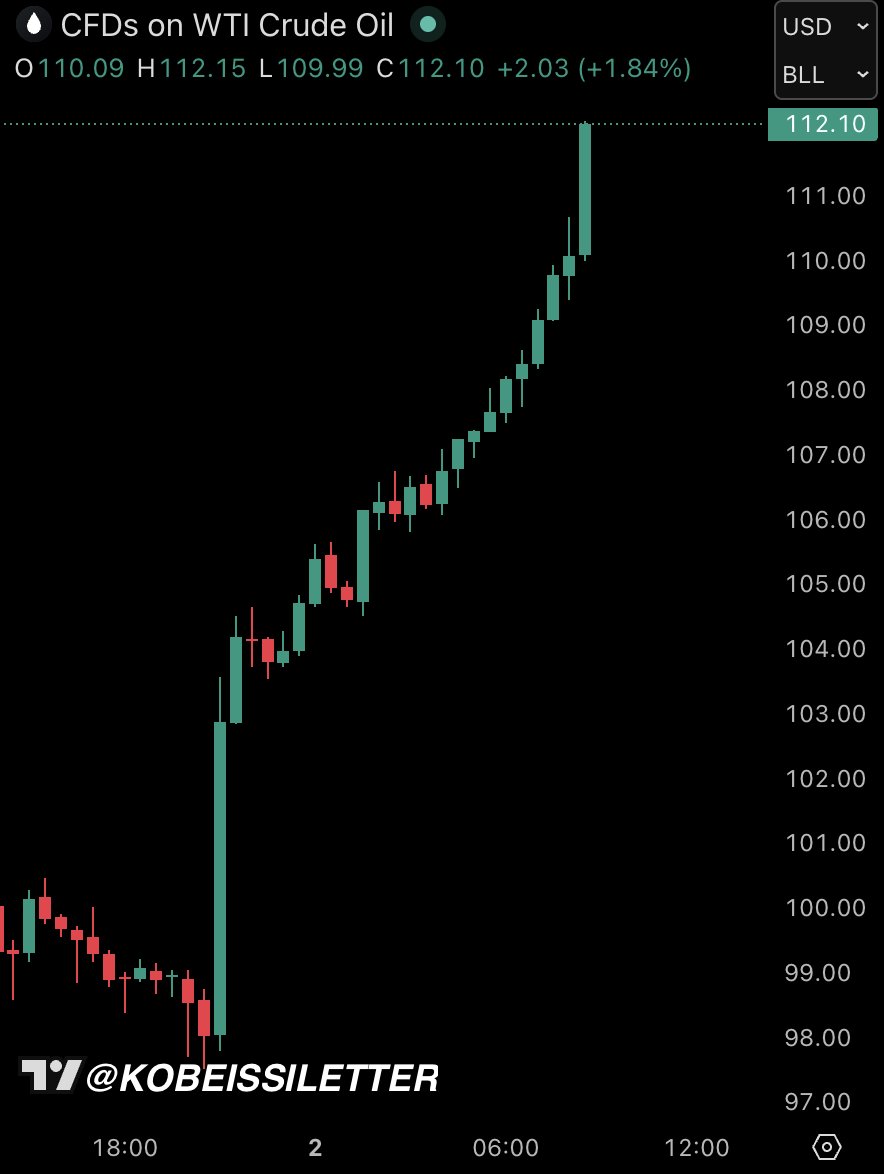
The speed of the move matters more than the level. Sharp repricing in oil tends to signal that risk is shifting from inventory cycles to system stress, where chokepoints, production outages, and escalation risk begin to dominate pricing. That’s when energy transitions from a macro input into a macro driver.
English
0
0
2
774
The Kobeissi Letter
The Kobeissi Letter@KobeissiLetter·
BREAKING: US oil prices surge above $112/barrel, now up +13% on the day.
The Kobeissi Letter tweet media
English
489
2K
7.6K
1.3M
HENRY HUANG retweetledi
HENRY HUANG
HENRY HUANG@HenryNestpoint·
Dependency is not just an economic condition, it is a strategic exposure. Whether it is energy, semiconductors, food, capital markets, data infrastructure, or labor, reliance shifts leverage away from the dependent and toward the supplier. History shows that systems fail not when they stop working, but when they become brittle, optimized for efficiency instead of resilience. The defining competition of this decade is not ideology, it is control over production, inputs, and optionality. Nations, institutions, and individuals that mistake low cost for strength will learn that stability is earned through redundancy, domestic capacity, and the ability to adapt under pressure. Independence does not mean isolation, but it does mean never confusing convenience with security.
HENRY HUANG tweet media
English
0
1
2
39
HENRY HUANG
HENRY HUANG@HenryNestpoint·
This is a clear example of how states try to reduce exposure to critical chokepoints rather than eliminate it entirely. Even at full capacity, bypass infrastructure only offsets a portion of flows, which means the Strait of Hormuz remains a central node in global energy markets and a persistent source of systemic risk.
English
0
0
1
321
The Spectator Index
The Spectator Index@spectatorindex·
BREAKING: Saudi Arabia's east-west pipeline that bypasses the Strait of Hormuz is now pumping oil at its full capacity of around 7 million barrels a day, according to Bloomberg report.
The Spectator Index tweet media
English
348
1.5K
7K
678.4K
HENRY HUANG
HENRY HUANG@HenryNestpoint·
@KobeissiLetter Intraday reversals like this highlight how sensitive energy markets are to flows and sentiment when positioning is crowded.
English
0
0
4
714
The Kobeissi Letter
The Kobeissi Letter@KobeissiLetter·
BREAKING: US oil prices erase gains and turn negative on the day, falling below $98/barrel. Equity markets are also paring losses.
The Kobeissi Letter tweet media
English
370
450
4.2K
2.7M
HENRY HUANG
HENRY HUANG@HenryNestpoint·
Energy has a disproportionate impact on inflation because it feeds through both directly and indirectly into the broader economy. Rising oil and fuel costs lift headline CPI while also increasing transportation, production, and input costs, which can sustain inflationary pressure even as other components soften.
English
1
0
1
111
Charlie Bilello
Charlie Bilello@charliebilello·
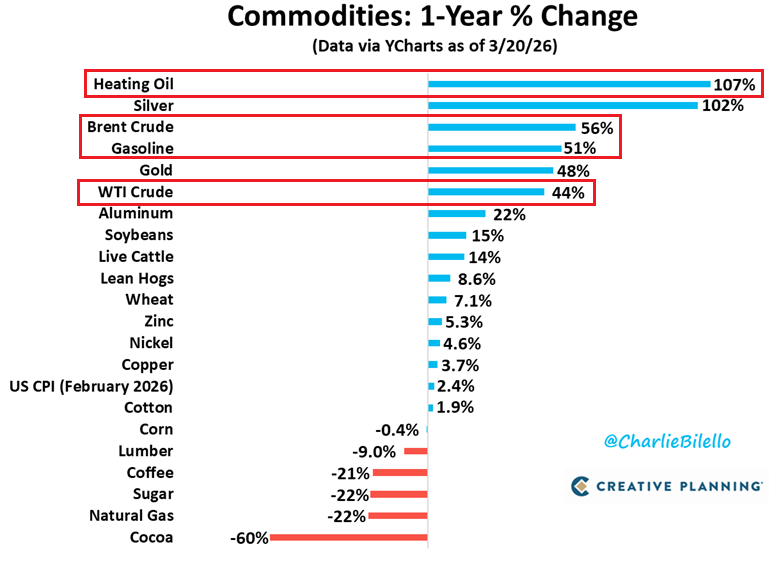
For most of the past three years, falling energy prices had been helping to push the US inflation rate (CPI) lower. But that tailwind will soon become a headwind, with prices of Oil and Gas spiking on a YoY basis. CPI could hit 3% in March. Video: youtube.com/watch?v=L3o7T1…
YouTube video
YouTube
Charlie Bilello tweet media
English
26
49
232
43.8K
HENRY HUANG
HENRY HUANG@HenryNestpoint·
What stands out is how concentrated the dependency is among Asian economies, particularly China and India, which rely heavily on uninterrupted flows through a single chokepoint. This creates asymmetric exposure where disruptions in one narrow corridor can have disproportionate economic and strategic consequences across entire regions.
English
0
0
0
151
Jesse Cohen
Jesse Cohen@JesseCohenInv·
What do you notice?
Jesse Cohen tweet media
English
34
69
189
29K