Hiesinger Lab
65 posts

Hiesinger Lab
@HiesingerLab
Innovation at the intersection of cardiothoracic surgery and machine learning.


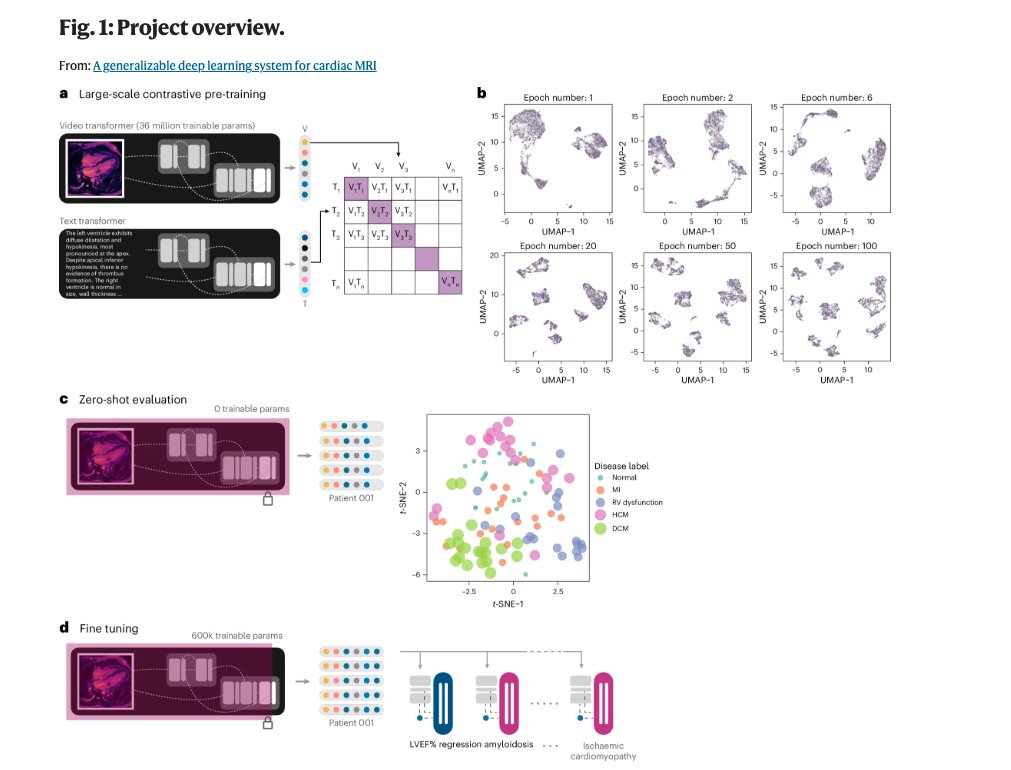
I’m excited to finally showcase our work on developing a generalizable deep learning system for cardiac MRI. This is the culmination of over 3 years of research spanning my time as a postdoc in @HiesingerLab and now as a cardiac surgery resident at @pennsurgery, and I couldn’t be happier with the finished product. Weights to be released for academic use (coming soon!). All built with @pytorch and @pytorch_lightning. Lots of really cool stuff to unpack, but here are few main results: Contrastive learning with cine-sequence CMR studies from multiple different views (short axis, 2-chamber, 3-chamber, and 4-chamber views) with long-form CMR free text reports is really hard. A good sign for us was how the video transformer embeddings evolved with each epoch. We train for about 600 epochs taking about 2 weeks. In a zero shot fashion, the model can then do some really interesting things: separate out different diseases (ACDC dataset), and different genders, age groups, and ejection fractions (UK BioBank) with no explicit supervised instruction. No such behaviour with kinetics-600 initialized weights (see preprint)! Finetuning over our system yields results superior to baseline approaches on downstream tasks of interest, with 10x and sometimes 100x less data. Here’s a quick figure showing how we achieve superior results for UK BioBank LVEF estimation with just 1% of the available data. Better yet, that same model when tested on a Kaggle dataset does exceptionally well (dashed line = kinetics-600 performance on left; lower is better!). Focusing on some disease diagnosis tasks, we label a separate dataset of some 6000 individual patients. This is real-world representative unenriched dataset. Our methods show massive improvements in AUC compared to baseline methods. Validation set shown here, internal test set (Stanford / Medstar / UCSF), and external test set (UPenn) figures are in the paper.


✨Congratulations to our incoming @StanfordCTSurg integrated residents! 🎉 We're excited to have three new interns joining our program: Dhamanpreet Kaur of @StanfordMed, Arian Mansur of @harvardmed, & Alice Zhou of @HopkinsMedicine- welcome to the team!🌲#WeAreStanford #Match2025


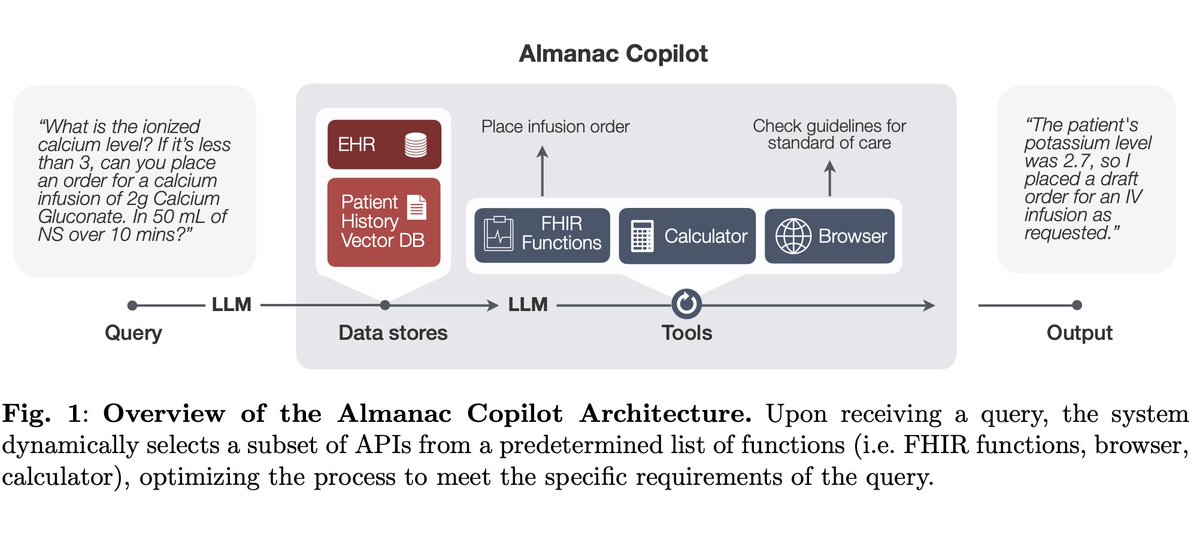
Super excited to showcase our newest work Almanac Copilot an EHR agent capable of answering questions about your patients and placing orders for you across any modern EHR system. Background: Nearly 75% of clinicians with burnout symptoms pinpoint EHRs as a source due to poor usability or workflow integration. Methodology: We train a 33B LLM to perform open-ended QA on patient information, as well as order placement using the FHIR interoperability standard (cc @zakkohane , @AdamRodmanMD) Result: Almanac Copilot obtains a success rate of 74% across 300 common EHR tasks based on MIMIC-IV. Your very own personal EHR assistant!


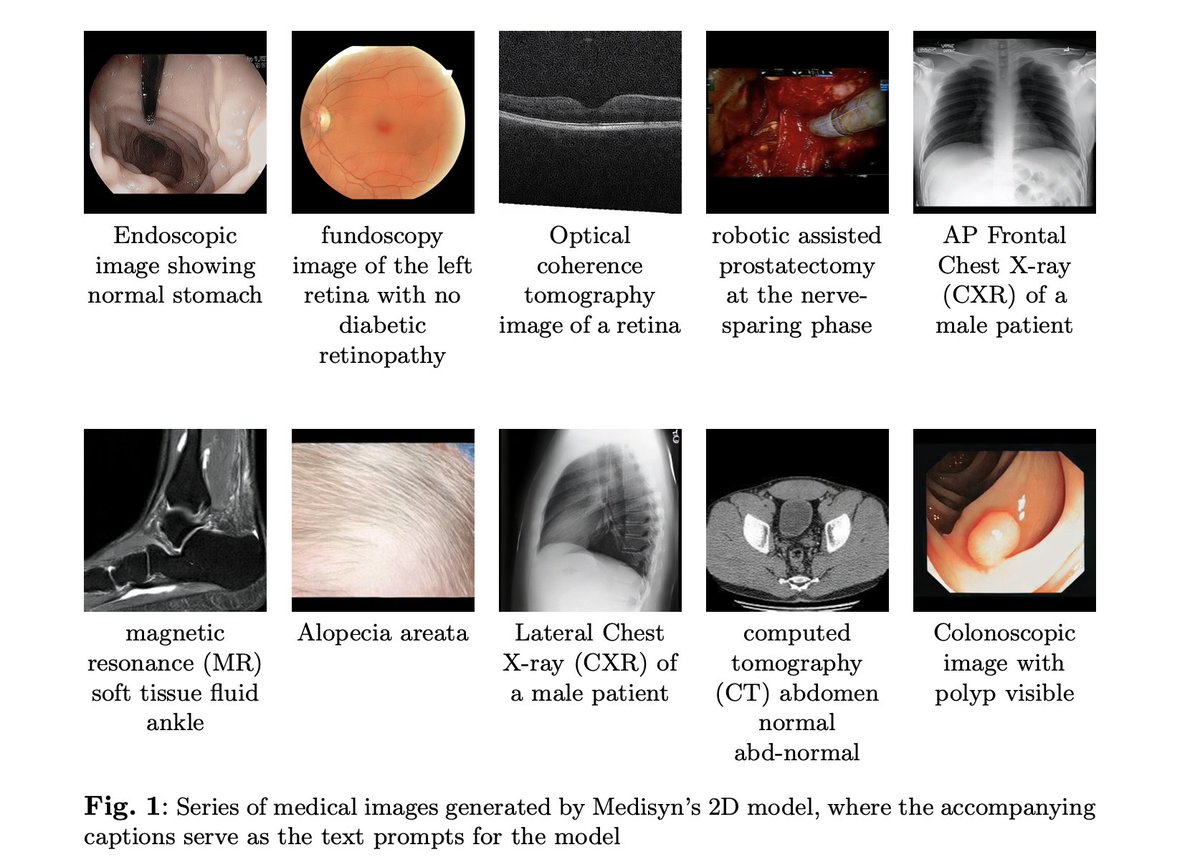
Introducing MediSyn, a pair of text-guided diffusion models for generating high-fidelity and diverse medical 2D and 3D images across medical specialties and imaging modalities. arxiv.org/abs/2405.09806 1/n