Margaux Hujoel

44 posts

Margaux Hujoel

Margaux Hujoel

@HujoelM

Katılım Mayıs 2016
84 Takip Edilen184 Takipçiler
Margaux Hujoel retweetledi
Steve McCarroll
Steve McCarroll@s_mccarroll·
Excited to share the paper: Huntington's disease is a DNA process for almost all of a cell's life. Inherited HD alleles are innocuous, just unstable – CAG repeats slowy expand throughout life. We call it a "ticking DNA clock". cell.com/cell/fulltext/…
English

1
34
119
15.1K
Margaux Hujoel retweetledi
Ryan Collins
Ryan Collins@RyanLCollins13·
Delighted to share that the peer-reviewed version of our study on germline structural variants in pediatric cancers was published yesterday in @ScienceMagazine science.org/doi/epdf/10.11… Thanks as always to the patients, their families, and our funders for enabling this research!
Ryan Collins@RyanLCollins13

🚨🔊Interested in structural variants? Genome sequencing? Pediatric cancers? Germline variants+cancer risk? Rare variants+rare diseases? If so (or even if not!), I'm delighted to share the first paper from my postdoc @VanAllenLab @DanaFarber: biorxiv.org/content/10.110… 1/12

English
1
3
18
2K
Margaux Hujoel retweetledi
Ben Strober
Ben Strober@BennyStrobes·
Excited to kick off 2025 with our latest publication! We've developed TGFM, a new statistical method for identifying the causal tissue and gene underlying GWAS disease loci—providing new insights into the biology behind GWAS signals. nature.com/articles/s4158…
English
2
19
63
7.5K
Margaux Hujoel retweetledi
Robin Hofmeister
Robin Hofmeister@Rbn_Hfmstr·
🚨 Our preprint on parent-of-origin effects (POEs) is out! With our new method, we inferred the parental origin of >220,000 individuals, revealing new insights into the genetic architecture of complex traits. 👉 Read here: medrxiv.org/content/10.110… 👇 Highlights below!
English
2
29
54
7.1K
Margaux Hujoel
Margaux Hujoel@HujoelM·
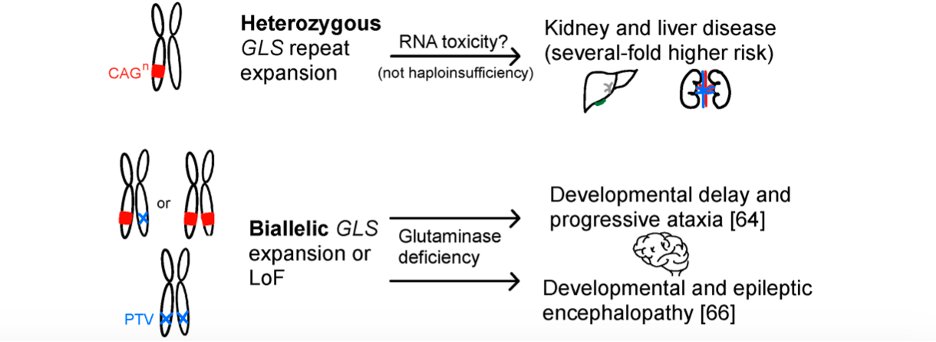
Highly expanded repeats in the 5’ UTR of GLS cause a dominant DNA-repeat disorder. Carriers of expanded GLS repeats had 14-fold [5.7–34.3] increased odds of stage 5 CKD. These associations appeared to be driven by toxicity of expanded alleles rather than loss of GLS function.
Margaux Hujoel tweet media
English
1
1
5
801
Margaux Hujoel
Margaux Hujoel@HujoelM·
Excited to share our recent work: expansions and contractions of DNA repeats have produced many genetic polymorphisms. We studied repeat instability among >700,000 biobank participants using new computational approaches to analyze DNA sequencing data. biorxiv.org/content/10.110…
English
4
26
120
35.5K
Margaux Hujoel retweetledi
Veera Rajagopal 
Veera Rajagopal @doctorveera·
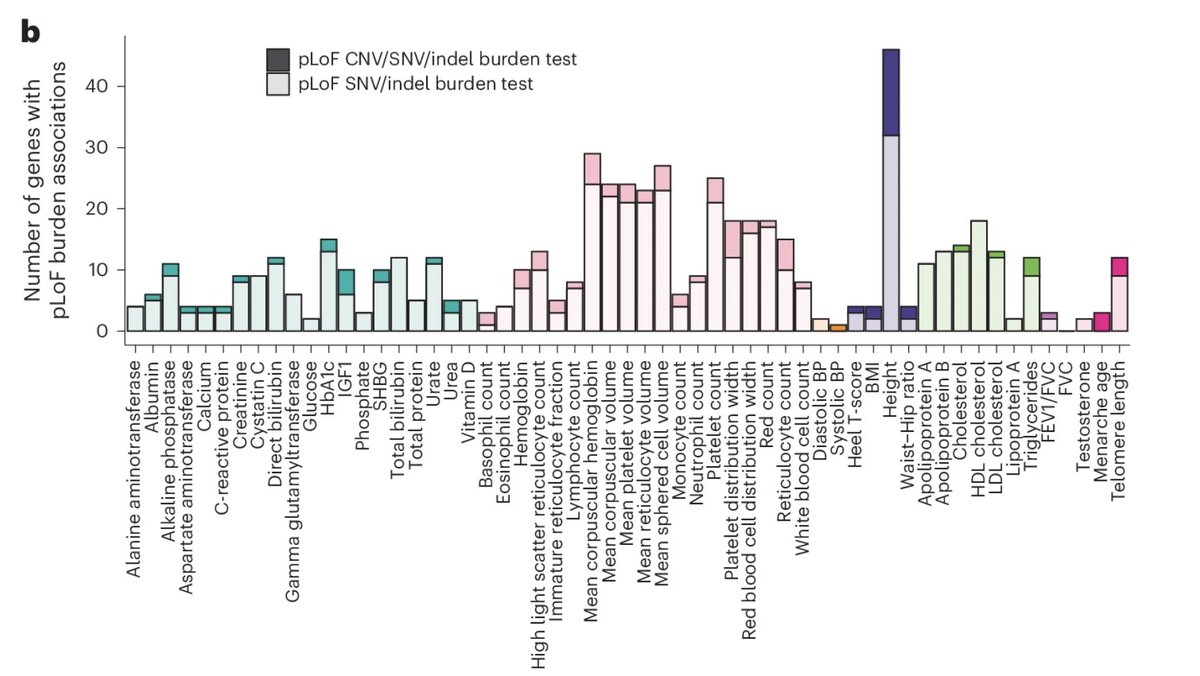
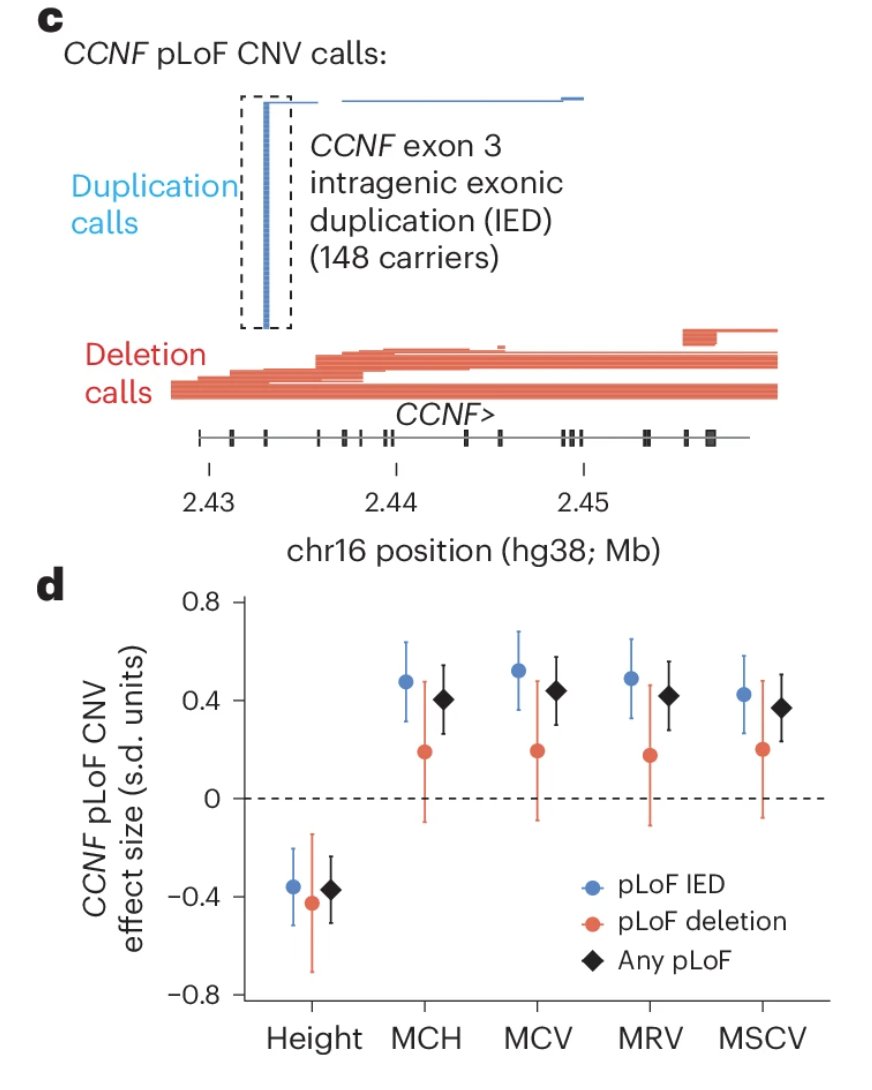
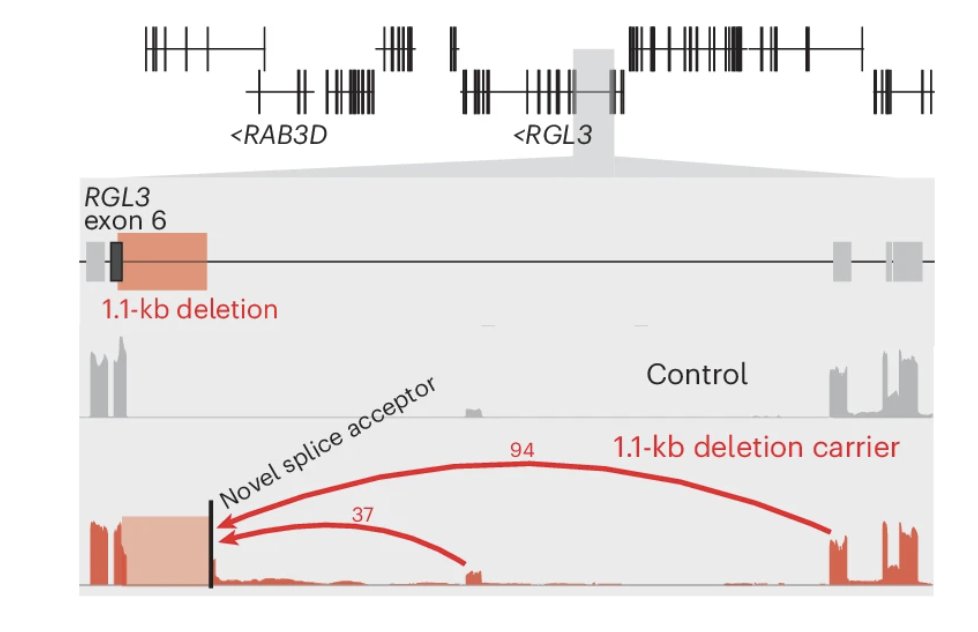
In a new, exciting work by @HujoelM et al. dive really deep into the half a million exomes in the UK Biobank and harvest out small CNVs that have been hiding and evading detection by short-read sequencing so far. nature.com/articles/s4158… As always, Po-Ru Loh and team, the experts in haplotype-sharing based imputation methods, is one step ahead of the game. - They did ExWAS and discovered coding variant associations in the UK Biobank even before the exome sequencing was released (nature.com/articles/s4158…). - They captured some of the most beautiful VNTRs of coding genome (LPA, ACAN etc.) without even using the exome data in the UK Biobank (science.org/doi/10.1126/sc…) -They captured VNTRs of the non-coding regions without using the whole genome sequencing data in the UK Biobank nature.com/articles/s4158… And now, they've upped their game a notch, showcasing that they can impute even the most challenging small CNVs deleting or duplicating subregions of protein coding genes and SNVs located within segmental duplications that would typically require long-read sequencing to identify. One of the goals ExWAS is to identify large effect risk and protective associations of loss of function variants in protein coding genes. Despite, the large sample size of the UK Biobank (N=500,000), for most of the genes, researchers were able to identify only fewer heterozygous carriers (10s to 100s) of predicted loss of function (pLOF) variants. The authors here show that you can increase this number substantially, by capturing those sneaky mini CNVs that bite off parts of genes, for example, only one exon, and render the genes useless. The plot below summarizes the gains in the number of pLOF associations when you aggregate CNVs and pLOFs in comparison to aggregating only pLOFs. Particularly for height, they have identified many new exciting associations, including an association with CCNF (encodes a cell cycle regulator), where an exonic duplication "accounted for more pLOF events than all other CNVs, SNVs and indels combined"! Another interesting discovery is the protective association between RGL3 (a signal transduction protein) and hypertension. The end of an 1.1kb deletion CNV slices 55 base pairs off an RGL3 exon resulting in loss of function. It turns out this deletion is seen in >8000 participants and has one of the strongest effect size known to date for BP among the coding variants. Of all, the analyses of SNVs in segmental duplications is most fascinating. One of the revelations of complete telomere-to-telomere sequencing of human genome is the surprisingly abundant SNVs hidden with segmental duplications (SDs) (nature.com/articles/s4158…). The SDs are predicted to affect at least parts of >800 genes in the human genome. So, you can imagine a functional coding variant within an SD could be present in multiple copies (multiallelic) and as a result, their phenotypic effects could be amplified as well. The authors have uncovered such examples. A 99 kb SD in chromosome 7 long arm, strongly associated with type 2 diabetes and chronotype, is one of the most polymorphic CNVs in the human genome (can vary between 2 and 14 copies). The authors found within this SD sits a missense variant that got duplicated along with the SD during evolution and so present in multiple copies in the humans. This missense variant seems to associate more strongly with T2D and chronotype than the actual SD itself, increasing the risk in proportional to number of copies 😍. There are a lot more interesting findings in the paper. A must-read for genetics lovers. Thank you to @HujoelM et al. on this beautiful work.
Veera Rajagopal  tweet mediaVeera Rajagopal  tweet mediaVeera Rajagopal  tweet mediaVeera Rajagopal  tweet media
English
2
19
97
15.3K
Margaux Hujoel retweetledi
Max Frenkel, MD, PhD
Max Frenkel, MD, PhD@CasualVariant·
Excited to share my thesis work: Discovering chromatin dysregulation induced by protein-coding perturbations at scale Reading DNA is fast and high-throughput. Discovering mechanisms is slow and low-throughput. A 🧵 on how we addressed this 1/10 biorxiv.org/content/10.110…
English
1
16
61
14.4K
Margaux Hujoel
Margaux Hujoel@HujoelM·
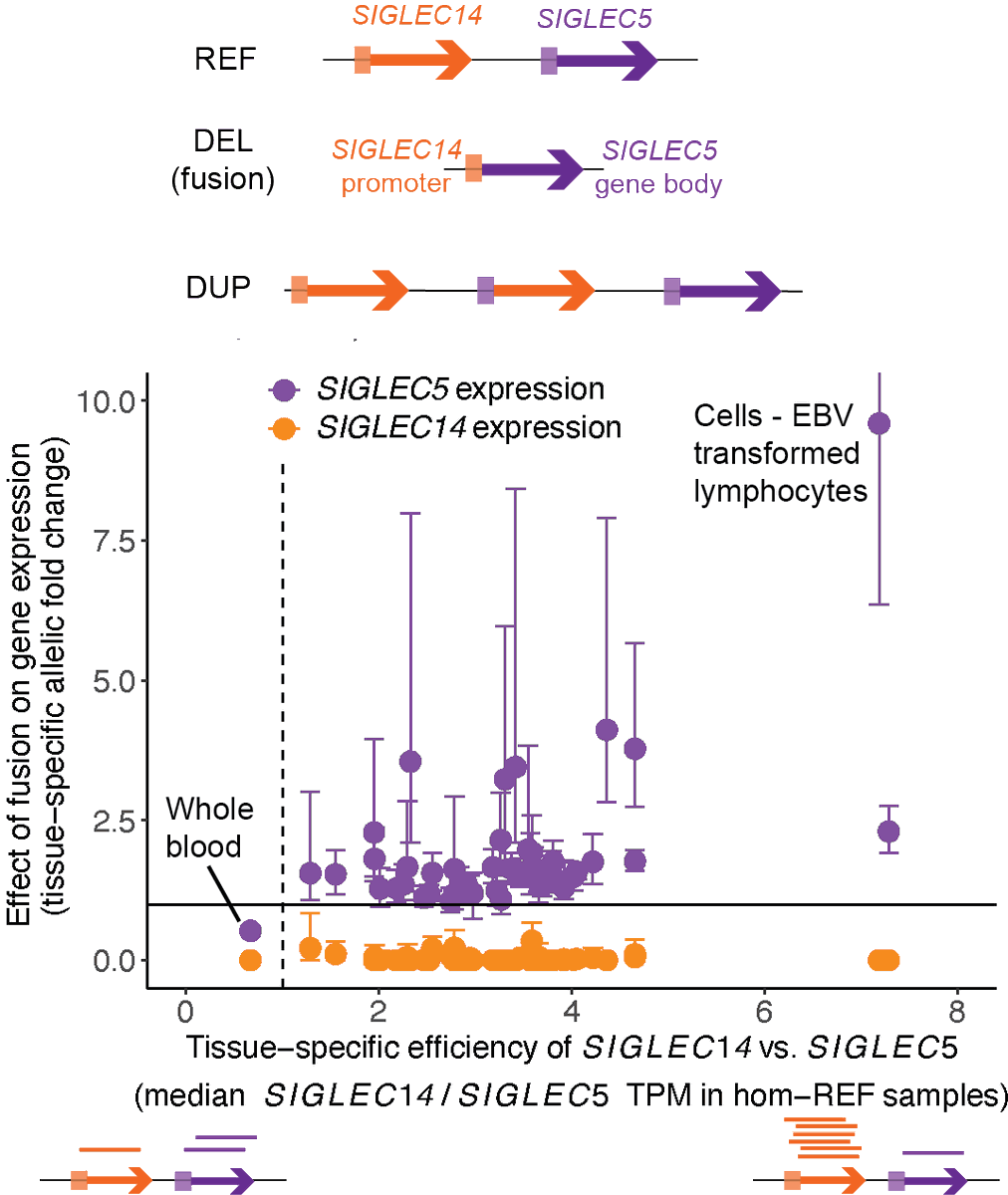
We explored a common deletion which creates a fusion gene: SIGLEC5 under the control of the SIGLEC14 promoter. We found a tissue-specific effect of the fusion on SIGLEC5 expression consistent with substitution of the SIGLEC14 promoter in place of the SIGLEC5 promoter
Margaux Hujoel tweet media
English
1
0
2
609