3ROY

7K posts

3ROY banner
3ROY

3ROY

@IAM_3ROY

be urself always

in the studio Katılım Kasım 2024
1.3K Takip Edilen1.1K Takipçiler
Sabitlenmiş Tweet
3ROY
3ROY@IAM_3ROY·
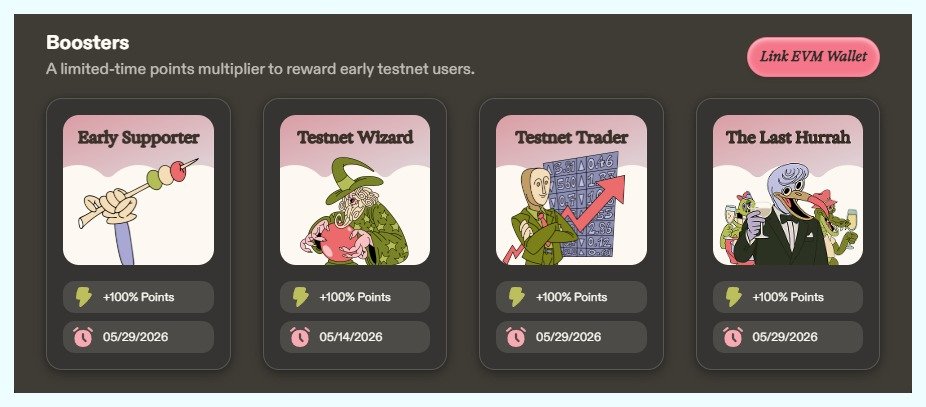
spent ~$7 to cop these 3 Dango OATs on the marketplace went from 1x to 4x points booster instantly limited time thing ending week 6, felt like free leverage on the points farm wish I knew these were tradable from week 1 still early tho (week 3/38) who else stacking boosters?
3ROY tweet media
English
0
0
0
18
3ROY
3ROY@IAM_3ROY·
jumping across many apps, users can access trading, lending, borrowing, and onchain tools in one smoother experience. 3/ The goal is simple: Make decentralized finance feel less stressful and more accessible for everyday users.
3ROY tweet media
English
4
7
7
13
Skibbz ^Tm
Skibbz ^Tm@oxtheMoonWalker·
There’s a lot of talk about innovation in Web3, but not enough about how it actually feels to use. Because at the end of the day, people don’t stick around for complexity, they stay for comfort. If something feels stressful, they avoid it. If it feels natural, they come back without thinking twice. That’s why @TheARCTERMINAL feels like it’s leaning into something that really matters. It’s not trying to make users smarter, it’s trying to make the experience simpler. You don’t have to go through multiple steps in your head before taking action. You just focus on what you want done. And over time, that kind of interaction changes how people engage with the entire space. The Mindshare leaderboard adds another layer to it. It’s not just about showing up, it’s about who can actually make others understand what’s being built. Because once people understand something, they’re more likely to trust it, talk about it, and stick with it. Still early, but it’s one of those setups where being clear and consistent can take you further than just being active.
Skibbz ^Tm tweet media
Skibbz ^Tm@oxtheMoonWalker

A lot of people talk about adoption like it’s some distant milestone, but it usually comes down to something simple, how easy something feels to use. If it feels stressful, people avoid it. If it feels smooth, they come back. That’s why @TheARCTERMINAL stands out, it’s focusing on making interaction feel natural instead of technical. You’re not thinking through multiple steps, you’re just focusing on the outcome you want. And that small shift changes how people approach everything else in the space. The interesting part is how they’ve combined this with their Mindshare campaign. It’s not just about onboarding users, it’s about building voices that can explain the idea clearly and keep others engaged. Because in the end, the projects that grow are the ones people understand and talk about. Most people will treat it like just another campaign and move on. But the ones who take time to understand and communicate properly will stand out without forcing it. And over time, that kind of presence usually compounds.

English
47
162
184
2.4K
Oluwafemi👑❤️🚀
The future of crypto won’t be decided by who builds the fastest chain or the most hyped token, but by who solves the two deepest problems holding the industry back: security and usability at scale. That’s where @CerbAgent and @dango quietly intersect. On one side, @CerbAgent is addressing the most expensive flaw in Web3 today, security. In 2025 alone, over $2.1B was lost to exploits, largely because wallets and protocols were never designed to actively defend users in real time . What makes CerbAgent different is its shift from passive protection to autonomous defense. Instead of waiting for users to notice threats, its AI agents monitor wallets continuously, simulate transactions before execution, and revoke malicious approvals instantly. This transforms security from a user responsibility into an embedded intelligence layer, something DeFi has always needed but never truly had. On the other side, @dango represents the evolution of how users interact with DeFi itself. Rather than forcing users to juggle fragmented platforms, Dango is building a unified system where trading, lending, and liquidity exist within a single environment, powered by a unified margin account and optimized execution . Its goal is simple but powerful: remove the complexity that makes DeFi inefficient and inaccessible, while improving capital efficiency and user experience at the protocol level . Individually, both are strong narratives. Together, they point to something bigger. Because scaling DeFi is not just about better infrastructure or better security in isolation, it’s about integrating both into the core experience. A seamless financial layer like Dango without intelligent security remains vulnerable. A powerful security layer like CerbAgent without high-activity ecosystems lacks depth. But when systems like these evolve in parallel, the industry moves toward something more mature: an environment where users can deploy capital efficiently and safely, without needing to think like attackers to survive. That’s the real direction of the future, not more tools, but smarter systems. Not more users learning security, but security learning users. And not fragmented DeFi, but unified, intelligent financial environments where protection and performance are built into the same layer. $CERB fits into this as more than just a token, it represents the economic layer of autonomous security, where protection scales with adoption. And in a world where capital is increasingly on-chain, the value of that protection only compounds. The next phase of crypto won’t reward noise. It will reward systems that make the space safer, simpler, and more efficient at the same time. @CerbAgent and @dango are building exactly in that direction.
Oluwafemi👑❤️🚀@TheFemog

The real shift in crypto right now isn’t speed, liquidity, or UX, it’s survival. And that’s exactly where @CerbAgent and @Dango intersect in a way most people are still underestimating. @CerbAgent is built on a simple but brutal truth: wallets were never designed to defend themselves. In 2025 alone, over $2.1B was lost not because users were careless, but because the security model is fundamentally reactive. What Cerb does differently is introduce autonomous AI agents that don’t wait for exploits, they anticipate them. By monitoring approvals, simulating transactions before execution, and revoking malicious permissions in real time, it turns the wallet from a passive storage tool into an active defense system. The $CERB token then becomes more than a utility, it sits at the center of a new security layer where protection is continuous, intelligent, and embedded into user behavior. Now place that beside @Dango, and the contrast becomes the insight. Dango is rethinking DeFi from the execution layer up, not as fragmented apps, but as a unified trading system. It combines spot, perps, lending, and vaults into one margin account, removing the capital inefficiencies that define today’s DeFi stack. More importantly, it redesigns infrastructure around traders, introducing on-chain order books, eliminating MEV through batch auctions, and replacing seed phrases with biometric-backed smart accounts. This is not just better UX, it’s a structural upgrade to how value moves on-chain. But here’s the part most people miss: better infrastructure without embedded security just scales risk faster. Dango solves execution, capital efficiency, and usability. CerbAgent solves the invisible layer, trust at the transaction level. One is building the fastest, most unified DeFi experience possible; the other ensures that experience doesn’t become a more efficient way to lose funds. That’s the real convergence. As DeFi moves toward unified systems like Dango, where everything trading, lending, leverage, sits in one account, the attack surface doesn’t shrink, it concentrates. A single compromised approval or malicious contract interaction becomes exponentially more dangerous in a unified margin environment. That’s exactly where CerbAgent’s model fits: pre-transaction intelligence, real-time monitoring, and automated defense acting as a native layer alongside execution. This is the direction the industry is quietly heading toward: execution layers optimized by projects like Dango, secured by autonomous intelligence layers like CerbAgent. Because the next phase of crypto won’t be won by the fastest chain or the cheapest fees. It will be won by the systems that users can actually trust with their money.

English
60
19
66
705
3ROY retweetledi
BASH-TECH OG
BASH-TECH OG@Bashtechceo·
LONGS PRIVILEGE: Why Dango is a hidden alpha play right now Dango isn’t just another data protocol. It’s doing something most projects talk about but never execute: Turning hidden data into real-time, on-chain insight And that changes everything. The Problem Most People Ignore Right now, the best alpha in crypto is: Private dashboards Insider analytics Closed communities Off-chain signals Meaning? The average user is always late. What Dango Actually Solves Dango flips the system: Unlocks hidden data Brings it fully on-chain Makes it accessible in real time No delays. No gatekeeping. Everyone gets access to the same intelligence layer. Data = edge. If Dango becomes the layer for: Prediction markets Trading signals Behavioral analytics On-chain decision making Then it’s not just a tool… It becomes infrastructure And infrastructure = long-term value. The Real Strategy (Don’t Just Hold Position Smart) If you’re playing this right: Accumulate early before attention comes Track ecosystem integrations (this is key) Watch for partnerships with DeFi prediction platforms Engage on-chain (projects reward activity, not silence) The winners won’t just buy they’ll participate Every contribution to the FIH pool isn’t just passive it’s tracked, recognized, and rewarded in real time. That changes everything. Most systems delay rewards. FIH flips that → instant feedback loop = stronger holder conviction. Real-Time Reward Engine Immediate recognition creates psychological stickiness Users are more likely to stay + compound positions Pool-Based Growth Model Contributions increase overall ecosystem strength Early participants benefit most → classic early accumulation edge Behavioral Advantage People don’t leave systems that pay them instantly This builds organic retention, not forced locking Phase 1 — Entry Don’t ape in at peak hype Look for low-volume consolidation zones Enter gradually (DCA style) Phase 2 — Participation Actively contribute to the pool Maximize exposure to real-time rewards Let the system work with your position Phase 3 — Compounding Recycle rewards back into position This increases your share of future distributions Phase 4 — Risk Control Always secure partial profits on spikes Never go 100% exposure keep liquidity ready Chasing green candles instead of structure Ignoring contribution mechanics (missing rewards) Holding without a scaling-out plan Smart players? They accumulate quietly and let rewards build momentum.
BASH-TECH OG tweet media
BASH-TECH OG@Bashtechceo

Jummah mufeedahtul frens>>> FIH_USD1 is building…” That’s weak. Pick ONE angle and dominate it: “The future of prediction markets is meme-driven” “Attention is now a tradable asset” “Betting on narratives > betting on prices” This makes you recognizable. Everyone thinks prediction markets are about accuracy. They’re wrong. It’s about attention flow. Body: Explain how memes drive outcomes Show how USD1 captures value Link behavior → rewards Close: FIH_USD1 isn’t building a product. It’s building a market for human belief. These are your growth engine: “People don’t trade assets anymore. They trade narratives.” “Prediction markets + memes = addictive loops.” “The real alpha? Betting before the narrative forms.” Go under big accounts and reply like this: Prediction markets only work when people care. Meme layer fixes that. That’s why projects like FIH_USD1 are interesting. This brings attention to you + the narrative. People don’t just want to trade anymore. They want to participate in narratives. That’s where projects like @FIH_USD1 come in. Instead of: Trading tokens Bet on outcomes Engage socially Earn from activity And everything is powered by USD1. Here’s the shift: Old system: Liquidity = capital New system: Liquidity = attention Memes bring the attention. Prediction markets capture it. DeFi distributes the rewards. Dango isn’t just “simple Web3.” It’s: Signal over noise Momentum over confusion Structure over chaos Most Web3 projects fail because they: Dump too much info Chase hype cycles Ignore user clarity Dango flips that. Dango is emerging as a new kind of Web3 signal. Not louder. Not more complex. Just… clearer. And that’s exactly why it’s dangerous (in a good way). Right now, Web3 has a problem: Too many projects = noise Too many promises = confusion Too much tech = user fatigue People aren’t leaving because Web3 is bad… They’re leaving because it’s overwhelming. Dango doesn’t try to win by complexity. It wins by structured momentum. That means: Clear direction Simple entry points Consistent growth signals No chaos. Just progression. Think about this: Most projects say: “Here’s everything we built.” Dango says: “Here’s exactly where to start.” That difference? That’s adoption. Simplicity is not weakness in Web3. It’s leverage. Because: Simple spreads faster Simple builds trust Simple converts users → believers @dango understands this early.

English
29
10
39
976
3ROY retweetledi
cryptobaby 😍$XAGE 'ZETARIUM '
@get_optimum Most networks don’t fail because they grow too fast. They fail because stability collapses under growth. Scaling throughput is easy in theory. Sustaining coordination, latency, and reliability under constant pressure is the real test. infrastructure.
cryptobaby 😍$XAGE 'ZETARIUM ' tweet media
cryptobaby 😍$XAGE 'ZETARIUM '@EIyanuoluw17789

Optimum care isn’t built on chance, it’s engineered through precision, balance, and intent. Every diagnosis is a hypothesis tested. Every note is a data point. Every decision is a calculated step toward a better outcome. @get_optimum isn’t just about care, it’s about refining .

English
10
11
13
43
Umar Muhammad Sani
Umar Muhammad Sani@umar_msani·
New Starboard is live,FIH on Galxe. FIH highlights contribution as signal. Dango structures that signal into clear, state,driven flow. Defined actions. Transparent steps. Verifiable outcomes. No noise,just work that’s seen, structured, and proven.
Umar Muhammad Sani@umar_msani

FIH turns participation into visible, recognized contribution. Dango turns that contribution into structured, state,driven progress. Every action is recorded. Every step is defined. Every outcome is verifiable. No lost effort. No hidden work. No unclear transitions.

English
8
10
10
167
3ROY retweetledi
m33 🀄️
m33 🀄️@masterford33·
New logo just dropped for @quipnetwork 👀 It's based on Hofstadter's butterfly which is a fractal from quantum physics that emerges when electrons dance on a lattice. ➠ Why does that matter for the ecosystem? Because it's a quiet flex. They're not just building another crypto project. They're leaning hard into the quantum identity that is complex, beautiful, and mathematically deep. The brand now matches the tech: layered, weird, and seriously smart. Feels like the start of something real. Quantum vibes only. gQuip 🦋
m33 🀄️ tweet media
Quip Network@quipnetwork

The Quip Network brand is evolving with a new identity for a bigger mission 🦋 Hand crafted with @relate_studio 🙏 Learn more ↓ quip.network/blog/new-look-…

English
17
14
25
262
3ROY retweetledi
Grace Iwuchukwu
Grace Iwuchukwu@Ahmazingammahhh·
Speed is overrated in Web3. Clarity is the real edge. Most users are reacting in real time, but reacting faster to bad signals just leads to better mistakes. The problem is not execution speed. It is signal quality. Right now, decisions are built on scattered inputs. Charts say one thing Onchain data says another Social sentiment shifts every hour Users are left to reconcile all of it manually. That’s where most value is lost. @TheARCTERMINAL is focusing on this exact gap. ANIMA doesn’t just surface data. It filters, prioritizes, and connects signals into something usable. So instead of chasing information, users operate with context. This changes how decisions are made. From reactive to structured And when decisions become structured, outcomes become more consistent. What makes this powerful is not automation alone. It is intelligent filtering. Because in a system flooded with information, the winner is not who sees more. It is who understands faster. ARC is building around that principle. Less noise More signal Better decisions #Web3 #AI #Crypto #ARC
Grace Iwuchukwu tweet media
English
65
17
70
271
Grace Iwuchukwu
Grace Iwuchukwu@Ahmazingammahhh·
Most people think better tools will fix Web3. But better tools on top of broken workflows just create faster confusion. The real issue is not access. It is how decisions get made. Right now, users are the glue holding everything together. You gather data from different places Interpret signals yourself Then execute manually That process is slow, and it breaks under pressure. @TheARCTERMINAL is approaching this differently. Instead of adding another tool, it is restructuring the flow. ANIMA acts as the intelligence layer that connects fragmented inputs and turns them into coordinated outcomes. Not suggestions. Decisions shaped by context. This is where the shift happens. Web3 moves from user-driven execution to system-assisted coordination That reduces friction, but more importantly, it changes leverage. The advantage is no longer who has more tabs open. It is who has better systems interpreting reality. And when that becomes the standard, manual workflows start to feel outdated. Projects that understand this don’t just improve UX. They redefine interaction. ARC is building in that direction early. #Web3 #AI #Crypto #ARC
Grace Iwuchukwu tweet media
Grace Iwuchukwu@Ahmazingammahhh

Most people are watching ARC Terminal as a product. The more interesting question is what behavior it starts to replace. Right now, Web3 rewards people who can stay glued to the process. You open tabs Track movements Double check everything Then execute It’s hands-on by design. But that model doesn’t scale. @TheARCTERMINAL is quietly introducing a different interaction layer, where input matters more than activity. You define intent once. The system handles the path. ANIMA sits in that gap, translating signals into coordinated onchain actions without requiring constant user intervention. That’s not just efficiency. It’s abstraction of effort. And when effort is abstracted, the required skill changes. You don’t need to react faster. You need to think better. Because you’re no longer executing every step. You’re evaluating outcomes. That shift moves users from being part of the workflow… to sitting above it. Which raises a real question. Are users ready to trust systems they don’t fully control? ARC isn’t just solving for usability. It’s testing readiness for a more automated Web3. #Web3 #AI #Crypto #ARC

English
46
19
55
447
3ROY retweetledi
Alan
Alan@mufc_s00·
If you zoom out, most of crypto’s problems don’t come from complexity. They come from mismatch. A mismatch between what users think is happening… and what the system actually does. You think your wallet is safe after you sign. You think your trade executes at the price you saw. You think your intent carries through cleanly. But in reality, there’s always a gap. A gap where approvals stay open. A gap where bots extract value. A gap where outcomes drift away from decisions. And over time, that gap becomes the hidden cost of participating. What’s interesting is how @CerbAgent and Dango approach that problem from completely different angles — yet arrive at the same conclusion: The system shouldn’t approximate user intent. It should enforce it. @CerbAgent does this on the security layer. It doesn’t rely on you to monitor your wallet or react in time. It assumes you won’t — and builds around that reality. • Transactions are evaluated before you commit • Approvals are treated as active exposure, not passive settings • Exploits are met with automated intervention, not post-event analysis It’s not about awareness. It’s about coverage. @dango does this on the execution layer. Instead of accepting that trades will always come with friction, it challenges that assumption at the infrastructure level. • Onchain orderbook for transparent price discovery • MEV resistance to reduce silent extraction • Execution designed to reflect your decision, not distort it It’s not about faster trades. It’s about truer trades. Put together, they highlight something bigger: Crypto isn’t just evolving in what it can do — it’s evolving in how faithfully it does it. From “this should work” to “this works exactly as intended” Less guesswork. Less leakage. Less reliance on users compensating for system flaws. Because at scale, the difference between intention and outcome isn’t just technical… It’s everything. $CERB
Alan tweet media
Alan@mufc_s00

There are two types of losses in crypto. The ones you feel… and the ones you don’t notice. Everyone talks about the first — hacks, liquidations, rugs. They’re loud, obvious, impossible to ignore. But the second type is quieter, and in many ways more dangerous. It’s the trade that executed slightly worse than expected. The approval that stayed open longer than it should have. The transaction that looked fine… until it wasn’t. No single moment feels catastrophic. But over time, those gaps compound into something real. And what’s uncomfortable is this: Most of those losses aren’t coming from bad decisions. They’re coming from systems that don’t fully respect user intent. That’s where the intersection of @CerbAgent and @dango becomes interesting. They’re solving different problems on the surface, one focused on security, the other on execution but underneath, it’s the same thesis: 👉 The space between what you intend and what actually happens is still too wide. @CerbAgent is closing that gap on the security side. Instead of assuming users will catch threats in time, it operates continuously: • analyzing transactions before they’re signed • tracking permissions as live risk • acting during exploits, not after Because once something malicious is in motion, awareness alone isn’t enough. Dango is closing that gap on the execution side. By building around an onchain orderbook and MEV resistance, it pushes toward trades that reflect your actual decision, not a compromised version shaped by slippage, latency, or extraction. Less hidden friction. Less silent compromise. Together, they point toward a broader shift: Crypto is moving away from systems that approximate user intent… toward systems that preserve it. Where your wallet isn’t exposed because you were too slow, and your trade doesn’t drift because the system couldn’t execute precisely. It’s a higher standard. And once users experience it, going back to “close enough” won’t feel acceptable anymore. $CERB

English
10
35
33
151
3ROY retweetledi
Alexis
Alexis@Alexxx636·
𝐒𝐓𝐑𝐈𝐊𝐄𝐑𝐎𝐁𝐎𝐓_𝐀𝐈 𝐗 𝐂𝐄𝐑𝐁𝐀𝐆𝐄𝐍𝐓 𝐗 𝐅𝐈𝐇_𝐔𝐒𝐃𝟏 𝐂𝐇𝐑𝐎𝐍𝐈𝐂𝐋𝐄𝐒 🚥 𝐄𝐏𝐈𝐒𝐎𝐃𝐄: 𝐓𝐇𝐄 𝐍𝐄𝐗𝐓 𝐖𝐀𝐕𝐄 𝐈𝐒 𝐔𝐒𝐄𝐅𝐔𝐋 The next cycle may look flashy. But the winners will be the ones solving real problems quietly. A Thread 🧵👇
Alexis@Alexxx636

𝐒𝐓𝐑𝐈𝐊𝐄𝐑𝐎𝐁𝐎𝐓_𝐀𝐈 𝐗 𝐂𝐄𝐑𝐁𝐀𝐆𝐄𝐍𝐓 𝐗 𝐅𝐈𝐇_𝐔𝐒𝐃𝟏 𝐂𝐇𝐑𝐎𝐍𝐈𝐂𝐋𝐄𝐒 🚥 𝐄𝐏𝐈𝐒𝐎𝐃𝐄: 𝐒𝐘𝐒𝐓𝐄𝐌𝐒 𝐓𝐇𝐀𝐓 𝐖𝐎𝐑𝐊 𝐀𝐋𝐖𝐀𝐘𝐒 𝐖𝐈𝐍 Narratives can trend for a week. Working systems can grow for years. A Thread 🧵👇

English
36
61
85
1.5K