The National Context@NatlContext
How Ali Zaidi became Iraq's PM-designate
Zaidi's rise begins inside the "economic committees" of militia-linked Shia parties, the financial engine rooms through which armed factions manage, invest and recycle capital. From that base, he launched a licensed currency exchange business, a sector widely used for money laundering and Iran-related sanctions-busting. Inferring from the ecosystem that shaped the rise of figures such as Zaidi, the seed capital very likely came from those same faction networks. The exchange business then became a bank, and in Iraq, a banking licence does not come without serious political cover.
The real acceleration came under Prime Minister Mustafa al-Kadhimi. Zaidi was awarded food ration and army catering contracts, among the most lucrative and corruption-prone in the Iraqi state, and the timing does not appear incidental. Kadhimi, a journalist by background who rose without election to intelligence chief and then prime minister, is from Shatra, a small town in Dhi Qar province. So is Faiq Zaidan, head of Iraq's judiciary and its most powerful unelected figure, who was consolidating that influence precisely during this period. So is Zaidi. So is the current intelligence chief, Hamid al-Shatri. So is Hamid Naeem al-Ghazi, secretary-general of the Council of Ministers, one of the key administrative positions in the Iraqi executive. Not one of these figures reached their post through an election. The Shatra cluster, spanning the judiciary, the intelligence services, the executive apparatus and now business, has become one of the most significant informal power networks in the Iraqi state, emerging visibly only over the past decade as Zaidan's influence expanded. That Zaidi's rise and most valuable contracts arrived during a Shatra-linked premiership, under a Shatra-linked judicial chief, points directly to Zaidan as the connective tissue.
Under outgoing Prime Minister Mohammed Shia al-Sudani, that integration deepened. Zaidi received contracts for Sudani's signature cooperative hypermarket chain. Just months before the November 2025 elections, Zaidi's family acquired Dijlah TV as his brother became its manager, which then openly campaigned in Sudani's favour. His other brother won a parliamentary seat on Sudani's list.
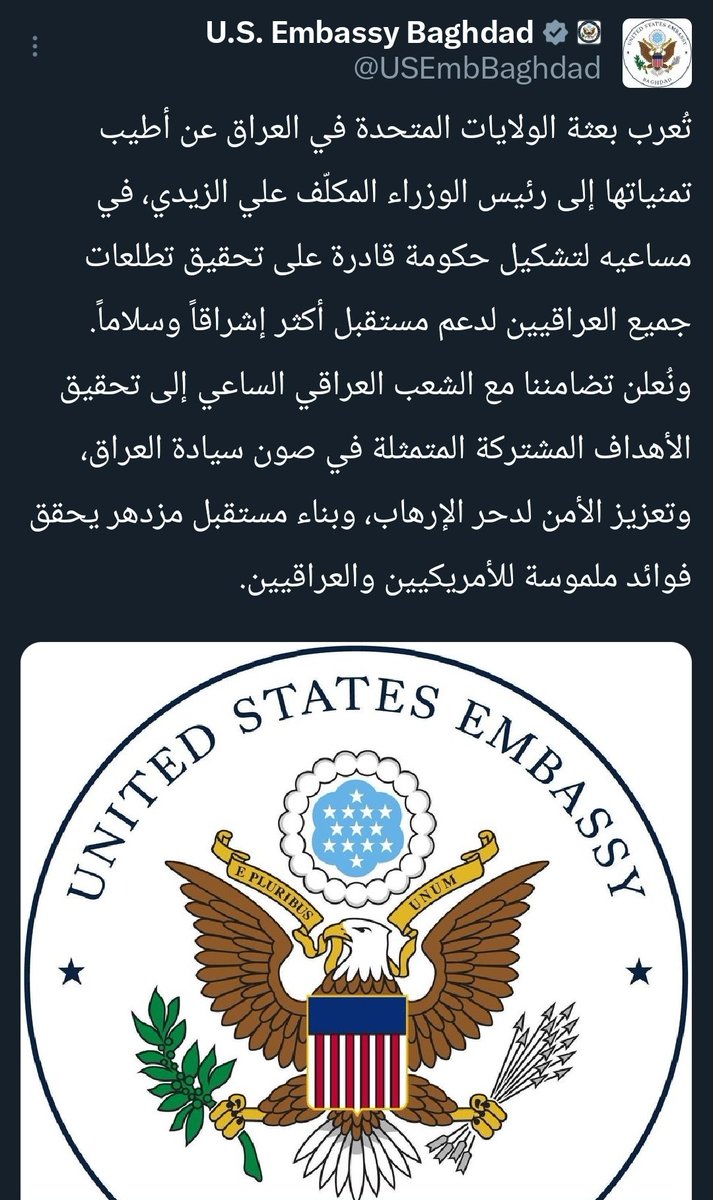
The convergence of two patronage lines, one running through Zaidan's network and another through the Sudani political camp, appears to have made Zaidi the acceptable candidate when the moment came. His lack of an overt militia profile or hardline factional identity likely made him easier for Washington to clear, while his emergence from an ecosystem that Iran has long shaped meant Tehran had little reason to object.
More: thenationalcontext.com/manager-of-a-c…