IDCA

841 posts

IDCA banner
IDCA

IDCA

@IDCAorg

Digital Economy Think Tank

Washington D.C. Katılım Ocak 2014
7 Takip Edilen515 Takipçiler
Sabitlenmiş Tweet
IDCA
IDCA@IDCAorg·
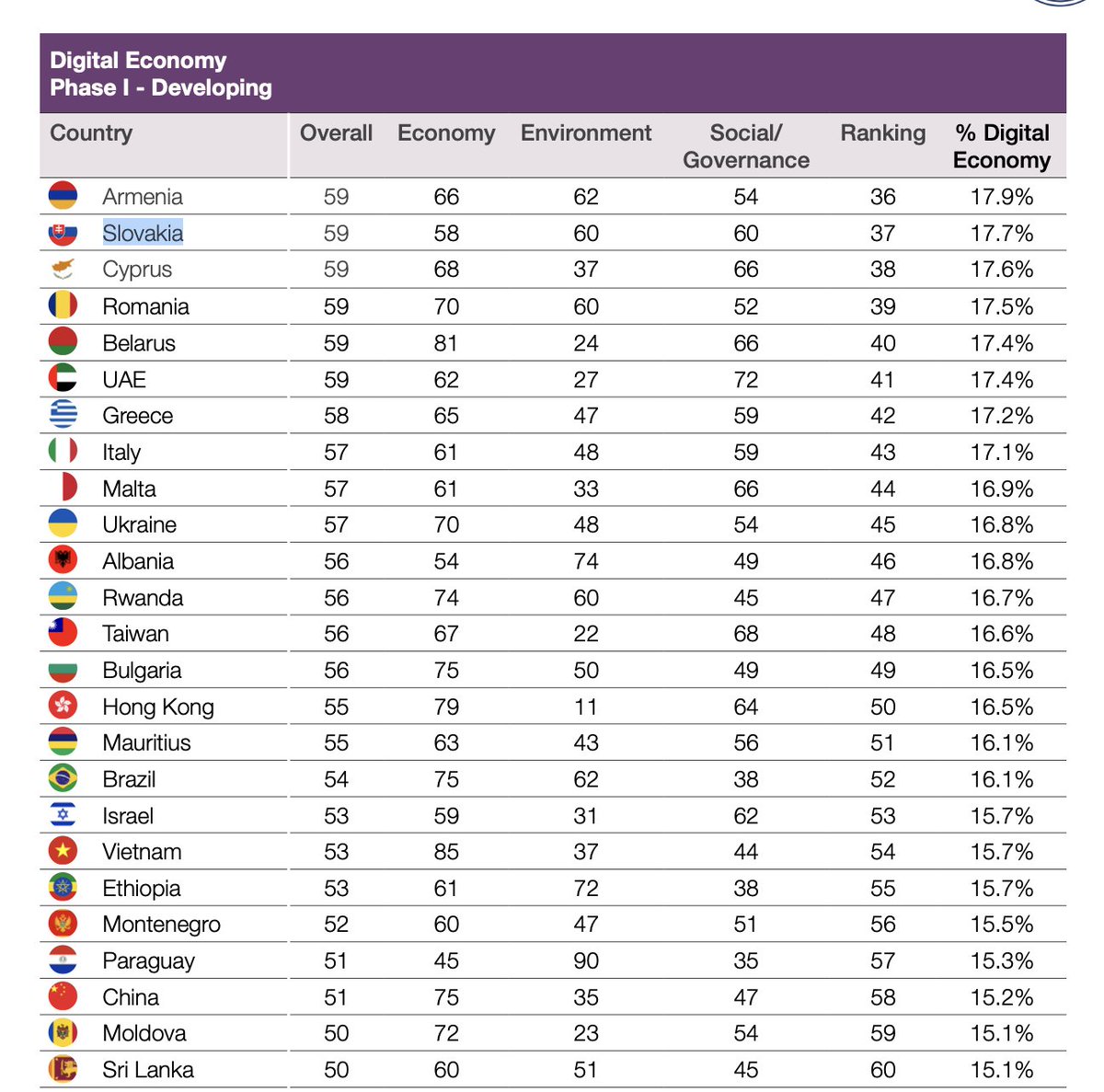
📰Is Europe Declining? - Story of the week European nations comprise 18 of the top 25 spots in the IDCA Digital Readiness Index 2026, which has just been released. Correlating the development of Digital Economies with these rankings, IDCA finds these nations now benefit from having 19 and 25 percent of their GDPs be classified as a Digital Economy, in comparison to the world average of 17 percent. Yet, across the ocean, the US administration publicly and frequently describes Europe as “declining,” citing more robust growth rates in the US when compared to Europe over the past 20 years, clear leadership in innovation and entrepreneurialism, and growing leadership in the hot tech topic of today, AI. Can these apparently opposing points of view be reconciled? The first point to address is the data-driven nature of IDCAs research in contrast o the political statements of any administration. Yet even though the US position is indeed political, it is largely a function of GDP growth. In that respect, the US has been exceeding Europe on an annual basis for many years. Thus, today average per-person income in the US stands are more than $80,000, compared to around $60,000 for the wealthiest European nations. (This data point does not consider a small number of small European nations with distorted income levels stemming from outlier accounting processes.) But there is much more to a society than pure income. The IDCA analysis factors in relative income distribution, relative development and achievements of education and health care, the amount of perceived corruption, and relative internet development, access, and speed. Abstracting and boiling down data sets from more than 200 factors into a single result shows how many European countries are currently leading the US in relative Digital Readiness development, often by a wide margin. It's essential to note that the Index shows where things stand. It does not make projections into the future. But the underlying data can be viewed to at least take a glimpse; doing this shows that many European nations are reaching, or have already exceeded, the point in which power consumption is a big concern. Power consumption is a big concern in the US, too, in selected regions, but not throughout the entire, massive country. In Europe, though, these concerns are real in the large countries of Germany ahd the UK, and in the smaller countries of Ireland, Denmark, and the Netherlands. There is also potential for enormous expansion in France and some smaller to mid-size European nations such as Slovenia and Slovakia, Bulgaria and Romania, and a few others. So an overall, nuanced picture created from IDCA's data shows that Europe leads the US in Digital Readiness, that it faces larger concerns about electricity, and that there are bright spots along with gloomy ones. Larger concerns can be raised about Europe's ability to achieve the quantum leaps in power and digital infrastructure that's required for global AI leadership. If it cannot, then it will start to lag in more than just simple GDP. The US appears able to achieve such a leap, thus fueling optimism from AI developers and investors. It is thus critical to watch both regions closely to see whether they, in fact, represent leadership or decline over the longer term.

IDCA tweet media
English
0
0
1
351
IDCA
IDCA@IDCAorg·
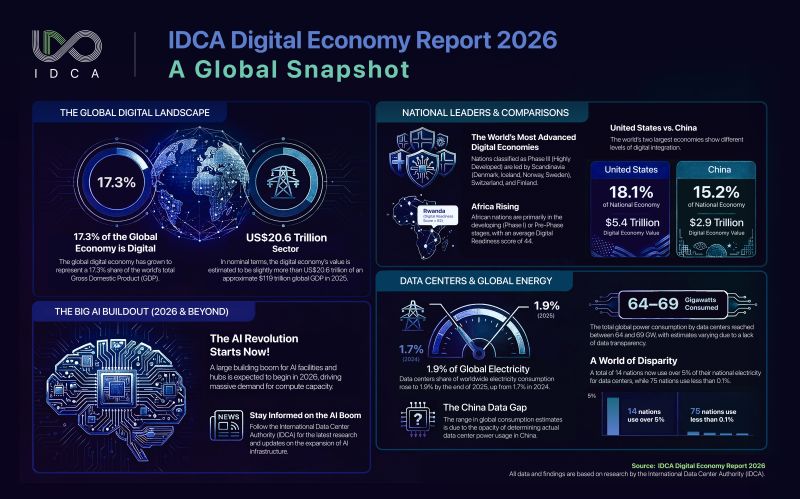
The digital economy now represents 17.3% of global GDP, reaching an estimated US$20.6 trillion in value. Yet national readiness, AI expansion, energy consumption, and infrastructure maturity vary significantly across regions. The 2026 report highlights: • National leaders and comparative digital integration • The accelerating global AI infrastructure buildout • Data center energy consumption trends (1.9% of global electricity) • Regional digital readiness disparities As digital economies expand, structured measurement, infrastructure planning, and policy alignment remain critical for sustainable growth.
IDCA tweet media
English
1
0
1
139
IDCA
IDCA@IDCAorg·
🇺🇬Uganda - Country Snapshot Uganda is a nation of more than 50 million people in East Africa, with substantial renewable energy that serves an underdeveloped but growing electricity grid, and potential for growth that extends throughout the dynamic East Africa region. 1/3
IDCA tweet media
English
4
8
93
148.2K
IDCA
IDCA@IDCAorg·
3/3 Uganda experiences moderate water stress should it go down the path of traditional data center development. But given its successful deployment of renewable energy, almost solely from hydroelectric resources, there is potential for AI-centric development. The very large caveat is that Uganda has among the weakest overall electricity grids in the world, generating only 1.7 percent of per-person electricity of the EU average. It's time for investors to flood the country with new power projects, work to synchronize that with AI-driven development, and put Uganda on the path it could actually follow to become a regional leader.
IDCA tweet media
English
1
1
3
380
IDCA
IDCA@IDCAorg·
⚡️ Quebec Utility Proposes Doubled Rates for Data Centers A harshing of the vibe comes from utility operators at Hydro Quebec ( @hydroquebec ), in one of the most promising data center development areas in the world. The utility has proposed a doubling of rates, to match what consumers pay rather than what other very large operators pay. The new policy would affect any data center larger than 5MW, so is thus an issue for essentially the entire industry in Quebec.
English
0
0
0
62
IDCA
IDCA@IDCAorg·
⚡️ Australian Company Sees Worldwide Electricity Crunch The Australian real-estate company Goodman Group $GMG now manages more than $10 billion that's focused on data centers. The company cites a looming, “material” shortage of electricity throughout the world if AI-center development plans are to take place. The company itself is planning to add a gigawatt of power to the Australian grid in support of large projects.
English
0
0
1
104
IDCA
IDCA@IDCAorg·
Data centers have transformed from single mainframe systems supporting census operations to AI-optimized hyperscale facilities powering global digital economies. What began in 1951 with centralized business computing evolved through distributed PCs, mission-critical server infrastructure, virtualization, hyperscale cloud, and now High Performance Compute (HPC), AI-driven GPU clusters designed for large-scale model training and inference. Today’s data centers represent more than scale — they embody high-density architecture, advanced interconnect fabrics, and liquid cooling systems engineered for unprecedented computational demand amounting to tens of GW of energy demand to sustain the world’s economic needs. Looking ahead, possibilities of hybrid classical-quantum facilities, photonic interconnects, and post-silicon architectures may further redefine how digital infrastructure is designed, deployed, and governed. Data centers are the core utility and the infrastructure backbone for modern economies, that enable AI and digital transformation growth and sustainability.
IDCA tweet media
English
1
3
36
517.8K
IDCA
IDCA@IDCAorg·
IDCA provides global strategic advisory services to corporations and government alike in ensuring that they optimize choices and boost performance across the digital economy, data centers, cloud, AI, cybersecurity, and regulatory compliance. From feasibility studies and site selection to out-of-the-box design, cloud migration, digital transformation, ROI modeling, and project finance, IDCA supports governments, investors, and enterprises throughout the full infrastructure lifecycle. With services delivered in 120+ countries and 99.9963% satisfaction, backed by certified expertise, IDCA advisory ensures informed decisions, resilient functions, and sustainable digital growth.
IDCA tweet media
English
1
0
1
61
IDCA
IDCA@IDCAorg·
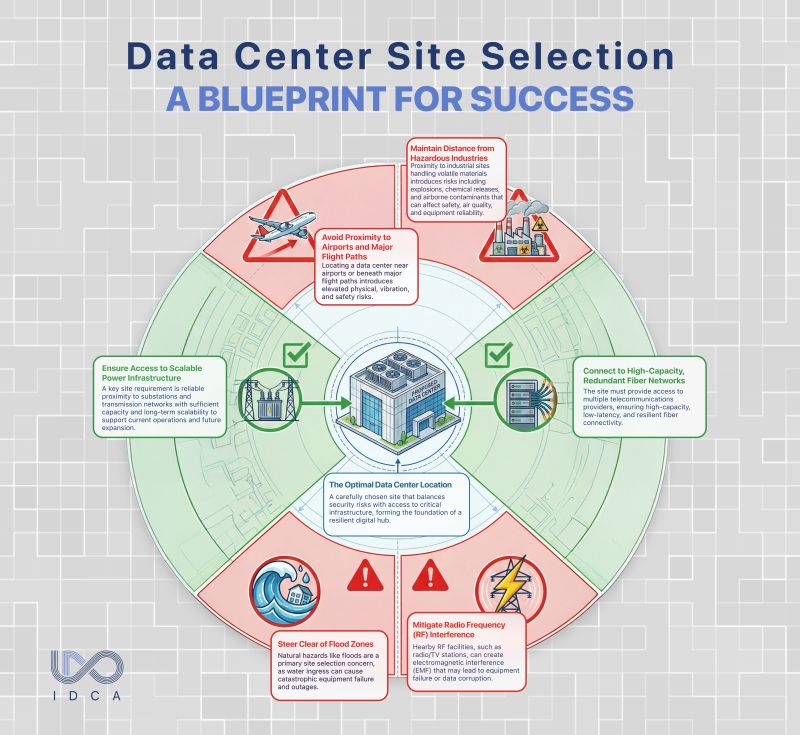
Site-selection and ensuring that the right location is chosen are two of the most critical decisions in a data center lifecycle. Effective site selection directly influences avoidance of risk and exposure to hazards, operational resilience, scalability, energy availability, connectivity, and long-term sustainability. As compute density increases and infrastructure becomes more strategic, the margin for error continues to narrow. Due site selection requires balancing access to scalable power, water, and workforce, as well as reliable connectivity with risk mitigation across environmental, industrial, and physical factors. This integrated approach forms the foundation for resilient, secure, and future-ready digital infrastructure. IDCA continues to emphasize site selection as a strategic discipline, one that underpins reliable operations, supports evolving workloads, and enables long-term value creation across digital economies.
IDCA tweet media
English
0
0
0
40
IDCA
IDCA@IDCAorg·
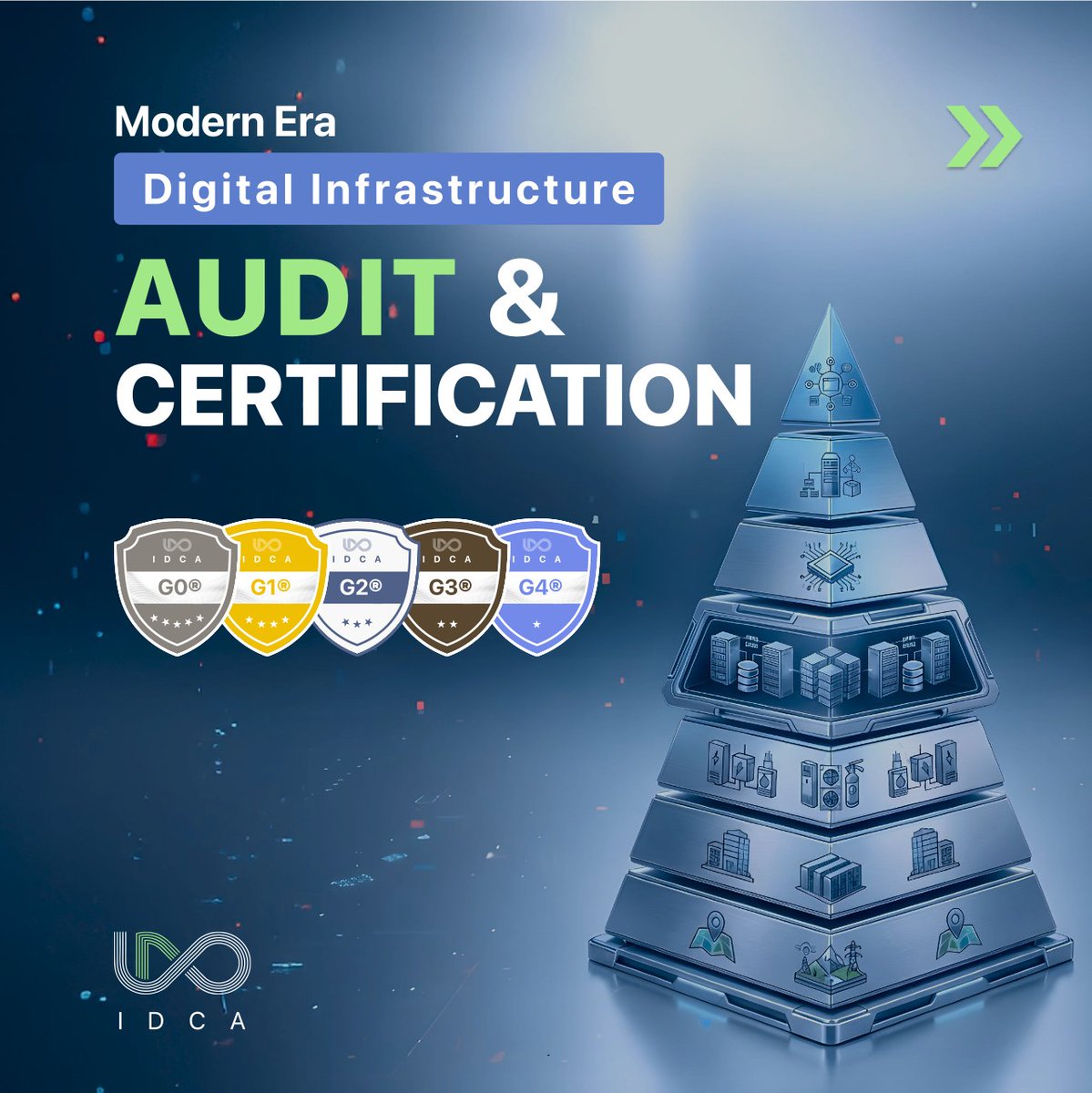
IDCA Audit & Certification programs deliver comprehensive, multi-layer assessments across the full stack digital infrastructure ecosystem, from Application and Platform to Compute, IT Infrastructure (ITI), Site Facility Infrastructure (SFI), Site, and Topology. Through structured Design, Build, and M&O audits and benchmarked Grade Levels (G0–G4), organizations gain measurable validation of availability, resilience, efficiency, safety, capacity, and operational excellence. Audit beyond compliance. Certify for performance, credibility, and long-term infrastructure integrity.
IDCA tweet media
English
1
0
1
41
IDCA retweetledi
Roger Strukhoff
Roger Strukhoff@IoT2040·
@elonmusk I happen to agree, and our research at @IDCAorg validates this. The strongest correlation across our 200+ fields of underlying data is between the strength/resilience of electricity grids & the development of the national Digital Economy.
English
2
4
14
1.8K
Greg Brockman
Greg Brockman@gdb·
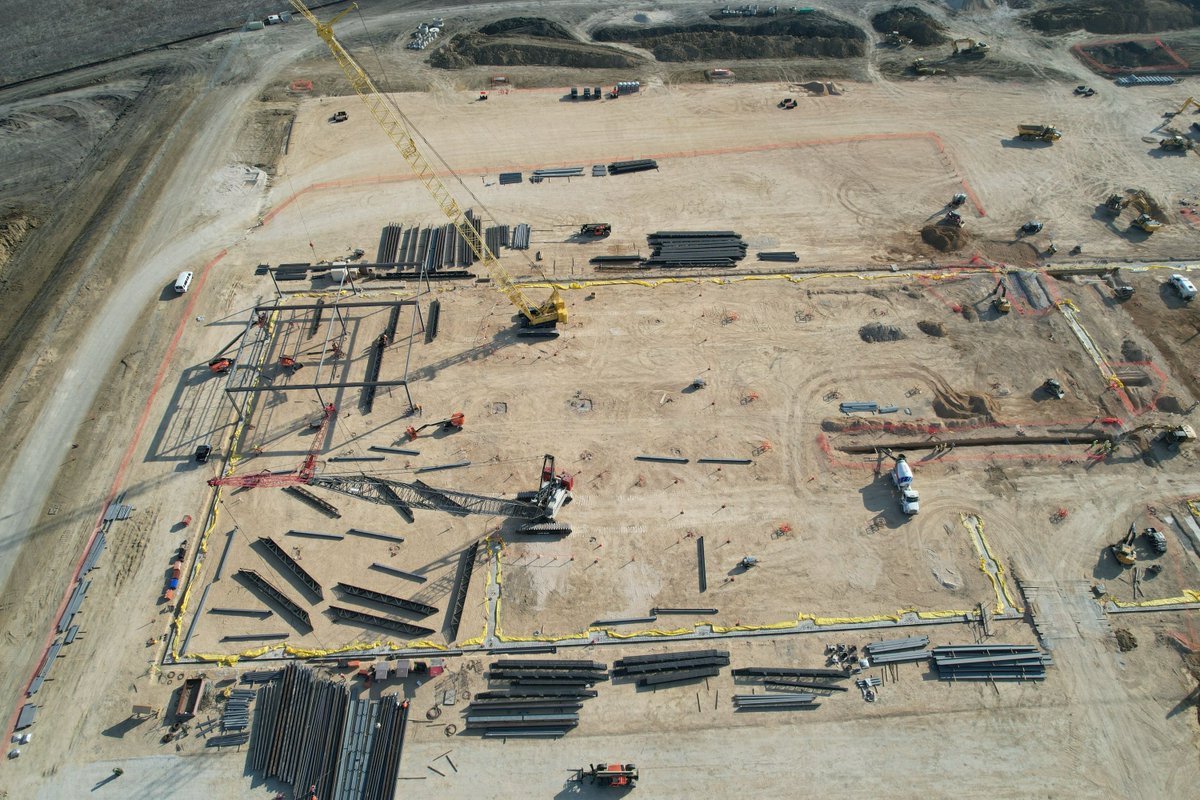
First steel beams went up today at our Stargate site in Milam County, Texas. Exciting to see this project taking shape with @SoftBank and @SBEnergy.
Greg Brockman tweet mediaGreg Brockman tweet media
English
179
127
2.1K
287.9K
IDCA
IDCA@IDCAorg·
3/3 The key to Slovakia's future lies in its highly developed nuclear-energy grid, which delivers about 60 percent of its electricity. Another 25 percent of the country's electricity comes from renewables, establishing Slovakia as a true global sustainability leader. But as a small country, this leadership is constrained by its size. That said, Slovakia has bright prospects to continue to develop its technology infrastructure and achieve continued societal improvement, and it has the potential to also serve as a significant resource for larger EU nations (such as Germany and Poland) to at least investigate its potential to deliver power for an emerging AI-driven era.
IDCA tweet media
English
1
1
2
680
IDCA
IDCA@IDCAorg·
🇸🇰Slovakia - Country Snapshot Slovakia was the poor cousin in the peaceful breakup of Czechoslovakia in 1993, and continues to lag the Czech Republic in per-person income by about 20 percent. It's a nation of 4.5 million people encompassing an area about half the size of the US state of Indiana. 1/3
IDCA tweet media
English
4
3
27
98.5K
IDCA
IDCA@IDCAorg·
The International Data Center Authority (IDCA) delegation will be attending Data Centre World London (@DataCentreWorld) 2026 | Cloud & Cyber Security Expo London (@CSE_Global), taking place 4–5 March 2026 at Excel London. IDCA representatives, including Liz Hood, Solomon Edun, and Liam Moore, will be engaging with digital infrastructure industry representatives to discuss data center and cloud strategy, workforce development, mission-critical resilience, and the evolving demands of the digital economy across Europe and beyond.
IDCA tweet media
English
0
1
2
69