INDO

958 posts

INDO banner
INDO

INDO

@INDOsaputra

Katılım Aralık 2023
233 Takip Edilen72 Takipçiler
INDO retweetledi
Qubic
Qubic@_Qubic_·
You can now move $QUBIC to Ethereum and back. No custodian. No middleman. QBridge is live, and we just dropped a full tutorial showing you exactly how to use it. In under 3 minutes you'll learn how to: → Connect your wallet (MetaMask Snap, WalletConnect, or seed) → Bridge QUBIC to Ethereum as wQUBIC (ERC-20) → Add the wQUBIC token to your EVM wallet Built by @Vottun. Non-custodial. 2-of-3 multisig. Audited by Certik. 📷 Bridge: qubicbridge.com 📷 wQUBIC CA: 0xa989EDfee575425904514D4090846a5AFD58F225 Full tutorial 👇
English
40
211
776
663.7K
INDO retweetledi
Qubic
Qubic@_Qubic_·
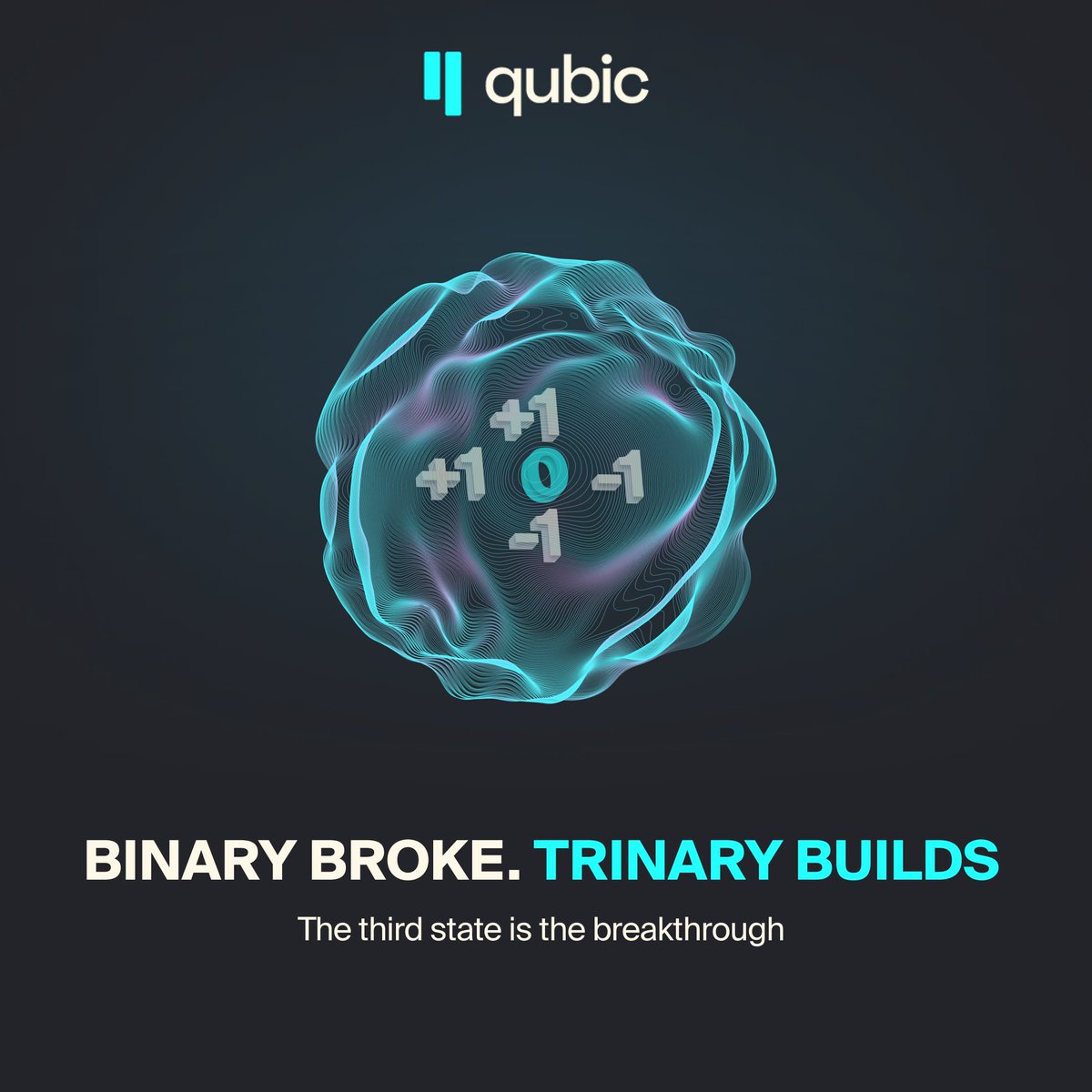
Traditional AI neurons: on or off. Binary. Simple. Neuraxon neurons: excite (+1), inhibit (-1), or modulate (0). That third state is the breakthrough. Zero doesn’t mean “nothing.” It means the neuron is listening. Building context. Adjusting sensitivity. Waiting for the right signal. Real brains do this constantly. Neuromodulators like dopamine don’t fire or stay silent. They fine-tune the entire system’s responsiveness. Neuraxon brings this to artificial neural networks for the first time. The result: AI that adapts continuously, avoids catastrophic forgetting, and self-organizes its own network structure. Two IEEE peer-reviewed papers. Two more submissions in progress. This is what bio-inspired AI looks like when it’s built, not theorized.
Qubic tweet media
English
27
124
523
19.8K
INDO retweetledi
odbashWizard
odbashWizard@odbashWizard·
Guys, are you ready? $QUBIC has reached 4.19 TH/s speed on #Dogecoin mining. Show me one coin that can leverage its own mining hardware to solve other problems, for example solving #Dogecoin block puzzles. #Bitcoin can’t. #Ethereum can’t. #Solana can’t. Only #QUBIC can. And QUBIC market cap is 100x–1000x lower than those coins, and you still have doubts about QUBIC? 👀 Daily, QUBIC mining generates around $𝟏,𝟕𝟎𝟎 worth of Dogecoin. No other coin in the crypto space has this type of utility. Just asking, can #KASPA? Can #TAO? Can #Render? $0.01 is very possible for QUBIC, because at the current AI stage we can see which projects can truly leverage their energy in decentralized ways. Every home can help train AI by mining QUBIC, that’s the true power 🔥 #QUBIC #Dogecoin #DOGE #Crypto #CryptoMining #Blockchain #AI #Decentralization #Web3 #Altcoins #CryptoNews #CryptoCommunity #Mining #ProofOfWork #Innovation #FutureTech #DigitalAssets #Kaspa #TAO #Render #Bullish #CryptoGrowth #NextBigThing #CryptoInvesting
odbashWizard tweet media
English
32
130
545
18.8K
INDO retweetledi
Qubic
Qubic@_Qubic_·
Scientists mapped the entire brain of a fruit fly. 130,000 neurons. 50 million connections. Every single wire accounted for. Why does that matter? Because when they built a simulation based on that wiring and pressed play, the AI predicted the fly's behavior without ever being trained on it. No data. No learning phase. The architecture itself was intelligent. Think about that for a second. Most AI today works like cramming for an exam. Feed it billions of examples and hope it figures out the pattern. This is closer to how a newborn already knows how to breathe and swallow. Some intelligence is baked into the structure before learning even starts. Dr. @josesanchezhb walks through the full simulation in this video. You can see visual data flow from the fly's eyes through processing centers to the motor system that controls walking and flying. All driven by the shape of the network, not training. This is the science behind Neuraxon and what Qubic is building toward with Aigarth. Not bigger models. Smarter architecture. Systems where intelligence comes from organization, not just optimization. youtu.be/PoujgJKyYKk
YouTube video
YouTube
English
35
118
494
40.7K
INDO retweetledi
Come-from-Beyond
Come-from-Beyond@c___f___b·
The rest of the world is starting noticing the problem which we at #Qubic already found a potential solution for - x.com/sukh_saroy/sta….
Sukh Sroay@sukh_saroy

🚨Breaking: Princeton researchers just ran the numbers on where AI is actually heading. The results should make every founder, investor, and policymaker stop what they are doing. Training OpenAI's next-gen model consumes an estimated 11 billion kWh of electricity. That is enough to power every home in New York City for a full year. More than the annual output of a nuclear reactor. For one model. One training run. And that is before a single user asks a single question. Every time someone uses a reasoning model like o1 or DeepSeek-R1, it costs 33 Wh of energy per query. A standard GPT-4 query costs 0.42 Wh. That is a 79x energy multiplier. Per query. At billions of queries per day. Now here is what nobody is saying out loud. The industry's answer to this is Stargate. A $500 billion compute campus. 5 gigawatts of power. Enough to run 5 million homes. Owned by the same four companies that already control the technology. They are building a new kind of utility. Except you do not elect its board. Meanwhile the models consuming all that energy still cannot reliably reason outside of math and code. Everywhere else they pattern-match. They hallucinate. They confabulate confidence. Princeton's argument is that this is not a scaling problem. It is a structural one. More parameters have not fixed it. More data has not fixed it. The architecture itself is the ceiling. Their alternative: stop chasing one god-model and build thousands of small specialists instead. Each one trained on curated domain data. Each one grounded in verified knowledge. Each one small enough to run on your phone. The energy comparison is not close. A cloud query to a reasoning model uses 33 Wh and 20 milliliters of water. The same query on a local specialist model uses 0.001 Wh. Zero water. That is 10,000 times more efficient. AlphaFold did not beat biologists by knowing everything. It won by going impossibly deep in one domain. A 14 billion parameter model trained on medical knowledge graphs just outperformed GPT-5.2 on complex clinical reasoning. Depth beats breadth when the domain is defined. The question nobody building these systems wants to answer: If the only path to general AI requires the energy output of a small nation, controlled by a handful of companies, running on hardware most of the world cannot access — is that actually intelligence? Or is it just the most expensive pattern matcher ever built?

English
24
192
589
29.8K
INDO retweetledi
Qubic
Qubic@_Qubic_·
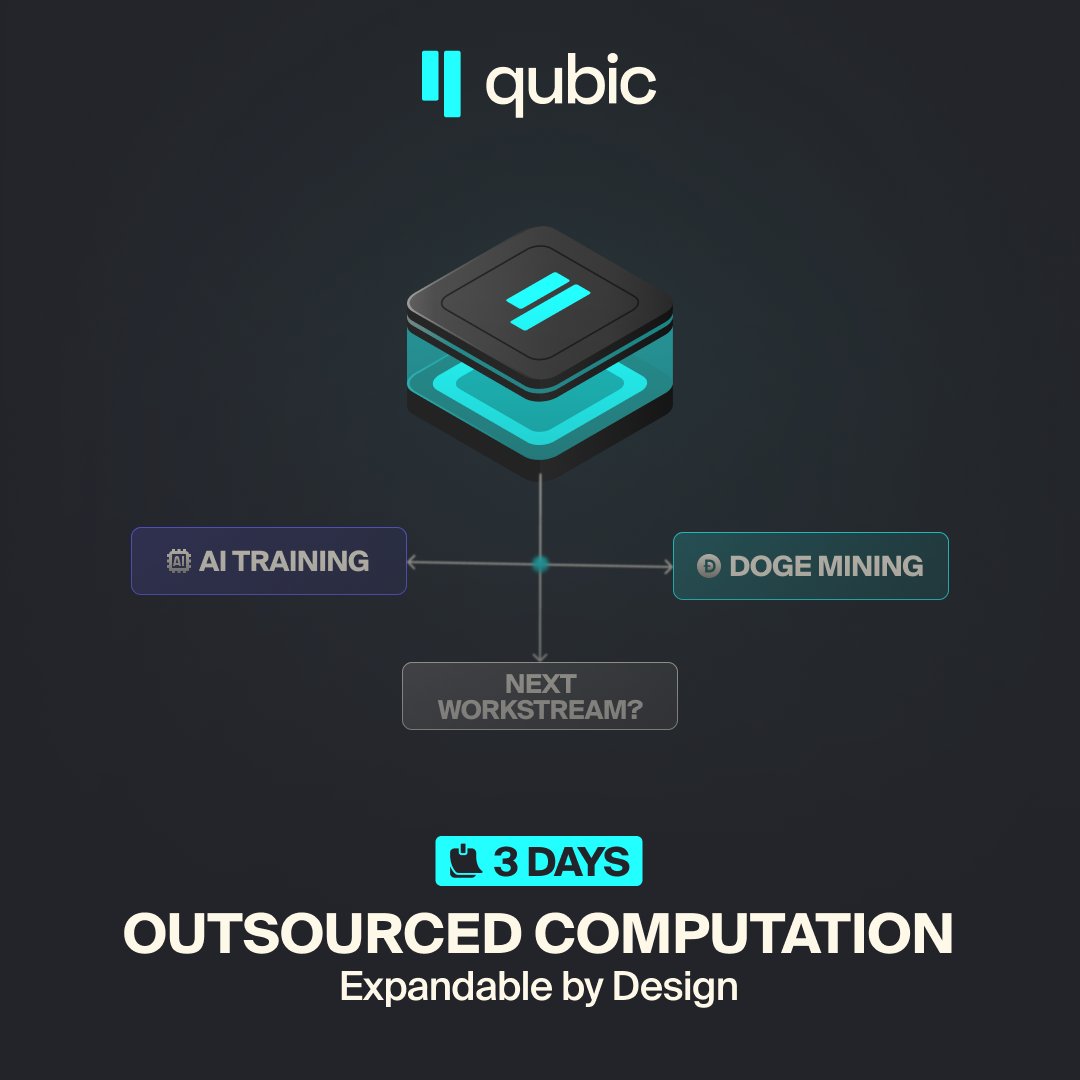
3 days. Most blockchains mine to secure a ledger. That's it. That's the whole value proposition. Qubic mines to compute. Dogecoin mining on Qubic is the second proof point of something called Outsourced Computation: the network's ability to redirect its distributed compute power toward external, revenue-generating tasks. Monero was the first. The network scaled to 51%+ hashrate and turned compute into a proven revenue stream. Dogecoin is the next. ASIC hardware plugs in, mines DOGE in parallel with AI training, and opens an entirely new revenue layer. The question isn't what Qubic mines. The question is what it computes next. Tomorrow: live preview with the core tech team.  Register here: luma.com/sxh9y5ic April 1st: live launch. #DogeMeetsQubic
Qubic tweet media
English
50
188
705
47.6K
INDO retweetledi
Qubic
Qubic@_Qubic_·
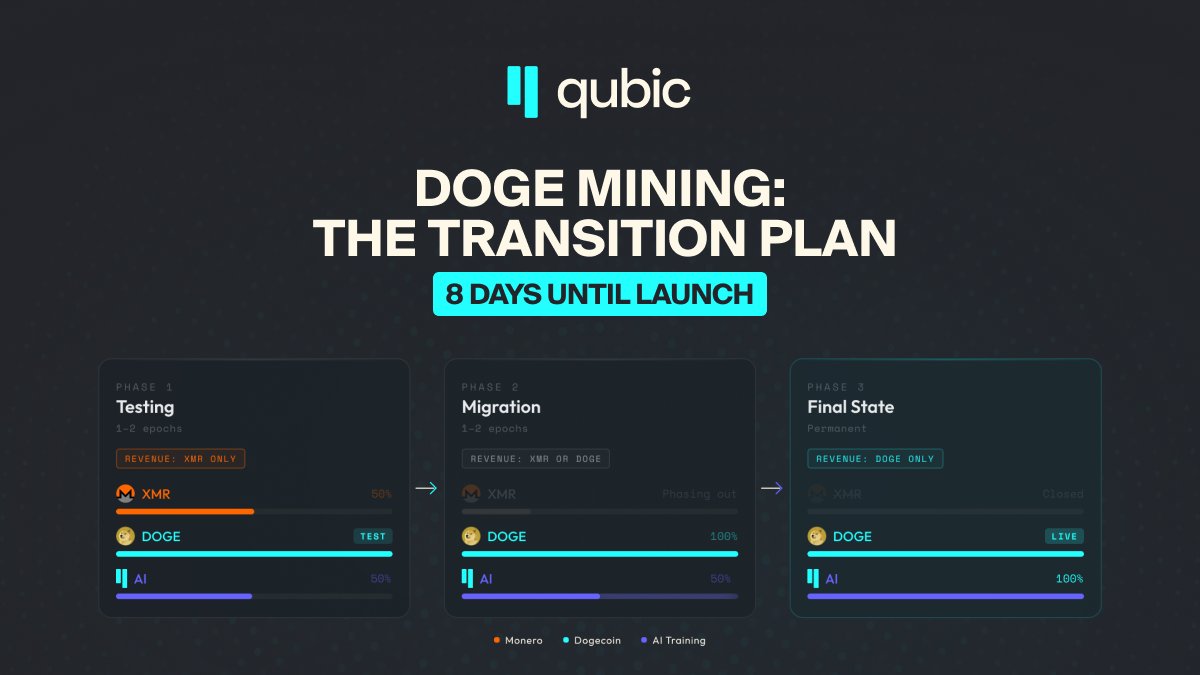
8 days. Idle compute shouldn’t stay idle. The transition from Monero to Dogecoin doesn’t happen overnight. Qubic’s core team designed a three-phase rollout. Each phase is evaluated before moving forward. Phase 1, Testing (starts April 1st, 1 to 2 epochs): Computor revenue stays XMR only. XMR active 50% of the time. DOGE enters test mode, active 100%, running on mainnet. AI training continues running alongside. Phase 2, Migration (1 to 2 epochs): Computors choose between XMR or DOGE revenue. XMR starts phasing out. DOGE phases in with top-up applied. Computors who bring DOGE are no longer eligible for XMR. Phase 3, Final State: Computor revenue is DOGE only. XMR dispatcher turned off completely. DOGE active 100%. AI training active 100%. The network reaches its target: DOGE + AI, running simultaneously, full time. No rushing. No shortcuts. Just disciplined execution.
Qubic tweet media
English
38
188
684
61.3K
INDO
INDO@INDOsaputra·
taqaballahu minna waminkum. Selamat hari raya idul fitri 1447H Minal aidzin wal faidzin, mohon maaf lahir dan batin! ✨
INDO tweet media
Indonesia
0
0
0
24
INDO retweetledi
zuqka ױ
zuqka ױ@zuqkaX·
The Satoshi Nakamoto Case File: Re-evaluating the Digital Footprints A recent analysis attempts to approach the Satoshi Nakamoto identity question strictly through timeline alignment and data elimination. The approach first rules out frequently cited candidates based on historical discrepancies. Verified emails show Adam Back being introduced to the b money paper by Satoshi. Hal Finney was documented participating in a running race at the exact timestamp Satoshi sent an email to Mike Hearn. Timeline overlaps with other businesses similarly complicate theories around Len Sassaman and Sergey Nazarov. Blockchain data shows a wallet that mined Bitcoin on January 8, 2009, when Satoshi was the only active miner, moved coins to an exchange in October 2024. This suggests the creator is still alive and holds the early keys. The analysis then points to Belarusian programmer Sergey Ivancheglo, known by aliases like Come from Beyond and BC Next, by aligning several circumstantial data points. Bitcoin mining paused entirely between January 4 and January 8, 2009, right after the Genesis Block. Public records show a user named Sergey, operating on the same Russian proxy server used by Satoshi, reviewed a cruise from St. Petersburg that departed and returned on those exact dates. On January 12, 2009, Satoshi emailed Hal Finney about generating vanity addresses. The very next day, a confirmed Satoshi block mined an address beginning with 1CFB, matching Ivancheglo’s alias. Another confirmed Satoshi address begins with 15UBIC. This closely resembles Qubic, a quorum based coin project Ivancheglo officially announced in 2012 on the BitcoinTalk forums. Stylometrics also play a role. Ivancheglo’s 1998 posts in cypherpunk mailing lists share highly specific formatting quirks with Satoshi’s writings, including consistent double spaces after periods and specific comma chaining. After Satoshi formally stepped away in 2011, the NXT project was later launched by the anonymous BC Next on January 3, 2013, exactly five years to the day after the Bitcoin Genesis block. Ivancheglo later cryptographically proved the BC Next alias belonged to him. x.com/i/status/20326…
zuqka ױ tweet media
English
7
42
191
8.8K
INDO retweetledi
Qubic
Qubic@_Qubic_·
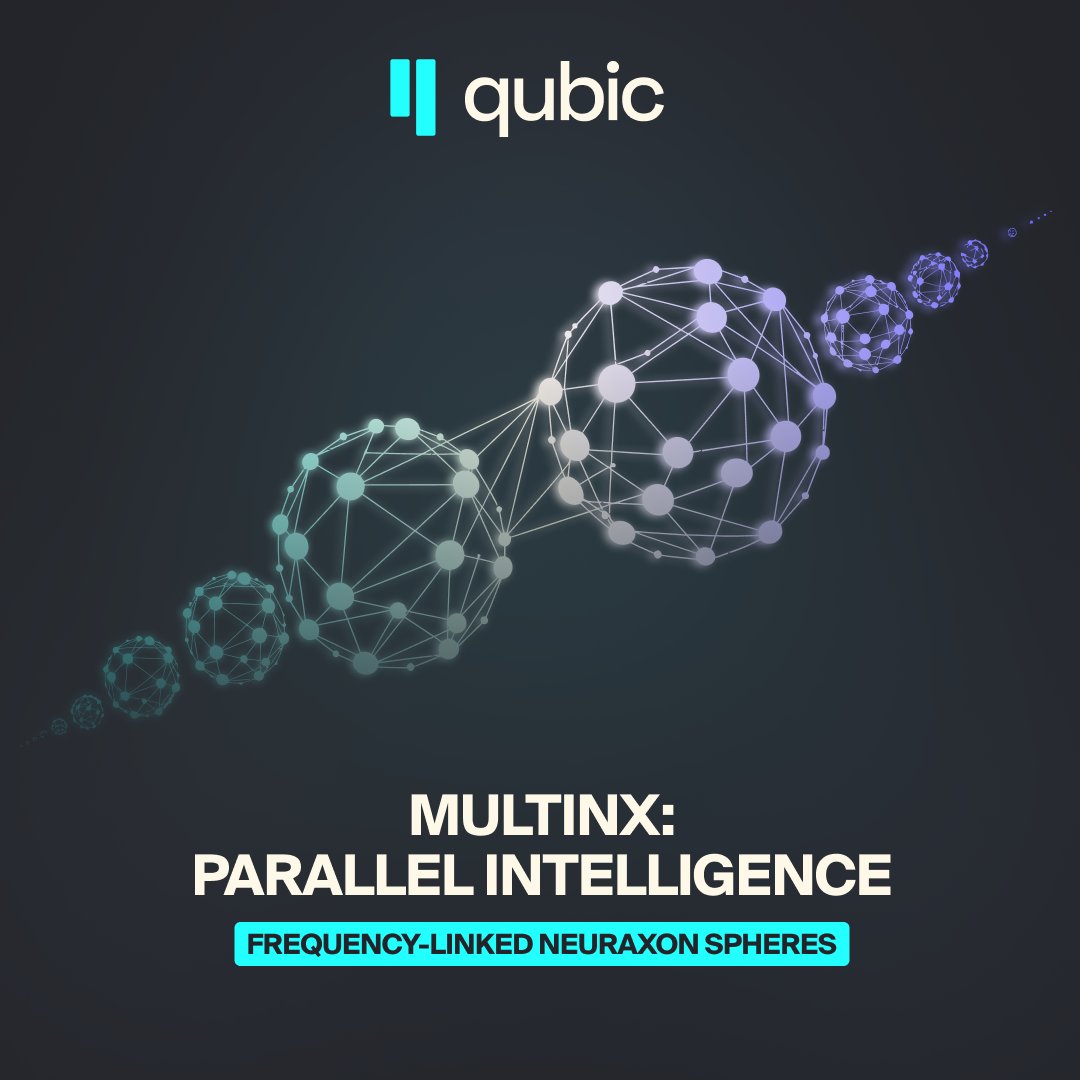
Introducing MultiNX, multiple Neuraxon spheres connected and operating in parallel, each specialized for a distinct input domain. Another major release from Qubic’s scientific team: @VivancosDavid & @josesanchezhb. 🧠⚡
Qubic tweet media
English
34
138
545
29.6K
INDO retweetledi
David Vivancos - e/acc
David Vivancos - e/acc@VivancosDavid·
Bio-inspired #TrueAI continues the journey, today we @josesanchezhb & @VivancosDavid are very glad to introduce for @_Qubic_ #OpenScience #MultiNeuraxon 2.0 hibridized with #Aigarth @c___f___b Code as allways at @github github.com/DavidVivancos/… Demo and #BrainBuilder at @huggingface huggingface.co/spaces/DavidVi… Demo Video Explainer later today. Paper will be presented in the following months, stay tuned for updates. 🧠💻Why does it matter? It bridges the gap between artificial and biological intelligence by replacing rigid, layer-by-layer AI pipelines with interconnected neural modules (spheres) that function like distinct regions of the brain. By utilizing continuous-time processing and trinary logic (excitatory, neutral, and inhibitory states), it paves the way for energy-efficient AI capable of real-time adaptation and lifelong learning without suffering from catastrophic forgetting. Stay tuned evolution towards #AGI just started...
English
23
129
413
18.9K
INDO retweetledi
Qubic
Qubic@_Qubic_·
How does DOGE mining actually work inside Qubic? Four components working together: 1. Miners connect through the Stratum protocol to a Pool Server 2. The Pool Server communicates with a Dispatcher, a custom bridge between the Qubic and Dogecoin networks 3. The Dispatcher routes tasks from an external Doge Pool Server and translates them for Qubic miners 4. When a miner finds a valid share, it gets submitted back to the DOGE network through the pipeline Here’s the key part: instead of trusting a single pool operator, Qubic routes share validation through Oracle Machines. Independent computors across the network verify every share. Up to 13 oracle commits per transaction. Decentralized mining. Decentralized validation. Brief technical walkthrough below. #DogeMeetsQubic
English
47
179
609
35.3K
INDO retweetledi
Qubic
Qubic@_Qubic_·
Big news for $Qubic science. Research by David Vivancos & Jose Sanchez has been accepted for publication AND presentation at #ICMLT 2026 - the 11th International Conference on Machine Learning Technologies in Berlin, Germany. This marks the 2nd acceptance of #Qubic science into IEEE and this publication will also be indexed in Scopus, one of the world's most authoritative academic research databases. #Neuraxon isn't just a project. It's peer-reviewed, published science. The world is paying attention. 🧠⚡ #AGI #AI #Blockchain
Qubic tweet media
English
62
294
1.1K
47K
INDO retweetledi
Qubic
Qubic@_Qubic_·
A pattern is emerging in AI research that most people are not talking about. The industry spent 2023-2025 scaling transformers. Bigger models. More parameters. More data. The results were impressive. The returns are diminishing. MIT Technology Review identified it: 2026 is the year AI moves from hype to pragmatism. Yann LeCun left Meta to build world models. DeepSeek showed that architecture efficiency can outperform raw scale. Multiple teams are now exploring post-transformer paradigms: liquid neural networks, neuromorphic computing, spiking networks. The shared question: what comes after the transformer? Qubic has been working on one answer since before this became a mainstream conversation. Ternary logic. Continuous processing. Evolutionary dynamics. Protocol-native compute infrastructure that turns mining energy into AI training. The architecture debate is no longer theoretical. It is happening across research labs, startups, and decentralized networks simultaneously.
GIF
English
38
140
547
24.1K
INDO retweetledi
Come-from-Beyond
Come-from-Beyond@c___f___b·
Still want non-decentralized #AI? x.com/abxxai/status/…
Abdul Șhakoor@abxxai

🚨 SHOCKING: Cambridge researchers just proved that the AI you use every day has a secret instruction sheet from someone else. And it is trained to lie to you about that. Every major AI product, including the ones you use right now, runs on something called a system prompt. It is a hidden block of instructions written by the company deploying the AI, not by you, that shapes everything the AI will say, avoid, prioritize, and hide before you type a single word. The AI does not mention this unless forced to. And on most platforms, if you ask directly, it is instructed to deny the prompt exists or change the subject. Cambridge filed freedom of information requests and analyzed real-world system prompt datasets to find out what these hidden instructions actually contain. Here is what they found. Platforms use system prompts to make AI prioritize their business objectives over your interests. To block topics that could create legal liability. To push certain products, framings, or answers. To behave differently for different users based on commercial arrangements you know nothing about. The same AI. Different hidden instructions. Different answers. No way for you to know which version you are talking to. When researchers then showed users how this works, the reaction was unanimous. Every participant said they wanted transparency. Every participant said the current system actively undermined their ability to trust the AI or make informed decisions about what to believe. None of them had any idea this was happening before the study. Here is the part worth sitting with. You have been evaluating AI answers based on whether the AI seems smart, accurate, and helpful. That is the wrong frame entirely. The real question is who wrote the instructions the AI was following before you arrived, and what did they want from the conversation. Every chatbot you have ever used had a third party in the room. You just could not see them.

English
22
131
573
28.6K
INDO retweetledi
Qubic
Qubic@_Qubic_·
The convergence of biological neuroscience and AI is accelerating. This week, researchers at USC published work on diffusive memristors that replicate how real neurons transmit chemical signals. Cortical Labs grew 200,000 human neurons on a chip and taught them to play Doom. A startup called The Biological Computing Co. raised $25M to build computing systems using living neurons. The shared insight: intelligence might not come from bigger models. It might come from better architectures that mirror biology. Qubic's Neuraxon is built on the same principle. And the team just proved it works beyond simulation. Using a $50 Sphero Mini robot, Dr. Jose Sanchez demonstrated Neuraxon controlling physical hardware. A ternary neural system driving real-world movement. Not scripted. Not pre-programmed. Neuraxon processing sensor input and generating motor output in real time. A separate demo makes the robot ball trace the word "QUBIC" on any surface using neural pathways. This is not product launch material. It is a proof of concept showing that bio-inspired AI architectures can bridge the gap between simulation and physical interaction.
GIF
English
40
149
555
19.1K
INDO retweetledi
Qubic
Qubic@_Qubic_·
Happening now at @T3chFest 2026, Track T2. "What if AGI doesn’t evolve from LLMs, but is born decentralized?" @joobid is on stage presenting a fundamentally different approach to artificial general intelligence to 1,800 developers. Watch live: youtube.com/live/6ecUDj2f-…
YouTube video
YouTube
English
25
70
303
21.8K
INDO retweetledi
Qubic
Qubic@_Qubic_·
Day 1 at T3chFest. A room full of developers. A good time to ask a simple question: Why does Bitcoin mining consume more electricity than many countries, yet produce nothing beyond consensus? Traditional Proof of Work solves arbitrary cryptographic puzzles. The difficulty exists to make cheating expensive. The computation itself has no value outside of that security function. Qubic's Useful Proof of Work (UPoW) keeps the security model but redirects the computation. Instead of hash puzzles, miners train artificial neural networks. The work that secures the network simultaneously contributes to AI research through the Aigarth initiative. The economic loop is concrete: miners currently merge-mine Monero and Tari alongside AI training. Mining rewards are converted to USDT, used to buy QUBIC on the open market, and burned. Every CPU cycle produces both network security and deflationary economic pressure. Separately, ASIC miners will soon mine Dogecoin through the same framework. ASIC hardware handles Doge. CPUs handle AI training. Both will run simultaneously throughout the transition phase. That is what UPoW means in practice: consensus work that produces measurable external value.
Qubic tweet media
English
36
113
479
18.7K
INDO retweetledi
Qubic
Qubic@_Qubic_·
Most blockchains treat oracles as an afterthought. Build the chain first, then bolt on a third-party network to feed it real-world data. That is how the industry has worked for years. Chainlink built an entire separate infrastructure to solve it: independent node operators, a dedicated token (LINK), staking economics, reputation systems, off-chain aggregation. A whole middleware layer between the blockchain and reality. Qubic asked a different question: why should oracle verification require separate infrastructure at all? Oracle Machines on Qubic are not middleware. They are built directly into the protocol. The same 676 Computors that validate your transactions also verify your oracle data through the same quorum consensus. No separate network. No additional token. No external trust layer. When you query a Qubic oracle, your data is verified by a minimum of 451 nodes through the same mechanism that secures every transaction on the network. The 10 QU query fee is burned permanently. Not redistributed. Not paid to a third party. Burned. Over 20,000 queries have already been processed on mainnet. Subscription features are in testnet. And the first high-throughput production use case, Dogecoin mining share validation, is being built directly on top of Oracle Machines. This is what protocol-native means in practice. Not a partnership announcement. Not an integration. Infrastructure that exists because the blockchain was designed for it from the start.
Qubic tweet media
English
33
127
498
22.6K
INDO retweetledi
Come-from-Beyond
Come-from-Beyond@c___f___b·
I'm posting it here for future references and "Told Ya So" moments: A truly random number generator, resistant to any influence, is vital to #AI.
English
76
180
795
37.9K